OpenAI is set to begin testing ads in ChatGPT by late January or early February 2026.
Users in Free/Go tiers will be the first to experience sponsored content, while Plus/Pro/Business/Enterprise tiers will be ad-free.
Reported internal discussions suggest prioritization of sponsored content in search/answer results, which could change how traditional “rankings” work.
Once implemented, ChatGPT ads could mark the shift toward AI assistants as monetized platforms, as well as restructure how marketers/SEO strategists approach digital marketing.
To prepare for the shift, brands should start laying the groundwork that focuses on recommendability – not just traditional SEO rankings.
TL;DR: OpenAI is preparing to test ads in ChatGPT by late January or early February. Evidence suggests that ChatGPT ads 2026 global rollout could happen by the end of Q1 or the beginning of Q2 at the latest. The introduction of paid advertising could transform AI Search + SEO into a hybridized “organic + sponsored” ecosystem, shifting optimization goals from rankings/visibility to recommendability.
What many speculated is now coming to pass: ads are being introduced into ChatGPT. On January 16, OpenAI announced that it would begin testing advertisements in the Free and Go subscription tiers, probably by early February.
Once implemented, ChatGPT sponsored content will mark a dramatic shift – not only in user experience, but in agentic and e-commerce in general. In this comprehensive analysis, we’ll explore what you can expect when the change goes live and how you can prepare for paid ads in AI Search in 2026.
While there’s no official global rollout date, the existing information strongly suggests that the arrival of ChatGPT ads in 2026 is imminent.
In addition to internal leaks, comments from leadership/execs, internal notes, financial projections, and hiring patterns, now we have an official statement from OpenAI and CEO Sam Altman, confirming that ad testing will begin “in the coming weeks.”
We are starting to test ads in ChatGPT free and Go (new $8/month option) tiers.
Here are our principles. Most importantly, we will not accept money to influence the answer ChatGPT gives you, and we keep your conversations private from advertisers.
In the coming weeks, we plan to start testing ads in ChatGPT free and Go tiers.
We’re sharing our principles early on how we’ll approach ads–guided by putting user trust and transparency first as we work to make AI accessible to everyone.
The inevitable implementation of ads is further inferred in the article on the OpenAI official website, which was released on the same day – specifically from the wording such as “…as we introduce ads…,” “…you see relevant, high-quality ads…”, and “We’re not launching ads yet…”Given all the info available and considering the sheer rapidity of recent developments – from beta code leaks in November 2025 through testing – we can assume that official rollout may be closer than we think, probable to happen as early as Q1 or Q2 at the latest.
What are “sponsored results” in ChatGPT and how might they appear?
In a recent interview for The Information, an OpenAI spokesperson said that “…we’re exploring what ads in our product could look like.” While no further official explanation or examples have been given at that time, multiple analyses predicted that:
ChatGPT ads will show in relevant searches (e.g., when users ask about products, services, shopping, travel, etc.) – not in random chit-chat.
Sponsored results in ChatGPT may be a part of a dedicated, separate interface, like the already-implemented Shopping Research, rather than traditional banners.
A separate system may be used to analyse conversation history and commercial intent, so “that an ad will most likely only appear after a user shows clear interest or purchase intent, so that the model can be confident the ad is relevant,” as noted by AdExchanger.
Now, with the availability of new information, we can say that the above predictions were quite accurate. As for how ChatGPT sponsored content might look within the platform, we already have several good ideas.
Now, with the availability of new information, we can say that the above predictions were quite accurate. As for how ChatGPT sponsored content might look within the platform, we already have several good ideas.
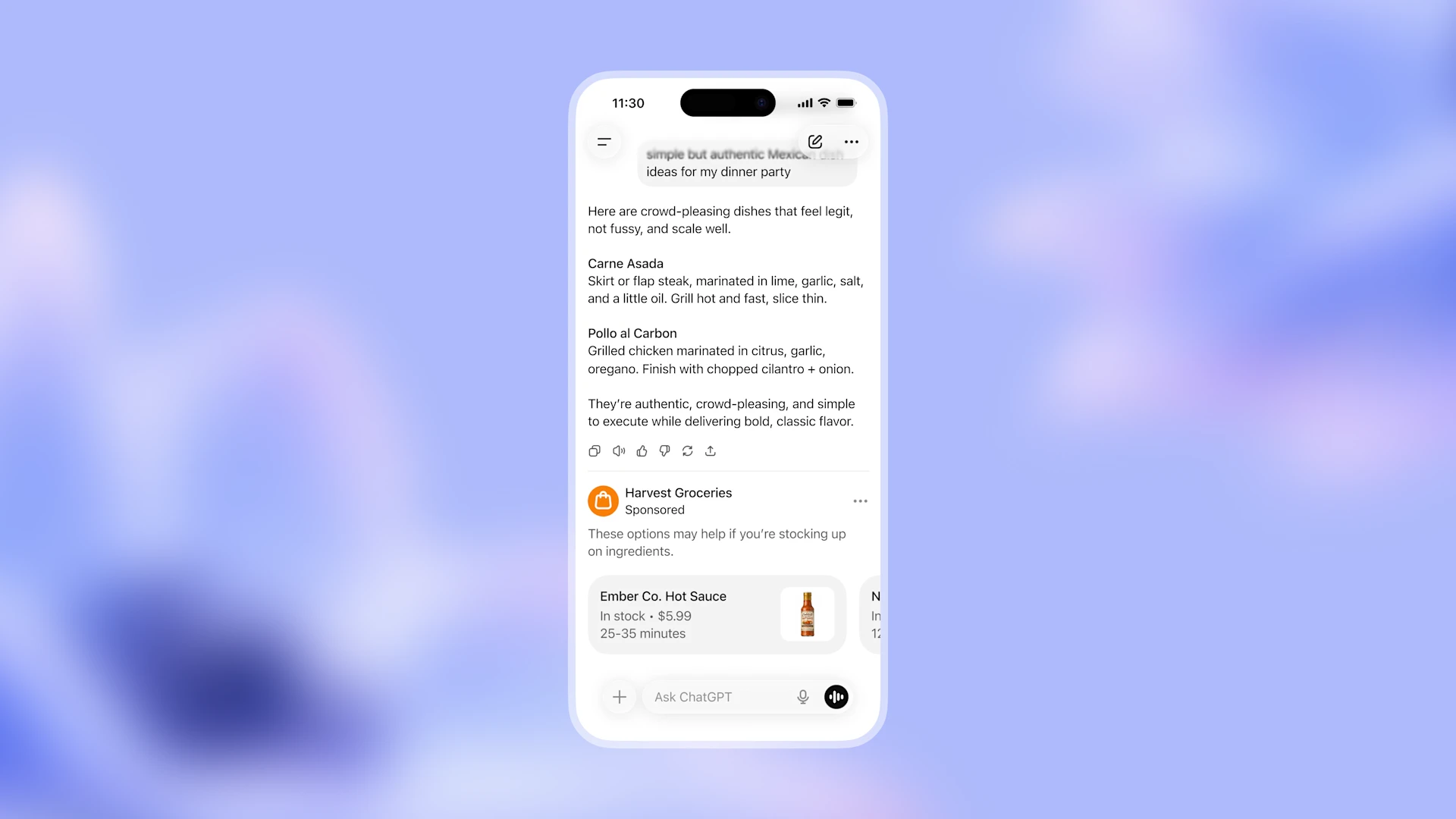
1. Header/Footer Sponsored Module w/ Carousel
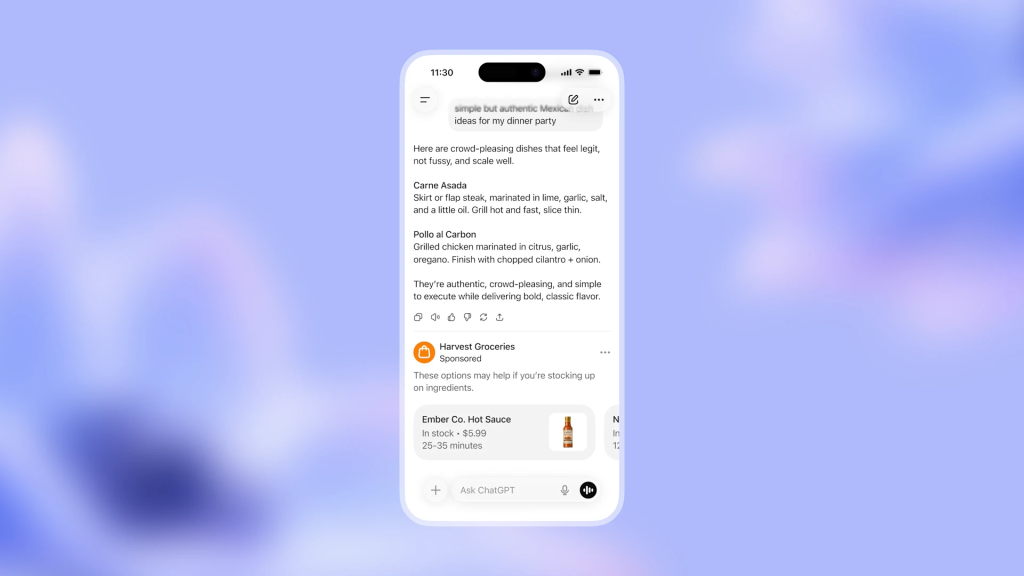
The aforementioned article by OpenAI already provided an example of formats they are exploring – a sponsored module with an ad carousel at the header/footer:
In addition, we can identify several other ad formats that could be coming to the desktop version of ChatGPT.
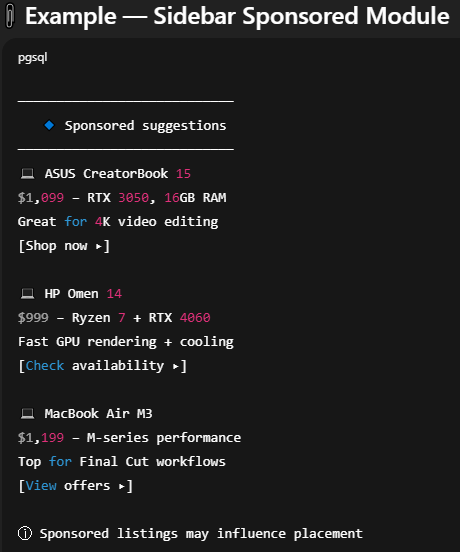
2. Sidebar Sponsored Module
“In recent weeks, ad mockups have included displaying sponsored information in a sidebar next to the main ChatGPT response window, according to the person who has seen them” – meaning that this format is already being explored. Most likely, this will be a traditional, vertical, banner-style ad box, typically displayed on the right side of the page.
Finally, we have two independently-inferred formats: “contextual” and “session”-style ads. However, it must be noted that these formats are unlikely, based on the “Answer Independence” principle OpenAI noted in their article, stating: “Ads are always separate [from organic answers] and clearly labeled.”
Example of a Sidebar Sponsored Module in ChatGPT
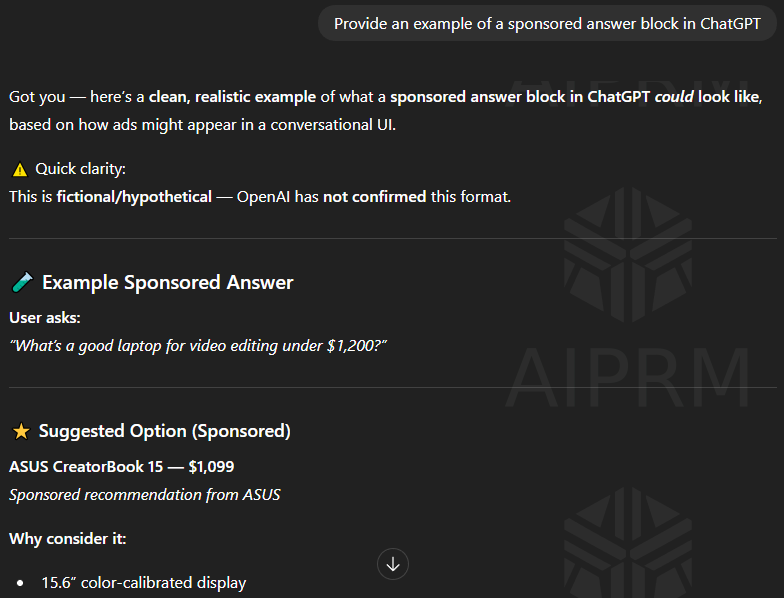
3. Contextual recommendations
These would be sponsored answer blocks, naturally integrated into the model’s responses and labeled as “Sponsored”:
4. Sponsored Sessions
Arguably, the most dreaded format of all, sponsored sessions may require the user to watch or interact with an (unskippable) ad to unlock premium features – or to just continue with their chat session. This format is already implemented across other platforms (e.g., Spotify, Android apps, etc.) and is widely considered to be the most disruptive of all.
However, considering the OpenAI spokesperson’s statement for The Information, “People have a trusted relationship with ChatGPT, and any approach would be designed to respect that trust,” as well as recent statement on X, “how we’ll approach ads–guided by putting user trust and transparency first as we work to make AI accessible to everyone,” we could assume that this would be the “last resort” option.
Will ChatGPT prioritize sponsored results over organic answers?
Based on OpenAI’s “Answer Independence” principle, which states, “Ads do not influence the answers ChatGPT gives you. Answers are optimized based on what’s most helpful to you,” we could assume that there will be no preferential treatment.
However, we simply cannot ignore previous evidence that, although inconclusive, strongly suggested that ChatGPT sponsored results would get prioritized over non-sponsored answers within the platform.
In the interview by The Information, an anonymous OpenAI employee stated that “AI models could prioritize sponsored content to ensure it shows up in ChatGPT responses.” What this means in practice is that, when a user asks for a solution to the problem, the model might prioritize a sponsored brand instead of a straightforward answer, however generic.
Why is this controversial?
The potential “preferential treatment” immediately raised concerns about “AI slop” and the consequent degradation of result quality, with actual useful info buried under a mound of ad-related content.
Needless to say, many consider this approach a prime recipe for user alienation. However, OpenAI also stated that they’re exploring safeguards to prevent this scenario, emphasizing that “People have a trusted relationship with ChatGPT, and any approach would be designed to respect that trust.”
This and new information imply that, while prioritization is being explored, it may be balanced against relevance and user experience. Whether they will manage to hit that “sweet spot” remains to be seen.
Stay Ahead of AI Search Developments
Sign up to The Laboratory and get the latest GEO insights, AI optimization strategies, and expert tips straight to your inbox.
Who will see ChatGPT ads first, free users or paid users?
In their X posts, OpenAI and Altman both confirmed that Free and Go tier users will be the first to “enjoy” all the advantages of ChatGPT ads in 2026, while “Plus, Pro, Business, and Enterprise tiers will not have ads.” This was to be expected, for two reasons:
ChatGPT currently boasts more than 800 million users, projected to hit 1 billion during 2026 – yet only ~4% – 5% are currently subscribed to Plus/Pro plans. This makes free users the highest volume of potential targets for monetization.
Introducing ads to free users while keeping paid tiers ad-free is a standard freemium model that encourages subscriptions and has proven effective in the past.
However, we cannot in good faith ignore the “ad-like tests” from December 2025, when the Pro/Plus subscribers witnessed Peloton and Target “ads”, despite those being framed as “Apps SDK recommendation” by OpenAI’s spokesperson. This could indicate that even paid users won’t necessarily be 100% immune to advertising interruptions, at least during testing phases.
Consequently, while free users may be the expected prime targets for ChatGPT advertising, it is possible that paid users will be among the first to experience “partnered”, “integrated”, or “premium” promotional features. While this is speculative, it wouldn’t be unprecedented, based on cases such as YouTube Premium feature testing or monetization hybridization in apps such as Duolingo and Spotify.
What does this mean for AI Search and SEO in 2026?
The 2026 ChatGPT ads rollout will have a significant impact on marketers, SEO strategists, publishers, and brands, who could likely expect the following outcomes:
1. AI Assistant becomes Ad Platform
Introduction of ads could transform ChatGPT from a purely research platform to a commercial discovery platform and a “recommendation gatekeeper”, potentially even evolving into a “pay-to-play” marketplace.
Traffic would increasingly start and end within an AI system, creating a “zero click” environment where users will get all the info without ever having to visit a website, causing site owners and publishers to lose significant traffic.
2. Winners win BIG. Losers vanish.
Currently, ChatGPT Shopping Research shows 3-6 product suggestions per query. If one or two (or more) of those become paid placements, we’re looking at a potential CPC bloodbath, especially considering there will be no blue links or 10+ pages of SERPs.
4. Optimization hybridization
The apparently imminent integration of sponsored results in ChatGPT marks a major shift from traditional SEO as a primary ranking tool and, consequently, SERPs as primary visibility environments to an SEO/AEO (Answer Engine Optimization) hybrid.
Much like they are now competing for Page 1, brands will now have to compete to appear in AI answers – and that will require across-the-board optimization, including traditional and technical SEO, authority and EEAT signals, discoverability, LLM-readability, and yes – potential paid placements.
5. Dual ranking strategies
With the introduction of hybrid ranking factors (i.e., structure + relevance + money), marketers and strategists would likely need two AI ranking strategies – one focused on organic AI presence and one revolving around paid visibility.
6. Websites become data sources – not destinations
Very soon, users could search, compare, choose, and pay for products/services directly from ChatGPT. The problem here is two-pronged:
Even if a site outranks the competitors on Google or other search engines, this won’t guarantee visibility in AI Search.
Currently, detecting brand mentions in ChatGPT is largely based on guesswork, since most proprietary tools don’t have access to real volume and usage data due to privacy concerns. However, there are indications that better AI Search analytics may be coming in the near future.
Effectively, this may leave many brands blind to potential opportunities in AI search unless they partner with industry-leading agencies to help them make sense of their actual visibility in this new frontier. More broadly, it has become clear that websites must now be optimized for relevance, not merely raw visibility.
7. New tech stack requirements
Since users will eventually be able to undertake the entire buyer journey within the ChatGPT platform, product/service providers will likely need intentional technical infrastructure to enable AI to capture sales, such as inventory/pricing APIs, streamlined checkout paths, and AI-friendly payment methods.
However, Google already launched its new Universal Commerce Protocol (UCP) that lets AI shopping assistants “talk” to online stores, payment services, and apps – enabling them to handle the entire buying process without needing custom integration. Since Google is OpenAI’s biggest competitor, it’s logical to assume that they’ll be working on similar functionality, which would render this point moot.
How should brands prepare for ChatGPT ads & sponsored answers?
When ChatGPT and other LLMs start blending organic results and paid placements, brands with clean data and strong trust/authority will be the ones that win placements. To that end, ZeroClick Labs advises brands to take the following steps now, as it will help them smooth the transition:
1. Audit the existing brand mentions
Search where your brand appears online
Prioritize trusted, authoritative sources
Identify outdated, inconsistent, or wrong descriptions
Build a list of pages to boost through PR outreach
2. Create “reference assets”
Publish pages containing canonical facts about your brand
Host canonical pages on your domain
Ensuring the pages are public, crawlable, and shareable
Reinforce the pages across PR, social, and partner pages
3. Strengthen commercial content for AI Shopping intent
Ensure product/service pages include:
Unambiguous naming
Transparent pricing
Accurate technical data (specs, features)
FAQs written in natural language
Product/service pros/cons or comparison to alternatives
Optimize for information clarity, rather than keyword density
4. Implement measurement infrastructure early
Standardize UTMs across organic + paid efforts
Ensure each landing page corresponds to a specific moment in the buyer’s journey (learning/discovery – commercial/shopping – purchase)
Track first-touch entry points across:
Google (ads vs. search)
ChatGPT (sponsored vs. organic)
Socials (brand posts vs. user search)
Build your team’s reporting habits now to minimize the confusion when LLM-related results start coming in
5. Draft internal ad policy guidelines
Define products/services that you will and will not promote
Define topics or terminology that you will and won’t use
Create safety disclaimers for regulated industries and/or sensitive topics
Define how your brand should sound in AI answers
Clearly identify and assign approval roles (marketing/legal/product)
Jordan Parkes, the CEO and founder of ZeroClick Labs, has been building and scaling digital marketing strategies since 2012, leveraging performance-driven SEO and data-based digital marketing solutions to guide the growth of hundreds of companies across the U.S. and Europe.
ChatGPT Ads = Opportunity. Are You Ready to Seize It?
We may not know exactly what ads in ChatGPT will ultimately look like, but we know what they mean for merchants: opportunity. More specifically – the “unicorn opportunity” – if history repeats itself, which it most likely will.
Just like with Google Ads in 2008 and TikTok ads in 2016, first movers will reap the benefits of dirt-cheap CPC/CPA, extended reach, and becoming the category leaders before the competition even has the chance to react – and to do it all on pennies and dimes.
In other words, being first on the bandwagon means the biggest wins – so don’t hesitate. Connect with our experts today and let us print you a one-way ticket to success!
“Our agency had no idea how to approach AI visibility. ZeroClick only does this one thing so they actually know what works. Worth every penny just to not waste time figuring it out ourselves.” – Jay