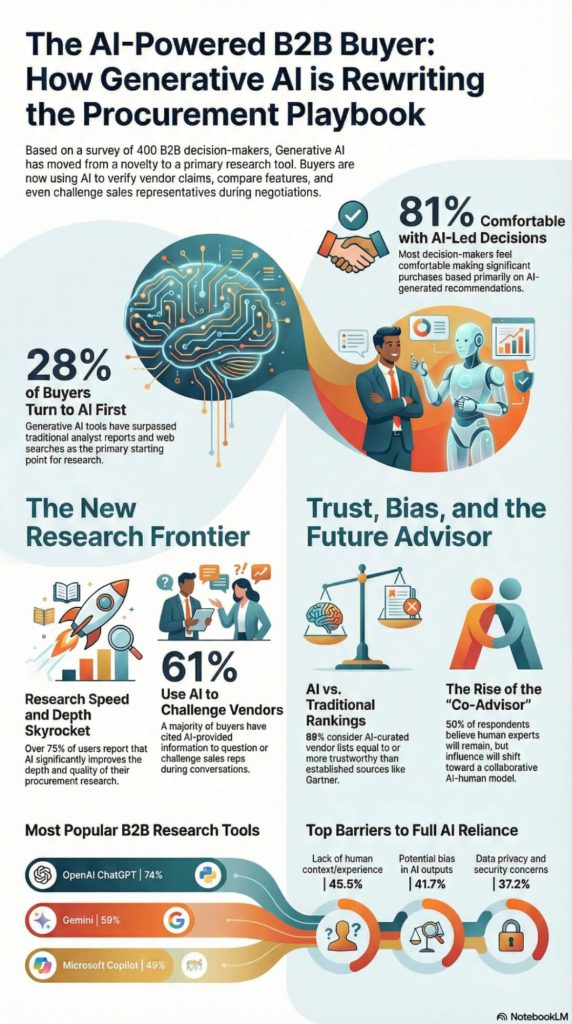
AI is already a first-stop for vendor research for nearly a third of respondents (27.75%), overtaking industry analyst reports/rankings (25%) and traditional web search (20.75%).
Buyers use AI heavily, with more than 80% of respondents reporting using AI tools in conjunction with traditional search methods to surface vendors, but still worry about accuracy, bias, and context.
60.80% of respondents already leveraged AI-provided insights in sales conversations, while 31.23% expressed future intent.
Trust in generative AI is high, with 32.23% of buyers stating they trust AI-curated vendor lists more than established analyst rankings, and 55.81% considering them equal in weight.
For 50.25% of respondents, AI is becoming a co-advisor, with human experts being introduced toward the mid-end of the funnel to verify results and turn them actionable.
Due to the AI-imposed minimal window to influence buyer perception, vendors need to deliver instant credibility in the form of info that is clear, transparent, and easily verifiable.
TL;DR: This report analyses the increasing trust in generative AI sources during the B2B buying process, summarizing findings from a private online survey of 400 respondents involved in B2B purchasing decisions, fielded on December 3, 2025. The primary intent of the survey was to understand how B2B buyers use AI, with a focus on adoption, usage patterns, and trust levels, as well as to provide actionable implications for vendors looking to align their business models with an AI-driven environment.
Introduction
Well, it looks like it’s official – e-commerce is entering the “zero-click” era, ushered in by the dominance of AI tools as the primary means of research. B2B buyers are increasingly using – and trusting – generative engines to assist them across every stage of the purchase lifecycle, driven by the ever-growing need to perform in-depth research in the least time possible.
Recognizing the growing trend, we at ZeroClick Labs wanted to see the extent of AI usage in B2B purchasing decision-making, the level of trust and confidence in synthesized answers, and discover the potential implications of this dramatic shift for vendors in 2026. To that end, we’re bringing you the in-depth analysis of a survey we conducted in December 2026.
Variable bases: Some questions show lower bases (e.g., 301 or 289 completes) due to skip logic and eligibility based on AI usage.
Methodological note: Responses are self-reported; the data should be interpreted as directional sentiment, rather than causal truth.
How do B2B buyers discover vendors in 2026?
The B2B vendor discovery process is shifting from traditional Google/Bing search to a hybrid model dominated by generative AI (GenAI). Given the speed, intensity, and trajectory of the change, it is not unreasonable to assume that vendor discovery is entering the zero-click era – where the majority of searches begin and end within AI platforms.
Finding A: GenAIs are the preferred starting point for vendor discovery
In our survey, the majority (27.75%) of respondents cited generative AI tools as the first stop when researching a new B2B product/vendor, ahead of industry analyst reports/rankings (25%) and general web search (20.75%).
“First Stop” for Product/Vendor Research
Ranking
Source
Percentage
🥇
Generative AI tool (e.g., ChatGPT)
27.75%
🥈
Industry analyst reports (e.g., Gartner, Forrester)
25.00%
🥉
General web search (Google/Bing)
20.75%
4
Colleagues or peers
13.50%
5
Customer review sites (e.g., G2, Capterra)
12.75%
6
Other
0.25%
“First Stop” for Product/Vendor Research
Ranking 🥇
Source: Generative AI tool (e.g., ChatGPT)
Percentage: 27.75%
Ranking 🥈
Source: Industry analyst reports (e.g., Gartner, Forrester)
These findings align with the premise that the discovery process is indeed reorienting toward being GenAI-centric, but it also showcases something more interesting: the shift is no longer just “trendy” or “preferential”; it’s structural, fundamental, and carrying real implications.
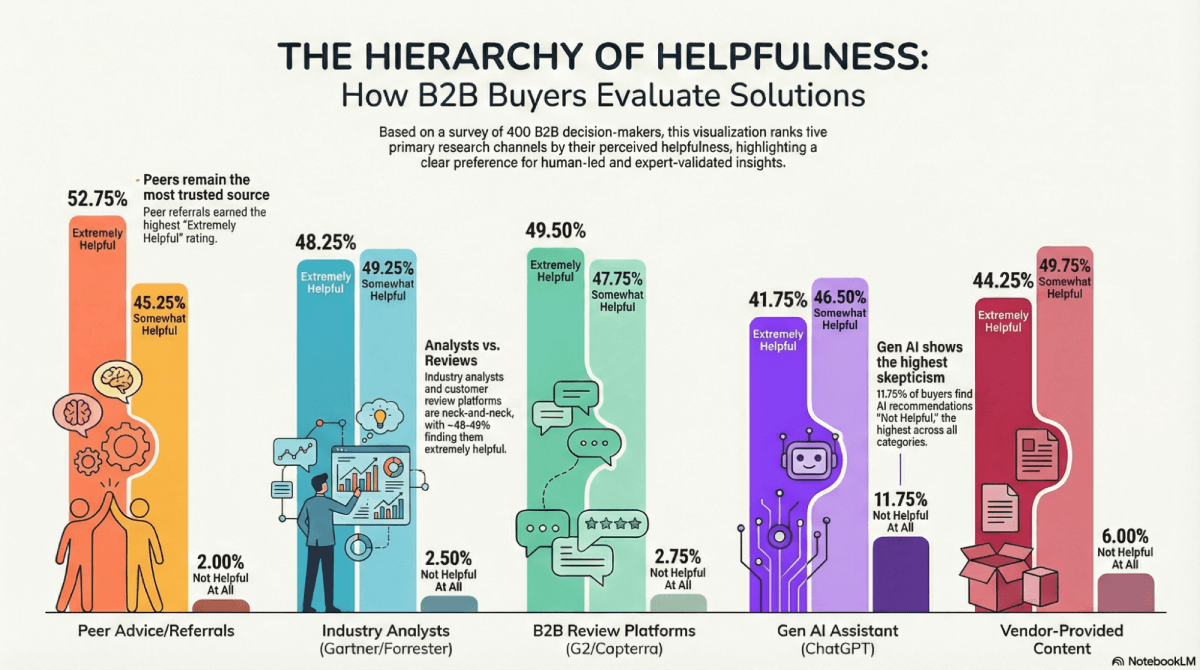
As it stands, AI tools emerged as the most popular starting point for B2B vendor surfacing. However, when it comes to evaluating solutions, human-centric sources still rank as more helpful. Here’s how our 400 respondents rated the helpfulness of different sources:
Bar chart showing the degree of helpfulness of different sources, with generative AI ranked 4th in both “Somewhat Helpful” and “Extremely Helpful” categories.
What may not be obvious at a glance, but is definitely interesting, is the fact that 11.75% of respondents rated GenAI recommendations as “Not Helpful at All.” In contrast, the “unhelpfulness” of human-centric sources is significantly lower, with the next “most-unhelpful” being vendor-provided content at 6.00%, showcasing that buyers still trust human input more when weighing their options, at least during the early stages of the decision-making process.
Which gen AI tool is the most popular among B2B buyers?
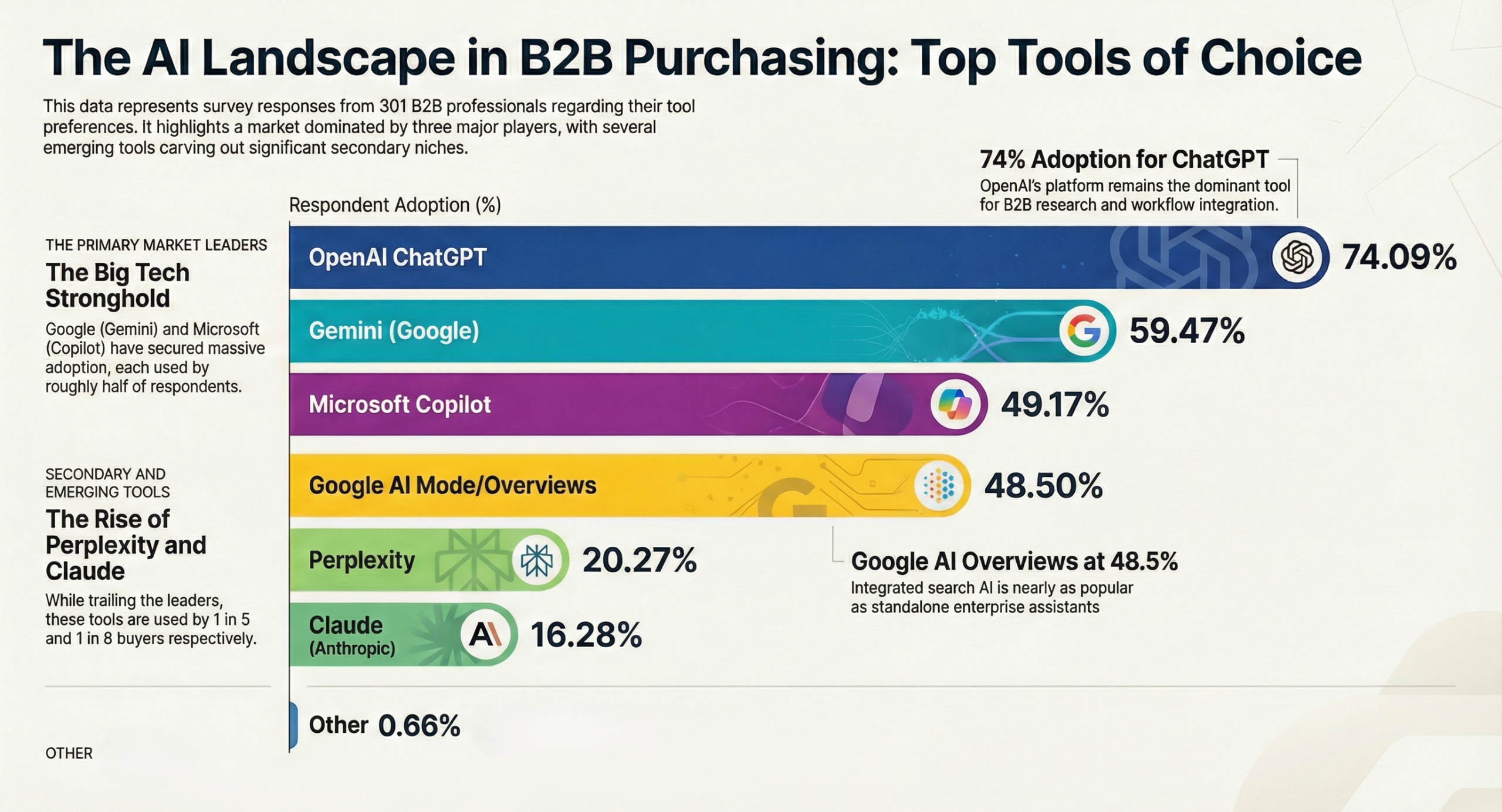
While Gen AI tools are popping like daisies, B2B users still keep to the “Big 6” of the most developed ones. To exactly no one’s surprise, OpenAI’s ChatGPT remains the undisputed leader with 74% of respondents marking it as the most likely Gen AI tool to use as part of the buying/research process. However, other industry leaders are not (too) far behind, showing significant adoption:
ChatGPT (OpenAI): 74.09%
Gemini (Google): 59.47%
Copilot (Microsoft): 49.17%
AI Mode (Google): 48.50%
Perplexity (Perplexity AI): 20.27%
Claude (Anthropic): 16.28%
Other AI tools/platforms: 0.66%
Bar chart showing the adoption rates of different AI tools in the B2B research process.
Here, we see a clear dominance of more “generalistic” engines in B2B research, which can be attributed to greater overall “hype” (or controversy) surrounding the first four LLMs. However, such positioning can also be the result of the latter two (Perplexity and Claude) being considered “specialized” or “niche” models.
This solidifies the previous point of AI tools being the “research springboard,” providing buyers with a wealth of options and information they could later crystallize, either through iterative refinement within the platform itself or through external (traditional) research, ultimately narrowing the choice to the vendor that best suits their requirements.
How do buyers actually use generative AI in the buying process?
B2B buyers are integrating AI into their workflows throughout the entire purchasing lifecycle – from vendor discovery to comparison and vetting, and even to find arguments that give them the upper hand during sales negotiations. Our findings and multiple industry reports confirm that extensive AI tool usage is the new standard. The findings from our survey indicate that:
83.5% uses AI tools in B2B purchasing
37.75% uses AI regularly
45.75% uses AI occasionally
Only 5.75% never use AI
83.5% uses AI tools in B2B purchasing
37.75% uses AI regularly
45.75% uses AI occasionally
Only 5.75% never use AI
Finding B: AI is the new normal in B2B buying
Gen AI usage is now widespread among B2B buyers, with 83.5% reporting using AI tools in their processes either “regularly” (37.75%) or “occasionally” (45.75%) – with only 5.75% saying they “never” use it. In addition:
The usage of Gen AI among employees nearly doubled in the last six months alone;
Forrester’s report that B2B buyers are adopting AI-assisted search at three times the rate of consumers AND:
89% of B2B buyers have adopted AI as the primary source of self-guided information across the purchasing lifecycle in the last two years.
If we pair all these findings, we can see they’re not reflective of “trends” nor early adopter behavior; they are a confirmation of Gen AI becoming an integral and fundamental part of the B2B purchasing process.
Finding C: Primary use cases
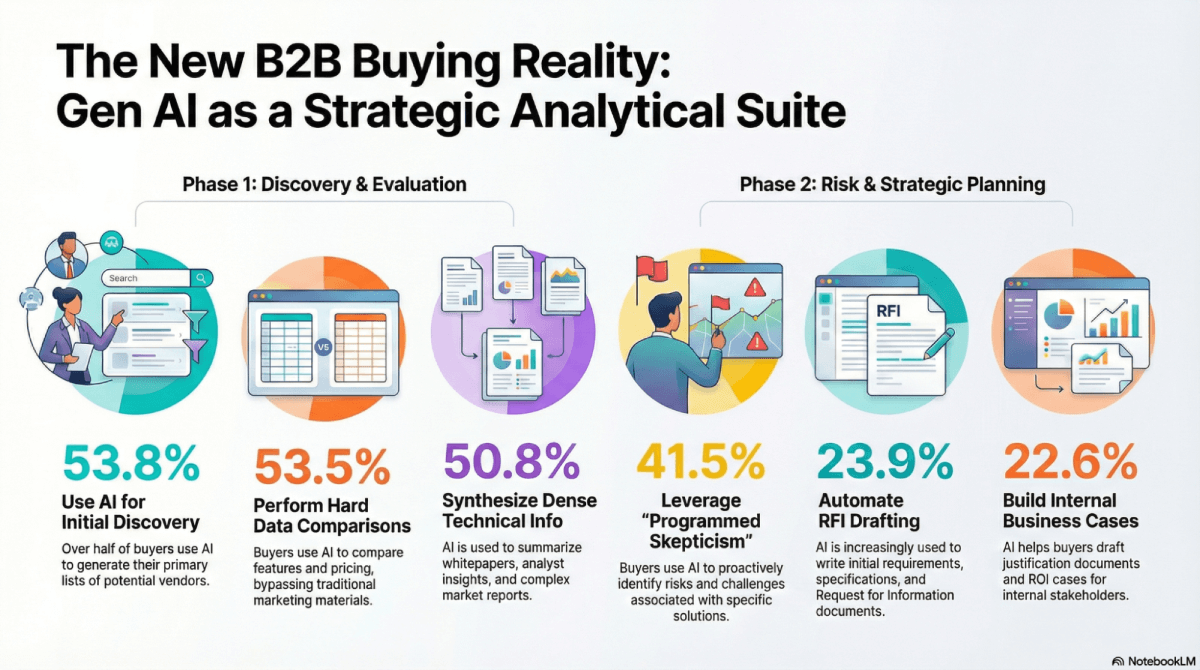
AI is not just a discovery tool anymore; It’s a complete analytical suite used to perform complex tasks which, if done the old-school way, would require hours of manual labor or paid consultation. Today, Gen AI is being used in B2B buying for the broadest array of purposes, covering virtually every aspect of the purchasing lifecycle:
Infographic showing top generative AI use cases in B2B buying. Note: Multiple responses permitted; total exceeds 100%
C1: Discovery & list building
As we already discussed at length, using GenAI to simply identify who is in the market is the most common use case, by far:
53.82% of our respondents use AI tools to generate an initial list of potential vendors or solutions.
C2: Evaluation & comparison
Once vendors are shortlisted, half the buyers further employ AI to conduct in-depth analysis and compare hard data – without having to dig through marketing fluff:
53.49% use AI to compare key features, pros, cons, or pricing across the shortlist.
50.83% use AI to summarize and synthesize dense info (e.g., vendor whitepapers, analyst insights, market reports).
C3: Risk assessment
Unbiased scrutiny is arguably one of the things generative AIs do the best – and buyers are heavily leveraging this “programmed scepticism” to their advantage:
41.53% of respondents use AI tools to identify specific risks or challenges associated with a particular solution.
C4: Strategic planner
This is where confidence in answer engines fizzles out a bit, but a percentage of B2B buyers who use AI tools as actual strategic planners is still significant:
23.92% use AI to draft initial requirements, specifications, or Request for Information (RFI).
22.59% use AI to draft business case documents or justification for internal stakeholders.
Stay Ahead of AI Search Developments
Sign up to The Laboratory and get the latest GEO insights, AI optimization strategies, and expert tips straight to your inbox.
Finding D: The “Armed” buyer
Arguably, the biggest “threat” to vendors is that buyers are now bringing “AI-powered loaded guns” to sales meetings – and they’re not afraid to use them. B2B decision makers are increasingly leveraging AI insights in negotiations, with 60.8% reporting they have used AI-provided information to challenge or question a vendor/salesperson during a sales conversation.
In addition, more than 31% of respondents expressed future intent, stating that they haven’t used AI insights in this way, but they likely will in the future. To that, let’s add the fact that more than 35% uses AI to explicitly prepare for negotiations (e.g., formulate questions, talking points, or counter-arguments).
With the above results in mind, it’s only logical to assume that sellers will increasingly find themselves between the proverbial hammer and an anvil – forced to defend their pricing and claims against buyers armed with AI insights and near-zero tolerance for ambiguity or weak proof – and to do it all with far less leverage or prep time.
60.8% already leveraged AI insights in sales negotiations
35.55% actively use AI to prepare for negotiations
31.23% open to the idea of using AI insights in sales conversations
Only 6.64% would NOT rely on AI info to challenge a vendor in real-time
60.8% already leveraged AI insights in sales negotiations
35.55% actively use AI to prepare for negotiations
31.23% open to the idea of using AI insights in sales conversations
Only 6.64% would NOT rely on AI info to challenge a vendor in real-time
Why is AI dominating the B2B decision-making process to such an extent?
The incentive to use Gen AI tools across every stage of the buying process is clear and boils down to two factors that matter most in high-stakes environments: efficiency and confidence.
Efficiency: 66.44% reported that using AI tools speeds up their decision-making process.
Confidence: 75.43% reported that AI tools improve the depth and quality of their research by helping them aggregate more information faster.
Now, let’s flip the narrative:
Negative efficiency: Only 9.34% of respondents said that AI actually slows down their research.
Negative confidence: Only 11.42% said that AI actually decreases the thoroughness of their research.
Even from this viewpoint, things are looking up for the AIs’ case, especially considering that negative performance is not entirely the AI’s “fault.” Rather, the negativity results from a combination of technical limitations (“conflicting AI info”; “inaccurate information”) and human factors (“extra verification steps slow me down”; “I may miss nuances by relying on AI summaries”).
Given the monumental disparity between the positives and negatives, as well as external reports reinforcing the facts that AI undeniably increases efficiency and confidence, it’s easy to conclude that AI’s overwhelming presence in the B2B buying process is more than justified.
➕ Efficiency
➖ Efficiency
“AI speeds up my research” 66.44%
“AI slows down my research” 9.34%
➕ Confidence
➖ Confidence
“AI increases quality of my research” 75.43%
“AI decreases quality of my research” 11.42%
➕ Efficiency
“AI speeds up my research” 66.44%
➖ Efficiency
“AI slows down my research” 9.34%
➕ Confidence
“AI increases quality of my research” 75.43%
➖ Confidence
“AI decreases quality of my research” 11.42%
How much do B2B buyers trust AI for decision-making?
“To trust, or not to trust?” – a Shakespearean conundrum has been enveloping the community ever since we got the first functional AI models. Naturally, in the beginning, most were leaning towards the latter, but now it seems that the tides are turning. B2B buyers in particular are displaying a surprisingly high level of confidence with AI-led decision-making, though the majority still requires at least some degree of human verification.
Finding E: Trust is high – but not blind
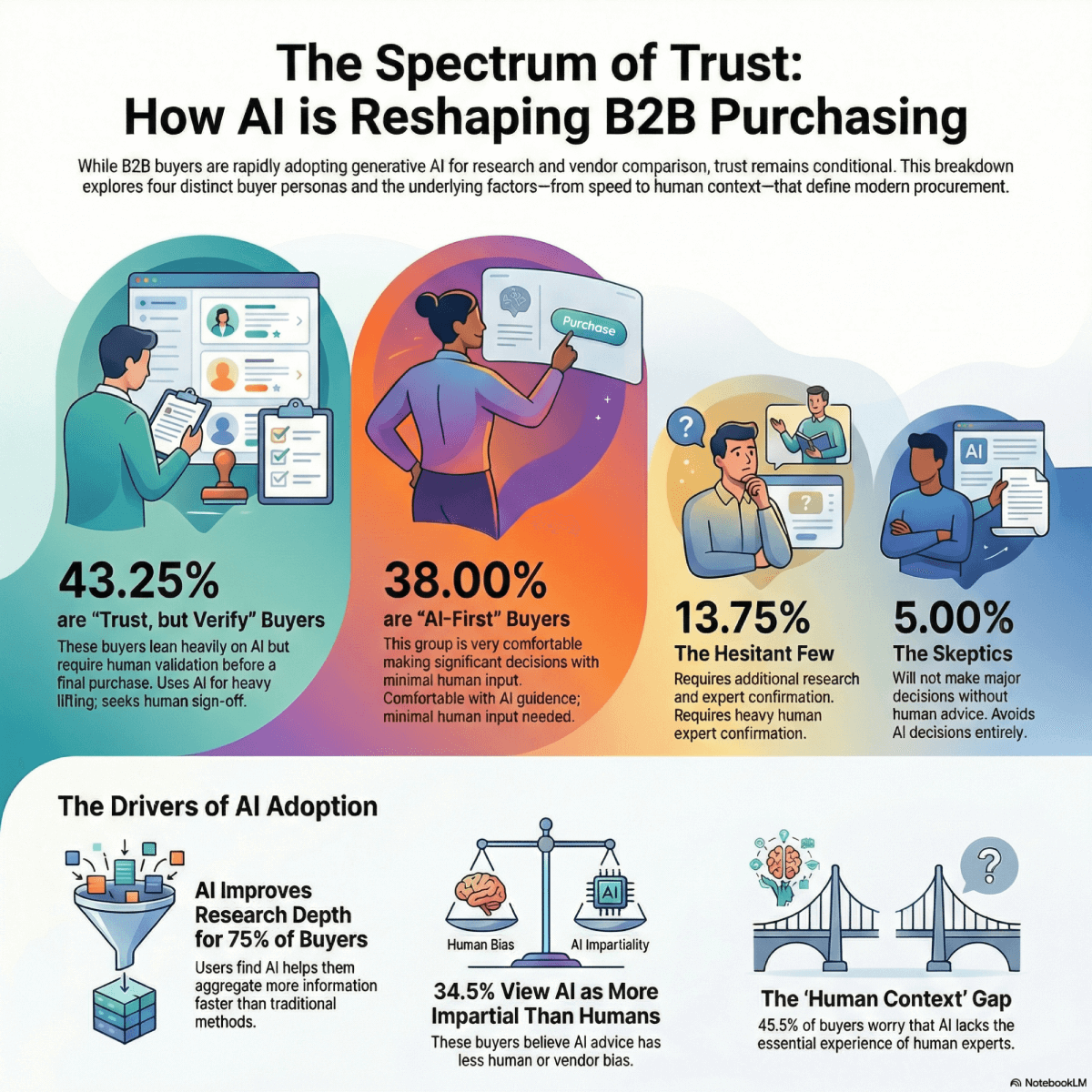
While our survey revealed many interesting things, this is perhaps the most (un)surprising of all: a combined 81.25% of respondents said they are comfortable with AI-led decision-making. The caveat is that the comfort intensity level varies:
“Trust, but verify”: 43.25% lean heavily on AI tools in their decision-making processes, but still require human validation before committing to the purchase.
“AI-first buyers”: 38.00% said they are “very comfortable” making significant buying decisions with minimal human input.
“The hesitant few”: 13.75% would necessarily seek confirmation from human experts or additional research before committing.
“The skeptics”: 5.00% are “not at all comfortable” making a decision based solely on AI insights.
Now, the dominance of the first segment was expected. What wasn’t is the minimal (5.25%) disparity compared to the second segment – and the negligible presence of the third segment. If we revisit the “rapid adoption” argument from the beginning, the logical conclusion is that the resistance to AI in the B2B purchasing process is waning, and fast. In other words, buyers are ready to let the AI take the wheel, but most still want a human in the front passenger seat.
Chart showing comfort intensity levels spread in AI-led decision-making.
Why do so many buyers trust AI?
The reason behind comfort is the perceived objectivity of AI models. 34.50% of respondents believe that AIs are more impartial and objective than human experts and vendors. However, nearly half (49.50%) acknowledge that, while the synthesized answer may be data-driven, the training data behind them isn’t – i.e., it is still human-centric and, therefore, can’t be 100% unbiased, at least not yet.
What are the biggest concerns with AI-led buying in B2B?
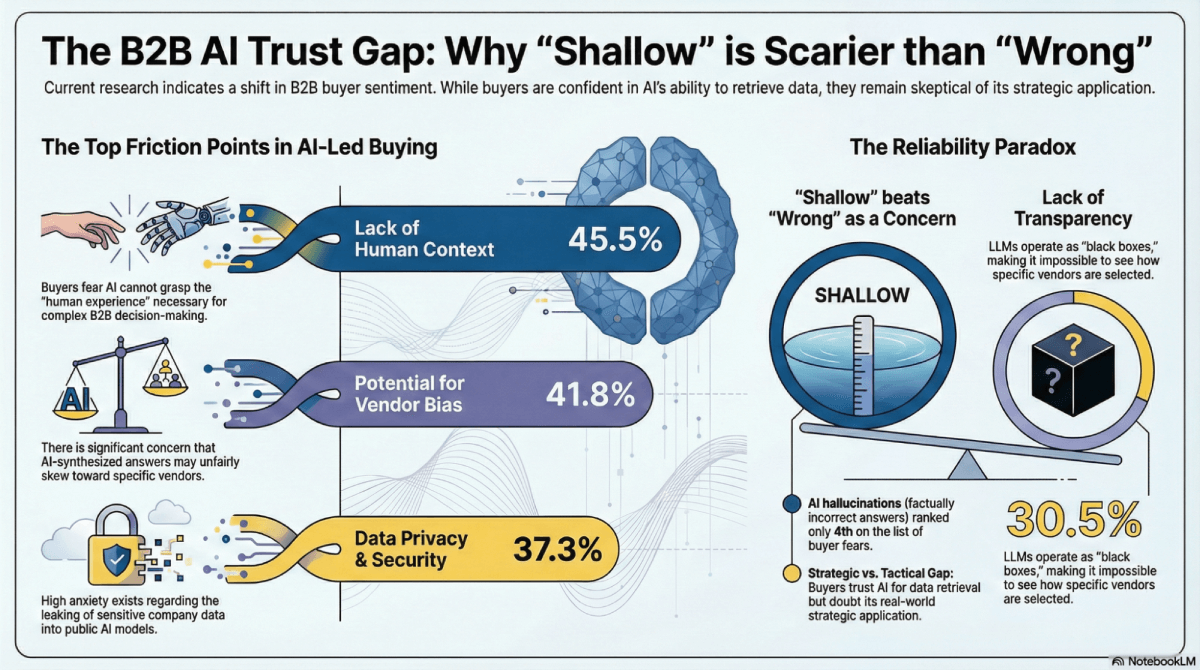
Many thought (us included) that the biggest concerns with AI-driven decision-making would be “hallucinations” (i.e., factually inaccurate information). Turns out, B2B buyers are more concerned about “shallow answers”than they are about “wrong answers.” Here’s what our respondents cited as top friction points:
Lack of human context (45.50%): The #1 concern is that AI cannot grasp the “human experience” necessary to make decisions in complex B2B scenarios.
Potential bias (41.75%): Many buyers fear that synthesized answers may skew toward certain vendors due to the methods and data used to train the AI model.
Data privacy & security (37.25%): The fear of leaking sensitive data into public models via prompts is high and not unfounded (e.g., the “Samsung Effect”).
“AI hallucinations” (34.25%): Concerns about factually incorrect answers that appear valid rank only 4th.
Lack of transparency (30.50%): The “black box” data policy is present with every LLM provider, making it impossible to discern how AIs select specific vendor/solution.
These findings suggest buyers are relatively confident in the AI’s data retrieval abilities, but remain skeptical about said data’s real-world strategic application.
The Primary Point of Concern for the Majority of Buyers: AI’s inability to understand the nuance of real-life B2B operations or applications.
External sources back these claims, citing “hallucinations” and “data poisoning” (adversaries deliberately altering training data to confuse models) as factors that diminish the strategic applicability of AI-synthesized data in real-world B2B scenarios the most.
In addition, the same sources note that, while the confidence in AI is high in the beginning stages of research, trust does drop significantly toward the end of the funnel (i.e., finalizing the purchase), where the cost of error is the highest.
Finding F: “AI co-advisor” as a dominant model
Finally, when asked how AI advisors will impact the influence of human experts in the B2B decision-making process, around half of respondents (50.25%) agreed that the dynamics will shift toward AI as a co-advisor, with human experts still present to validate the decision.
Trust = high usage + active verification
In summary, data suggests that the “AI-first” habit will remain dominant across the entire purchasing lifecycle, especially during the early stages of the process, with human experts being brought into the loop toward the end of the funnel to verify the integrity of results and their applicability in complex real-world scenarios.
Actionable implications of rising AI dominance in B2B search for vendors and marketers in 2026
To succeed in zero-click environments in 2026, vendors and marketers must shift toward Generative Engine Optimization (GEO) to ensure AI-alignment and consequent discoverability, as well as deliver “instant credibility” early in the discovery process to pass the extremely narrow, AI-imposed verification window – which is now seconds, not sessions.
Boasting a “Rank #1 in Google” is not enough for discoverability within AI environments. The metric will remain relevant in blue-link environments, but vendors should start refocusing or (better) enhancing traditional SEO with GEO strategies to significantly improve their chances of being surfaced by answer engines. In other words, having an AI-legible website/content is no longer optional – it is becoming a standard for new-age demand capture.
In addition, AI is compressing the top of the funnel. Instead of spending days or weeks comparing solutions, buyers are now reaching shortlists and decisions within minutes – meaning that vendors have the absolute minimal time to influence buyer perception.
Consequently, vague descriptions, hidden pricing, and similar “hooks” no longer work. In a zero-click era and especially with the upcoming rise of agentic commerce, vendors must deliver credibility immediately, including (and these are not either/or anymore):
Forrester: B2B buyer adoption of generative AI (2024 Buyers’ Journey Survey data overview) (Forrester)
Digital Commerce 360: Forrester coverage on AI search reshaping B2B marketing (Digital Commerce 360)
McKinsey: Generative AI opportunities in procurement and sourcing (McKinsey & Company)
Deloitte Insights: Emerging categories of gen AI risks (privacy, compliance, governance) (Deloitte Italia)
G2: 2024 Buyer Behavior Report (B2B decision-maker survey context on scrutiny and trust) (research.g2.com)
Microsoft and LinkedIn: 2024 Work Trend Index (broad adoption of AI at work) (Source)
Gartner press release: distrust and confidence issues with AI-powered search results (Gartner)
Jordan Parkes, the CEO and founder of ZeroClick Labs, has been building and scaling digital marketing strategies since 2012, leveraging performance-driven SEO and data-based digital marketing solutions to guide the growth of hundreds of companies across the U.S. and Europe.
Traditional marketing strategies – digital or otherwise – are no longer sufficient. The search is fragmenting, metrics are fanning out, standards are shifting. The winning vendors will be the ones who make discovery and verification easy – both for Gen AIs & human experts.
With extensive experience in generic engine optimization and a proven track record of success across 200+ clients, ZeroClick Labs makes achieving those goals easy.
Connect with us today and be among those who make digital environments their own playgrounds!
“Our agency had no idea how to approach AI visibility. ZeroClick only does this one thing so they actually know what works. Worth every penny just to not waste time figuring it out ourselves.” – Jay