ChatGPT ads are currently being tested with Free and Go users in the U.S.
Recent coverage reports ~$60 CPM pricing and ~$200,000 minimum commitment for early partners.
Early-stage testing is invite-only, focused on major brands and enterprises.
The high pricing range positions ChatGPT as a premium marketing channel.
The reported pricing and the “elitist” approach raised concerns of exclusion among SMBs.
TL;DR: Since February 9, 2026, OpenAI has been actively testing ads in ChatGPT. Early reports suggest pricing of around $60 per 1,000 impressions and approximately $200,000 minimum entry fee. High price positions ChatGPT as a premium advertising platform, currently unattainable by many mid-level organizations and SMBs.
AI platforms, spearheaded by ChatGPT, are rapidly becoming the preferred first-point discovery tools, with the increasing number of high-level decision makers using them throughout the early stages of the buying process. With hundreds of millions using them on a daily basis, monetization was just a matter of time. Well, that time has come.
As of February 2026, OpenAI started testing ChatGPT ads, adopting a pricing strategy that immediately signaled their view of the platform as a premium-level advertising channel. Needless to say, this deliberate positioning sparked a heated debate on whether the premium price tag is worth it, as well as if it’s exclusionary toward smaller organizations.
How much are ads in ChatGPT?
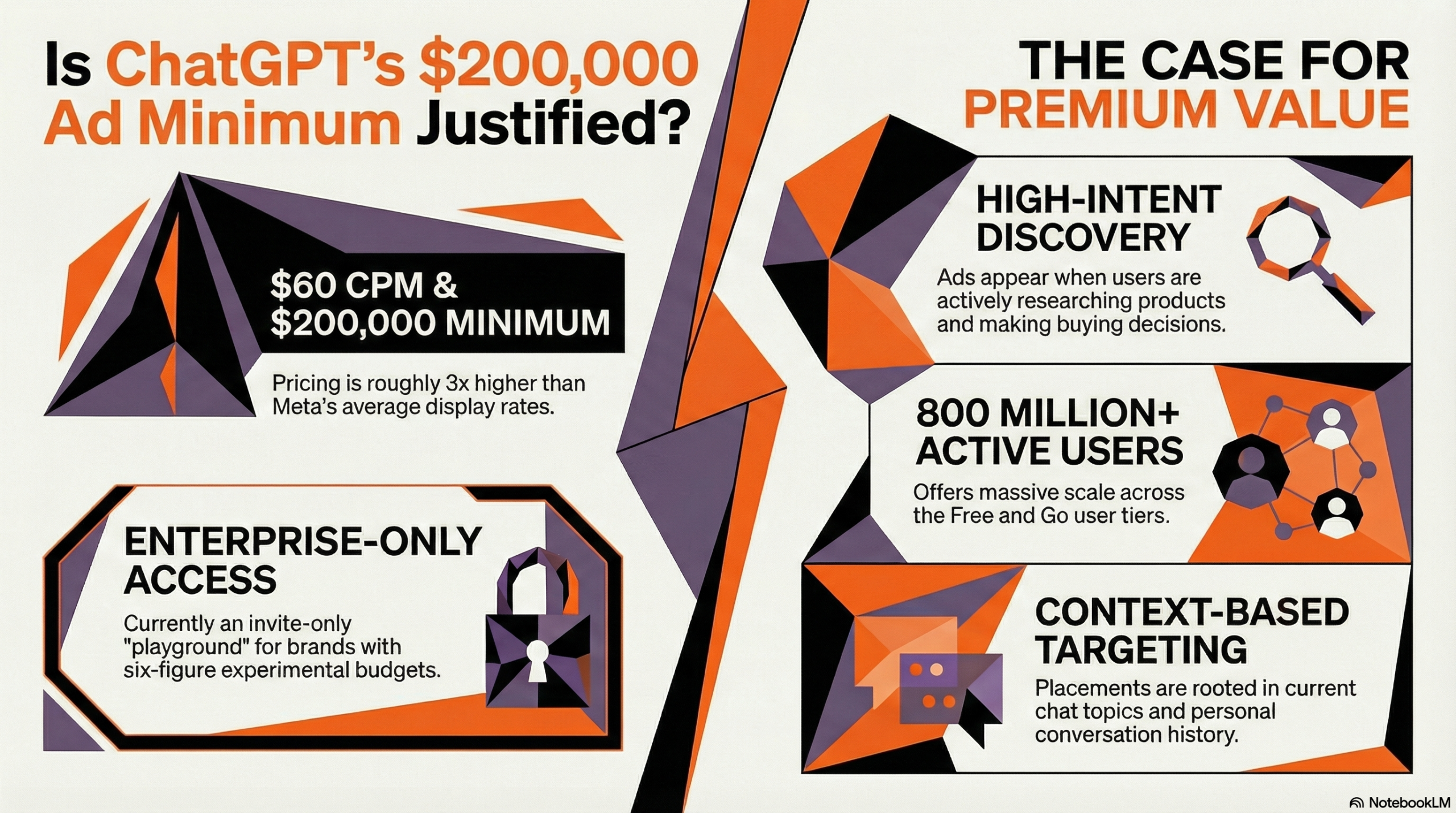
According to industry reports, ads in ChatGPT cost ~$60 per roughly 1,000 impressions (CPM), and ~$200K minimum commitment for beta entry – significantly higher than typical display or socials CPMs (e.g., 3 times the Meta average) and more in line with premium advertising inventory.
The initial signals – the steep price and by-invite-only entry – were interpreted by many as ChatGPT deliberately being positioned as a premium marketing channel, aimed primarily at established brands and enterprises who can justify a six-figure experimental spend. This inevitably brings us to the crucial question: the commercial plausibility of a premium price tag.
Stay Ahead of AI Search Developments
Sign up to The Laboratory and get the latest GEO insights, AI optimization strategies, and expert tips straight to your inbox.
Is the premium pricing of ChatGPT ads justified?
Because ChatGPT ads are still in an early-stage testing phase, and pricing + execution is likely to evolve at full release (or a bit further down the line), the only answer currently plausible is: it may be. That being said, there’s no denying that OpenAI’s flagship platform has the potential to be the “next big thing” in digital marketing, for three main reasons.
1. The discovery is shifting
AI platforms have evolved far beyond chat “toys.” They are now full-on discovery interfaces, enabling users to conduct comprehensive research, data synthesis, features comparison, and even draft internal justification documents – all within minutes, all in a conversational manner.
In high-stakes environments, the initial convenience easily translates into increased efficiency and better research quality. This is exactly what drives more and more decision-makers to integrate AI into their procurement processes – and the majority uses ChatGPT as a starting point.
2. Not just another generic advertising channel
Arguably, the biggest justification for OpenAI to cite for premium pricing is the very nature of AI-powered search. Google Ads work based on keywords, Meta placements rely on “reading” user behavior – but ChatGPT ads are rooted in context.
OpenAI confirmed that ads in ChatGPT will be based on the current chat topic, general location information, user interaction (hiding or engaging with ads), and even previous chat history, leading to high levels of personalization, relevance, and resonance with potential customers.
Intent-based, intentional placement within an intent-dense environment
When a SaaS buyer uses ChatGPT for research and asks “What’s the best enterprise CRM software?”, that interaction is not casual nor passive – it’s intentional and decision-making.
They’ve defined the problem, budget (or at least internal justification), and intent – and are now actively looking for solutions. In such high-intent environments, ads are not interruptions – they are a part of the solution – especially if they appear after an already-helpful synthesized answer that aligns with the context of the conversation.
3. The reach
ChatGPT boasts a reach unlike any other AI platform currently on the market. Currently, it has 800 million active users, projected to exceed 1 billion by the end of 2026. Of those, approximately 95% are in Free or Go tiers, which is exactly where ads are being placed. That’s roughly 760 to 950 million potential ad targets – and they are not random.
Ads in ChatGPT boast a premium price tag – but there’s a case to be made for it.
Does visibility in ChatGPT justify the $60 CPM or six-figure minimums?
No, it doesn’t – at least not yet. And, yes – the very presence in intent-dense, decision-formation environments is an undeniable strategic advantage, and that alone may be enough to command a premium. However, the final worth still depends on potential ROI, which still depends on measurement and attribution – and therein lies the issue.
Namely, the reporting capabilities are still limited, with advertisers only receiving high-level data (e.g., aggregated ad views and clicks), and practically nothing else. Granted, OpenAI hinted at the possibility of expanding measurements in the future, but as of now, metrics that could be misleading unless approached cautiously and the experimental nature of ChatGPT ads still position them in a high-risk category, albeit with the high-reward potential.
Will ChatGPT ads become a playground for enterprises?
Yes – at least in the short term. The early inventory, with high buy-ins and CPMs, currently favors enterprise-level budgets and brands willing to treat ChatGPT ads as a strategic, though experimental, placement tool.
On the flip side, mid-market and SMB advertisers can do nothing but wait and watch. If history is any indicator, like with Google and Facebook, as the platform continues to scale and measurements improve, ads may become more accessible.
When will ChatGPT ads become accessible for smaller and mid-sized businesses?
The timeline for the “democratization” of ChatGPT Ads is uncertain and will most likely depend on how quickly OpenAI can deliver reliable attribution, as well as the ability to prove that ads can coexist with UX without eroding user trust. If both mature rapidly, broader access is likely to follow – if not, the “elite-only” phase may persist longer than expected.
Seth Matthews, an AI SEO content writer within ZeroClick Labs, began his career in civil engineering, but his passion for writing drove his deliberate transition into professional content strategy and SEO. The clash of two worlds produced a writer who can effortlessly combine technical precision and narrative clarity with the emotional and psychological impact of creative storytelling.
ChatGPT is prime real estate. We can help you claim it.
Advertising inside ChatGPT is not just about “buying impressions” – it’s about engineering influence across the discovery layer.
For enterprises, this means delivering structured pilot frameworks, attribution modeling, and brand-safety strategies.
That’s right – For mid-market and SMBs, it means strengthening your AI alignment now, so when broader access opens, you’re ready to dominate it.
That’s exactly what the team at ZeroClick Labs does – optimizing your brand presence, entity authority, citation patterns, and conversational positioning, so that paid placements don’t compensate for the absence of organic AI visibility, but amplify it across the entire discovery layer.
Connect with us today and let us help you create a sure footing in a future ecosystem!
“Our agency had no idea how to approach AI visibility. ZeroClick only does this one thing so they actually know what works. Worth every penny just to not waste time figuring it out ourselves.” – Jay