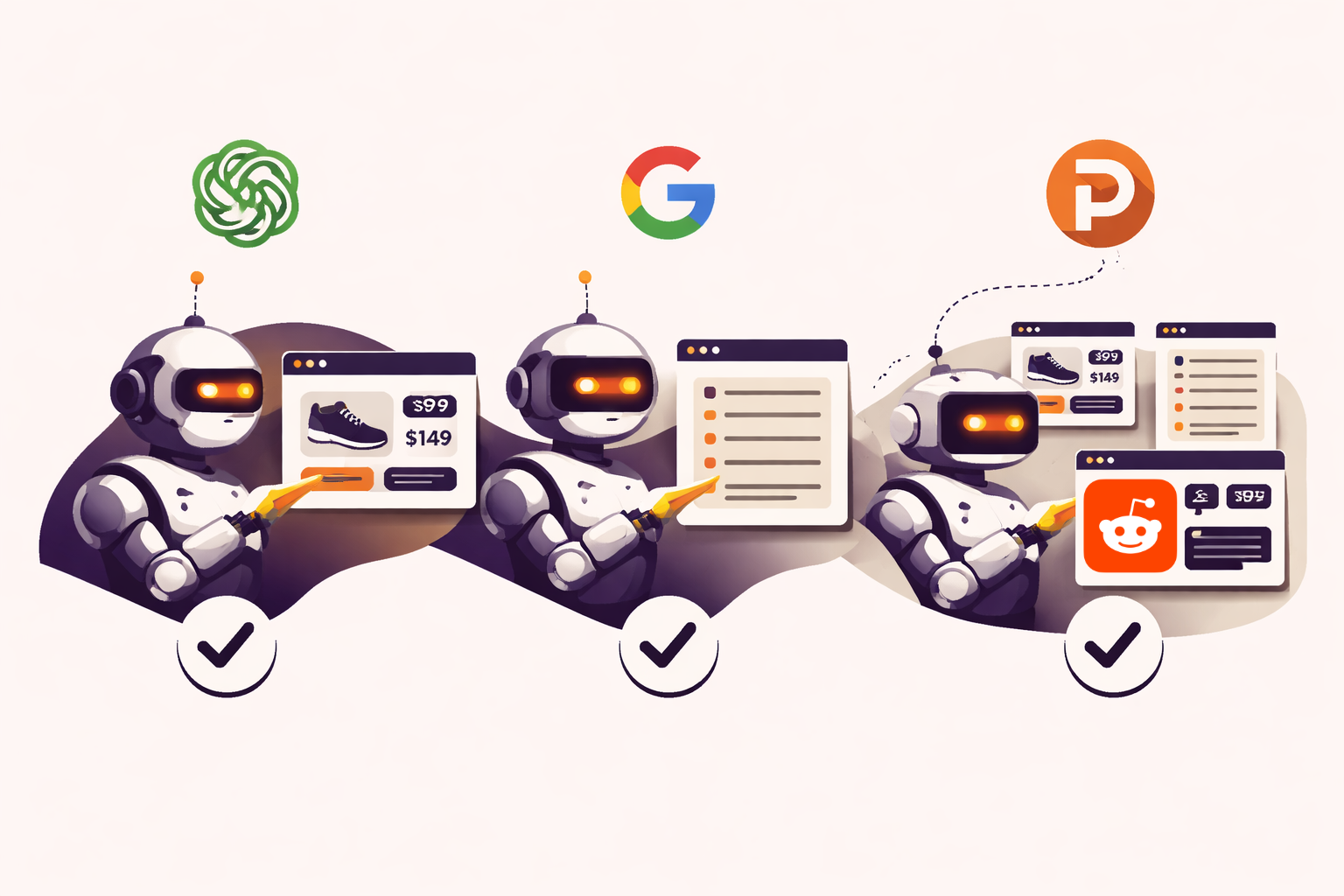
AI Overviews, ChatGPT, Perplexity – despite their differences, the three models have near identical purpose. So why do they give vastly different answers to the same queries?
AIO, Perplexity, and ChatGPT prioritize listicles, product pages, and homepages as citation sources.
AIO favors listicles (46.3%), suggesting it prioritizes coverage over depth.
ChatGPT favors product pages (41.6%), indicating a confidence-first, fact-based approach.
Perplexity shows source-agnostic behavior with balanced distribution (listicles 26.89%, product pages 26.87%) and meaningful inclusion of discussion content (13%).
Executive Summary: ZeroClick Labs performed a study on ChatGPT, AI Overviews, and Perplexity, aiming to determine which content types are most frequently cited in their answers. Listicles (33.8%), product pages (28%), and homepages (11.3%) were the most prevalent page types across all three models, accounting for 73.1% of all citations.
Although most AI tools fall under the umbrella of Large Language Models (LLMs), ultimately serving a similar purpose, there’s no denying that different models deliver notably different answers – even to the exact same queries.
For recreational users, this is just a fun factoid. For individuals who depend on these tools for high-level decision-making, however, knowing which models cite which content types is a critical part of AI Overviews optimization, ChatGPT marketing, and Perplexity SEO strategies.
In March 2026, ZeroClick Labs conducted a study on ChatGPT, Perplexity, and AI Overviews, aimed at determining which content types are most frequently selected as citation sources. This article is a comprehensive review of study results, focusing on each specific model’s behavior.
Methodology:
Time window: 30 days
Total URLs analyzed/cited: ~3.3K
Total citations observed: ~38.5K
Platforms: ChatGPT, Perplexity, Google AI Overviews (AIO)
Industries: SaaS, digital marketing, home services
Overall citations per URL: ~11.67 (38.5K ÷ 3.3K)
NOTE: Approximate; topline values are rounded;
Which content types are most commonly cited by AI models?
Listicles, product pages, and homepages were consistently the most frequently cited content types across all three observed AI models, accounting for ~69% (Perplexity) to up to 77.5% (ChatGPT) of total selections.
Table 1 — Top 3 cited content types per platform
Ranked by % share of citations
AI Overviews
#1
Listicle
46.3%
#2
Product page
22.9%
#3
Homepage
6.4%
ChatGPT
#1
Product page
41.6%
#2
Listicle
26.0%
#3
Homepage
9.9%
Perplexity
#1
Product page
26.9%
#2
Listicle
26.9%
#3
Homepage
15.3%
This distribution isn’t unexpected, considering how most LLMs share the same RAG selectability criteria: precisely defined entities, modular organization, and explicit information. The reason is that content structured this way is easier for LLMs to extract and reuse in answer synthesis. Since all three dominant page types meet these criteria, it’s natural that they are consistently surfaced across the observed platforms.
However, while all three models prioritize the same top content types, the degree to which each is cited varies significantly across platforms. In addition, as we move further down the citation line, the content-type distribution begins to diverge dramatically, revealing meaningful secondary trends, most notably:
Table 2 — Secondary trends
Highest and lowest platform per content signal
Metric
Video content
Highest
AI Overviews
6%
Lowest
ChatGPT
0.02%
Metric
Discussion content
Highest
Perplexity
13%
Lowest
AI Overviews
3.27%
Metric
Unavailable content (404s)
Highest
ChatGPT
2%
Lowest
Perplexity
0.05%
This data shows something very interesting: although the citation selectability criteria coincide, the intensity signals vary between each criterion across all three models, resulting in dramatically different citation behavior:
ChatGPT → product-page dominant citation behavior, with the highest number of 404 crawls.
Perplexity → source-agnostic citation behavior (balanced distribution w/ noticeably high discussion footprint).
AI Overviews → listicle dominant citation behavior, with the highest share of video content.
Why are different platforms rewarding different content types?
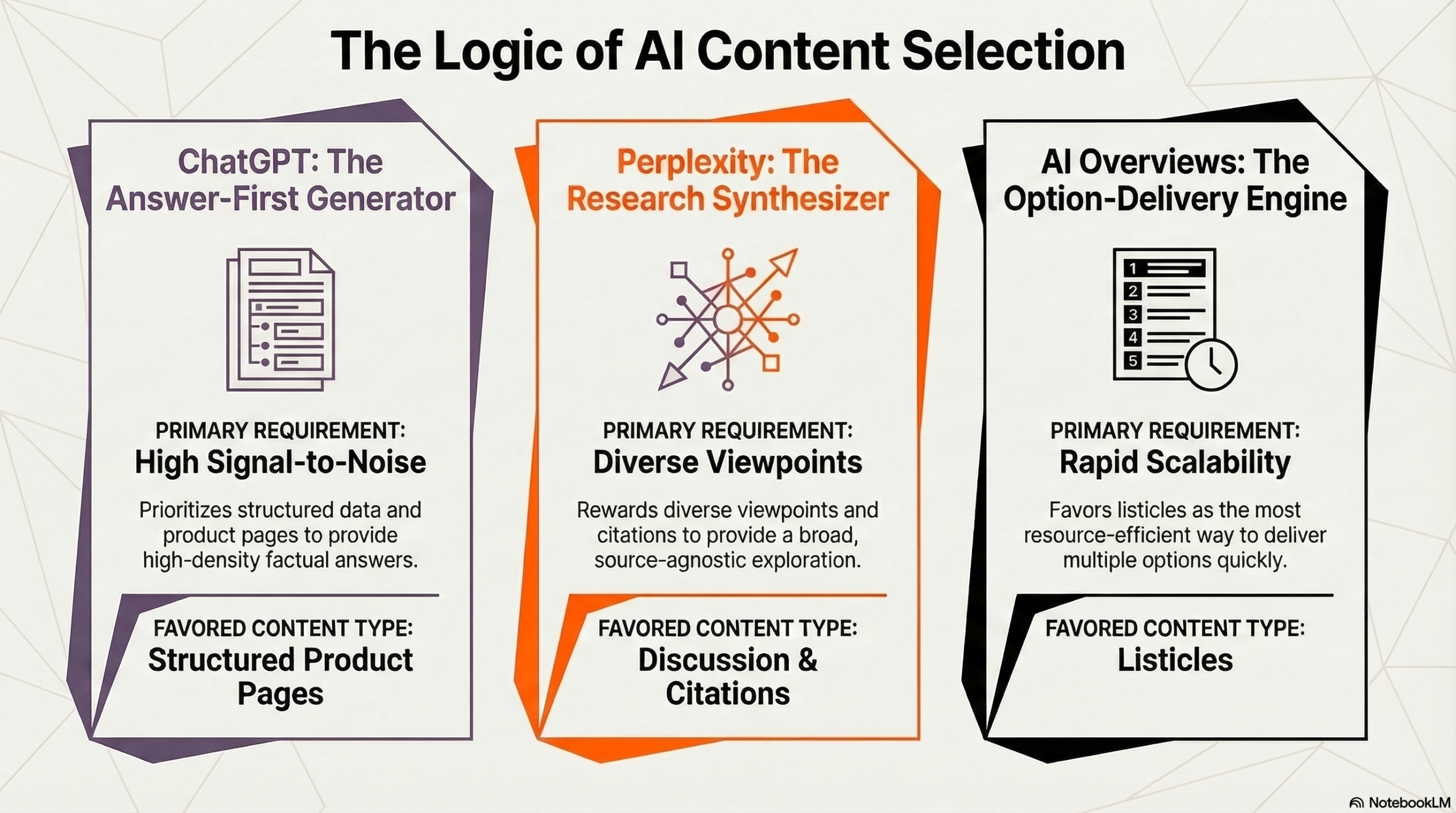
While it may appear so, different content type selection patterns are not preferential; they are structural – rooted in system architecture or, rather, design constraints. Essentially, each of the 3 AI platforms solves fundamentally different problems:
ChatGPT: The “answer-first” generator
Objective: Provide the most direct answer to a query.
Requirementsfor realization: Clean input, a high signal-to-noise ratio, and structured data.
Hence, favoring product pages with clear definitions, structured information (features, pricing, specs), and high factual density.
Perplexity: Research aggregator + synthesizer
Objective: Explore breadth and back it up with transparency, rather than just “provide an answer”.
Requirements for realization: Diverse viewpoints and an abundance of citations from different sources.
This is why we’re seeing balanced top and mid distribution, as well as source-agnostic behavior (heavy inclusion of discussion content).
AI Overviews: “At-scale SERPs summarizer”
Objective: Deliver options, rather than definitive solutions, and do so quickly.
Requirements for realization: Pre-organized, immediately usable data.
AIO heavily favors listicles since they are the easiest and most resource-efficient way to deliver the highest volume of options in the least amount of time.
ChatGPT, Perplexity, and AIO employ similar selection logic, but prioritize different selectability criteria.
The Laboratory: Where AI Visibility Gets Decoded
Get exclusive research, expert insights, and cutting-edge GEO and AI optimization strategies delivered directly to your inbox.
Subscribe now and stay ahead of every model update, every platform shift, every opportunity.
Attribution philosophy difference: Citations vs URL count
The final metrics that bear comparative analysis are total citations and URL counts, since these patterns reveal meaningfully different philosophies toward source attribution across the three platforms.
AI Overviews cite a significantly greater number of unique URLs overall, most commonly pulled from the top 10 Google search results. However, they produce fewer citations per response, resulting in a lower total citation count. Notably, AI Overviews use the same URLs across chats way more often than other sources, even if they’re not explicitly citing them, suggesting that AIO prioritize coverage breadth over depth.
ChatGPT sits on the diametrically opposite end of the spectrum: it has the highest total citation count but the lowest URL count, and it relies on Bing indexing and ranking, rather than Google. This pattern indicates that it explicitly references sources within responses more frequently than other platforms, but draws from a comparatively narrower set of high-trust ones – indicative of the confidence-first approach.
Perplexity falls right between the two extremes, balancing source diversity and consistent citation visibility. Paired with a substantial presence of discussion-derived citations, the behavior aligns with its source-agnostic, transparency-first philosophy, where information origin clarity matters as much as response quality.
Table 3 — Content type distribution per platform
Top content types by % share · AI Overviews (n=2,226) · ChatGPT (n=1,390) · Perplexity (n=1,438)
AI OverviewsChatGPTPerplexity
While all three platforms ultimately serve a similar purpose, the way each handles attribution and how it arrives at the end result differs meaningfully – which can influence how users perceive, verify, and trust the synthesized information.
This is, in part, why private users and decision-makers alike are growing skeptical of search-integrated and generic AI platforms and gravitating toward alternatives like Claude and Perplexity that prioritize response integrity and directness over simple source aggregation.
When attribution is inconsistent or opaque, trust erodes; and for users making consequential decisions – especially those in high-stakes environments – the cost of that erosion is simply too high, both metaphorically and realistically.
Seth Matthews, an AI SEO content writer within ZeroClick Labs, began his career in civil engineering, but his passion for writing drove his deliberate transition into professional content strategy and SEO. The clash of two worlds produced a writer who can effortlessly combine technical precision and narrative clarity with the emotional and psychological impact of creative storytelling.
It’s a wild and unexplored frontier – but you can conquer it with an intentional AI SEO strategy and structured content – and ZeroClick Labs can give you the tools to do so.
“Our agency had no idea how to approach AI visibility. ZeroClick only does this one thing so they actually know what works. Worth every penny just to not waste time figuring it out ourselves.” – Jay