AI Marketing SaaS Statistics
ZeroClick Labs compiled a list of SaaS marketing statistics to help brands and marketers understand how their buyers research, what...
Continue Reading
Schema markup isn’t dead – it just switched gears.

Schema’s value is indirect and systemic – it now operates through knowledge graphs and RAG pipelines.
Google and Microsoft have confirmed schema aids LLM grounding.
In May 2026, Google deprecated FAQ rich results – not structured data altogether.
Deep content with average schema consistently outperforms shallow content with robust structural data.
Executive Summary: Schema markup doesn’t guarantee AI citations, but outright dismissing it can be a mistake. In 2026, the value of structured data is infrastructural: feeding entity graphs, grounding RAG systems, reducing ambiguity, and increasing factual accuracy.
From the “ultimate AI visibility hack” to a “pure waste of resources,” structured data holds many (not so) flattering titles. Neither of them is correct. The reality is that schema markup plays a much different role in the world of AI than it does in traditional search.
Yet, misconceptions remain, either undermining or over-exaggerating the purpose and usefulness of this tool. Today, we’re debunking the 5 most common myths about structured data to showcase what it does and doesn’t do for AI search, as well as where it fits into the overall visibility strategy.
FALSE: LLMs do NOT parse JSON-LD directly, the way traditional crawlers do.
The mechanism is fundamentally different from the classical “crawl-and-index” pipelines – whereas traditional crawlers like Googlebot are purpose-built to parse structured data, LLMs have no equivalent mechanism.
Instead, when LLMs parse a webpage, the raw HTML typically undergoes preprocessing, which “strips” structured blocks to extract readable text content and preserve tokens. Then, the “cleaned” text is broken down into tokens, at which point, the JSON-LD is already gone. However, this doesn’t mean that schema holds no value for AIs – it does, but that value is indirect and systemic.
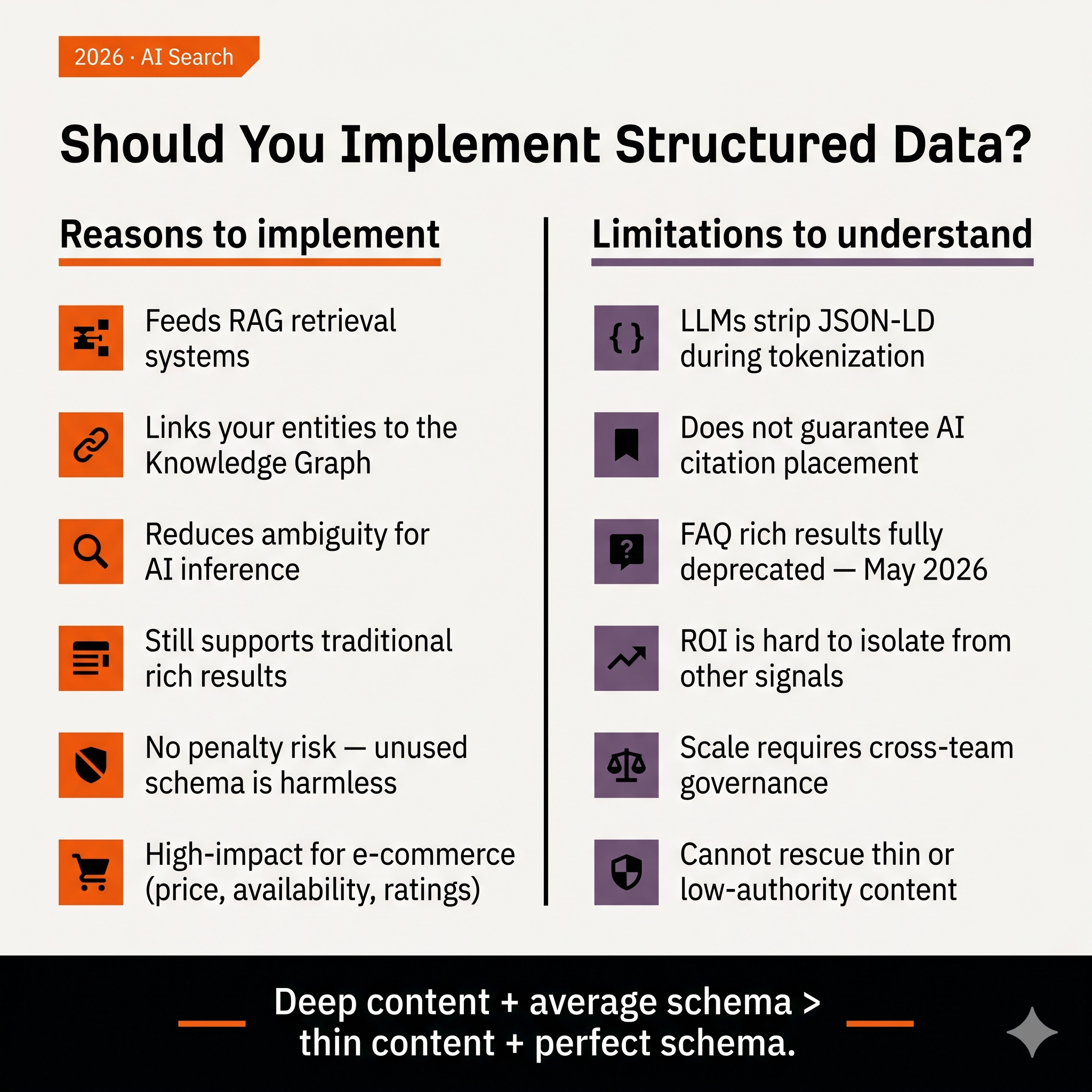
Google and Microsoft have confirmed that structured data helps ground AI outputs – not because LLMs read the raw markup (they don’t), but because schema builds a content knowledge graph that feeds retrieval-augmented generation (RAG) systems.
The value of structured data for AI visibility is real – but the vector is context enrichment, not direct tag parsing.
FALSE: No single technical signal dictates AI placement.
Schema is only one among many, with content quality, E-E-A-T, topical authority, and entity clarity all meaningfully contributing to selectability criteria. What schema actually does is help LLMs understand the brand’s entity and content relationships better and faster.
In other words, schema can reduce ambiguity and strengthen attribution – but only when used to complement authoritative content, not instead of it. Therefore, hyperfocusing on structured data in hopes of “reserving a spot in AI summaries” often leads to misplaced technical effort.
Deep content + average schema > thin content + great schema.
FALSE – unless it’s prioritized over content quality.
This point may seem in direct contradiction to the previous, but it’s not. The thing is that AI search spans different models, each with its own architecture. What one LLM ignores, the other system may rely on heavily.
The real truth is that evidence is genuinely mixed. Some studies show that schema dramatically increases presence in citations, while others show that there are no meaningful changes whatsoever.
Therefore, the only way to gauge the value of adding schema is to weigh its compound effect: supporting rich results, feeding entity graphs, aiding RAG retrieval, and increasing factual accuracy across platforms. That’s not negligible by any norm.
At best, implementing schema aids discoverability. At worst, it’s neutral.
FALSE: Google deprecated one specific surface – FAQ rich results in SERPs.
On May 7, 2026, Google updated its Search Central structured data documentation, officially ending support for FAQ rich results in Google Search. However, FAQPage markup remains a valid Schema.org type.
Google itself noted that “whether the FAQ schema aids AI search is separate from Google’s support for rich results,” as well as that they will continue to use the FAQ schema to better understand pages.Therefore, the deprecation of FAQ rich results does not indicate a rejection of structured data as a machine-readable signal – but it does position schema as RAG grounding and entity resolution mechanics.
Schema’s future is to help AIs cite the right source – and do so swiftly, accurately, and unambiguously.
FALSE: This is a gross overcorrection.
As stated in the previous point, content quality is king – but structured data is the translation layer that makes said quality content legible to machines. Therefore, dismissing schema means dismissing how AIOs, Bing AI, and RAG pipelines actually consume web data.
The thing is, Google’s Knowledge Graph was estimated to encompass approximately 54 billion entities and a staggering 1.6 trillion facts – and that was in late 2023 / early 2024. AI systems use that network to verify entities and facts – and schema markup is how content connects to that network.
Ignoring schema markups effectively means forfeiting a significant infrastructural advantage.
Yes – but not as a standalone “AI visibility hack.” Schema should be a part of a broader content knowledge graph strategy, and implemented as such: prioritizing entity definition, relationship markup, and coverage at scale.
However, it’s also crucial to set the expectations straight: robust structural data does not secure you a spot in AI citations and is most definitely not a replacement for high-quality, authoritative content. What it is, however, is an excellent way to signal to AIs that your content is ready for them to use, with minimal effort.
Tina Clarke is the AI SEO Manager at ZeroClick Labs, specializing in AI search optimization and Generative Engine Optimization (GEO). With a strong foundation in content strategy, technical SEO, and operations, she leverages her expertise to help brands shift from traditional rankings to discoverability and excel in AI-driven ecosystems.
A comprehensive knowledge graphs strategy will.
The brands winning AI citations are those who use schema intentionally – not bolting them on as afterthoughts.
ZeroClick Labs offers full-service AI website optimization, from AIO SEO to newly-released ChatGPT ads, making your content legible, citable, and authoritative for every major LLM out there.
“Our agency had no idea how to approach AI visibility. ZeroClick only does this one thing so they actually know what works. Worth every penny just to not waste time figuring it out ourselves.” – Jay