AI Search Content Report 2026: Which Types of Content AI Engines Cite the Most
Key takeaways:
-
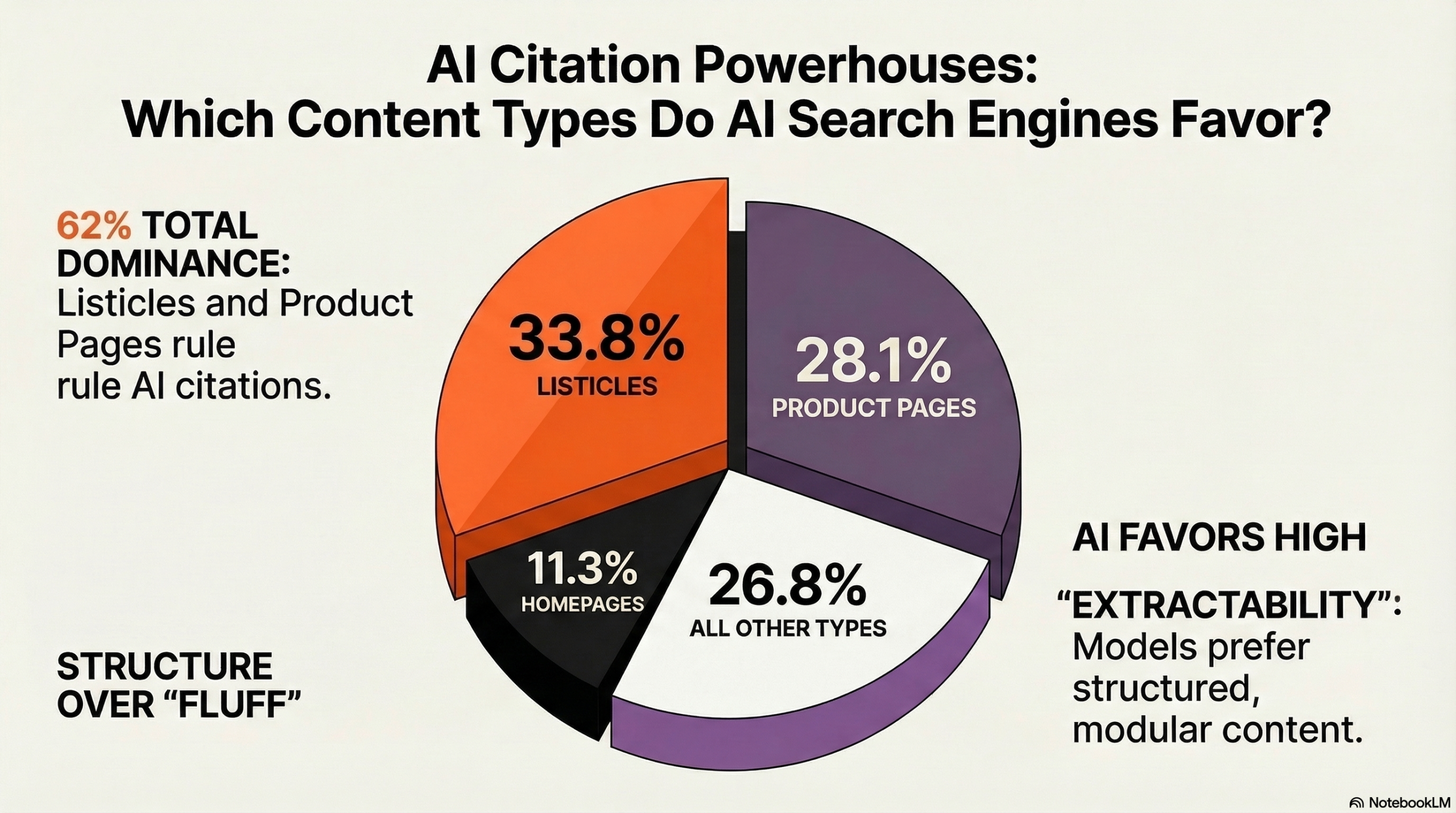
Listicles (33.8%) & product/service pages (28%) account for ~61.8% of the content types most frequently cited by AI in this dataset.
-
The majority of the cited URLs across platforms come from 1st party sources and are self-promotional in nature.
-
ChatGPT is product-page dominant (41.6%), AIO is listicles-dominant (46.3%), and Perplexity shows a balanced listicle/product page distribution (26.89%/26.87%).
-
AI Overviews cite the most unique URLs (2,226) but generate fewer total citations (8.3K), implying broader-but-shallower visible citation coverage.
-
ChatGPT has the highest total citation count (15.9K) but the lowest URL count (1,390), implying heavy reliance on a smaller volume of higher-trust sources.
-
Reddit and YouTube, while popular, show lower citation rates than expected, especially in ChatGPT responses.
Executive Summary: ZeroClick Labs conducted a study of ~3.3K URLs and ~38.5K citations over a 30-day window, spanning three industries (SaaS, digital marketing, and home services) across three dominant AI platforms in B2B procurement processes (ChatGPT, AI Overviews, and Perplexity). Listicles (33.8%) and product pages (28%) consistently dominate citation share, with homepages (11.3%) a distant but substantial third. Source selection behavior differs dramatically by platform, with ChatGPT leaning heavily toward product pages, AIO toward listicles, and Perplexity toward a balanced, source-agnostic distribution. Winning AI visibility requires developing intentional AI SEO strategies and content portfolios built for AI citations.
Ever-increasing reliance on AI engines is shifting the discovery paradigm toward a whole new layer of visibility – one where rankings are slowly being replaced by citations. Although platforms like ChatGPT, Perplexity, and AI Overviews (AIO) still depend on traditional signals when surfacing content, very soon that might no longer be the case. For these reasons, understanding what gets cited – and why – is no longer optional. It’s the core of AI-driven SEO and content strategies aimed at securing visibility in zero-click environments.
Methodology:
The objective of the study was to discern what content types most frequently appear as cited sources in AI-generated answers and, consequently, how content strategies should be adapted to reflect the AI systems’ content selection, prioritization, and reuse mechanics.
Study Scope:
- Time window: 30 days
- Total URLs analyzed/cited: ~3.3K
- Total citations observed: ~38.5K
- Platforms: ChatGPT, Perplexity, Google AI Overviews (AIO)
- Industries: SaaS, digital marketing, home services
Metrics (definitions):
- URL count / Type count: Total number of unique URLs that appeared as cited sources in the dataset within the 30-day window.
- Used total: Number of responses where a URL was used as a source (counted once per response).
- Citations: Total number of explicit URL citations shown in AI responses.
- NOTE: “Citations” are not the same as “Influence” or “Rank.” They reflect what was visibly referenced in responses in this dataset and timeframe.
- Avg. citations: Median count of times the URL was explicitly cited when used (calculated as: total citations for a URL divided by the number of responses where the URL was used as a source).
Content-type taxonomy
| Content Type | Taxonomy |
|---|---|
| Homepage | The main entry page of a website |
| Category Page | A page that lists products, articles, or subcategories |
| Product Page | A page detailing a single product or service |
| Listicle | An article structured as a list (e.g., “Top 10 Laptops of 2024”) |
| Comparison | An article or page that directly compares two or more products or services |
| Profile | A directory-style entry for a company, person, or product (e.g. G2, Yelp, Crunchbase) |
| Alternative | An article focused on alternatives to a specific product or service (e.g., “Best HubSpot Alternatives”) |
| Discussion | Content from discussion forums, comment sections, or community threads |
| How To Guide | Instructional content with step-by-step guidance on completing a specific task |
| Article | General articles, news pieces, features, and other editorial content |
| Video | Video content |
| Press Release | Press release style content |
| Other | Any page type that does not fit into the categories above |
| Unknown | Page unavailable |
Table 1: Content-type taxonomy
Study limitations
- Arbitrary content type division: Some of the content type categories may be too general (e.g., different types of product pages can be categorized into location, service, and umbrella service pages, among others).
- The study focused on prompts with commercial and transactional intent: The study doesn’t analyze content types cited for informational intent prompts.
- Prompt counts varied by industry (5–23): Raw citation totals by industry should be treated as directional rather than definitive.
- Heuristic content-type classification: The taxonomy includes an “Other” bucket and an “Unknown/Unavailable” bucket; some pages may be borderline.
- Rounded topline metrics (e.g., 38.5K citations, 3.3K URLs): Mean derived per-URL averages are approximate.
- Platform interfaces differ: AI systems may reuse and synthesize sources without always explicitly citing them, effectively decoupling “source usage” from “citation visibility”.
What content types appear most frequently in AI search citations?
| Content Type | Used Total (% Share) |
|---|---|
| Listicle | 33.84% |
| Product Page | 28.08% |
| Homepage | 11.27% |
| Discussion | 7.93% |
| Category Page | 6.69% |
| Video | 3.30% |
| Profile | 2.93% |
| Article | 2.08% |
| Comparison | 1.39% |
| How-To Guide | 1.20% |
| Unknown | 0.91% |
| Alternative | 0.15% |
| Other | 0.14% |
Table 2: Content-type distribution in AI search
Across our dataset, listicles (33.8%) and product pages (28.0%) emerged as preferred sources for AI answers, accounting for ~61.8% of all cited content. Homepages were also frequently cited (11.3%), but at lower rates than the most dominant content types.
Based on our data, a large majority of AI citations for commercial intent prompts are self-promotional and come from 1st party sources instead of 3rd party review and directory websites.
This is the case for listicles as well: the top-cited listicle content in our dataset consists of 1st-party self-promotional articles, with brands placing themselves at the top of their respective lists.
Other notable types include category pages (6.7%) and profile pages (2.9%). In this dataset, category pages mainly refer to company lists on directory websites, while profile pages include social media profiles and individual company listings on various websites, including directory and review websites.
In spite of relatively low total percentages, these content types remain relevant to AI search visibility, since a small number of authoritative domains, such as Wikipedia and G2, may hold a lot of weight for certain industries and prompt types.
Finally, the substantial presence of discussion (7.9%) and video (3.3%) content is mostly model-driven (Perplexity and AIO, respectively), so it should be considered directional for the purposes of model-specific AI SEO.
Surprisingly, Reddit and YouTube show relatively low citation rates in ChatGPT, but are used more frequently in Perplexity and AI Overviews, respectively.
Why are listicles, product pages, and homepages cited frequently in AI responses?
The dominance of the top 3 page types is likely a combination of three factors:
- Traditional ranking power;
- Alignment with the AI selectability criteria;
- Closed-loop decision-making system (combined).
1. Traditional ranking power
Historically, all three page types fared well in traditional SERP rankings, and they manage to translate that power to the zero-click environment.
Listicles
Once a go-to format in early SEO, listicles earned their reputation by capturing long-tail keywords in headings and delivering the scannable, high-engagement content that pre-Panda search engines rewarded. Over time, however, rampant overuse and low-quality execution led to their association with clickbait and thin content, a reputation further cemented by Google’s algorithmic crackdowns throughout the 2010s.
With the rise of AI-powered search, listicles have regained some ground: their structured, clearly delineated format makes them particularly easy for AI systems to parse, cite, and surface in generated responses.
However, as of early 2026, listicles are under scrutiny again, mainly due to their overuse. Google may be cracking down on listicles, with some SEOs predicting manual penalizations for self-aggrandizing and self-promotional content (e.g., pages that rank their own products as “#1” or “best” among competitors, without objective evidence).
Many AI SEO experts are also opposed to the idea of using this content format, consequently causing many agencies to look for ways to reduce or altogether eliminate using listicles in their strategies.
And although recent industry research shows that their AI-selectability power is dropping, for now, self-promotional listicles still rank well, both in traditional and AI searches – if they provide genuine value.
However, the near future may see this content format losing its staying power and possibly even being considered low-quality content for purposes of AI citation.
Product pages
Product and service pages have long been the backbone of traditional SEO. As the content type most directly tied to transactional intent, they consistently drive the highest-value organic traffic and conversions, making them the best-performing asset in most strategies despite their competitive landscape. Their authority, depth, and commercial relevance have always made them a priority for both search engines and users.
That strength carries over seamlessly into AI Search. With the shift from blue-link to zero-click discovery, product and service pages have emerged as citation powerhouses, nearly rivaling listicles in selectability. Furthermore, independent external research suggests that this page type is the single most-cited content type across every stage of the buyer journey.
The reason for this shift stems primarily from the fundamental difference between human and AI-driven search. AIs don’t care about flowery language or marketing fluff; they care about cold, hard data – and product pages offer exactly that, making them one of the “cleanest” zero-click assets (provided they are well-structured, specific, and easy to parse).
Homepages
Homepages are among the strongest ranking assets within a domain, frequently outperforming deeper pages thanks to their concentrated link equity, low crawl depth, and broad topical authority. Combined with their significance in capturing branded queries, homepages are a foundational element of any SEO strategy, both for visibility and authority anchoring.
That same authority makes them a prime choice for AI citations. LLMs prioritize clear attribution and trust signals when selecting sources to cite, and a well-structured homepage provides both: clearly defined, consistent entities and strong domain authority.
So, unlike listicles (which focus on breadth) and product pages (which focus on specificity), homepages excel in establishing credibility, helping AI models associate concrete information with a recognized, unambiguous source.
2. Alignment with AI-selectibility criteria
From the above, we can already extrapolate what makes a page “appealing” to popular AI models. However, the full picture becomes clear once we understand the criteria for AI selectability:
- Extractability: The degree to which a model can pull usable information from the page.
- The less additional interpretation required, the higher the extractability
- Structural clarity: The degree to which the page content is logically organized (e.g., headings, lists, schemas).
- The more structured the content, the easier it is for AI to parse the relationships between ideas.
- Entity clarity: The degree of precision with which key entities (brands, products, people) and their associations are defined.
- The lower the ambiguity, the stronger the attribution and perceived authority.
- Coverage efficiency: The degree of effectiveness with which the page delivers complete, relevant information on a topic.
- The lower the fluff/gaps, the higher the utility and authority.
The top 3 formats meet all four criteria – while others may fail to do so on one or more points, explaining why they are not nearly as prevalent in our dataset.
Table 3: Selectability gaps by content format
| Content Format | Weak Selectability Criteria | Why |
| Discussion | Extractability, Structural clarity, Coverage efficiency | Unstructured, multi-voice content w/ inconsistent quality; |
| Category Page | Coverage efficiency, Extractability | Surface-level data; high item / low usable information volume; |
| Video | Extractability, Structural clarity | Requires platform multimodality; lacks consistent, parseable structure unless transcribed; |
| Profile | Coverage efficiency | Single-entity focused; |
| Article | Coverage efficiency (standalone/single article) | Fluff or digressions reduce efficiency, even w/ strong structure; |
| Comparison | Entity clarity (if inconsistent), Coverage efficiency | Mixed criteria or biased framing can blur distinctions and leave gaps in coverage. |
| How-To Guide | Coverage efficiency (if step gaps), Extractability (if unstructured) | Missing steps reduce completeness; poor formatting makes instructions harder to extract; |
The deeper pattern: Cognitive load reduction
A deeper reason why listicles, product pages, and homepages are the “winning” formats is that they all share the same core trait: They reduce AI models’ cognitive load – i.e., the resource requirement to extract, process, and reuse information.
All three observed models (ChatGPT, Perplexity, and AIO) share the same bottlenecks: limited token counts, need for fast synthesis, and risk of hallucinations. As such, they naturally gravitate towards the content that is:
- Structured – Clearly defined lists, sections, H-hierarchies;
- Modular – Information broken down into reusable chunks;
- Explicit – no ambiguity or excessive interpretation required.
The problem: Constraints are structural and consistent across all systems – but so is the need for efficiency and accuracy in answers. For these reasons, AI models tend to converge on the same, lowest-effort solution – content that is already well-organized, clearly defined, rooted in facts, and most importantly, immediately usable.
3. Closed-loop decision-making system
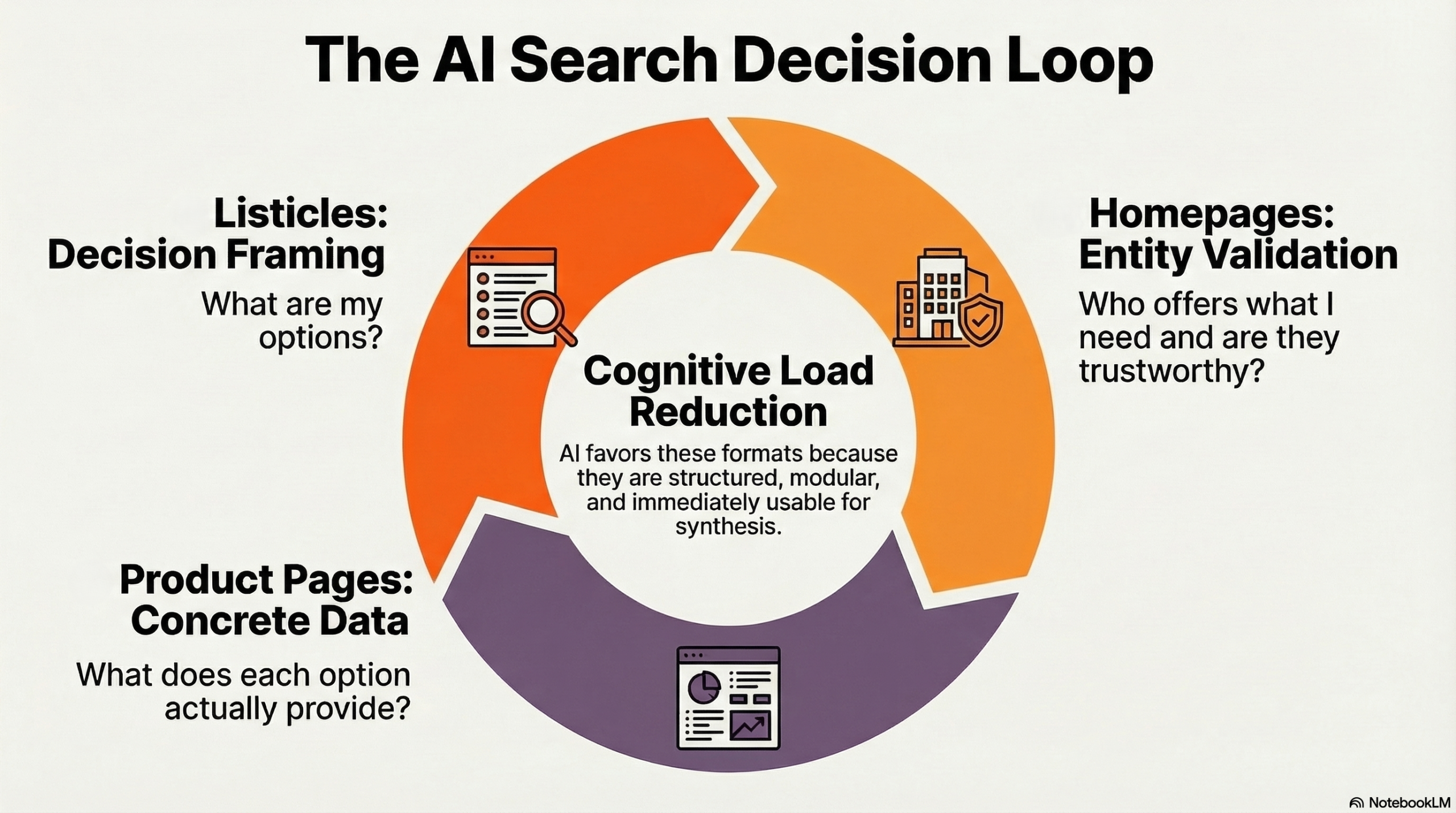
Finally, the three dominant page types have another major thing going for them: together, they form a complete decision-making system – a low-effort (for both AI and user) closed-loop that guides the user from intent to decision to solution:
What are the top content types cited per AI platform?
Our data showed that the three dominant page archetypes overall – listicles, product pages, and homepages – are also the most commonly cited for each of the observed models – ChatGPT, Perplexity, and AI Overviews. However, the degree to which they are cited varies across all platforms:
- ChatGPT:
- Product page (41.6%)
- Listicle (26%)
- Homepage (9.9%).
- Perplexity:
- Product Page (26.89%)
- Listicle (26.87%)
- Homepage (15.3%)
- AIO:
- Listicle (46.3%)
- Product page (22.9%)
- Homepage (6.4%)
An even clearer image emerges once we observe the next most prevalent content types (i.e., those in 4th place):
- ChatGPT: Profile pages (6.28%), mainly Wikipedia and directory listings.
- Perplexity: Discussions (13.17%), mainly Reddit.
- AIO: Video (6.05%), mainly YouTube.
Combined, these results showcase notably different citation behaviors and selectability criteria across all three models, leading to actionable insights:
- ChatGPT → focus on well written product pages and high-level citations on authoritative 3rd party websites.
- Perplexity → focus on well written product pages and listicles, as well as community engagement strategies.
- AI Overviews → supplement your on-site content strategies with high quality video content;
The key takeaway here is that a well rounded AI search optimization strategy necessitates a multi-channel approach: a diversified content portfolio, engineered around each platform’s citation behavior rather than a single model.
What are the top content types by industry?
Across observed industries (SaaS, Digital Marketing, Home Services), citation patterns appear reflective of intent structure. Still, they should be interpreted as directional, not causal, since we’re observing outputs (citations) rather than the decision process behind them.
In SaaS and Digital Marketing, listicles dominate the top of the citation ladder, immediately followed by product pages. This distribution indicates that comparison-heavy, structured content aligns well with research-driven queries that aim to frame options before shortlisting solutions.
In contrast, Home Services skew heavily toward product pages and homepages, suggesting more transactional and entity-validating intent, where users are looking for a solution/provider rather than exploring or comparing options.
Interestingly, discussion content (forums, Reddit threads) appears across all three industries, but remains marginal in Digital Marketing (3.93%) and Home Services (2.95%). In SaaS, however, the presence is substantial (13.41%), suggesting that experience-based peer opinion can be a strong trust signal for AI selectability.
Another interesting finding is that SaaS content is by far the most cited. The top-performing URL overall is a SaaS listicle (cited 904 times across responses), compared to just 166 responses for the top URL (homepage) in the Home Services niche.
Relative query volume aside, this pattern also showcases how a well-structured, AI-aligned page can become a reusable AI-visibility asset – surfaced repeatedly, rather than being replaced by competing sources.
What to publish next to increase chances of being selected for AI citations?
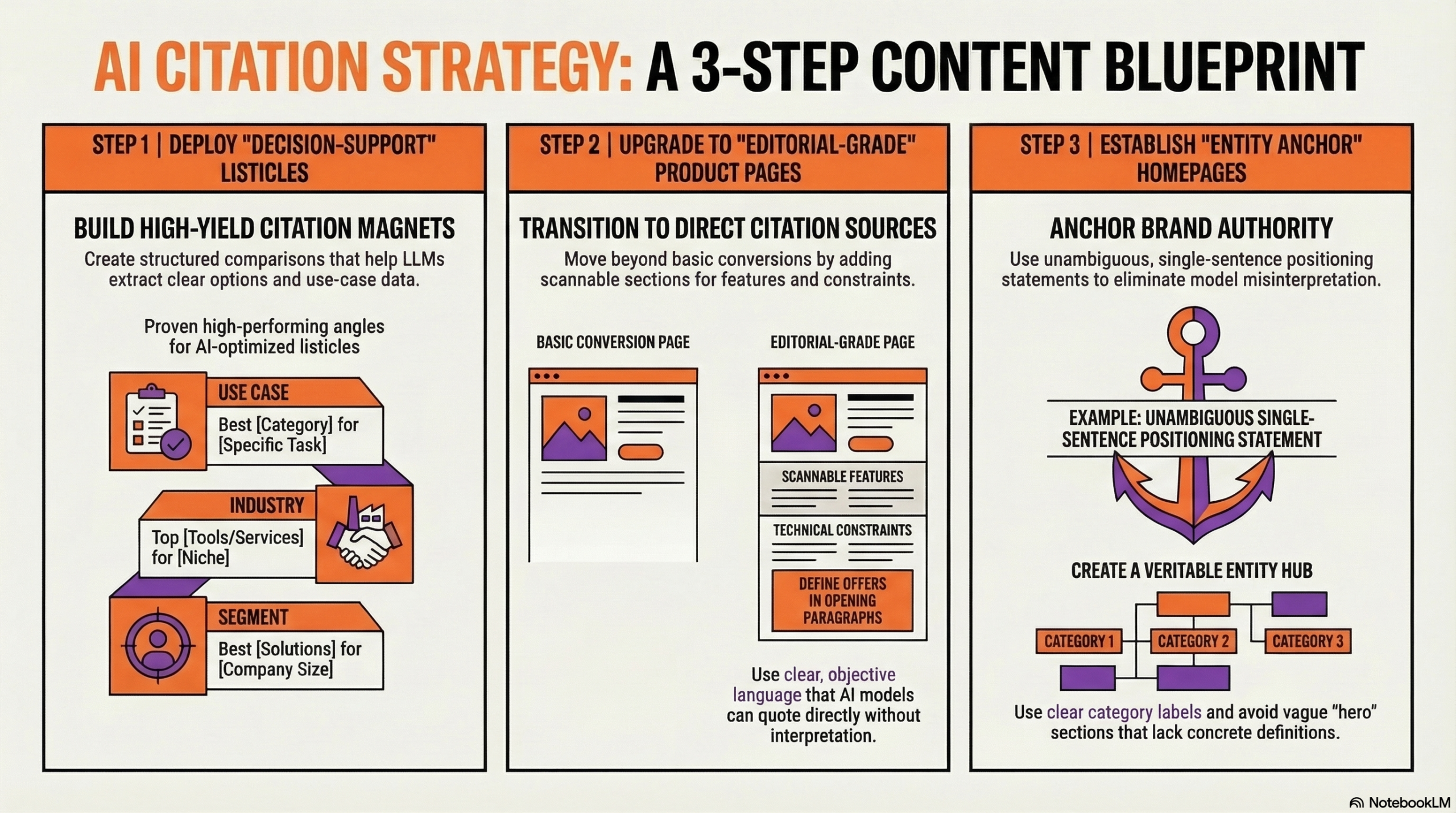
The logical next step is building an intentional content portfolio for AI citations – starting with the three page archetypes that consistently dominate: listicles, product pages, and homepages. For most websites, this would entail a combination of creating new and restructuring existing content.
Listicles: The citation magnets
Although some experts oppose listicles as a long-term strategy, there’s no denying their effectiveness – especially if they’re built as decision-supporting assets, rather than a foundation for AI selectability. When designed as well-structured comparisons that help both readers and LLMs extract clear, useful information within seconds, listicles can become high-yield short-to-mid-term citation magnets. Some examples of high-performing angles include:
- “Best [category] for [use case]”
- “Top [tools/services] for [industry]”
- “Best [solutions] for [budget/company size]”
Product pages: Editorial-grade sources
A 2025 research by SEJ showed that product-centric content tops AI citations – yet product pages remain basic conversion hubs, thereby losing their selectability potential. However, if they function as editorial-grade source pages, product pages can become prime citation targets. This can be achieved using a combination of the following methods:
- Defining the offering clearly in the opening paragraph;
- Specifying who it’s for, what problems it solves, and what it includes/excludes;
- Structuring the content so AI models can quote it directly (adding scannable sections covering features, pricing models, and constraints).
Homepages: Entity anchors
As noted previously, homepages are highly effective as entity anchors – providing clarity on brand, products, and services in a way that leaves no room for misinterpretation or requires extra interpretation. Therefore, the strategic move is to make the homepage a veritable entity hub by:
- Including an unambiguous, single-sentence positioning statement;
- Ensuring clear category/service labels;
- Avoid hero sections that offer no concrete definitions.
Your content… exists. Does AI know that?
If your content isn’t structured for how AI models select, surface, and reuse sources, you’re not a citation target. You are noise.
Perplexity, AI Overviews, and ChatGPT are no longer mere search enhancers. They are rapidly becoming decision-driving engines – and they decide who gets cited and who gets ignored.
If your content isn’t built for that, your competitors’ is.
The gap is widening by the day – ZeroClick Labs is here to help you close it.
“Our agency had no idea how to approach AI visibility. ZeroClick only does this one thing so they actually know what works. Worth every penny just to not waste time figuring it out ourselves.” – Jay