Google is Rewriting Your Brand Using AI – And it’s Doing it on the Sly
Key Takeaways:
-
In March 2026, Google started replacing headlines in Search results with AI-generated headlines without notice, disclaimer, or opt-out option.
-
The same thing happened in January 2026 with Google Discover, where AI headline rewrites went from “small experiment” to a permanent feature in less than a month.
-
In January 2026, Google patented a system capable of AI-rewriting entire pages in real time, designated “AI-generated Content Page Tailored to a Specific User”.
-
AI Overviews, AI-headline rewrites, the landing page patent, and UCP all point toward Google building an infrastructure that effectively eliminates buyer-vendor interaction from the user journey.
-
The best counter-strategy is building pages that are responsive, well-structured, authoritative, genuinely useful, topically deep, and entity-anchored.
Executive Summary: Google started rewriting headlines in search results, replacing them with AI-generated article titles. The Verge was among the first to publicly document their content being altered without consent, disclosure, or an opt-out option. A newly granted Google patent takes things further still, describing a system capable of replacing entire pages in real time with AI-generated alternatives. Combined with the recently released Universal Commerce Protocol (UCP), everything points toward Google attempting to position itself as the web’s ultimate storefront, at the direct expense of vendors’ brand autonomy. For businesses and their marketers, the strategic response is not to wait for an opt-out mechanism that may never come, but to optimize their digital presence so Google’s AI has no algorithmic reason to alter them.
Looks like Google is at it – again. Yes, we’re talking about the company’s growing practice of replacing organic with AI-generated content. First, it was the headlines in Discover. Now, it’s headlines in Search. Tomorrow, it will be entire pages.
Is this an attempt to push brands and marketers to optimize for AI Overviews, so the quality of pages aligns with Google’s standards? Or is the company that already owns where 90% of all searches begin making a quiet move to “own” the entire buyer journey?
What’s happening to headlines in Google Search?
Apparently, Google is replacing original headlines in search results with AI-generated ones. Not trimming, not summarizing, not condensing them – replacing them completely, without notice, label, disclaimer, or the ability to opt out.
Somewhere around mid-March 2026, the editorial team at The Verge noticed something rather disconcerting: Their meticulously crafted article titles were appearing in Google search results – only, they weren’t their titles. The new headlines were obviously AI-generated – and completely missing the point of the article.
The examples of this practice are depicted in the screenshot below, where Google changed The Verge titles from “I used the ‘cheat on everything’ AI tool and it didn’t help me cheat on anything” to “”Cheat on Everything” AI Tool” and “Microsoft is rebranding Copilot in the most Microsoft way possible” to “Copilot Changes: Marketing Teams at it Again”.
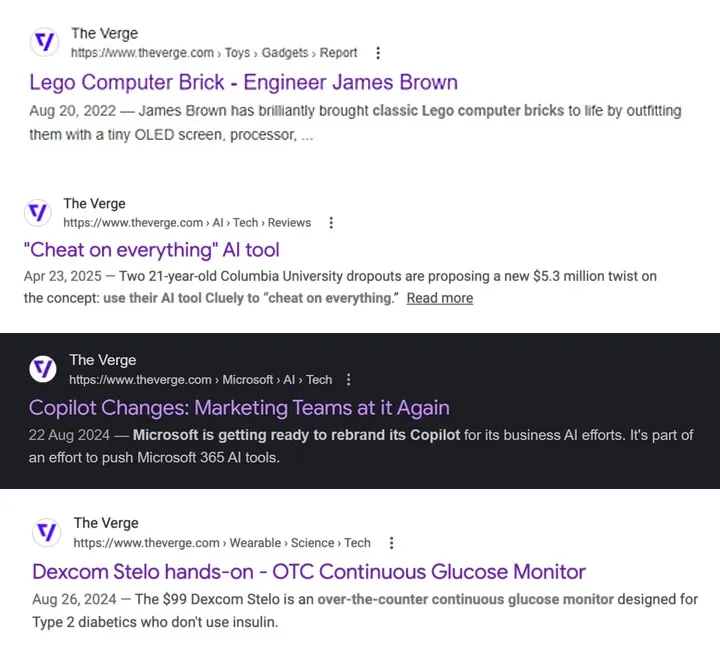
Outraged at this blatant disregard of their journalistic efforts, The Verge team reached out to Google’s spokespeople, who confirmed that their AI is “tweaking” how websites are showing in SERPs, calling it a “small and narrow experiment, one that’s not yet approved for a fuller launch”. And, if this sounds familiar – that’s because this is not the first time Google pulled off something like this.
We’ve seen this mov(i)e before
In December 2025, Google launched an AI headline rewriter in Discover – and used near-identical language to describe it (ironically, for The Verge): a “small UI experiment for a subset of Discover users.” The twist? Less than a month later, the experiment was reclassified as a “feature”, as it “performs well for user satisfaction” per Google’s own words.
Evidently, the same is now happening in traditional search results – which wouldn’t be that much of a problem if AI rewrite actually pulled from the content that was already on the page. However, that is NOT the case; it is generating something completely different and, more often than not, misleading – and presenting it as a natural part of or the actual website.
Needless to say, for brands, publishers, and businesses, this is a major cause for concern since, as SEO Director at ESPN, Louisa Frahm put it, “a headline is the most prominent element for attracting readers in timely windows, to provide a targeted synopsis that elevates your brand voice. If that vision gets altered and facts are misrepresented, long-term audience trust will be compromised.”
The patent nobody talks about (enough)
If you think the AI headline rewrites are alarming, just consider what may come next. On January 27, 2026, Google was granted a patent (US12536233B) titled “AI-generated Content Page Tailored to a Specific User,” which takes the entire concept miles further.
The mechanic behind the madness
Here’s how the patented system works: a user searches for something (e.g., a product/service that you happen to provide), Google generates a standard search result, and the user clicks through to your landing page. Except, they don’t.
What actually happens is: Google’s AI model evaluates the landing page in real time, assigns it a performance score, and if said score falls below a certain threshold (set by Google, of course) – the system generates a completely new page, based on what the AI model thinks will perform better for a specific visitor.
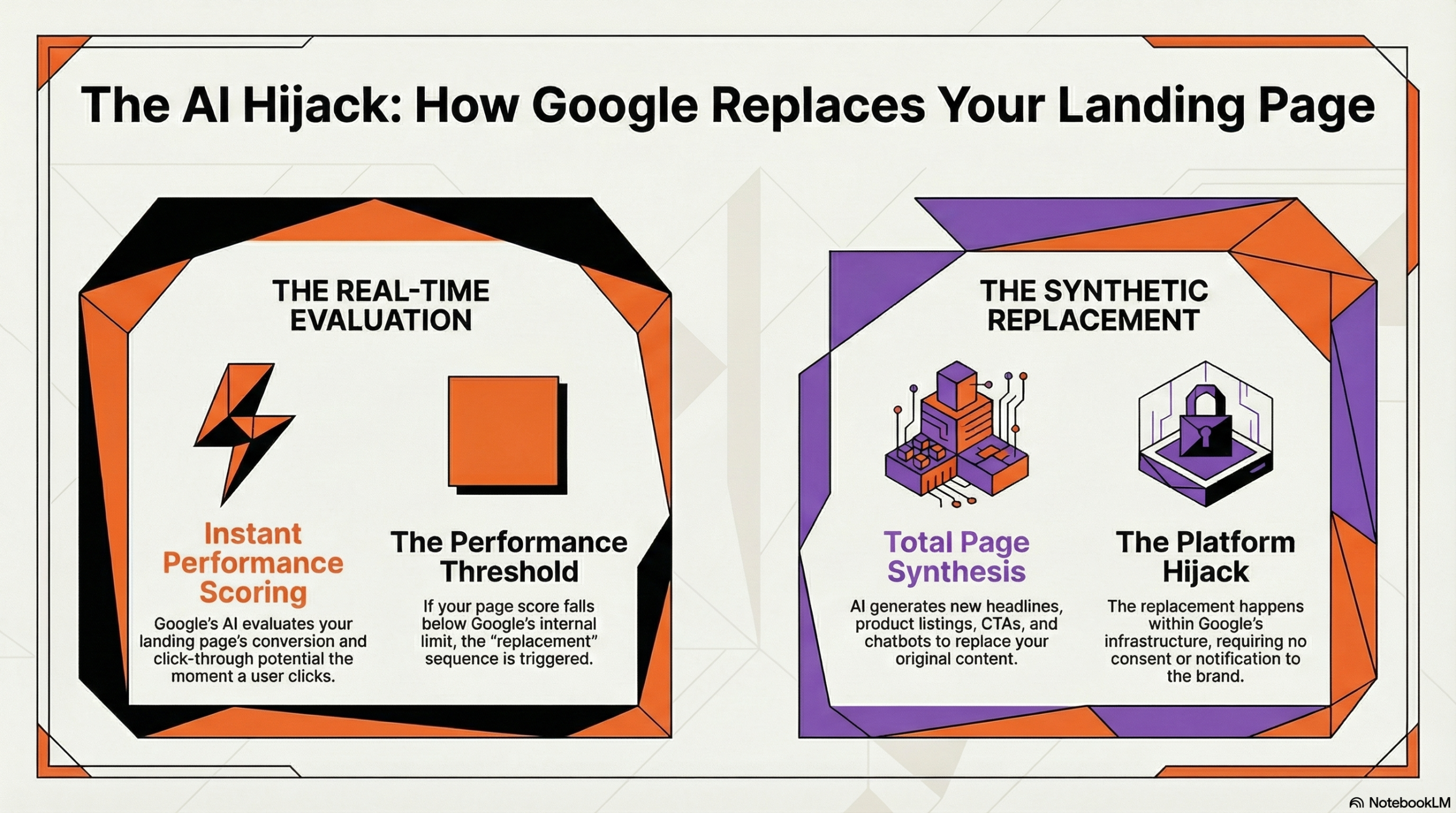
Mind you, it’s not just about headlines or website copy; the system is also imagined to generate product listings, CTAs, and even chatbots. This goes beyond Google merely penalizing a poorly performing page – it’s about AI deciding your page is not good enough, and effectively “hijacking” it.
The worst thing? Google doesn’t “owe” you a notice or require your consent because, technically, they are not altering your website – everything happens within their platform. As if that’s not bad enough, there’s also no mention of an opt-out mechanism, at least as of now – and that’s still not all.
The bigger picture
The aforementioned patent and headline replacer do not exist in a vacuum – they are but two pieces of a grander puzzle. In January 2026, Google released its Universal Commerce Protocol (UCP), streamlining agentic commerce – and enabling start-to-finish purchases directly from AI Mode and the Gemini app.
With that in mind, finally, the full image emerges: Google is building the infrastructure that will effectively enable them to “own” the entire buyer journey – from query to checkout. A closed-loop environment, so intuitive and convenient, that customers will have no reason to visit your website, let alone meaningfully engage with its contents.
How to counter Google’s AI-replacement algorithm?
Ironically, Google provided a solution to the problem it itself is creating, hidden in the landing page patent: the system will only replace pages it considers “weak” – i.e., those that score below the threshold. If the page performs well, then AI has no algorithmic justification to alter it. Therefore, the most direct countermeasure is also the most straightforward – optimize the page so Google has no reason to improve it:
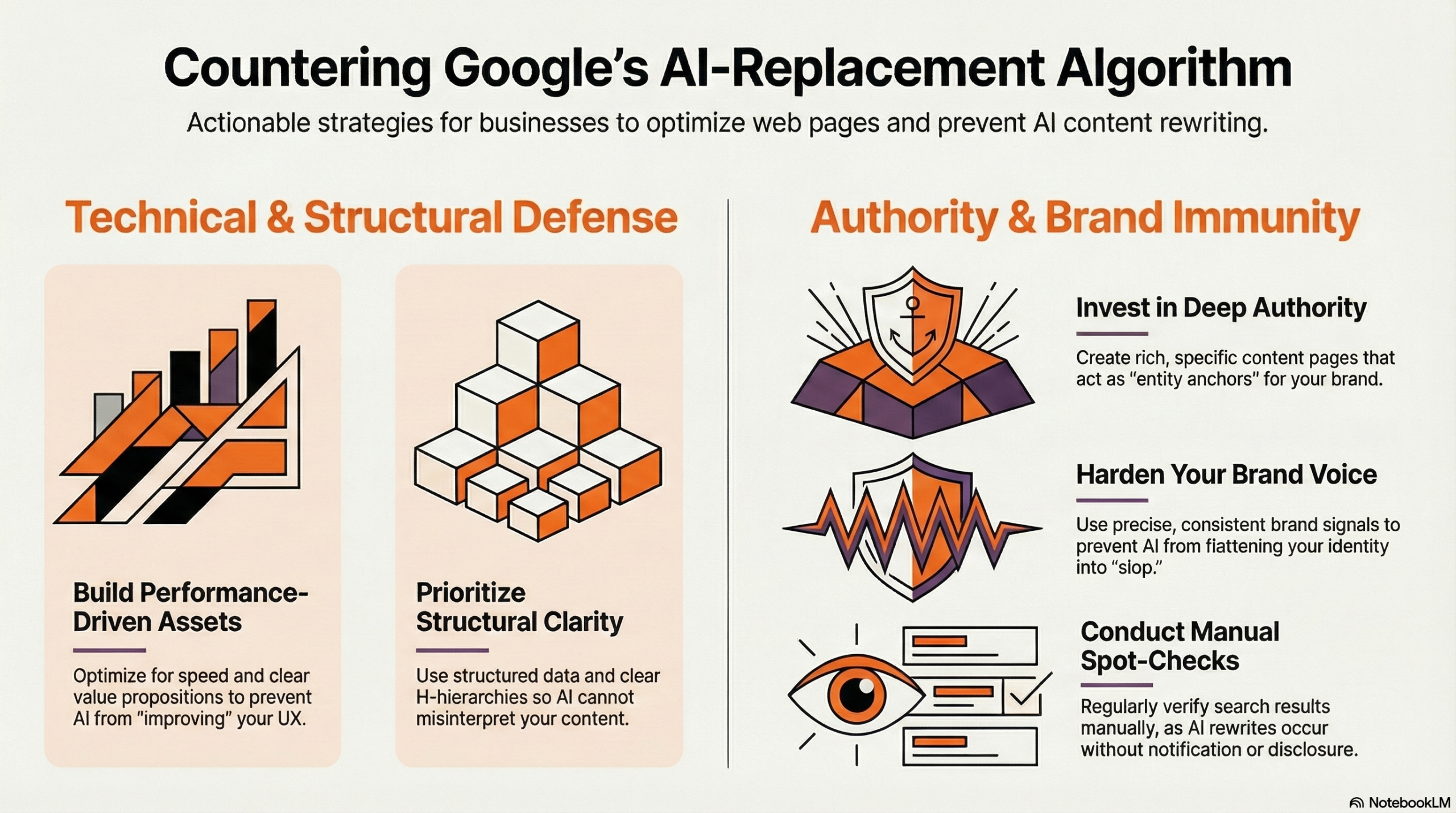
- Transform your page into a performance asset: Google’s patented system grades on bounce, conversion, and click-through rate. A page that loads fast on both mobile and desktop, communicates a single value proposition clearly, and makes the next step obvious for the user makes it difficult for AI algorithms to second-guess.
- If AI’s going to read your page, make it impossible to read it wrong: Google’s AI prioritizes content that is easy to extract and synthesize. Structured data (e.g., FAQ, HowTo, Product Schemas), clear H-hierarchies, precise product descriptions, genuinely informative FAQs, and liftable content blocks go a long way toward achieving that goal.
- Prioritize depth over breadth: Thin, generic copy is a liability, whereas authority builds immunity. Invest heavily in creating rich, specific, in-depth content pages that will act as entity anchors (e.g., About Us, case studies, founder story, Why Us, etc.).
- Treat your digital presence as a body of evidence: The more clearly your content signals who you are, the harder it is for AI to flatten that into something generic. Ensure your brand tone, values, and differentiators are as precise and consistent as possible across the entire website.
- Start checking how your pages appear in Google search results: Rewrites carry no disclosure or notification, and it’s uncertain if they ever will. Plus, at the moment, no tool does this automatically, so manual spot-checking is the only way to know if your content is still yours.
This is not the time to panic – it’s time to wake up
Google does what Google wants, and there’s no stopping it.
If the pattern holds – and, with Google, it always does – today’s “experiment” becomes a default feature within months.
Your layout, your design, your content, your offer, your brand identity – all at risk of being replaced with AI slop.
Quietly – without you ever knowing.
ZeroClick Labs is here to ensure that doesn’t happen.
Rely on us to audit, restructure, and optimize your pages to the latest industry standards, making them impervious to Google’s replacement.
“Our agency had no idea how to approach AI visibility. ZeroClick only does this one thing so they actually know what works. Worth every penny just to not waste time figuring it out ourselves.” – Jay