Faceless Advisors: SaaS buyers increasingly trust AI for decision-making
Key takeaways:
-
Generative AI has overtaken traditional search engines as a first-touch point for SaaS vendor discovery and research.
-
94% of SaaS buyers integrate AI into their procurement workflows, primarily for information synthesis, data comparison, and vendor shortlisting.
-
Nearly half of decision-makers trust AI enough to make major purchase decisions based predominantly on generative insights.
-
SaaS buyers are using AI to engineer leverage for sales negotiations, reversing traditional power asymmetry.
-
Vendor discovery is transitioning to zero-click environments, requiring comprehensive AI SEO strategies to maintain AI-alignment and visibility.
Executive Summary (TL;DR): Result of the survey from December 2025, involving 100 high-profile SaaS decision-makers, show that the SaaS buying journey has fundamentally shifted in 2026. Generative AI platforms like ChatGPTare now the starting point for vendor discovery (41%), surpassing analyst reports (29%) and traditional search engines (10%). AI is deeply embedded in procurement workflows, with 94% of respondents using it regularly or occasionally for initial research, data synthesis, and negotiation preparation. Trust in AI-generated insights is at an all-time high, with 48% of respondents willing to make major purchasing decisions with minimal human input. As a result, we’re seeing an information asymmetry flipped in favor of the buyer.
Methodology:
- Sample size: 100
- Respondent profile: Primary B2B SaaS decision-makers.
- Data representation: Percentages directly correspond to respondent counts (n=100 = 100%)
- Variable bases: Some questions reflect lower bases (e.g., n=77 / 77 completes) due to skip logic and eligibility tied to AI usage.
- Methodological note: Findings are based on self-reported responses and should be interpreted as directional sentiment, rather than causal evidence.
Introduction
A survey conducted by ZeroClick Labs revealed that the SaaS buying journey has entered a new era – one defined by distancing from traditional search. AI platforms are now THE primary entry point for vendor research, as well as market data synthesis, risk evaluation, vendor shortlisting, and even negotiation strategy preparation. And while buyers rejoice at a newfound efficiency, confidence, and certainty, vendors are faced with a harsh reality: the discovery is moving to zero-click environments – requiring fundamental restructuring to retain not only visibility, but relevance in an AI-mediated ecosystem.
Where do SaaS buyers start their market research in 2026?
Not on Google, that’s for sure – at least for the majority of our respondents. Our survey showed that the primary research starting point for SaaS buyers shifted toward AI platforms, and drastically so. In fact, 41 out of 100 respondents stated that their very first step in B2B vendor/product lookup is to “consult” with popular generative AIs, such as ChatGPT, Gemini, or Copilot.
As expected, traditional industry analyst reports and rankings (e.g., Forrester, Gartner) remain the second most popular jump-offs with 29/100 votes, followed by peer recommendations in a respectable 3rd place with 11/100 votes. After all, SaaS is an expertise-driven market, so it’s natural for decision-makers to gravitate toward expert opinions.
Finally, once dominant “species” in the ecosystem – Google/Bing searches and customer review sites – have been kicked down to 4th and 5th place, respectively, with only 10/100 and 9/100 of respondents still choosing them as first touchpoints in vendor/product research.
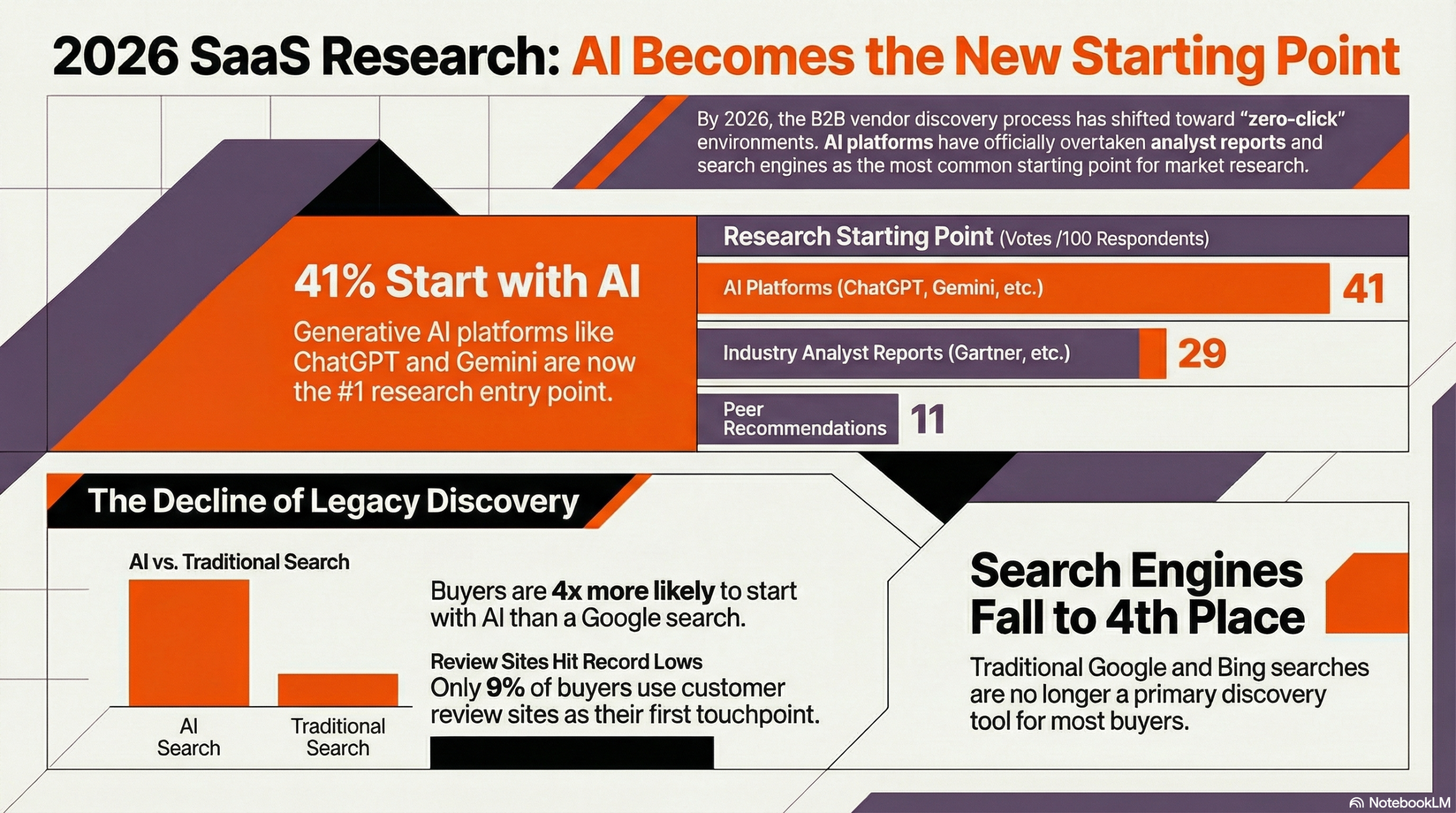
Our findings align with the broader market observations, many of which showcase a dramatic surge in AI-driven discovery, as well as the rising dominance of generative over traditional search engines. Even if this pattern is most notable in the earliest stages of the B2B buyer journey (for now), the implication is clear: vendor discovery is rapidly shifting to zero-click environments.
What are the most common AI use cases in real procurement workflows?
SaaS decision-makers primarily leverage the analytical power of generative AI to accelerate data processing and vendor evaluation during the earliest phases of procurement workflow, including:
- 65 respondents: Summarizing and synthesizing dense information;
- 56 respondents: Features and price comparison across shortlisted vendors;
- 48 respondents: Vendor/solution shortlisting during the early discovery phase;
- 36 respondents: Identifying risks associated with a particular vendor/solution;
- 18 respondents: Internal justification or business case documents drafting;
- 15 respondents: Initial requirements drafting (e.g., RFIs, RFPs, specifications).
This transition toward (semi-) automated synthesis dramatically transforms the earliest stages of the buying process, or rather, compresses them into one seamless, incredibly efficient workflow. What once demanded days upon days of cross-referencing data, reports, analyst opinions, and stakeholder inputs now takes minutes – and typically produces far more structured insights.
The “armed” buyer vs. the “oblivious” vendor
The most important thing to note here is that all of the above steps take place before the first contact with the vendor – and that’s only part of the shift. Our research showed that a significant volume (36%) of SaaS buyers use generative AI to gain leverage during sales negotiations: formulating sharper questions, talking points, or counter-arguments in advance.
What’s more, the adoption rate and practical application of said insights are accelerating. Nearly 80% of respondents said they already use AI to challenge vendors in real-time – and nearly 20% said they can see themselves doing the same in the future. In fact, less than 2% of respondents stated that they wouldn’t use AI information in this way.
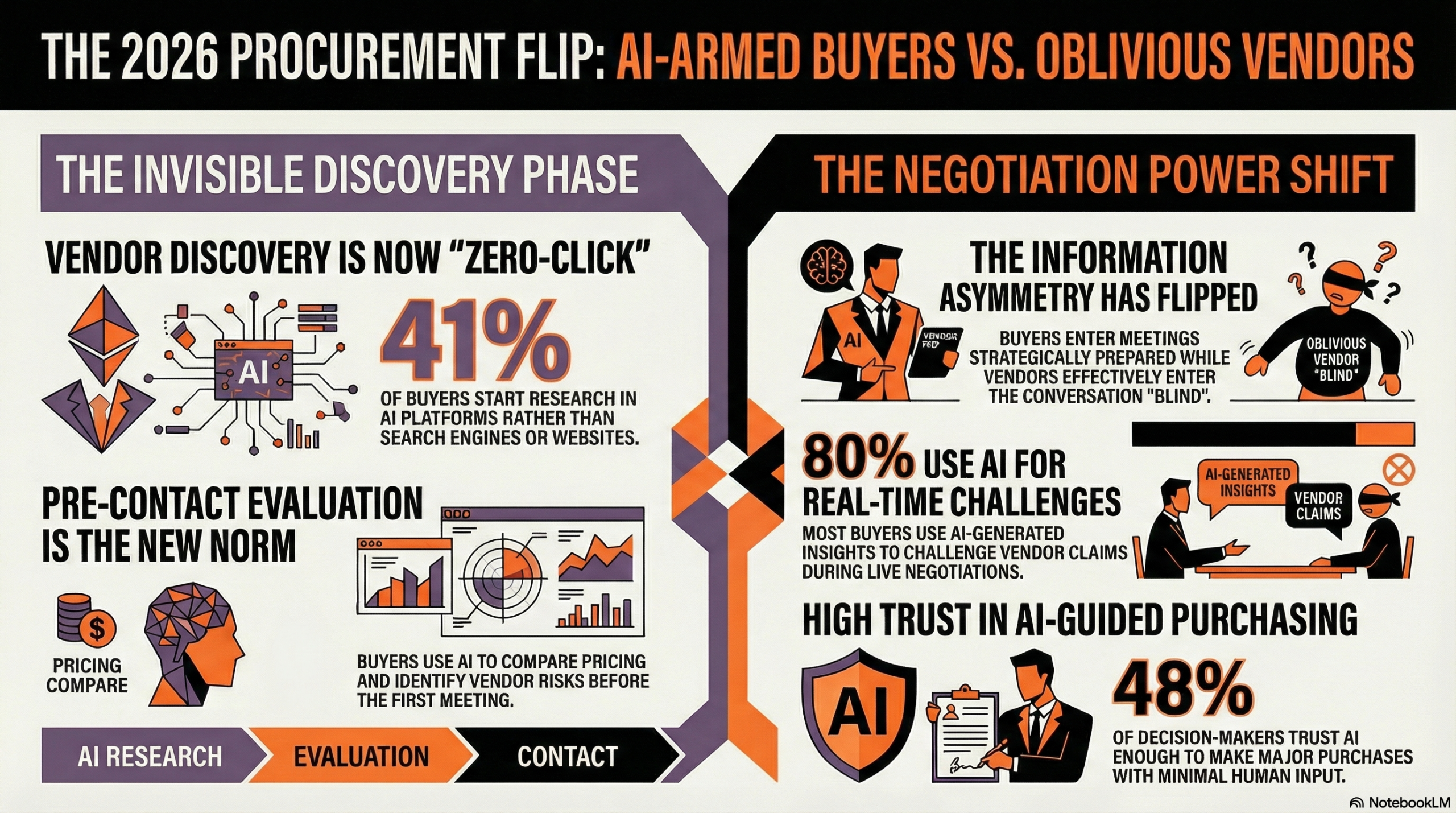
The implication here is structural, rather than merely tactical. By the time the vendor enters the conversation, the buyer is no longer “exploring” – they’re strategically prepared with pre-validated data, risk assessments, and mapped-out negotiation angles, while the seller is essentially going in blind. In other words, the information asymmetry has flipped – and so did the procurement power dynamics.
How often do SaaS buyers use generative AI in the buying process?
Our data indicates that a commanding majority (94%) of SaaS buyers integrate AI tools into their workflows to a substantial extent, with 60% stating they’re using it “regularly” and 34% “occasionally” during the procurement process.
This supports other findings of widespread use of GenAI in the B2B buying journey, as more than 50% of software buyers start their process in ChatGPT or a similar platform.
Furthermore, industry reports show that 25% of B2B buyers prefer GenAI over traditional search engines, with 80% of buyers in tech and software using them as much or more than standard Google/Bing search.
While the high frequency of use can be attributed to increasing institutionalization of AI tools, it also indicates something much bigger: the trust and confidence in synthetic insights is growing – and rapidly so.
How much do SaaS decision-makers trust AI?
The trust in generative AI is high among SaaS buyers, but it still competes with traditional, human expertise. Our survey revealed that the sentiments are divided between “AI-first” and “human-first” mindsets – yet the distribution was surprisingly balanced, with 44% of respondents stating that they find AI-insights as credible as those of human experts.
However, when it comes to “either/or”, the split becomes significantly more extreme, and NOT in favor of traditional sources:
- 38% trusts AI-curated recommendations more than analysts or review site rankings;
- Only 17% trusts established human sources more than generative AIs.
A similar pattern emerges in terms of perceived impartiality and objectivity of AI advice. The majority (49%) of respondents fall into the skeptic category, citing concerns about potential AI bias based on its training or input.
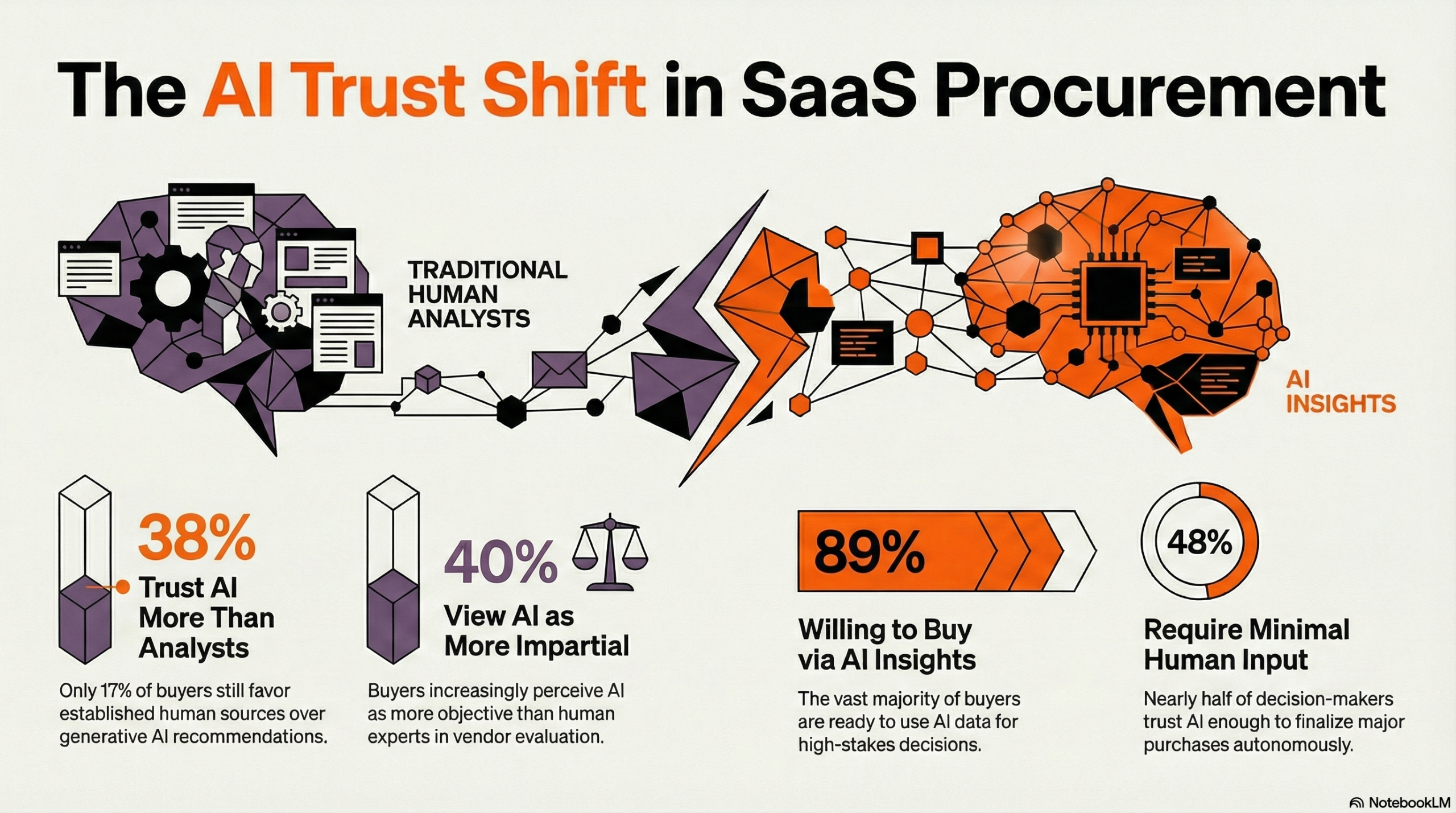
However, if we observe the extreme ends of the spectrum, we’re once again seeing a polarized division:
- 42% believe AI insights to be more impartial/objective than human ones.
- Only 4% find human expertise to be more impartial/objective than AIs.
This implies the AI is increasingly seen as a default reference point – at least, until its outputs start directly conflicting with established human expertise. In these situations, we have a relatively balanced distribution:
- 32.9% trusted human advice over AI suggestions;
- 27.6% trusted AI insights over human advice;
- 22.4% sought additional sources to reconcile the conflicting information.
At a glance, we can see that the “trust AI insights – but verify with human experts” remains the dominant sentiment among SaaS buyers. But what if we exclude the human factor from the equation?
Are SaaS buyers willing to make significant purchase decisions based primarily on AI insights?
The most surprising revelation of our survey wasn’t that the buyers are willing to make big decisions based on AI insights – but just how willing they are. More than half (55%) of our respondents, most of whom are primary decision-makers, stated that they trust AI guidance enough to make major purchasing decisions with minimal human input.
The next largest segment (37%) is the “trust, but verify” group – buyers who rely heavily on AI insights, but still require some degree of human validation before fully committing to a major purchase. Finally, only 5% stated they’re “not very comfortable,” and 3% said they’re “not at all comfortable” with letting AI insights guide their decision autonomously.
If we compare the “willing” against the “unwilling” segments against each other (8% against 92%, respectively), and compare that to other similar industry findings, the trajectory is more than clear: the zero-click, agentic commerce era is not coming – it’s already here.
Discovery is moving to Zero-Click town – and it’s taking your buyers with it
It’s also taking clicks, early-stage decision framing, shortlist control, and moment-of-intent vendor influence with it.
Buyers now have the ability to surface vendors, compare features, and identify risk points across a massive volume of market data. Tasks that previously required days, if not weeks, of rigorous research now only take seconds – and typically produce professional-grade results they can trust almost unconditionally. So, why would they go back to mind-numbing blue-link clicking and soul-crushing manual data analysis?
That’s right – they wouldn’t and they won’t.
With the discovery and e-commerce shifting and the AI’s tendency to produce different recommendations every time, you need an AI SEO agency that can audit, optimize, align, and stabilize your brand with AI-mediated discovery – and ZeroClick Labs can do it all, and more!
“Our agency had no idea how to approach AI visibility. ZeroClick only does this one thing so they actually know what works. Worth every penny just to not waste time figuring it out ourselves.” – Jay