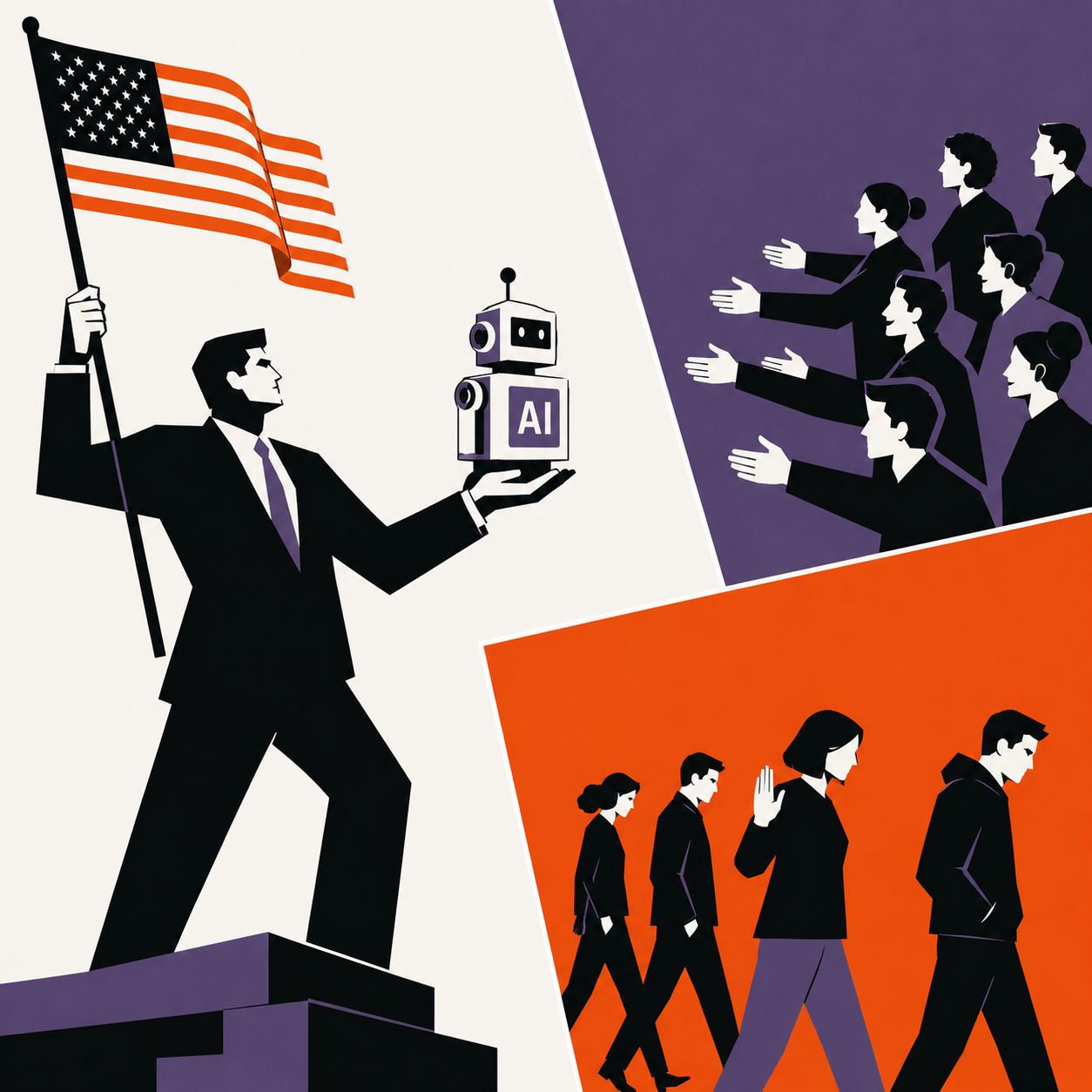
37% of Americans would trust government AI vs. 40% who would distrust it.
Roughly 1 in 5 Americans categorically reject government AI across at least 1 of 4 independent trust signals; 7.1% reject it in every framing tested.
AI familiarity predicts trust nearly 5 times more sharply than political party.
Two consensus answers stand out across the dataset: 70% put accountability for AI failure on the government and 70% want a human in the loop on consequential AI decisions.
Only one government AI use case clears majority support – basic chatbots at 51%.
71% of respondents named at least one condition that would increase their trust.
Executive Summary: In May 2026, ZeroClick Labs surveyed 350 U.S. adults to gauge the public trust in AI entirely built, trained, and run by the government. The results revealed a relatively balanced split between trust (37%) and distrust (40%). Notably, the strongest predictor of openness toward government AI was not political affiliation but whether the respondent uses AI personally. In addition, 71% of respondents named at least one specific condition under which their trust could be earned, signaling that for most Americans, trust in government AI is not an outright refusal but a negotiation.
“Americans wouldn’t trust an AI created by the government!” – If asked the question, most people would probably align with this statement. In reality, the trust and distrust camps are evenly split – 37% to 40% – with the neutral 20% sitting in the middle, according to our recent survey.
While there is a real mistrust reflected in our data, it is conditional, with the majority ready to accept a government-created AI with proper safeguards in place. The picture that emerges from the data is not one of blanket rejection, but of a public whose trust is, in effect, negotiable – contingent on transparency, oversight, and accountability.
Objective
To measure American public trust in government-built, trained, and operated AI in 2026, identify conditions under which said trust can be earned or lost, and detect demographic/behavioral patterns that shape it.
Bachelor’s+ 47% · Some college 26% · HS or less 27%
Weighting
Pollfish census weights applied (range 0.53–4.12)
Data snapshot: Net trust by segment
Segment
N
% Trust
Net trust
By AI usage frequency
Frequent AI users (>= weekly)
206
55.8%
+27.2
Occasional users (monthly/rarely)
83
13.3%
−37.3
Never use AI
56
5.4%
−60.7
By party affiliation
Republican / Lean-R
143
44.1%
+7.0
Pure Independent
38
39.5%
+7.9
Democrat / Lean-D
142
32.4%
−11.3
Other / no party
27
22.2%
−29.6
By age
18–29
30
40.0%
+3.3
30–44
119
46.2%
+7.6
45–59
144
32.6%
−9.0
60+
57
28.1%
−14.0
By education
College+
163
45.4%
+11.0
Some college / Associate’s
90
24.4%
−32.2
HS or less
78
35.9%
+3.8
Study limitations
Modest sample size (N = 350): Topline percentages are usable; party crosstabs (~140 per major group) and AI-usage crosstabs (~206 frequent / ~83 occasional / ~56 never) are usable but should be interpreted as directional for subsets smaller than ~50.
Single-wave survey: Snapshot for May 2026; no time-series available – the analysis describes the picture, not the trend.
Self-reported political affiliation: Standard limitation.
Would Americans trust a government AI in 2026?
Surprisingly, our study revealed no absolute answer to the question “How much would you trust an AI system designed, trained, and operated entirely by the U.S. government?”. The distribution between the “trusting” and “distrusting” camps is almost even: roughly 37% would trust government AI somewhat (26.00%) or strongly (11.14%), and roughly 40% would distrust it somewhat (20.29%) or strongly (20.00%). The rest, who neither trust nor distrust, sit right between them at 22.57%.
The surprise comes from the fact that the results of several studies, all of which measured broader AI sentiment, reveal historically high distrust toward AIs in public/government sectors:
Despite the slightly higher trust readout our survey produced, in the eyes of many Americans, government AI warrants not just an extra layer of suspicion but a whole different frame of reference, and categorical rejection patterns spread across the dataset confirm it.
Distrust of Government AI — Across Surveys
Why our 40% reading is the most trust-favorable comparison point in the field
Source: Public Trust in Government AI Survey, Pollfish, May 2026. Hover any bar for details.
How deep is the public’s structural distrust of government AI?
The structural trust deficit goes much deeper than what preliminary results show. Across multiple independent questions, roughly 1 of 5 respondents gives a categorically rejectionistic answer regarding government AI, across four distinct signals:
20.0% would strongly distrust an AI system designed, trained, and operated entirely by the U.S. government.
20.6% stated nothing would meaningfully increase their trust in a government AI system.
18.9% would support zero out of the seven government AI use cases presented in the survey.
33.1% said they wouldn’t trust government AI, regardless of which political party controls the federal government.
What’s crucial to note is that the rejectionist tendencies have nothing to do with political inclination or a response to a specific policy. It’s a stable feature of how the public feels about government AI in 2026 - and the proof lies in the fact that these signals aren’t isolated. They stack:
48.9% hit at least one of the four signals
23.4% hit at least two
13.1% hit at least three
7.1% hit all four
What these results show: For roughly half of Americans, distrust in government AI is present in some form. For 7.1%, it’s a default state. The government is not entering this conversation from a position of trust. At best, it’s entering neutral. Most likely, it’s entering behind.
The Structural Trust Deficit — Four Rejection Signals
Across four independent questions, ~1 in 5 Americans gives a categorically rejectionist answer on government AI.
How the signals stack
Share of respondents hitting at least N of the 4 rejection signals.
Individual rejection signalStack: at least 1 signalStack: at least 2 signalsStack: at least 3 signals
Source: Public Trust in Government AI Survey, Pollfish, May 2026. Hover any bar for details.
What really drives openness to government AI?
Since we’re talking about an AI created by the US government, most people would immediately assume that partisanship would be the key driver of trust. Most people would be wrong. According to our findings, the factor that dictates the openness toward government AI is familiarity, which can be confirmed if we cross-tab Q2 and Q3 to calculate the net trust score:
Table 1: Q2 × Q3 Crosstab
Usage group
N
Trust
Neither
Distrust
Net
Frequent (≥ weekly)
206
55.83% → 56%
15.53%
28.64% → 29%
+27.18 → +27
Never
56
5.36% → 5%
28.57%
66.07% → 66%
−60.71 → −61
Among the 59% of frequent users (daily or weekly), 56% would trust government AI and 29% would distrust it, for a net trust score of +27;
Among the 16% of never-users, only 5% would trust the government AI and 66% would distrust it, for a net trust score of -61.
The net gap is immediately obvious, sitting at 88 points between frequent users and non-users. By comparison, a partisan gap is only 18 points, suggesting that familiarity with AI tools is a nearly five times stronger trust signal than political inclination.
Net Trust in Government AI by Segment
The 88-point gap between frequent and never AI users is the sharpest split in the dataset.
Net positive trustNet negative trust
Source: Public Trust in Government AI Survey, Pollfish, May 2026. Hover any bar for details.
What do Americans unequivocally agree on when it comes to government AI?
While the opinions diverge across the majority of our queries, two “consensus answers” leave zero room for doubt, and they pertain to the burden of accountability in case of system failure and the mandatory presence of a human in the decision-making process.
Who should be held accountable when government AI fails?
If there’s one thing the supermajority (70%, combined) agrees on, it’s this: the burden of legal accountability if government AI causes serious harm is on the government - alone (38%) or jointly, with the AI developer (32%).
In stark contrast, only a negligible ~3% accept that “no one [is responsible], if the system followed approved rules.” The sentiment is clear: a system in which neither the agency nor the vendor owns the failure is NOT a position the American public is willing to entertain.
Who Should Be Held Accountable When Government AI Fails?
Q10 · Combined "government accountable" share = 70%. Only 3% accept "no one is responsible."
Government accountable (alone or jointly) — 70%Accountability assigned elsewhereNot sure"No one" — rejected by 97%
Source: Public Trust in Government AI Survey, Pollfish, May 2026. Hover any bar for details.
A system in which neither side owns the failure is a definitive no-go for the majority of Americans.
Should a human be involved in the government AI’s decision-making process?
Once again, the answer is a decisive yes. The majority of respondents (~70%) want real human involvement in the decision-making process, either for preemptive review (~29%), human-only final calls (18%), or post-decision issue resolution (~23%).
Even without taking other results into account, the directional answer is more than clear: Americans don’t want AI making decisions that could have real-life consequences - not without the human in the loo
Should a Human Be Involved in Government AI Decisions?
Q9 · 70% want a human in the loop. Only 9% accept AI-only decisions.
Human in the loop with AI — 70%No AI for these decisions — 14%AI-only acceptable — 9%Not sure — 7%
Source: Public Trust in Government AI Survey, Pollfish, May 2026. Hover any bar for details.
The above point is further reinforced by the fact that the “pro AI decision-making” segment is by far the smallest (excluding the indecisive 6.57%) - less than 9%. Even the strict “no AI in the loop” cohort beats it by a full 5%.
Simply put, no matter how you look at it, there’s no version of this question where this specific use case - automated decision-making - clears majority support. Which brings us to a much bigger question.
Stay in the Loop - Stay Ahead
Sign up for The Laboratory newsletter and get the latest insights from AI world straight to you inbox!
Which government AI use cases do Americans actually support?
Only one: answering basic questions about government services. That’s right - the lowest-stakes interaction, the most benign use case and a very practical one is the only that managed to win a majority public support - and even then barely, at 51%.
Every other application doesn’t even come close. Even the first two runner-ups, identifying risks during natural disasters or public emergencies and detecting fraud or improper payment, only sit at ~37% each, after which the distribution keeps collapsing, albeit gradually.
No ambiguity here: Americans are willing to accept government AI for routine, low-stakes administrative work. However, when it comes to decisions that affect their individual rights and liberties (eligibility, surveillance, policing) - that’s where they draw a hard line.
It must be noted that our survey isn’t the only one to reach this conclusion. Cornell’s review of recent public-opinion research spotted the same division: support for AI on mundane workflows, fierce opposition for use cases with personally consequential outcomes.
Which Government AI Use Cases Do Americans Support?
Q8 · Only one use case clears majority support. Every other application falls below the 50% line.
Majority support (50%+)Below majorityAbsolute oppositionNot sure
Source: Public Trust in Government AI Survey, Pollfish, May 2026. Hover any bar for details.
An interesting thing to note here concerns the “absolute opposition” - a segment that wouldn’t trust government AI no matter what. They sit prominently at ~19%, suggesting that roughly 1 in 5 Americans aren’t a persuasion target, but a constraint for widespread adoption. But while this segment leaves no room for negotiation, the majority isn’t so categorical in their position.
What would it take for government AI to earn public trust?
Trust could increase if the government maintained AI safety, data security rules, public disclosure, responsibility in AI use, accountability, and freedom of choice. At a glance, this seems like quite a lot. In reality, these demands are not at all unreasonable.
What Would Increase Trust in Government AI?
Q5 · 71% identified at least one specific safeguard. Trust is conditional, not categorical.
Source: Public Trust in Government AI Survey, Pollfish, May 2026. Hover any bar for details.
Translated into policy terms, they amount to privacy law, audit regimes, real penalties, opt-out rights, transparency standards, and due process. In other words, the procedural infrastructure that the government routinely builds for other regulated activities.
Note that this sentiment is not fringe - roughly 71% identified at least one stipulation for trust increase, suggesting that the trust deficit is conditional - not categorical - for the majority of Americans.
Ultimately, the widespread public acceptance of government AI doesn’t hinge on which party is in power, who developed the system, or even who’s controlling it. It hinges entirely on the government's ability to demonstrate that its AI is safe, fair, and applied in ways that tangibly improve the lives of American citizens.
Americans don’t want to stop government AI - they want it governed.
Jordan Parkes, the CEO and founder of ZeroClick Labs, has been building and scaling digital marketing strategies since 2012, leveraging performance-driven SEO and data-based digital marketing solutions to guide the growth of hundreds of companies across the U.S. and Europe.
We can’t make you trust AI - but we can make AI trust you
AI doesn’t grant trust. It cites those who earn it.
ZeroClick Labs is here to ensure your brand earns it.
Rely on us to run Generative Engine Optimization (GEO) services that align your content portfolio with AI visibility criteria – turning static resources into repeat citations across ChatGPT, Perplexity, Gemini, and AI Overviews.
Connect with us and let’s make visibility happen!
“Our agency had no idea how to approach AI visibility. ZeroClick only does this one thing so they actually know what works. Worth every penny just to not waste time figuring it out ourselves.” - Jay