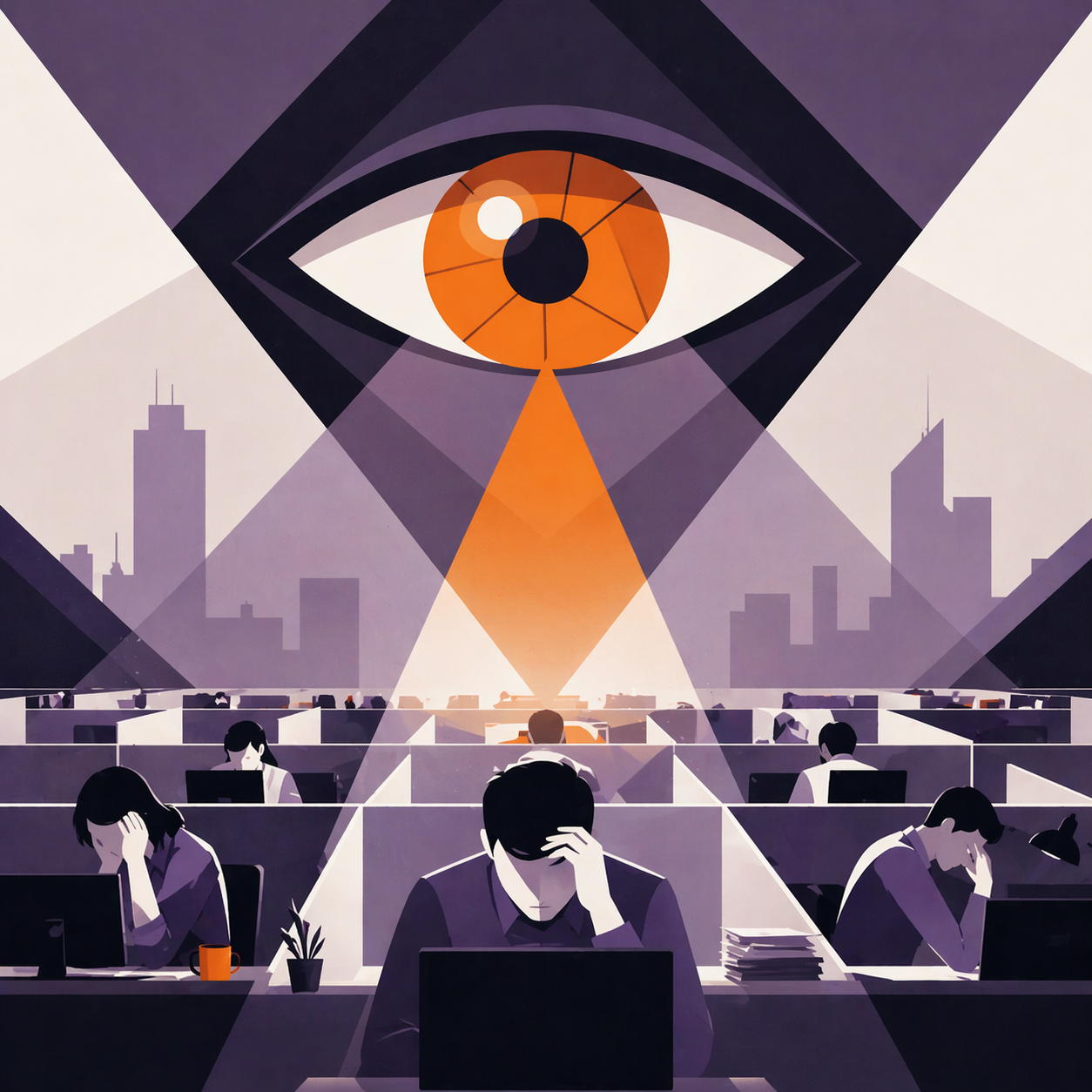
AI monitoring is becoming more prevalent, with adoption accelerating as AI tools get bundled with standard HR software.
AI monitoring tools have evolved far beyond keystroke loggers and can now analyze Slack, Teams, and emails to perform sentiment analysis.
Current federal laws skew heavily in favor of employers, giving employees little to no legal protection.
State laws are starting to close the gap, implementing regulations to protect workers’ rights.
Executive Summary: AI-powered surveillance is becoming ever-present in U.S. companies – and the federal law largely permits it. However, a dozen states are already implementing worker protection rules, signaling that regulatory tides are turning.
“A Slack message I just sent got scored for ‘emotional tone!’” “My screen has been quietly screenshotted this afternoon – twice!” “A casual message I sent to my work bestie just got flagged as ‘toxic!’” “A dashboard dinged me for taking 8 minutes longer to finish lunch!”
No, this is not another episode of “Black Mirror.” For many Americans, the Orwellian future is a reality – right now. Granted, bosses have been watching workers since forever, but here’s the twist: with AI, they can observe in real time, at scale, and across everything you do.
And in most of the U.S. – it’s completely legal.
Is my boss really using AI to spy on me?
Well, “spy” may be a bit of a strong word. “Pervasively measure performance and behavior using tools you almost certainly clicked ‘Accept’ during onboarding” is more accurate. Either way, the answer is: yes.
The normalization
During and after COVID, remote and hybrid positions rose exponentially and stayed normalized – but so did the category of workplace surveillance that used to be niche. Today, employers are routinely using keystroke loggers, mouse trackers, webcam check-ins, screenshot capture software, and even voice collection to monitor productivity throughout the workday. However, with AI becoming an integral part of virtually every workflow, this whole narrative took on a new groove – and escalated to heights nobody imagined possible.
Now, we have tools such as Prodoscore, which can assign a daily productivity score out of 100, based on criteria such as emails sent, messaging-app activity, database usage, etc. – then rank workers so managers can easily compare them against each other. Another example is CleverControl – a tool that can compare activity to industry/role benchmarks to flag “unusual” or unproductive behaviors and loss of focus.However, arguably the most unsettling thing of all is that AI can now conduct the so-called “sentiment analysis.” It can scan your Slack, Teams, and emails to learn your normal conversation/messaging patterns – and use those to flag any signs of stress, frustration, or toxicity with incredible accuracy (~87%).
Stay in the Loop – Stay Ahead
Sign up for The Laboratory newsletter and get the latest insights from AI world straight to you inbox!
The scope
To make things worse, this is not a fringe practice. A worker advocacy group, Coworker.org, documented more than 500 cases of workplace monitoring, and that number is rising rapidly as AI becomes an integral part of workflows.
Already, this goes way beyond just “performance measurement.” The mere fact that AIs can collect sensitive PERSONAL information – stress levels, behavioral data, and even health-related details – is already unsettling enough.
The Business Purpose Exception: Allows employers to monitor communications if there’s a legitimate business justification.
The Consent Exception: The employer has a full green light if the employee “consents” to being surveyed – which is often the case, as this exception is typically buried in an initial employment contract.
The problem is that ECPA is 40 years old. The Act was written in 1986 – way before the consumer Internet, and back when AI was science fiction. Yet, it still does most of the heavy lifting, despite addressing the issues that weren’t even conceivable at the time of writing.
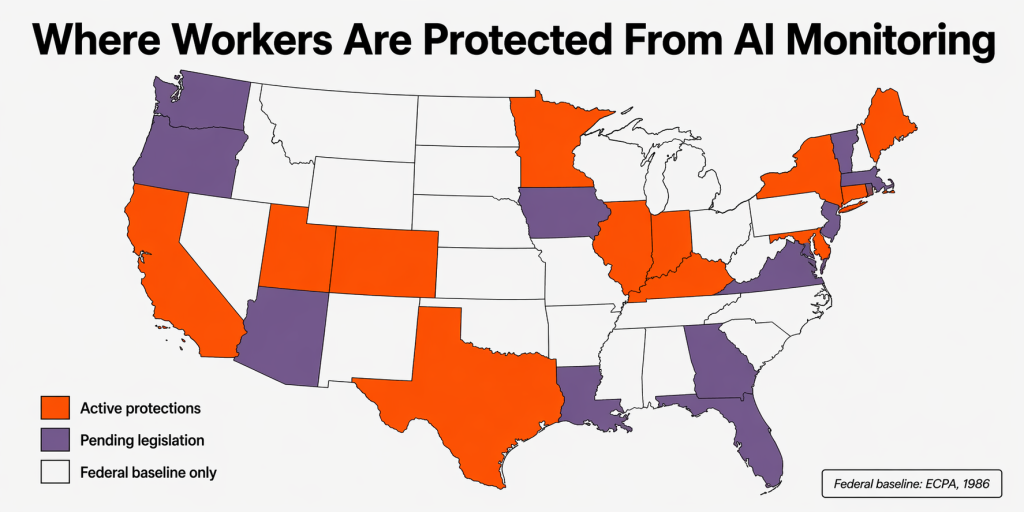
Many states have already implemented, or are actively working toward legislation protecting employees from unbridled AI-oversight. [Image Credit: ZeroClick Labs via ChatGPT]
How about the state of AI monitoring on the state level?
On the state level, things seem to be looking up, but the overall situation is still patchy. Currently, more than 10 states adopted some form of employee protections laws against unbridled workplace monitoring, most notably:
California: The California Consumer Privacy Act (CCPA) gives workers the same consumer-level privacy rights, meaning that employers must disclose the use and collection of any surveillance data.
The upcoming Automated Decisionmaking Technology (ADT) regulations taking effect on January 1, 2027 will push things further yet, forcing employers to provide even more detailed Pre-Use Notices.
Illinois: The IHRA amendment (HB 3773, effective January 1, 2026) explicitly applies the State’s anti-discrimination standards to AI utilization in employment decisions.
As noted above – these are not isolated cases. Similar bills are being passed in Washington, Massachusetts, New Jersey, Oregon, Minnesota, and several other states – all proposing stricter notice, consent, and/or impact-assessment rules regarding AI monitoring.
Even the federal agencies are starting to “soften,” with CFPB taking the position that the Fair Credit Reporting Act (FCRA) applies to certain types of workplace monitoring and employee surveillance, particularly those employing third-party AI tools.
With everything being said, the direction is clear: AI is becoming an integral part of every workplace everywhere. The rules are changing at light speed. The fringe is becoming the norm.
And lawmakers are starting to notice.
Seth Matthews, an AI SEO content writer within ZeroClick Labs, began his career in civil engineering, but his passion for writing drove his deliberate transition into professional content strategy and SEO. The clash of two worlds produced a writer who can effortlessly combine technical precision and narrative clarity with the emotional and psychological impact of creative storytelling.
AI may be watching your employees – but is it watching your brand?
Employees aren’t the only ones being scored. YOU are, too – and the algorithm is ruthless.
Right now, in most categories, only 5 brands capture 80% of AI citations. Everyone else gets – nothing. No mentions. No recommendations. No clicks. No business.
ZeroClick Labs is here to help you achieve a high score.
Book your audit today, and let’s make sure the AI is watching you – for all the right reasons!
“Our agency had no idea how to approach AI visibility. ZeroClick only does this one thing so they actually know what works. Worth every penny just to not waste time figuring it out ourselves.” – Jay