The dominant narrative about “Search vs. AI” as a zero-sum game no longer holds.
Search is evolving into an AI-powered system, capable of spawning sub-agents who can perform individual tasks.
Task Completion Eligibility will be one of the most dominant visibility criteria.
Traditional SEO will remain the foundation of visibility, with AEO/GEO layered on top, and AAIO underneath as agentic infrastructure.
Executive Summary: In a recent interview for Cheeky Pint, Google and Alphabet CEO Sundar Pichai shared first-hand insights on the future of Search and the presence of AI agents in everyday workflows. Pichai’s statements confirm that the Search is moving toward an agentic model, and that the shift is closer than we think.
With the above facts in mind, it’s no wonder that the dominant narrative around AI and search has been that it’s a “zero-sum game.” However, Sundar Pichai’s recent interview with John Collision and Elad Gil suggests that the dominant narrative is also the wrong one.
Is AI-Search clash a zero-sum game?
“…it feels so far from a zero-sum game to me,” Pichai said, “It can become a zero-sum game if you’re not innovating or the product is not evolving… We are doing both Search and Gemini. They will overlap in certain ways. They will profoundly diverge in certain ways. I think it’s good to have both and embrace it.”
He further structured his argument by citing how YouTube survived TikTok, Amazon survived Google, and Facebook survived Instagram, implying that the consumer internet was never in a fixed state.
Rather, the consumer internet has always expanded what “search” means, and each new iteration has created more demand, not less. Pichai’s statements are, by no means, unfounded – they are backed by real-world data:
Total search usage (LLMs + traditional search engines) has grown 26% globally since 2024.
AI-referred traffic increased more than tenfold between July 2024 and February 2025 in the US alone.
AI-referred visitors browse 12% more pages per session.
AI-referred visitors bounce 23% less than non-AI referrals.
The history and future of AI at Google, with Sundar Pichai by Cheeky Pint
As it stands, the above numbers do not indicate that traffic is dying. However, they do indicate that the traffic is restructuring. Pichai himself put it best, saying we’re at an “expansionary moment,” which explains why it doesn’t feel like a zero-sum game to him.
This also means that the ensuing panic among brands and marketers results from focusing on the wrong metric. The question is no longer whether the existing traffic will survive – it’s whether brands are ready to be reshaped and repositioned to capture traffic in its evolved form.
The collapse of the traditional search model
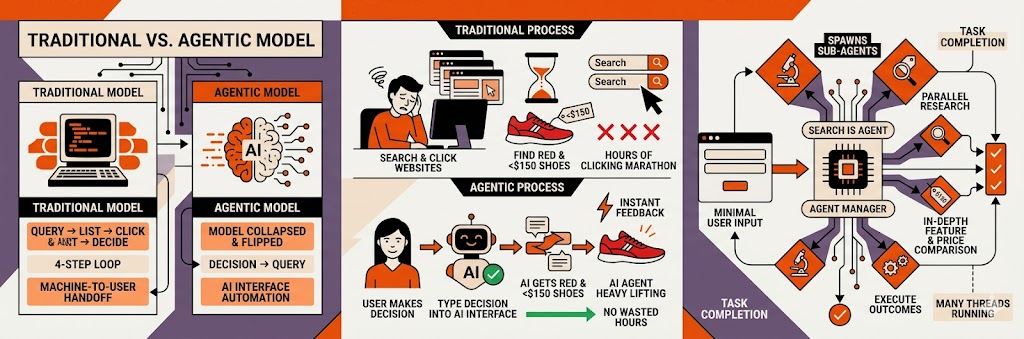
The old search model was a four-step loop, where each step was a handoff from machine to user: query → list → click → decide. The agentic search not only collapses this model entirely, but flips it: decision → query.
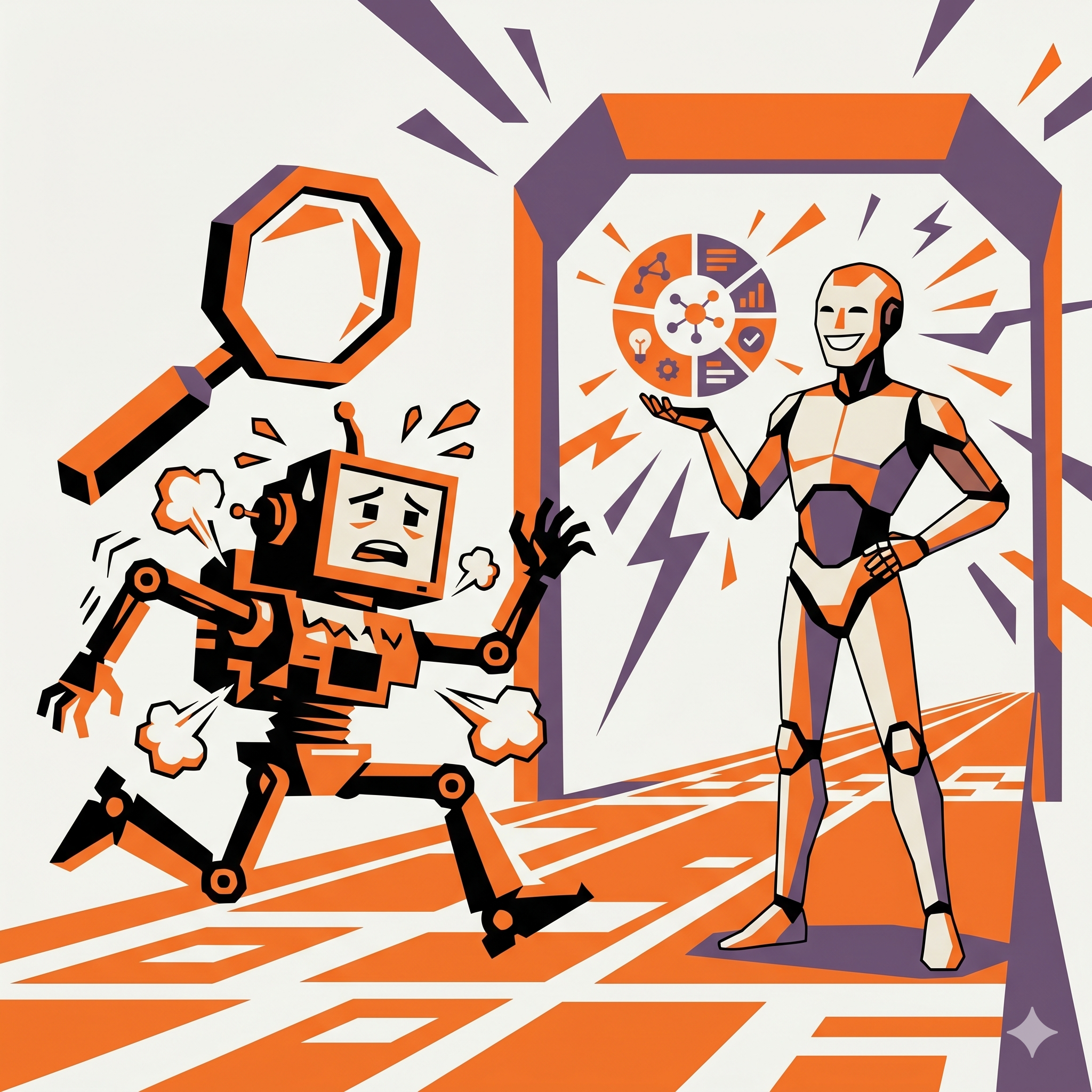
Traditional search model relied on the user. That’s no longer the case. [Image Credit: ZeroClick Labs via Gemini]
Here’s a banal example: Let’s say the user wants red running shoes for $150 or less.
With the old model, they had to search for “running shoes” and click through multiple websites until they found red ones that cost under $150. This process could take hours and then some (e.g., if they wanted to apply coupons), and then finally go through a checkout process.
With the agentic model, the user has already made a decision – they want red running shoes for under $150. All they need to do now is type their decision into the AI interface, the AI agent does all the heavy lifting, and they get their red running shoes for under $150. No wasted hours, no clicking marathons.
In the interview, Pichai described the endpoint perfectly: “…a lot of what are just information-seeking queries will be agentic in Search. You’ll be completing tasks. You’ll have many threads running.” He proceeded to state that “Search would be an agent manager” and “everybody’s going to have a personal agent who, instead of typing in a query, it’ll go and do something for you.”
In other words, the Search will become a system that spawns sub-agents, who can then run parallel research, perform in-depth feature/price comparison, and execute outcomes on behalf of the user, with minimal input. Now, this is where a brand new visibility metric comes into play.
The Laboratory: Where AI Visibility Gets Decoded
Get exclusive research, expert insights, and cutting-edge GEO and AI optimization strategies delivered directly to your inbox.
Subscribe now and stay ahead of every model update, every platform shift, every opportunity.
The new criterion for brand visibility: task completion eligibility
For the longest time, the rank in SERPs has been the key visibility metric. With the rise of AI, it has evolved to include citation eligibility. And now, with the arrival of the agentic model, it’s evolving yet again to include task completion eligibility.
The progression is clear: it’s no longer just “whether your content ranks” or even “is your content citation-worthy.” Now, it’s “Can AI agents actually do something with your content – without the human in the loop?”
Can it check inventory? Extract specifications? Verify pricing? Book an appointment? Complete a purchase? If the answer to any of these questions is no – your brand does not exist in the transaction layer. The agent simply moves on. The frightening thing is that the above scenario is not speculation – at least not for Pichai.
When Collision asked if “You can imagine an AI doing a fully, no human in the loop, forecast? What quarter do you think Google’s first fully agentic forecast is?” Google’s CEO identified 2027 as a likely inflection point TWICE, saying he expects “‘27 to be a big year in which some of those shifts happen pretty profoundly.”
Finally, if we take everything we’ve talked about and pair it with the fact that AI search is monetizing via paid placement fast, it’s clear that the window for establishing organic authority is open right now – but it won’t stay that way for long. Which brings us to the key question.
Who are we optimizing for in 2026/2027?
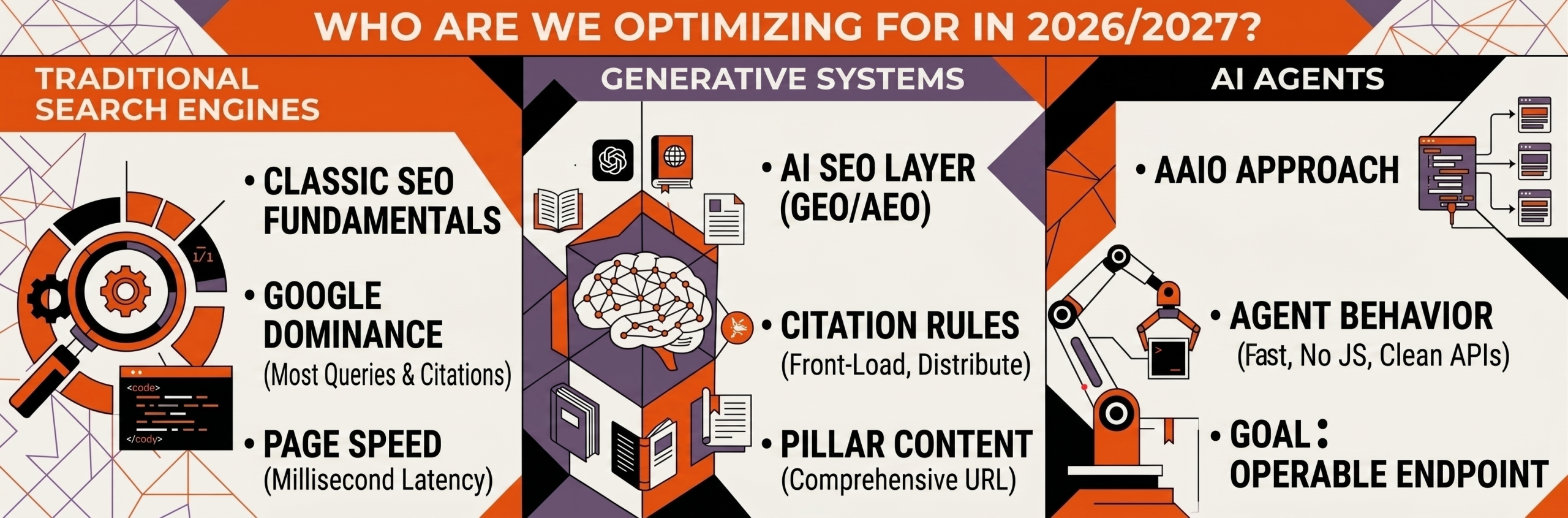
In the age of agentic commerce, brands and marketers will be facing a significant challenge, since their optimization strategies now must satisfy three distinct and occasionally competing audiences: traditional search engines, generative systems, and AI agents.
Search is changing. Optimization practices must follow. [Image Credit: ZeroClick Labs via Gemini]
Traditional search engines
Even in the agentic era, SEO will remain the core of visibility, purely for the fact that Google processes queries at a 373:1 ratio compared to its biggest generative competitor (ChatGPT), and that the majority of citations pull from the first 10 results of Google search.
However, in addition to classic technical hygiene (crawlability, CWV, schema markup, structured data), page speed will also become a major selectability factor, if Pichai’s borderline obsession with millisecond-level latency is any indication.
Generative systems
AI SEO (a.k.a. GEO/AEO) will become the next essential visibility layer, focused primarily on winning citations across multiple AI platforms, including ChatGPT, Gemini, Perplexity, and similar. However, to achieve this objective, the content would first have to meet several criteria:
Front-loaded: 44% of all LLM citations come from the first 30% of the text.
Distributed: Presence on a broad range of external platforms increases citation rateby up to 325% compared to publishing only on the brand’s site.
Comprehensive: Content will have to satisfy the entire research stage of the buyer journey in a single URL.
Pichai said that “today in AI mode in Search, people do deep research queries… I think people will do long-running tasks.” Within the broader context, this statement could be interpreted as a direct signal to content producers: thin pages will no longer cut it.
The industry data corroborates this: we already know that pages above 20,000 characters get cited way more often in ChatGPT responses. Since users will continue to delegate entire research projects to AI agents, the content will have to give them enough material to satisfy an in-depth, multi-step investigation – not just a single query.
AI agents
AI agents are an entirely different class of “website visitors,” who crawl at nearly four times the rate of Googlebot, with retrieval timeouts of one to five seconds, but cannot render JavaScript. Since these entities do not “browse” in any human sense, appeasing them requires a new approach – AAIO (AI Agent Interaction Optimization).
What AAIO does, essentially, is create a massive “sandbox for AI agents to play in” – easily navigable (e.g., clean API endpoints, no CAPTCHA friction) and packed with machine-readable data (e.g., real-time pricing, structured product specifications).
Collision articulated this point perfectly when he praised GCP’s MCP integration, saying that “one thing that works really well is the GCP/MCP is awesome, where your AI can just interact programmatically with Google Cloud.” Pichai agreed, stating that “AI being this orchestration layer in a way that makes sense for the end user, I think it’s been delightful to see.”
The dual perspective of this exchange gives us the most powerful insight yet: machine readability will become the norm – because if a brand cannot be operated as an endpoint by an agent, it can only be cited as a source – and citations alone seldom convert.
Reinforcing the point: The “OpenClaw-like systems” are the future
Despite the ongoing “war” between Anthropic and OpenClaw, there’s no denying that users see potential in having a personal agent – and Pichai seems to agree: “…you want to give users capability where you have persistent long-running tasks in a reliable, secure way… But I think that’s the future. That’s the agentic future.”
He even proceeded to double down, stating: “I think effectively the consumer interfaces are going to have full coding models underneath, and the right harnesses and the right skills and the ability to persist and run somewhere securely in the cloud, locally and in the cloud.”
From the SEO perspective, this is an enormously valuable insight: it describes the future where agents do not crawl a site just to answer a question, but to execute ongoing, complex tasks – repeatedly.
Pichai’s words not only reinforce that agent-operability as an endpoint will become a norm, but also confirm that AAIO is not the buzzword – it’s becoming an infrastructural requirement for brands wishing to dominate the agentic future.
Jordan Parkes, the CEO and founder of ZeroClick Labs, has been building and scaling digital marketing strategies since 2012, leveraging performance-driven SEO and data-based digital marketing solutions to guide the growth of hundreds of companies across the U.S. and Europe.
Connect with us today, and let’s discuss making you agent-proof!
“Our agency had no idea how to approach AI visibility. ZeroClick only does this one thing so they actually know what works. Worth every penny just to not waste time figuring it out ourselves.” – Jay
For brands, Reddit’s 126.8 million users represent 126.8 million potential customers. So, naturally, many actively participate in discussions, contributing experience...