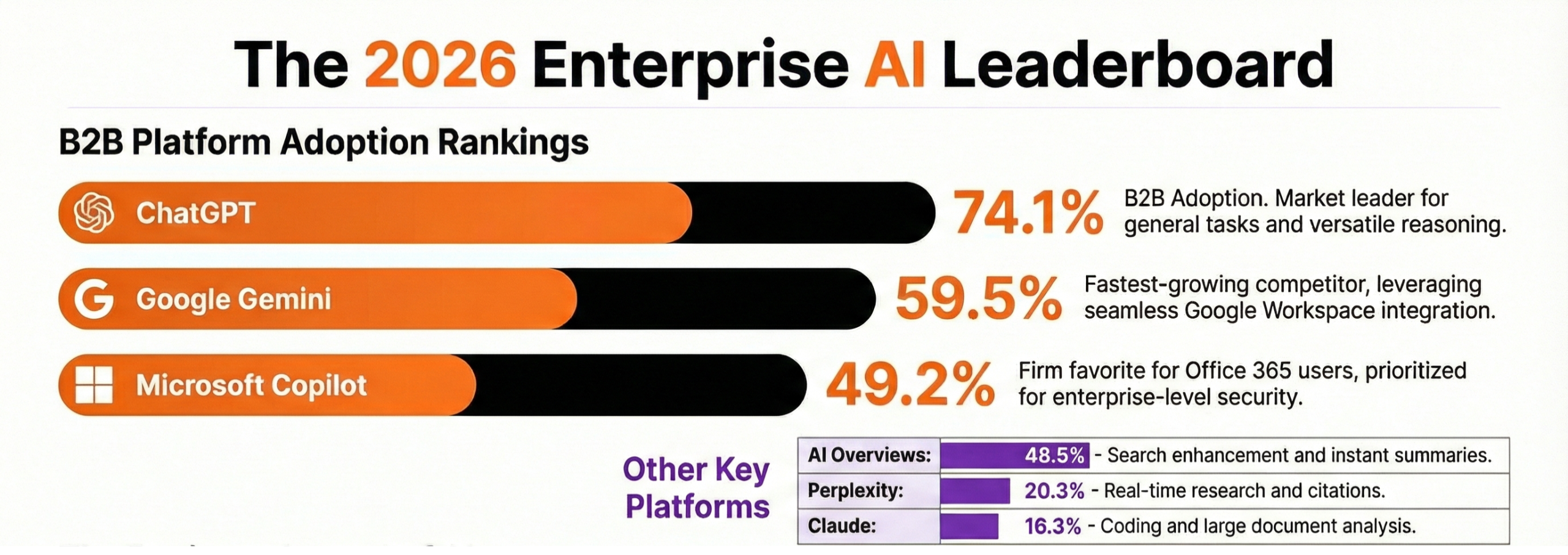
ChatGPT remains the de facto market leader, but ecosystem-native tools (Gemini, Copilot, AI Overviews / AI Mode) follow in lockstep.
The primary adoption drivers are research speed (66.4%) and research quality (75.4%).
Buyers utilize AI for high-value tasks, including generating vendor lists (53.8%) and comparing features (53.5%), but also to create leverage for sales negotiations.
Data privacy, sovereignty, and accuracy remain major points of concern, driving B2B users toward models featuring enterprise-grade security and RAG for accuracy.
By the end of 2026, we can expect a shift from passive “chatbots” to “Agentic AI” systems capable of autonomously executing complex tasks, as well as from all-purpose platforms to domain-specific models.
TL;DR: Survey conducted by ZeroClick Labs shows that the majority (74.1%) of B2B decision-makers prefer ChatGPT for their workflows, though integrated solutions like Gemini and Copilot are rapidly gaining traction with 59.5% and 49.2% adoption rates, respectively. Integration, task-specific functionality, security, accuracy, and autonomy are becoming the most sought-after features of AI tools. Data suggests that by the end of 2026, buyers will increasingly shift toward autonomous or semi-autonomous agentic AI and specialized models.
The utilization of AI in e-commerce has far surpassed the mere “experimentation” phase. Today, generative engines are widely used in virtually every facet of B2B operations and across every stage of the buyer journey.
But just how widespread is the adoption of AI platforms in B2B purchasing – and which ones are the most dominant in modern business environments? A survey fielded in December 2025 by ZeroClick Labs shows some surprising (and some not-so-surprising) results.
Most used AI platforms for B2B decision-making
What Are the Top AI Platforms Used by B2B Decision Makers Today?
Unsurprisingly,ChatGPT is the most dominant choice, with nearly three-quarters of respondents using OpenAI’s model to power their B2B buying or research. Following relatively closely are Google Gemini, Microsoft Copilot, and Google AI Overviews / AI Mode, primarily for being ecosystem-integrated tools. Finally, populating the bottommost ranks are Perplexity and Anthropic’s Claude, both of which are considered to be “specialized” or “niche” answer engines.
Table 1: AI Platforms ranked by adoption
Platform
Adoption %
Core Strengths
ChatGPT
74.1%
Established market leader: Highest trust for general tasks. Versatility: Broadest feature set.
Compliance: Enterprise-level data security. Office Synergy: Deep integration with Office 365.
AI Overviews / AI Mode
48.5%
Search enhancement: Both improve traditional search. Gemini core: Powered by the same model, but serving different purposes (instant, static summaries / conversational, in-depth research).
Perplexity
20.3%
Accuracy: Fact-checked, comprehensive answers to complex questions. Context awareness: Delivers more informative and relevant answers.
Claude
16.3%
Context window: 200k-1M tokens enables large document analysis. Superior coding capabilities: 74.4% on SWE-bench.
Why do B2B Buyers Use AI Platforms?
The primary reason for rapid and widespread AI adoption in B2B circles is its ability to fundamentally enhance the research capabilities of the buyer:
66.4% of respondents said that AI tools increase the speed of their research.
75.4% of respondents stated that AI tools improve the depth and quality of their research.
Reflecting on the reasoning behind these results, we can say that they are not exactly unexpected. Modern generative AIs can surface vendors, products, or services within seconds, all while eliminating marketing noise and fluff.
Furthermore, AI tools have advanced to the point where they can aggregate, analyze, compare, and summarize vast amounts of information AND create actionable insights (e.g., RFIs, vendor lists, justification documents for stakeholders, etc.) – also within seconds.
Considering that these tasks previously required hours, days, or even weeks on end, the reason for overwhelming adoption is crystal clear: AI tools help B2B users save vast amounts of time and reach decisions with more confidence.
Stay Ahead of AI Search Developments
Sign up to The Laboratory and get the latest GEO insights, AI optimization strategies, and expert tips straight to your inbox.
What features do B2B buyers value the most in AI?
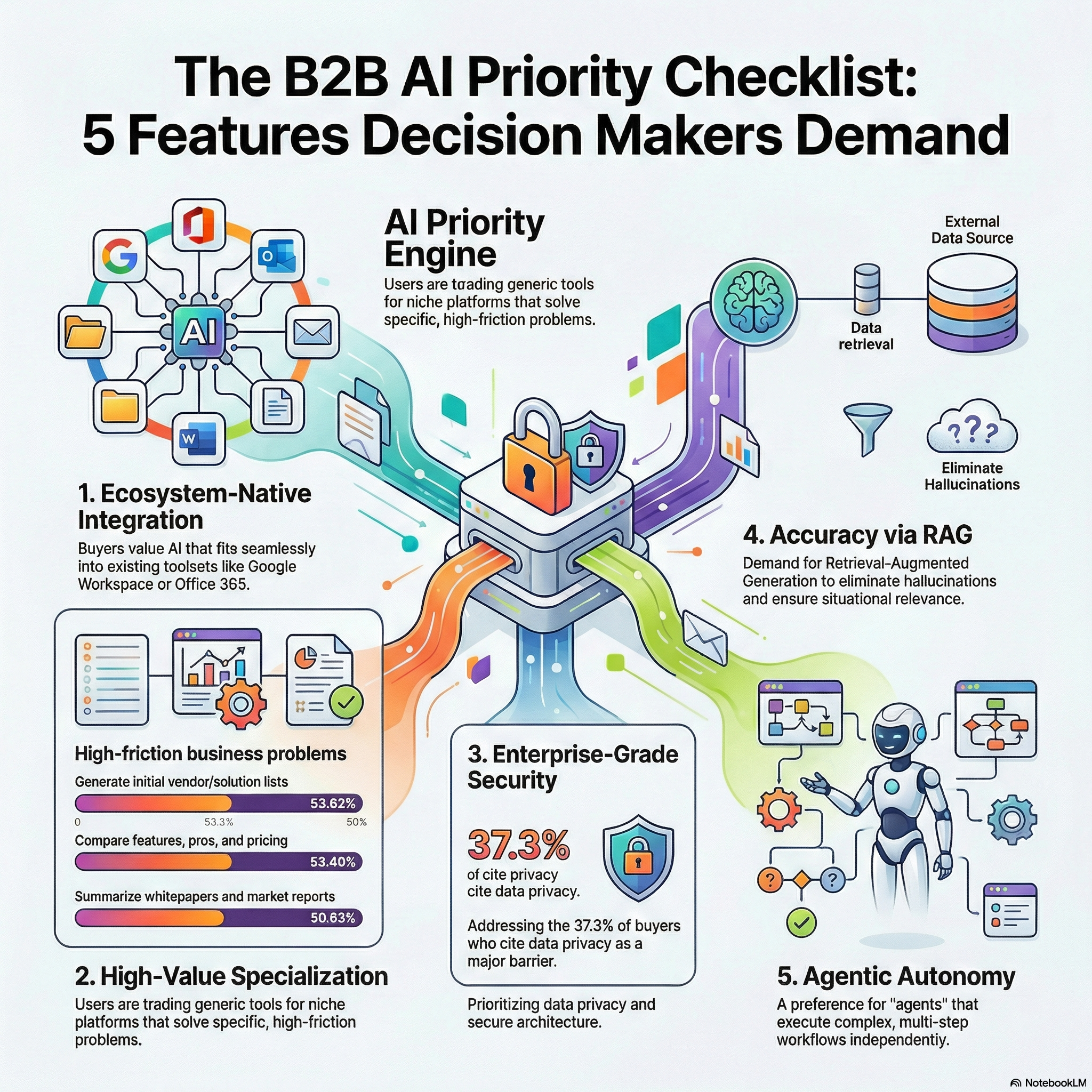
While an overwhelming majority (81.5%) of interviewed decision makers use AI tools either regularly (37.75%) or occasionally (45.75%), those who incorporate AI into their organizations’ workflows are predominantly looking for five core features: integration capabilities, high-value functionality, data privacy/security, information accuracy, and autonomy.
B2B buyers are expecting more from their AI tools
Integration capabilities
The results of the survey show high adoption of ecosystem-native tools – Gemini (59.5%), Copilot (49.2%), and AI Overviews / AI Mode (48.5%). This suggests that B2B buyers are increasingly valuing AI-powered solutions that fit seamlessly into their existing toolsets, rather than disconnected, siloed tools that replace their core systems.
High-value functionality
Our survey also showed two very interesting things:
Significant adoption rates of specialized or niche tools (Perplexity – 20.3% and Claude 16.3%),
High GenAI utilization rates for very specific tasks, primarily during the early stages of the buyer journey (see Table 2).
Table 2: Purpose of Generative AI in the B2B buying process
Purpose
Respondents (%)
To generate an initial list of potential vendors or solutions.
53.82%
To compare key features, pros, cons, or pricing across shortlisted vendors.
53.49%
To summarize and synthesize information (e.g., vendor whitepapers, market reports, analyst insights).
50.83%
To identify specific risks or potential challenges associated with a particular solution.
41.53%
To formulate points or counter-arguments for sales conversations or negotiations.
35.55%
I use Generative AI in the B2B buying process, but only for general tasks (e.g., formatting, quick definitions, non-purchase-specific tasks).
35.22%
To draft initial requirements, RFIs, or specifications.
23.92%
To draft business case documents or justification for internal stakeholders (e.g., ROI).
22.59%
I do not use Generative AI tools in my B2B buying process.
3.99%
Other
0.66%
Data privacy & security
As expected, trust remains the primary barrier to AI adoption, with 37.3% of respondents citing data privacy and security as major concerns when sharing company info with answer engines. This is why B2B buyers, especially those in regulated industries, value solutions that already have safeguards that ensure data privacy, sovereignty, compliance, and security.
What are the predictions for AI Tools Adoption in B2B by the end of 2026?
Based on our survey and industry data, it is likely that ChatGPT will remain the most widespread platform, but its dominance will no longer be absolute. Backing this prediction is the shift in decision-maker preferences, which is moving toward more integrated and/or specialized tools and multi-modal strategies in place of a single solution.
The projection of different AI platforms’ representations in B2B environments in 2026
What will be the most dominant AI Platforms by late 2026?
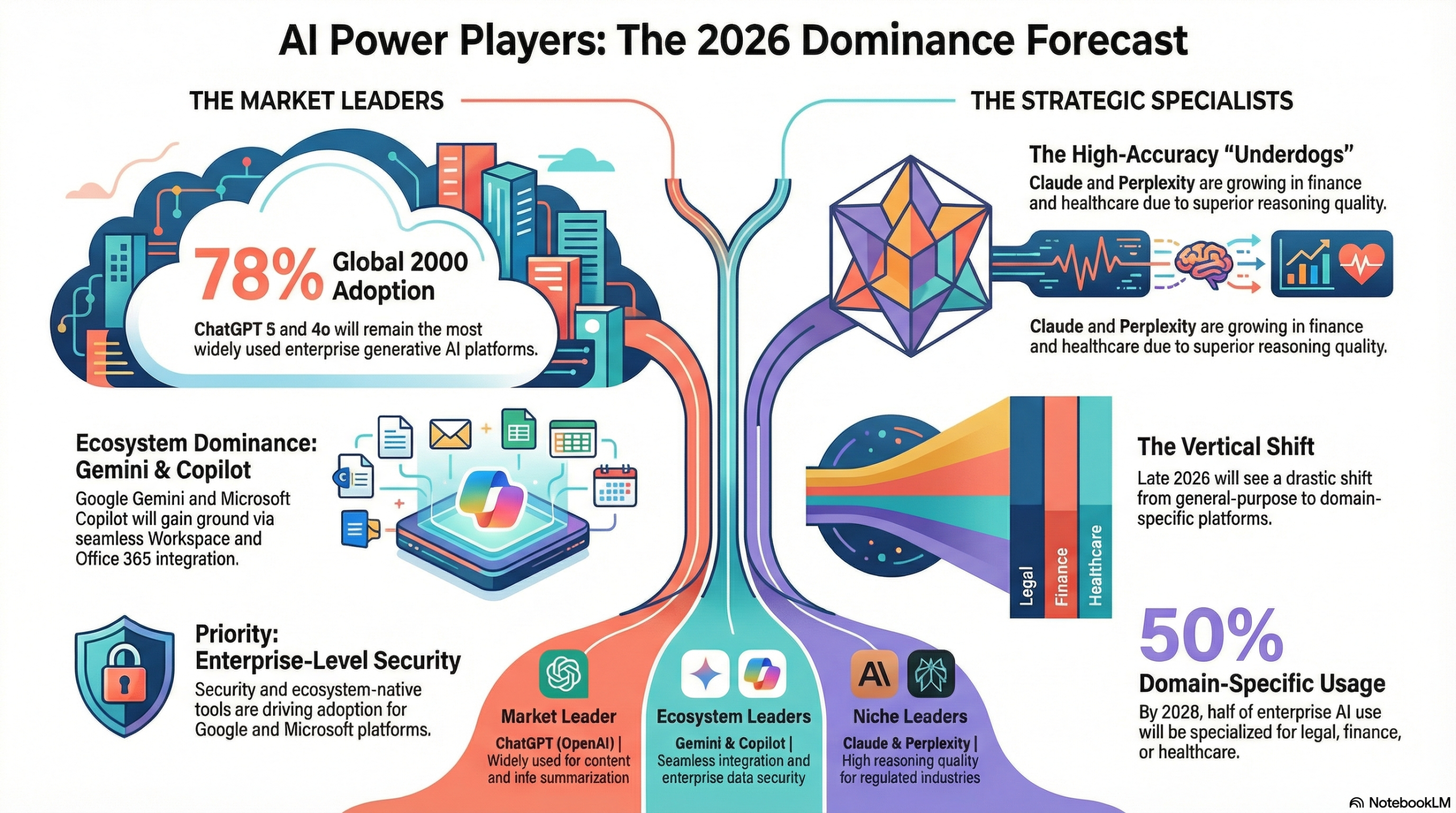
With approximately 78% of Global 2000 companies using OpenAI models for generative tasks (e.g., content generation, summarizing info, etc.), ChatGPT 5 and 4o will almost certainly remain the most widely used AI platforms, at least in enterprise settings.
However, Google Gemini and Microsoft Copilot will likely gain significant ground, primarily due to their seamless ecosystem integration (Gemini → Google Workspace; Copilot → Office 365), as well as emphasis on enterprise-level data security.
When it comes to “the underdogs,” Anthropic’s Claude and Perplexity AI are showing a strong and growing presence, most notably in sectors that prioritize reasoning quality and information accuracy, such as highly regulated industries like finance and healthcare.
Finally, by the end of 2026, we could also witness a shift from general-purpose to domain-specific platforms, such as for legal, finance, or healthcare. In fact, independent market analysis forecasts that, by the end of 2028, as much as 50% (or more) of enterprise-level generative AI use will be domain-specific, implying that B2B adoption will also hinge on task-specialized and vertical solutions.
Seth Matthews, an AI SEO content writer within ZeroClick Labs, began his career in civil engineering, but his passion for writing drove his deliberate transition into professional content strategy and SEO. The clash of two worlds produced a writer who can effortlessly combine technical precision and narrative clarity with the emotional and psychological impact of creative storytelling.
AI tools are becoming operational imperatives across every facet of e-commerce. Adoption is no longer a matter of choice or preference – and neither is the need for AI alignment.
In this brave new digital world, defined by zero-click buyer journeys and model-driven discovery, wins are not awarded to the biggest, loudest, or even best SEO-optimized brands; they are awarded to those who are most aligned with the future – and the future is AI-driven.
ZeroClick Labs is here to help you achieve alignment in the answer layer by optimizing your product data, content architecture, and trust/authority signals so they become unmissable – and unmistakable – for large language models.
Connect with us today and ensure your brand is not just present in the market – but present where the modern buyer is.
“Our agency had no idea how to approach AI visibility. ZeroClick only does this one thing so they actually know what works. Worth every penny just to not waste time figuring it out ourselves.” – Jay