Ranking is no longer the primary criterion for AI search visibility: citation eligibility and selectability are.
Content structure decides citation eligibility before quality does: easily-extractable, answer-first formats hold the highest leverage.
Breadth beats depth: query fanouts plus Reciprocal Rank Fusion reward content that appears consistently across multiple sub-queries.
Authority is an off-site asset: 3rd party platform reviews, community discussions and peer-generated content are critical trust signals for AI models.
Agentic AI Optimization (AAIO) is the next frontier: making a website operable for autonomous AI agents is becoming the core visibility factor heading into 2027.
Executive Summary: This AI search optimization guide covers what businesses and marketers need to stay visible in 2026. AI search has shifted the priority from ranking to getting cited, and that means structuring content for extraction, building third-party authority, and making sure your site is crawlable. As autonomous AI agents multiply, agentic search optimization is becoming the new standard for businesses that want to stay ahead.
More than half of B2B buyers start their research on AI platforms. 93 out of 100 queries end without a click. As of May 2026, Google Search itself became an agent that researches, monitors, and acts on users’ behalf.
The fabric of online visibility is restructuring.
Brands whose visibility strategies still rely solely on blue links are optimizing for a search experience that’s rapidly becoming obsolete. Brands who are winning – and will continue to win past 2026 – are those who adopt AI search engine optimization as the default tactic.
Disclaimer: This is deliberately not a technical manual on how to optimize a website for AI search engines, since implementation details may vary widely by platform, stack, CMS, and a host of other factors. Rather, it is built to explain how AI search engines select and cite content, and why current AI SEO practices work, giving marketing leaders and business owners strategic, directional understanding of the new visibility model.
How did AI search change online visibility?
To understand how to optimize for AI search, it helps to understand how Large Language Models (LLMs) changed search as a whole. With traditional search, users would get a list of ranked links (“blue links”). They would then click, browse, read, rinse and repeat, gradually forming their own conclusions. The brand’s job was relatively simple: earn a high-enough ranking to win the click.
The shift in one view
From ranking, to citation, to action
SEO
Earn the click
Ranked links
GEO
Earn the citation
Synthesized answers
AAIO
Earn the action
Autonomous agents
AI Search eliminated most of these steps. Platforms like ChatGPT, AI Overviews (AIOs), and Perplexity now synthesize information from dozens of sources, delivering a single, comprehensive, and confident answer. The user gets a recommendation, a comparison, or a shortlist, all within seconds and without ever having to visit a single website.
Effectively, AI Search has collapsed the research and discovery stages of the buyer journey into several prompts. More than that, AI Search has already become the default discovery layer in competitive environments, and the evidence abounds:
The implications of the ranking-to-citation shift is no longer a nuance and cannot be ignored: buyers using AI to research, shortlist, compare, and risk-assess are neck-deep in the decision arc, not browsing casually – meaning a brand absent from AI answers is invisible at the exact moment of vendor selection, not at the top of the funnel.
A brand that ranks first in Google SERPs but fails to appear in AI-generated answers is losing a rapidly growing segment of its most valuable, highest-intent customers.
How AI models select and cite content
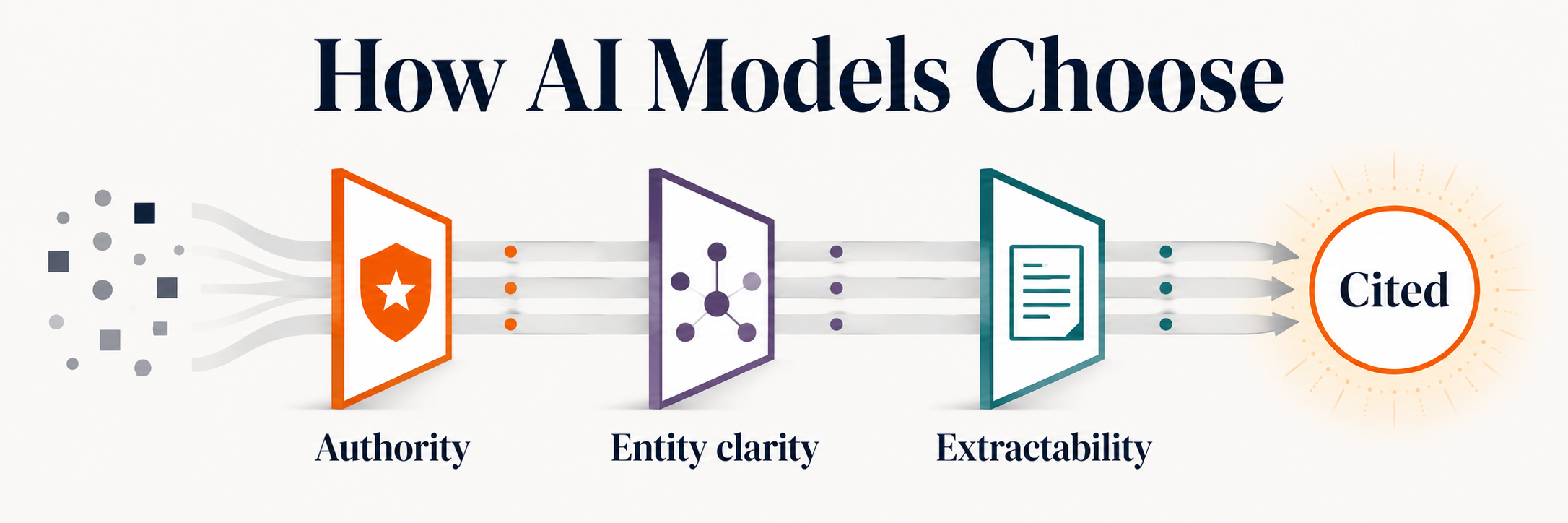
The citation selection mechanics are the baseline to understanding how to optimize content for AI search engines. When retrieving and synthesizing information, LLMs apply a distinct set of criteria: authority, entity clarity, and extractability.
How AI models choose content to cite
These are the factors that consistently determine what sources get cited and, although they overlap with traditional SEO authority, AI algorithms weigh them far more heavily and apply them at the point of synthesis, rather than ranking.
Authority
AI models favor sources that demonstrate genuine expertise: original research, consistent topical coverage, and corroboration from other credible sources. Domain authority still matters, but is superseded by topical depth.
Entity clarity
LLMs need to know exactly who a brand is, what it does, whom it caters to, and why it should be trusted. If these signals are ambiguous or inconsistent across web results, the AI will typically choose to ignore them, regardless of content quality.
To optimize your brand and website for AI search, we recommend focusing on these five distinct segments: AI-friendly content, off-site authority, community engagement, technical readiness, and agentic AI optimization.
1. AI-friendly content optimization & formatting: engineering for extraction
This is where the majority of AI search optimization either succeeds or fails early, and the reason is purely mechanical: AIs don’t read content the way we humans do. Instead, they scan, parse, and extract, and to do so efficiently, they need precisely defined entities, modular organization, and explicit information. In other words, they need information that requires minimum-to-no interpretation.
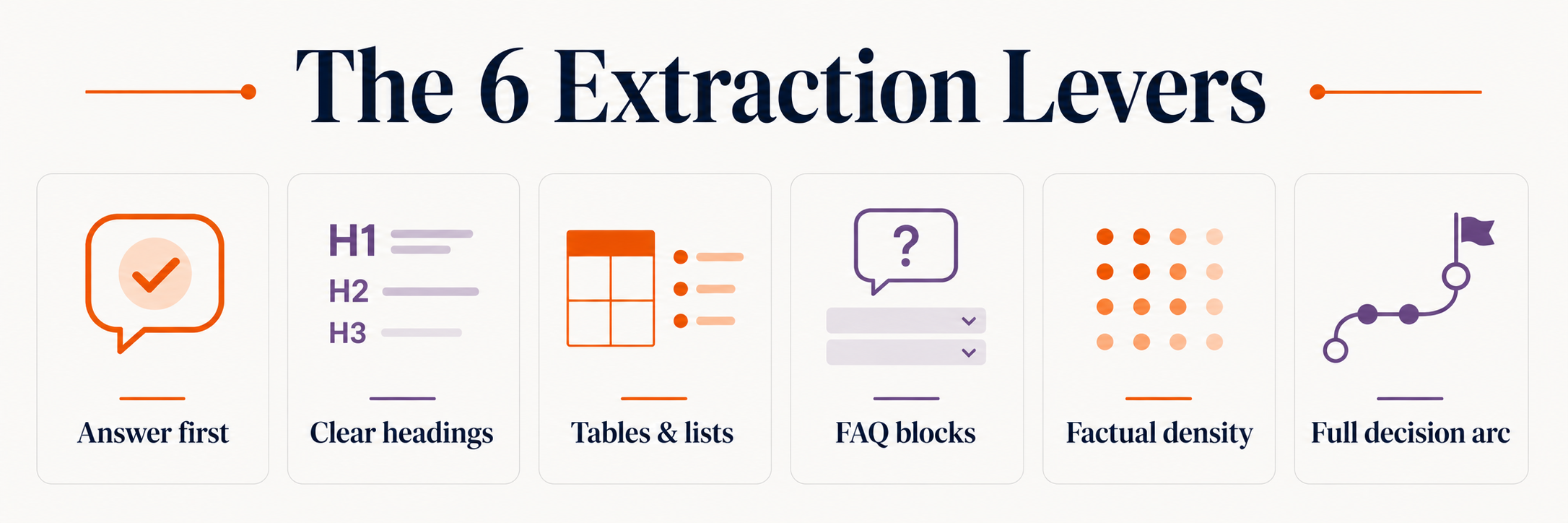
The Six Content Extraction Levers
The practical implication is that how to optimize content for AI search engines is largely a question of structure before it is a question of quality. Both matter, but the former determines whether the content enters the retrieval pool at all.
1.1 Answer-first architecture
AI models prioritize content that addresses search intent (query) directly and immediately, which is why answer-first structure remains the most consistently effective formatting principle. Leading with a clear, direct response (i.e., within the first 50-100 words), followed by supporting detail, aligns with how LLMs extract and synthesize information, thereby increasing citation likelihood.
1.2 Clear, descriptive headings
Headings serve a dual purpose: signaling topical relevance to AI crawlers and creating natural extraction points within longer content. A heading like “How to optimize a website for AI search results?” is more useful to an answer engine than “Introduction” or “Overview” because it tells exactly what the section contains upfront. Less processing means a lower cognitive load on the model, meaning higher selectability.
1.3 Logical heading hierarchies, tables, and lists
These aren’t stylistic preferences, they are extraction surfaces. An analysis split into H2 sections, each broken down further into logical H3, H4, and H5 sub-sections, makes it easier for AIs to answer specific user questions, without having to parse the entire article.
The simplest HTML pricing table is machine-readable in a way that a prose paragraph about the same pricing will never be, because each value is an exact data point, rather than something the model has to infer from the context. By similar logic, lists are already digested information, explaining why listicles are by far the most cited format in both traditional and AI answers.
ZeroClick Labs Citation Study
Which content types AI engines cite most
Share of ~38,500 AI citations across ChatGPT, AI Overviews & Perplexity over a 30-day window.
Owned / first-partyCommunity / earnedEditorial / long tail
Listicle
33.8%
Listicle — 33.8%Owned · ranked lists; the single most-cited format across every platform.
Product page
28.1%
Product page — 28.1%Owned · spec-rich pages ChatGPT leans on most heavily.
Homepage
11.3%
Homepage — 11.3%Owned · entity anchors that confirm who a brand is.
Discussion
7.9%
Discussion — 7.9%Community · forum & community threads; heavily Perplexity-driven.
Unknown — 0.9%Editorial · unavailable or unclassified pages.
Alternative
0.2%
Alternative — 0.15%Editorial · “best [X] alternatives” pages.
Other
0.1%
Other — 0.14%Editorial · uncategorized page types.
Bar length is scaled to the largest value (listicles, 33.8%). Source: ZeroClick Labs AI Search Content Report 2026 — ~3,300 URLs, ~38,500 citations, 30-day window.
Cross-platform AI citation patterns
Optimization isn’t uniform across platforms. Our citation study showed that each engine has a distinct content-type appetite, meaning that a single asset simply cannot win everywhere. For this reason, visibility strategies must be platform-specific:
AI Overviews optimization should focus on listicles first and product pages second, with homepage, discussions, and video content as a tertiary objective.
ChatGPT optimization should prioritize product pages, followed by listicles, and support them with homepage, profile pages, and category pages.
Perplexity optimization should be balanced between listicles and product pages, followed immediately by homepage and discussion content.
By identifying which engines their buyers use and optimizing accordingly, brands can avoid one of the biggest pitfalls of AI search engine optimization: diluting their strategy and, consequently, their visibility.
1.4 FAQ sections
Q&A-style formatting maps directly onto how users prompt AI models. This makes FAQ content naturally retrievable, evidenced by the fact that these content pieces and sections consistently remain among the highest-performing formats for AI citations.
AI models seldom search for the exact phrase a user typed in. Instead, they perform a query fanout: several parallel background searches per prompt, with intent modifiers (e.g., best, 2026, vs, reviews, comparison) injected into sub-queries.
How one prompt becomes many
Query fanout & Reciprocal Rank Fusion
AI rarely searches your exact phrase. It expands one prompt into parallel sub-queries, then fuses the results — rewarding content that shows up consistently across all of them.
1 promptwhat the user typed
bestvs2026reviews
parallel sub-queries
RRF
1 answerfused by consistency
Takeaway: breadth across the decision journey beats depth on a single phrase.
The results are then combined via Reciprocal Rank Fusion (RRF), which rewards content that appears most consistently across the largest number of sub-queries. For this reason, covering the entire decision journey is more valuable for AI visibility than covering one angle in detail.
Stay in the Loop – Stay Ahead
Sign up for The Laboratory newsletter and get the latest insights from AI world straight to you inbox!
2. Brand mentions and citation seeding: authority as an off-site asset
The relationship between link building and AI visibility is one of, if not the most misunderstood aspects of AI search optimization. Traditional SEO treated backlinks primarily as authority signals that influenced ranking algorithms (i.e., PageRank). AI models treat them as evidence.
A claim that exists only on a brand’s own website is an assertion. The same claim mentioned in a credible industry publication, cited in an independent analyst report, or discussed in an authoritative forum is evidence of trust and authority the AI needs to justify surfacing the brand.
AI-era authority building requires consistent, corroborated brand presence across sources AI models trust.
Why off-site authority wins
Assertion vs. evidence
Assertion
Your site only
A claim that lives on one domain is just a claim.
Evidence
Your brand
Reviews
Publications
Analysts
Forums
Corroborated across sources, it becomes a fact AI will repeat.
37.9%of AI Overview citations come from page-one results — authority now lives well beyond the top 10.
Source: Ahrefs, via ZeroClick Labs.
Application
For practical purposes, the citation and link building aspect of AI search optimization should prioritize:
Analyst and review platform presence: AI models actively seek reviews, even unprompted. Therefore, a brand’s presence on sites like G2, Capterra, and Trustpilot, as well as industry-specific directories and vertical-specific review platforms, directly shapes how AI describes it, whether the brand participates or not.
Editorial mentions presence: Being featured or cited in trade publications, industry blogs, and news outlets is vital, not just to increase the link value, but also to amplify narrative signals AIs use to characterize who the brand is, what it does, and who it serves.
Original data: Authentic research, studies, surveys, and other forms of proprietary data are potent citation magnets because answer engines need them to ground their synthesis. As such, publishing original content is no longer brand play, it’s a structural and strategic advantage.
Notably, across the above points, there are no mentions of winning a specific number of links. That’s because they are a bonus instead of an objective.
The goal of citation building for AI search is to intensify the depth of legitimate third-party evidence, making a brand’s real reputation more visible and more resistant to distortion.
3. Community engagement & social presence: the human signal layer
In short, peer-generated content carries weight that vendor-produced content cannot replicate on its own. Furthermore, they show that AI models treat community platforms as a trust layer, primarily because the content there is difficult to manipulate at scale.
Community platforms are not peripheral citation sources. They are primary ones.
From the strategic AI search optimization perspective, this means that every authentic community footprint is an independent, third-party validation node. As such, an effective community engagement strategy should follow two consistent optimization principles.
Authenticity over volume
A single well-placed, genuinely useful response in a high-traffic Reddit thread carries more citation weight than dozens of promotional comments. LLMs assess source quality, and communities can quickly distinguish between genuine participation and brand promotion – and are even quicker to point it out.
Topical consistency
Brands that contribute meaningfully and regularly to the same topics stand to build not just a stronger community presence but a stronger authority signal. However, caution is advised, because the inverse is also true.
Brands that participate sporadically or across too many unrelated subjects risk diluting their authority signal. Worse, topical inconsistency leaves more room for the model to misinterpret and, therefore, misattribute or misstate facts – effectively seeding hallucinations about the brand.
3.1 Where the signals concentrate
Although there’s a host of community platforms AIs use to confirm trust signals, the majority is concentrated around four major surfaces:
Reddit: The heavyweight
Subreddits routinely surface in AI answers for “Best of/for” and experience-based queries. Plus, the platform has a content-licensing agreement with Google, so it’s automatically favored by Gemini, AI Mode, and AI Overviews.
The play is authentic participation: genuinely helpful answers from credible accounts in relevant communities, NOT drive-by self-promotion, which is increasingly discounted by both communities and answer engines.
Quora: The credibility cue
Although it carries less weight than Reddit, Quora still retains strong citation presence across major models for definitional and how-to queries, especially threads with expert-flagged answers, which most AI systems treat as a direct credibility cue.
LinkedIn: Outsized in B2B
This platform carries disproportionate weight in B2B, since it’s preferred destination for executive thought leadership. As such, presence on this platform serves a dual purpose:
Building and reinforcing entity signals that confirm expertise and credibility.
Producing citable content that AI models can reference when characterizing the brand’s positioning and authority in its category.
Surfaces in “best of” and experience queries; licensed to Google.
LinkedIn
B2B weight
Executive thought leadership; reinforces entity signals.
Quora
Credibility
Definitional and how-to queries; expert-flagged answers count.
YouTube
Sleeper
Transcripts are extractable; over-indexes in AI Overviews.
13.4%of SaaS citations are discussion content — peer signals are primary sources, not peripheral ones.
Source: ZeroClick Labs SaaS citation study.
3.2 The mindset shift
How to optimize for AI search engines by leveraging community platforms has little to do with actual optimization, per se. It’s more about recognizing that community platforms are citation channels in their own right and treating them as such: with the same editorial discipline as native content, rather than as dumping grounds for leftover content.
4. Website performance & technical readiness
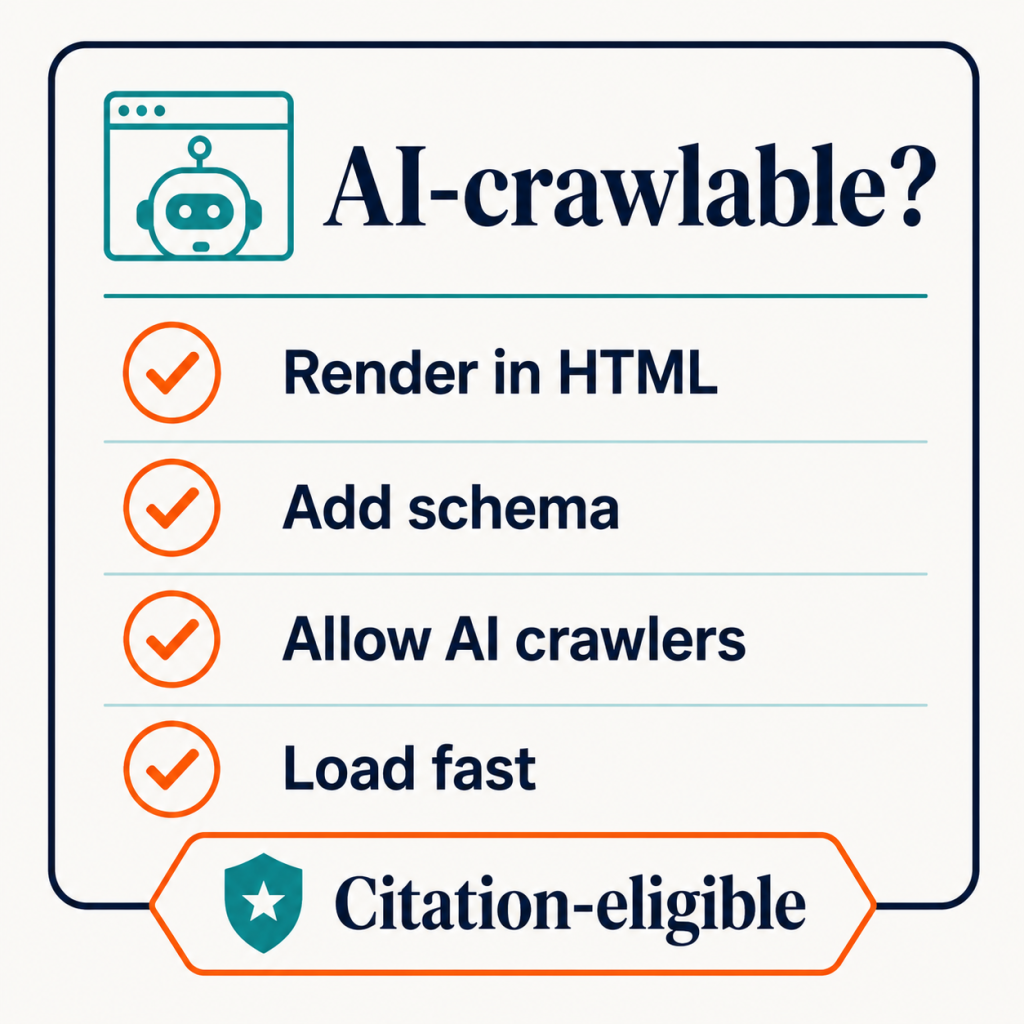
AI crawlers (and, increasingly, AI agents) aren’t as patient or as capable as Googlebot (yet). They struggle to render JavaScript, operate on tight crawl budgets, and skip pages that respond slowly, obscure their content, or introduce access friction, even inadvertently. Therefore, when considering how to optimize a website for AI search engines, three technical areas have the most direct impact.
Is your website AI crawlable?
4.1 Machine-readability
Optimizing the data to be machine-readable is a critical factor, as it determines whether the website is even eligible for citation. AI models have a far easier time extracting and using content that is structured and accessible. Therefore, rather than embedding them in images, PDFs, or JavaScript-dependent elements, ensure critical data meet the following criteria:
Server-side rendering / static HTML: Make critical data available in raw HTML. If real-time pricing, product specifications, contact information, service descriptions, and key claims only exist after client-side JavaScript executes, a meaningful share of AI crawlers never sees them.
Structured data (Schema markup): Implement Organization, Product, Article, and FAQ schema to help models parse entities and relationships. Schema isn’t a magical citation silver bullet, but it drastically reduces ambiguity about who the brand is and what it offers, which is precisely what citation selection algorithms reward.
One fact, one canonical location: Conflicting or inconsistent product/service information across pages forces models to guess. They guess wrong.
Notably, machine-readability is especially important for e-commerce and B2B service providers. Since these sectors increasingly use AI tools to research and shortlist vendors, accurate and current data is more than a nice-to-have, it’s a prerequisite for appearing in AI-generated answers.
4.2 Page speed & responsiveness
Fast, responsive pages are not just better for user experience (UX) – they are easier for AI crawlers to process at scale. What this means is that site speed is effectively a crawl-equity multiplier:
Slow sites get partial representation, which can produce inaccurate summaries of the brand.
Pages that load slowly or return errors are less likely to be included in LLMs’ retrieval pool, if at all.
An excellent example of this surfaced in our citation study, underscoring just what’s at stake: ChatGPT logged the highest rate of 404 crawl attempts (2%) of all platforms and, since models retain and revisit URLs over time, every broken legacy URL is more than just a UX issue – it’s a failed citation opportunity.
4.3 AI Crawler & Agentic access hygiene
Many sites unknowingly block Google-Extended/Google-CloudVertexBot, GPTBot, ClaudeBot, PerplexityBot, and other AI crawlers, as well as AI agents, inadvertently opting out of AI visibility, while wondering why they never appear in answers.
The solution for both angles involves addressing blockers that make it unnecessarily difficult for AI crawlers and agents to access the website:
For AI crawlers (bots):
Auditing robots.txt and bot-management rules ensures they’re not gatekeeping parts of the website you want indexed.
For AI agents:
Adopting LLMs.txt – it’s an emerging convention, but it can help direct agents to targeted content (APIs, pricing, return policies, etc.), ensuring correct summarization and citation of the brand in generated answers.
Auditing security infrastructure and relaxing measures that interpret automated access as suspicious (e.g., CAPTCHA, rate limiting, IP/user-agent blocking) to enable legitimate AI agents to access and navigate brand pages.
5. The frontier: Agentic AI Optimization (AAIO)
Everything up until this point addressed AI that answers. The next evolution is the AI that acts – and it arrived faster than almost anyone could’ve predicted: OpenAI’s operator-class models are completing multi-step tasks autonomously, Gemini 3.5 Flash builds custom mini-apps on the fly, and Google even made Search itself agentic.
The paradigm shift is no longer theoretical, it’s already happening and will only continue to accelerate. In fact, Google’s own CEO, Sundar Pichai, signaled this shift explicitly, pointing to 2027 as the inflection point where it happens “pretty profoundly.” The key implication is that this shift has the potential to redefine competitive visibility over the next two to three years.
For brands, this means thinking beyond citation and toward operability. A brand that’s easily citable is visible. The brand that’s easily operable becomes the endpoint, a place where an autonomous AI agent sends the user or completes a transaction on their behalf. This is where a new mode of AI search engine optimization comes into play.
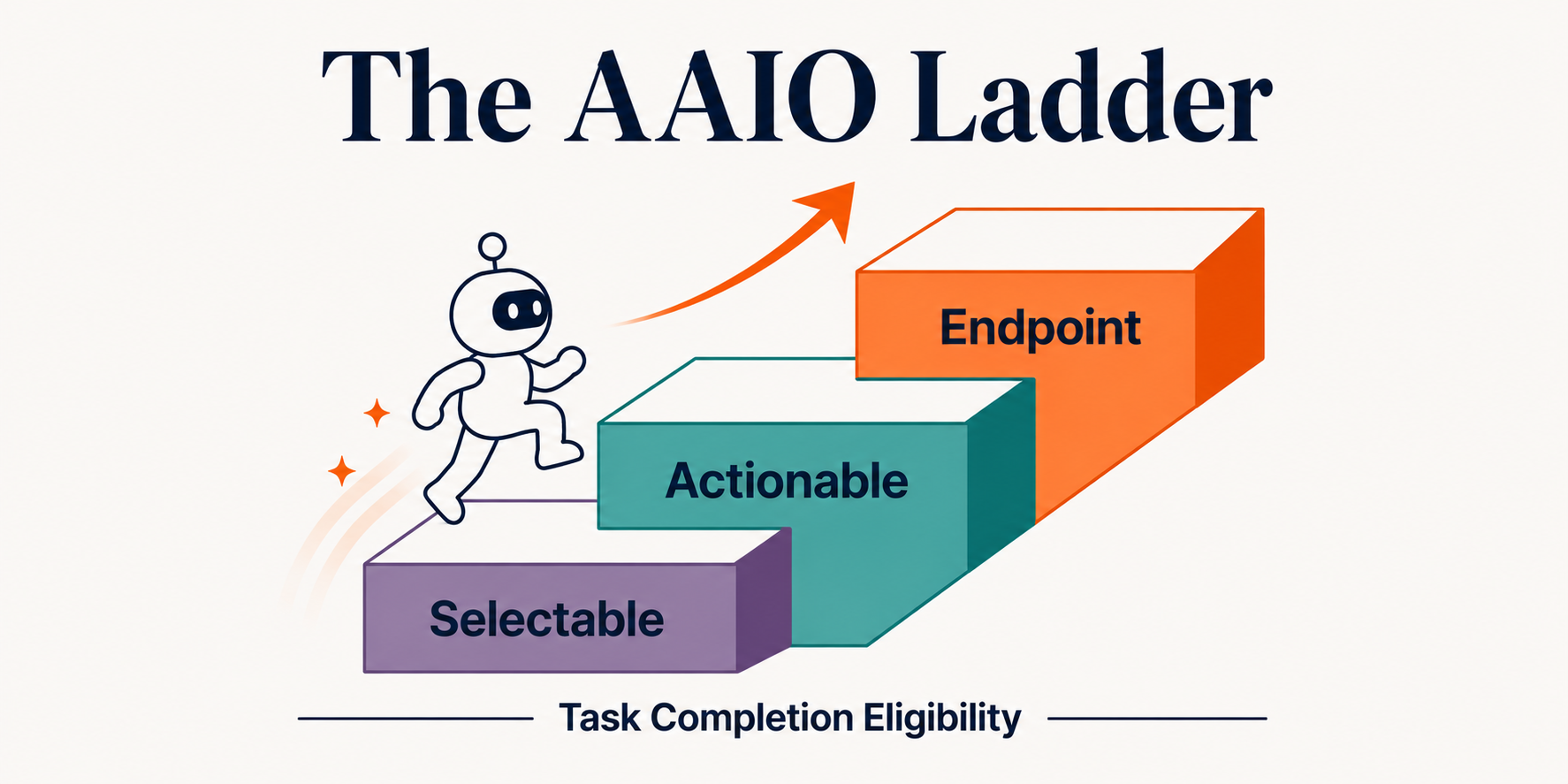
5.1 AAIO & Task Completion Eligibility
Agentic AI Optimization (AAIO) is the practice of making a brand both selectable AND actionable for AI agents. AAIO builds directly on the foundations covered in this guide, focusing primarily on a new core selectability factor: Task Completion Eligibility.
Task Completion Eligibility requirements
AI agents favor brands whose websites allow them to finish the job – i.e., who meet Task Completion Eligibility requirements:
The negative implication of lacking AAIO is unforgiving: the brand can be the best choice for an AI-synthesized answer and still lose the transaction just because the competitor’s site was easier for an AI agent to operate.
However, the positive implication of AAIO is equally consequential: it helps citation authority compound. Since agents synthesize the existing authoritative content continuously and autonomously, every visibility investment achieved through AI search optimization gets amplified – not obsoleted.
Brands already structured for AI selectability win even harder. Brands that aren’t get filtered out at machine speed.
AI Search engine optimization in 2026 is NOT a bolt-on tactic
It’s a foundational reorientation around a new question:
When a machine synthesizes the answer – why would it choose you?
The evidence base is consistent. Extraction-friendly content wins citations. Third-party validation is load-bearing infrastructure. Technical readiness determines citation eligibility before content quality is even evaluated. And the rise of agentic search is breaking the ceiling on what visibility is worth.
The value of being the answer has never been higher, and the brands treating that as an opportunity rather than a threat are the ones AI will be recommending in 2027.
Jordan Parkes, the CEO and founder of ZeroClick Labs, has been building and scaling digital marketing strategies since 2012, leveraging performance-driven SEO and data-based digital marketing solutions to guide the growth of hundreds of companies across the U.S. and Europe.
From ranking to citation and from citation to agent operability – the evolution of search has never happened faster or been more volatile.
To win in an environment that oscillates between extremes with every new AI model iteration, you need a partner that can figure out exactly where you stand in AI search and what it would actually take for you to become an answer buyers are reading.
You need ZeroClick Labs.
With 15+ years in digital marketing and search analytics, a team of dedicated visibility experts, and strategies proven across 200+ clients, we are the strategic partner to usher your brand into the new age of AI-visibility.
Connect with us today, and let’s make you show up where the decisions actually get made!
“Our agency had no idea how to approach AI visibility. ZeroClick only does this one thing so they actually know what works. Worth every penny just to not waste time figuring it out ourselves.” – Jay