AI Marketing SaaS Statistics
ZeroClick Labs compiled a list of SaaS marketing statistics to help brands and marketers understand how their buyers research, what...
Continue Reading
A strategic guide for marketers and business owners on earning citations and winning visibility in Perplexity in 2026.

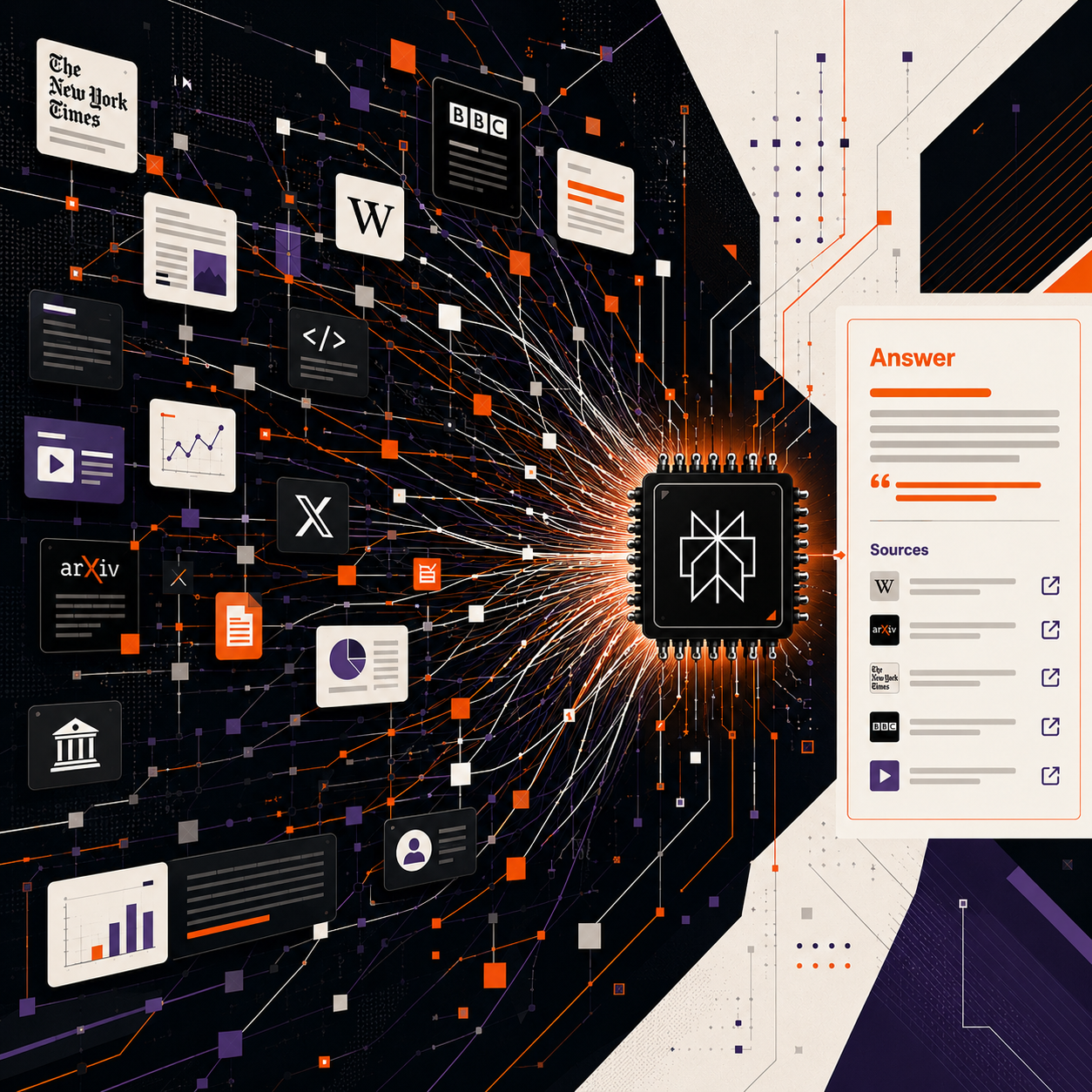
Crawl eligibility comes before citation eligibility: if PerplexityBot cannot crawl your website, nothing downstream matters.
Retrieval is live and per-query: freshness and structure are being re-evaluated on every query, rather than banked like backlinks.
Consistency of coverage beats peak position: full-decision-arc coverage wins more query fanouts than a single hyper-optimized or exact-match page.
Lead with the answer, structure for extraction: modular formats with front-loaded substance have a higher chance to get lifted.
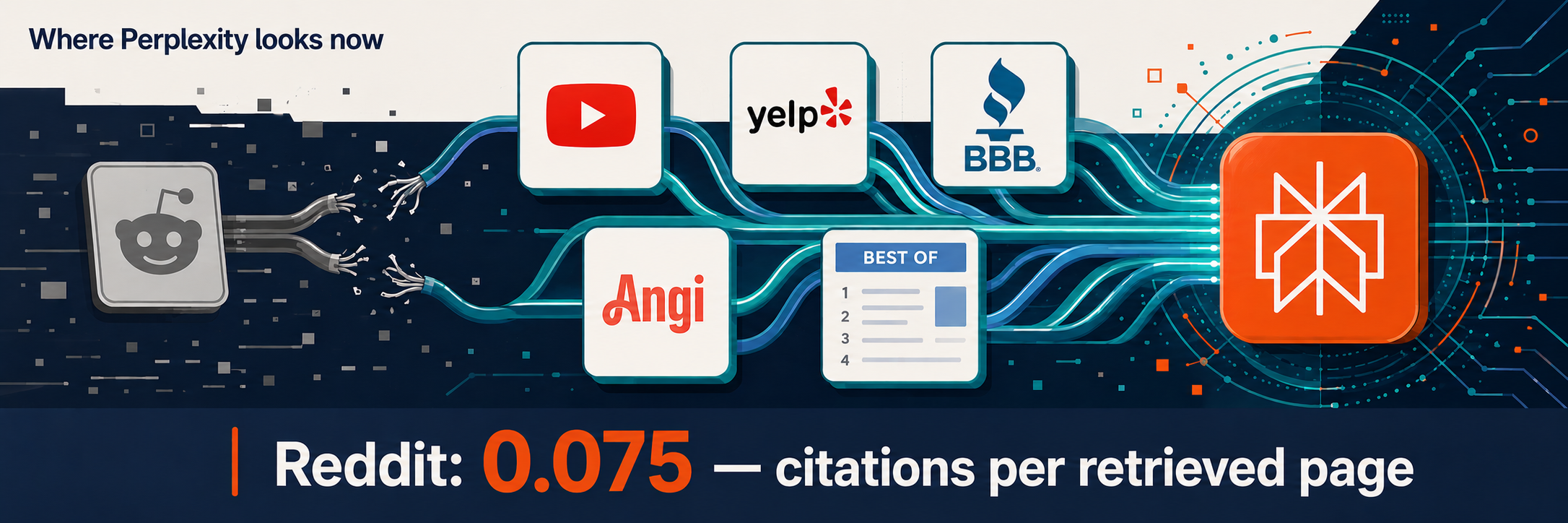
Reddit is no longer a Perplexity lever: the model now retrieves and cites it at the lowest rate of any major engine.
Executive Summary: Perplexity is a source-agnostic, live-retrieval answer engine that pulls and grounds sources fresh for every query. Winning it depends less on search rank and more on being a credible, extractable source backed by third-party roundups, directory presence, and clean brand entity. Perplexity SEO workflow entails getting retrievable first, then earning citations through structure, freshness, and full decision-arc coverage.
Despite being considered the “ultimate underdog” among frontier AIs, Perplexity is highly praised for its research and fact-checking capabilities, and even more for the ability to deliver the freshest information currently available on the Web.
This is exactly why more than half of its user base are knowledge workers and power researchers – users who know exactly what they’re looking for and who live in industries where peer opinions aren’t sporadic sanity checks, but mandatory steps in every decision.
And Perplexity is built to deliver exactly on those fronts – just not through the channels the entire industry keeps recommending.
Consequently, Perplexity AI SEO dramatically differs from other model-specific optimization practices, despite resting on the same foundational rules of AI search visibility. In this guide, we’ll be exploring those differences and showcasing how you can leverage the underlying mechanics to increase your odds of winning Perplexity citations.
Disclaimer: This isn’t a technical manual on how to rank in Perplexity. It explains how its engine selects and cites sources, and why the tactics that move the needle actually move it, therefore equipping business owners and their marketers with a directional, strategic grasp of how visibility in Perplexity is actually won.
Our March 2026 study mapped the citation behavior of all three models and found that Perplexity’s profile is distinct: it exhibits source-agnostic, transparency-first behavior with a notably balanced content-type distribution.
In contrast, ChatGPT and AIOs lean heavily toward specific content types (product pages and listicles, respectively), pointing to confidence- and coverage-first behaviors (respectively). The difference is not preferential, but functional: each engine solves a different problem, so the same content performs differently across them.
Not preference — function
| Engine | Citation behavior | Top content type |
|---|---|---|
| Perplexity Balanced | Source-agnostic, transparency-first; balanced distribution | Product pages & listicles (tied, ~26.9% each); high homepage share (15.3%) |
| ChatGPT | Confidence-first; narrower set of high-trust sources | Product pages (41.6%) |
| AI Overviews | Coverage-first; behaves like an at-scale SERP summarizer | Listicles (46.3%) |
Source: ZeroClick Labs citation study, March 2026.
Since Perplexity prioritizes diverse, transparent sourcing over a single definitive answer, its behavior is consistent with that of a research-aggregator engine, which helps explain why it draws on a wider range of content types than any other model we observed.
In addition, Perplexity displayed the highest inclusion of homepages of any engine (15.3%) and the lowest rate of citing dead/unavailable 404 pages (0.05%), signaling that it rewards strong brand-entity signals and link hygiene. These findings alone give us one of the key insights: For Perplexity SEO, the name of the game is balance.
The strategic takeaway #1: A generic, diluted strategy is all but guaranteed to underperform across the board. Therefore, resist the urge to spread AI SEO efforts across multiple platforms just for the sake of coverage. Instead, identify where your buyers actually research and discuss, and commit to surface-specific optimization.
The name of the game is balance
Scale: 0–30% of Perplexity citations. Leading content types shown; not an exhaustive 100% breakdown. Homepage share is the highest of any engine we studied.
Source: ZeroClick Labs citation study, March 2026.
The inherent source-agnosticism, balanced content-type distribution, and heavy reliance on third-party validation push Perplexity SEO more toward building a consensus about your brand across independent third-party sources and away from dominant SERP positioning.
This genuinely makes Perplexity a different optimization surface – and definitely not a place to recycle your ChatGPT visibility playbook or AI Overviews citation strategy. That being said, the differences are ultimately mechanical, and understanding how they work means understanding how to rank in Perplexity.
Without getting too technical: Perplexity runs a live web search for every query, reranks the candidate pages in real time, and synthesizes a cited answer from the best of them. In practice, the flow looks like this (simplified):
The strategic takeaway #2: Freshness and structure are evaluated at the time of retrieval, so they matter on every single query, rather than being banked once (like a backlink).
The strategic takeaway #3: Diversity of corroborating sources and visible attribution are valued more than a definitive answer from one authoritative source.
How Perplexity answers a query
Pulls candidate pages from its PerplexityBot index (plus supplementary sources for long-tail queries).
Scores each candidate on how directly it answers, how trustworthy it looks, and how cleanly it extracts.
Assembles the answer and attaches inline citations to the sources it actually used.
Under the hood
Hover or focus each stage for detail.
Source: ZeroClick Labs; Perplexity documentation.
Now, let’s take a peek under the hood, because understanding the underlying mechanics directly points to how to rank in Perplexity.
Unlike ChatGPT or Gemini, Perplexity AI isn’t a single model. Instead, it routes across several different systems, including frontier models from OpenAI (GPT-5.2), Anthropic (Sonnet 4.6, Opus 4.6), Google (Gemini 3.1 Pro), and NVIDIA (Nemotron 3 Super 120B).
In addition, it uses its own Sonar model, powered by Llama 3.1 70B and tuned specifically for fast, citation-backed web search. So, regardless of the model you pick (or let Perplexity pick), the engine’s behavior will lean on live retrieval, rather than a model’s training data alone, which is exactly its highest praise point: the capability to surface current, up-to-date information.
RAG (a.k.a. “grounding”) is the retrieval layer: the engine searches its index (rather than internal memory) for passages relevant to the query, and uses those to synthesize the answer. What this step rewards the most is self-sufficiency.
Per Google’s research, grounding systems need sufficient context – an information block complete enough to stand on its own, without the model (or human reader) needing the rest of the page to make sense of it.
On top of that, we have a “quality control layer” that filters out pages that merely regurgitate what’s already in the index, but rewards original material, such as proprietary data, first-hand experience, or a fresh point of view. Here, originality is a real strategic advantage.
The final underlayer is a combination of two inseparable mechanisms:
The strategic takeaway #4: Consistency of coverage beats any single peak position. This is a counterintuitive consequence of fanout and RRF, especially compared to traditional ranking mechanisms, where a page that ranks modestly (e.g., rank #5 or #6) across multiple sub-queries can easily outscore a page that ranks first for one or even the exact-match query.
Why consistency beats peak position
Query fan-out splits the question into sub-queries; RRF sums each source’s rank across all of them.
“best CRM for small agencies”Page A — broad coverage
Page B — one peak
Illustrative — shows the fan-out/RRF mechanic, not measured ranking data.
Source: ZeroClick Labs, “How to Rank in Perplexity in 2026.”
Before going any deeper into how to rank in Perplexity, it’s imperative that you ensure the model can actually retrieve your pages and their content – because if it can’t, nothing downstream matters. For Perplexity specifically, this comes down to addressing two bottlenecks: crawler access and JavaScript.
First things first
Eligibility comes before tactics — clear Gate 1, or nothing downstream matters.
Hover or focus each gate for detail.
Source: ZeroClick Labs; Perplexity documentation.
Perplexity operates two distinct crawlers: PerplexityBot (builds the search index that powers cited answers) and Perplexity-User (fetches pages live on a user request). Block the wrong bot in robots.txt, or let an overzealous Web Application Firewall (WAF) do it for you, and you’re effectively disqualifying your brand from the model’s answers. Fortunately, the fixes are simple:
You can build the most citable page on the internet. If the crawler hits a wall – it doesn’t exist.
Most answer-engine crawlers, including ChatGPT’s, Claude’s, and Perplexity’s, are architecturally incapable of rendering JavaScript. Unlike traditional browsers, AI models are text-based, so they can only read raw, initial HTML when fetching a page. Therefore, if your copy only appears after the JavaScript runs, for a crawler – it doesn’t appear at all.
The strategic takeaway #5: Make your core content available in clean, static HTML. This includes (but is not limited to) elements such as pricing tables, product specifications, comparison data, FAQ answers, primary CTAs, and contact details.
Once your website is retrievable, five levers determine whether you’re citable: third-party validation, answer-first structure, content extractability, content freshness, and full decision arc coverage. These are not theoretical – each lever traces right back to how Perplexity retrieves and synthesizes content.
Five levers that earn citations
Hover or focus each lever for detail.
Source: ZeroClick Labs, “How to Rank in Perplexity: A Complete 2026 Guide.”
Perplexity leans heavily on independent, third-party sources when building a narrative surrounding your brand. Currently, three surfaces act as a veritable live trust layer, and the model “consults” them even without the user’s explicit request:
Not anymore. In our March 2026 citation study, Reddit was Perplexity’s single most-cited domain, accounting for 12.56% of all citations and an astounding 95.4% of all community-content citations. Effectively, Reddit was Perplexity’s community validation layer, not just a part of it. That’s no longer the case.
In our June 2026 cross-platform analysis (coming soon), we measured how each model retrieves and cites Reddit content. Perplexity finished last on both counts, retrieving Reddit in only 3.5% of chats and citing it (once retrieved) in only 0.075 of chats.
The advice everyone is still giving
How each engine treated Reddit — June 2026
How often it retrieves Reddit
% of chats · scale 0–30%
How often it cites what it retrieved
blended citation rate · scale 0–2.0
Perplexity finishes last on both: it barely retrieves Reddit — and cites roughly 1 in 13 of what it does retrieve.
Source: ZeroClick Labs cross-platform Reddit analysis, June 2026 (21 projects). Two separate scales — the metrics are not comparable. Corroborated independently by Ahrefs (June 2026, 3.1M queries): Reddit does not appear in Perplexity’s 50 most-cited domains.
As the data shows, Perplexity barely even reaches for Reddit anymore and, when it does, it typically confines it to the source list only, with roughly one in thirteen retrievals ever making it to citation. Ahrefs’ study confirms this pattern, with Reddit not making it to their top 50 list.
The strategic takeaway #6: Reddit seeding is no longer a viable visibility play for Perplexity. However, note that this is a Perplexity-specific finding, not an across-the-board Reddit obituary. Other models still reach for Reddit heavily, so the play still pays, just not here.
With Perplexity, you can never fully control the narrative surrounding your brand. A roundup that omits you, a stale directory listing, a competitor’s comparison video, all these surfaces shape how the engine describes your brand at scale. Notably, this is also the area where most brands underinvest, which is a cross-model mistake, not Perplexity-specific.
The strategic takeaway #7: Audit which third-party sources Perplexity cites for your category, then work on them deliberately. Pitch for inclusion in the roundups and comparisons that already rank, keep your directory and review listings complete and current, and treat video as a top-tier Perplexity citation surface.
The caveat: Do not misinterpret this as a license to astroturf. Although manufacturing mentions and inauthentic seeding are widespread, AI models are increasingly being trained to recognize and penalize them, and many review platforms already have aggressive anti-fraud filters in place. Win coverage on merit, and you’re eliminating a risk point that could make you un-citable.
Like all LLMs, Perplexity suffers from the “Lost in the Middle” phenomenon: it remembers the information near the very top and very bottom of text, but misses the detail in between. In simple terms, if you force the model to dig through 500 words just to get to the point, you can rest assured it will promptly move on to a cleaner source.
The strategic takeaway #8: Front-load the substance. Open each section with a direct, self-contained response (e.g., answer, conclusion, statistic, recommendation), then provide the context. This “BLUF” (Bottom Line Up Front) model is the single cheapest structural edge available – plus, it serves human readers who increasingly skim over the content.
There’s a reason why FAQ-style Q&A blocks, numbered/bulleted lists, and comparison tables are all disproportionately represented in AI answers: each is a self-contained unit, near-effortless for a model to extract and ground against. And if there’s one thing answer engines love, it’s not having to spend an ounce of cognitive load more than necessary.
The strategic takeaway #9: Prioritize modular formatting to help the model lift your content without guesswork. This entails writing headings as plain, descriptive questions or noun phrases, opening with short paragraphs that deliver substance in the first 50-100 words, and then following with context/elaboration that preferably contain numbered steps, bulleted lists, or comparison tables.
A word of caution: Keyword stuffing is a no-go. While this practice still works for traditional ranking, for Perplexity it only adds noise that the model has to sift through.
Despite what the myths about structured data say, Schema is not some citation lightning rod. In Perplexity SEO, its role is a supporting one: helping sharpen entity definitions and the relations between them.
Therefore, implement Schema formats (Organization, Product, Article, FAQPage) to help Perplexity better understand who you are, what you do, what you offer, and who you cater to – not as a substitute for quality.
As a recent multi-million citation study confirmed, Perplexity maintains the most aggressive, systematic recency bias of all major AI models available today when it comes to selecting and citing sources. As such, content freshness must be treated as a primary ranking input, not just a nice-to-have.
The strategic takeaway #10: Refresh your pages regularly (quarterly is recommended). Bear in mind that blanket re-dating or similar “cosmetic” strategies won’t work. Revisions should be substantive, so as to add real value to existing content. In addition, focus your efforts on pages already earning Perplexity citations, as updating them tends to deliver a faster, more measurable lift than brand-new pages starting from zero.
Due to how query fanout works, breadth of coverage is more important than depth of coverage. This means that a content cluster answering as many questions as a buyer could ask, even lightly optimized, will get surfaced across far more fanouts than any single page, even perfectly optimized.
Most importantly, the citations compound within a topic cluster: the more often your content is cited across fanout prompts, the more Perplexity treats your brand as a default source for that entire topic. Put simply, a well-designed, multi-angular content cluster is a durable asset that compounds not only your Perplexity visibility – but authority, as well.
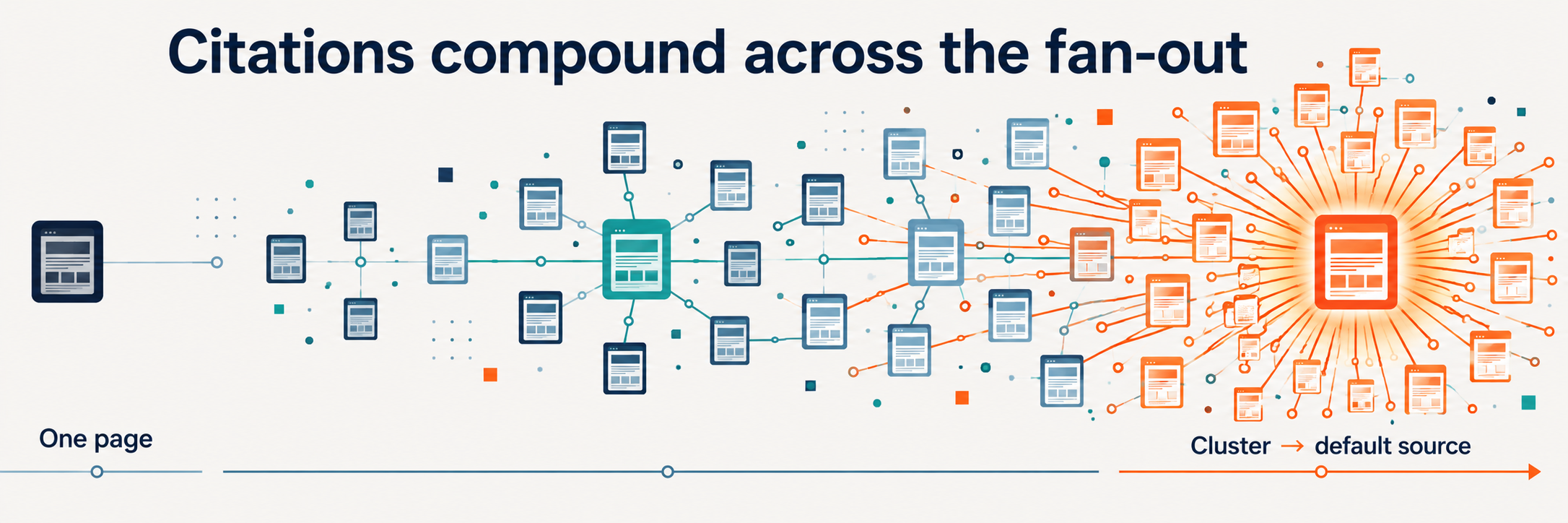
The strategic takeaway #11: Engineer a content cluster that covers the full decision arc. Answer what your product/service does, who it’s for, how it compares, what the practical use cases are, what it costs, what user experiences are – everything that a real buyer might ask. Interlink pages within the cluster using descriptive, unambiguous anchors so the relationships are immediately clear to the model and the user.
A word of caution: Don’t spin thin, near-duplicate pages for every variation. Doing so only raises spam flags, thereby sinking your authority and visibility, rather than building them up.
Like many other frontier models, including ChatGPT and even Google Search itself, Perplexity is aggressively pivoting toward agentic space, transitioning from a passive search engine into an autonomous workflow platform:
New capabilities also mean that the finish line has shifted. The endgame is a website an AI agent can operate as an endpoint, not just read.
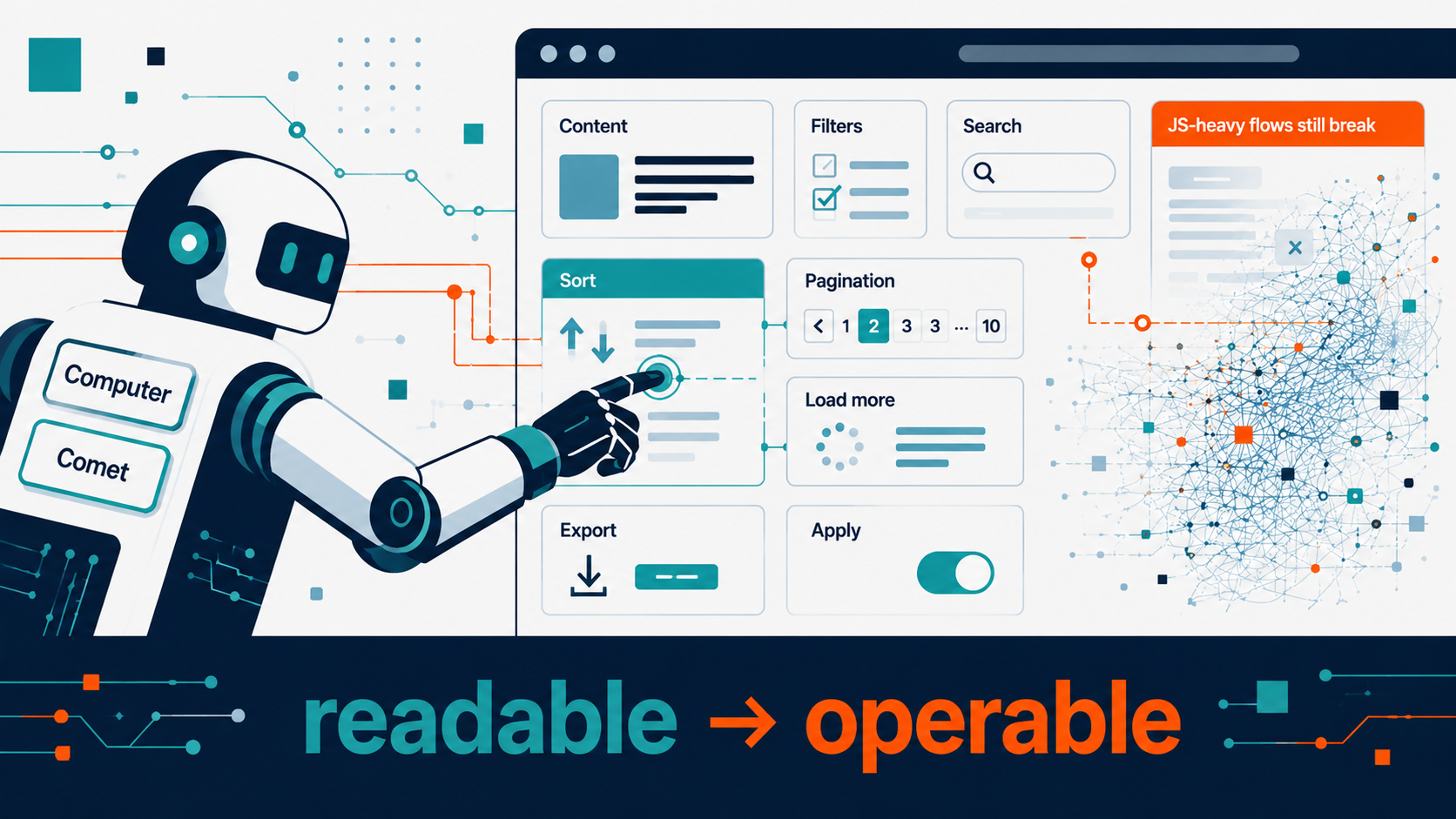
Yet, despite all the revolutionary functionality, AI agents still suffer many drawbacks: they still stumble on JavaScript-heavy flows and interaction-dependent elements, they hit brick walls with misconfigured robots.txt and WAFs, and get confused by unstable UIs or layouts.
Sounds familiar? It should, seeing how many of those are the same shortcomings that parent LLMs have, and that’s a good thing. It means that Perplexity SEO you do today lays the groundwork for tomorrow – and that tomorrow is coming sooner than you may think.

Seth Matthews, an AI SEO content writer within ZeroClick Labs, began his career in civil engineering, but his passion for writing drove his deliberate transition into professional content strategy and SEO. The clash of two worlds produced a writer who can effortlessly combine technical precision and narrative clarity with the emotional and psychological impact of creative storytelling.
The users Perplexity sends to a website know what they want and why.
The only question is: Are you the answer?
That’s where ZeroClick Labs comes in.
Our team will map where Perplexity sources its answers for your category, fix what’s blocking you, and build the content and third-party presence that makes you the prime contender for citation.
“Our agency had no idea how to approach AI visibility. ZeroClick only does this one thing so they actually know what works. Worth every penny just to not waste time figuring it out ourselves.” – Jay