AI Marketing SaaS Statistics
ZeroClick Labs compiled a list of SaaS marketing statistics to help brands and marketers understand how their buyers research, what...
Continue Reading
Google AI Overviews are the new Rank #1. These 5 rank trackers can help you stay on top.

ZipTie captures the live AI Overview answer with its citations and boasts a standout Reddit-source intelligence.
AthenaHQ is the mid-market pick that flags when AIOs describe your brand inaccurately.
Otterly.ai has the lowest entry point, while retaining genuine functionality.
seoClairty brings the URL-level AIO citation tracking to enterprise-scale keyword portfolios.
Surfer is suitable for content teams looking for an AIO tracker and SEO content editor in one platform.
Executive Summary: ZeroClick Labs tested AI-native and non-native AI Overviews SEO rank tracking tools. Based on whether each isolates AIO metrics, refresh cadence, query origin, ability to close gaps, entry and real usage price, and limitations, our selection landed on 5: ZipTie, AthenaHQ, Otterly.ai, seoClarity, and Surfer.
In 2026, Google’s AI Overviews appeared for 21% to 48% of all general searches, nested cozily and prominently above the blue links.
And above your organically ranked page.
The problem is not that AIOs appear or that they push the blue links down, it’s that they can push lower-ranked pages into the answer, painting them as the authority.
And many users are willing to trust them.
Winning in such an environment demands intentional AI Overviews optimization, which, in turn, requires a reliable way to turn a volatile, mostly-invisible surface into something you can measure, benchmark, and ultimately act upon.
That’s where the best AI Overview trackers come into play.
While there’s a plethora of excellent options available, our selection boiled down to three answer-level, native trackers purpose-built for AI search, and two rank-tracking suites that fold AIO coverage into a broader SEO toolset:
Because our aim was to showcase tools that don’t just confirm you appeared (or didn’t) in an AIO, but that help you get there, we based our selection on the following criteria:
ZipTie, AthenaHQ, and Otterly.ai were built as AI-search-first platforms, but the main reason we chose them is: they read the actual AIO answer. They can pull the brands, the citations, and even the exact on-screen text, meaning they are not inferring presence from a rank position. Needless to say, this is highly advantageous, because you won’t be optimizing for a proxy – you’ll be optimizing for the actual answer your target audiences see.
| Table 1 — Answer-level AIO trackers (native AI-search platforms) | |||||
| Tool | Best for | AIO refresh cadence | Standout extra | Pricing (from) | Notable limitations |
| ZipTie (ziptie.ai) | Purpose-built AIO tracking with live-answer capture, at a low entry price | Daily, weekly, or monthly slots (no on-demand) | Browser-level capture of the live AIO block: citations, sentiment, competitor recs; UGC Impact Analysis with deep Reddit coverage; AI Success Score | Starter $35.63/mo (7 engines, unlimited seats); Pro $549.67; Enterprise $2,614.34; custom builds from ~$12.50. Add-ons: UGC +80%, Content +$20, API/MCP +$10 | Steep Starter to Pro jump ($35.63 to $549.67), nothing between; key depth is paid add-ons; no on-demand re-checks; rigid slot returns |
| AthenaHQ | Mid-market/B2B teams tying AIO citations to real GA4/GSC traffic | Daily, several times a week, or weekly per prompt set | Oracle accuracy/hallucination alerts + Action Center (findings → tasks); GA4/GSC ties visibility to traffic | Free Essential; Starter $295/mo (3,600 credits, 9 models incl. AIO); Enterprise custom | Credit model burns fast at daily × multi-engine (needs overage); Headline features (ACE, personas, multi-country) gated above Starter |
| Otterly.ai | Budget SMBs/small teams wanting real AIO citation tracking + GEO fixes at the lowest entry | Daily (all tiers) | GEO recommendations + URL audits; AI prompt research | Lite $29/mo (15 prompts); Standard $189 (100); Premium $489 (400); Enterprise from $1,000 | Lite caps at 15 prompts / 1 workspace; +$99 per 100 extra prompts; |
ZipTie uses browser-level emulation to capture live search result pages – AI Overviews AND the top-10 organic results beneath it. From there, it parses the generated AIO text, extracts the exact domain citations, sentiment, and competitor products AIO recommended, then saves the entire live block as a screenshot. If part of your job is to prove AI visibility to the client, the “here you are in the AI answer” beats a dashboard abstraction any day.
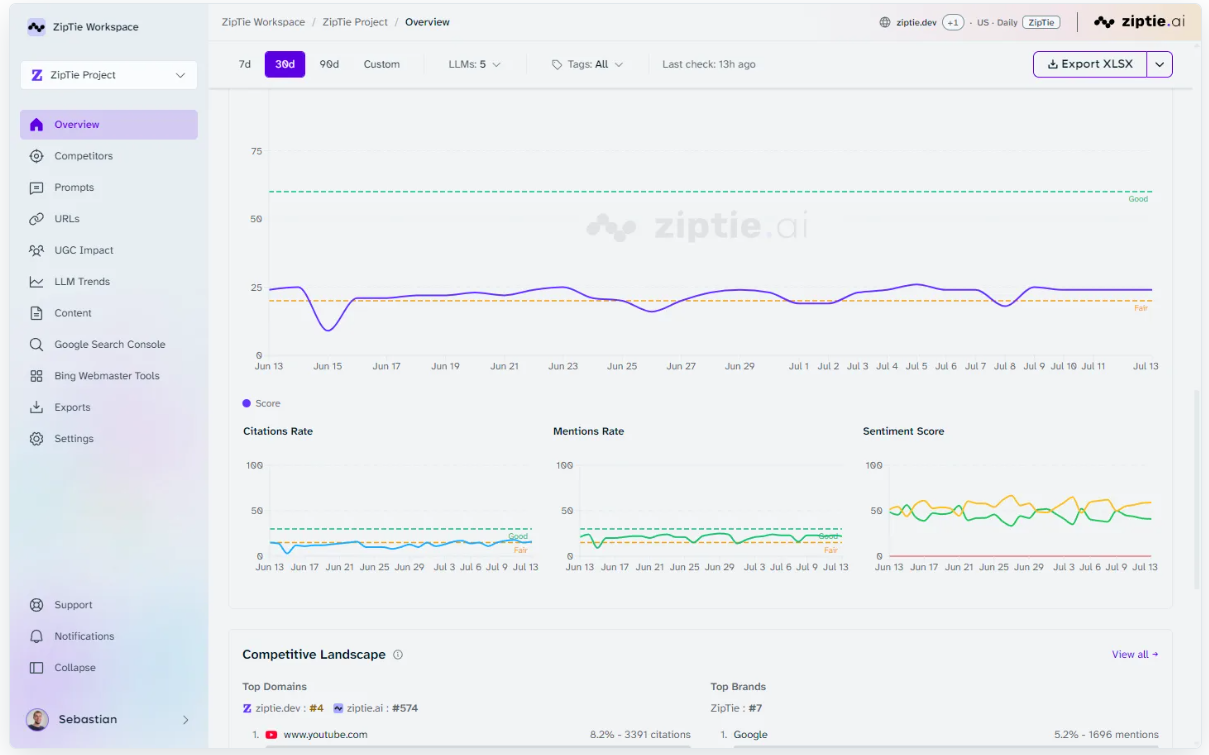
Beyond live-answer capture, ZipTie boasts two distinct features that put it a notch above tools in the same category. The Project Wizard scans your site and proposes the prompts your buyers are most likely to input, saving you from having to build the prompt list manually.
The UGC Impact Analysis shows which third-party (community) sources AIO actually cites, with “deep Reddit coverage” explicitly named. Since Reddit is the most cited UGC platform across virtually all engines, this feature only looks like novelty when it’s actually leverage.
Finally, ZipTie’s pricing structure is refreshingly flexible. The three preset plans (Starter, Professional, Enterprise) are suggested starting points, but you can fine-tune each to suit your exact needs and budget.
You can pick the engines you want to track, set prompt volume and refresh cadence, and choose optional add-ons including Content Generation, API & MCP Access, and the UGC Impact Analysis. Configured to AIOs only, 50 prompts, and daily refresh, the estimate landed at $12.50/mo.
However, as you scale, the pricing starts to get out of hand. To be fair, this is true for most tools – the advertised entry price rarely matches the realistic working cost. With ZipTie, this is evident in the brutal jump from Starter ($35.63/mo) to Professional ($549.67), driven by engine breadth and prompt volume, and further bloated by stacking UGC Impact Analysis that nearly doubles the plan’s original cost on its own.
Beyond pricing, three friction points hold ZipTie back. First, the checks fire only on fixed cadences (daily, monthly, weekly), and there’s no way to manually trigger them, so you’ll be forced to wait for the next refresh cycle to see if your updated content moved the needle.
Second, for a flexible tool, the prompt slot model is too rigid: each is tied to its respective cadence, and deleting a project does not free those slots until the next billing cycle. Finally, if you want to pipe your data into external tools automatically (e.g., Google Analytics (GA4) to evaluate the true business impact), you’ll have to buy a $10/mo API/MCP add-on.
| ZipTie is strong for: | ZipTie is weak for: |
| Teams who need to capture the actual AIO answer and see which community platforms (primarily Reddit) are shaping the AI output, at a configurable (entry) price. | Teams scaling into broad engine/prompt coverage or anyone needing native analytics along with tracking. |
AthenaHQ is well-established as an excellent AI Overviews tracking tool, primarily because it does three things most rank trackers don’t: it grades how accurately AI describes your brand, it wires into GA4 and GSC so AIO visibility connects to actual traffic, and it enables you to act on the results rather than just observing them.
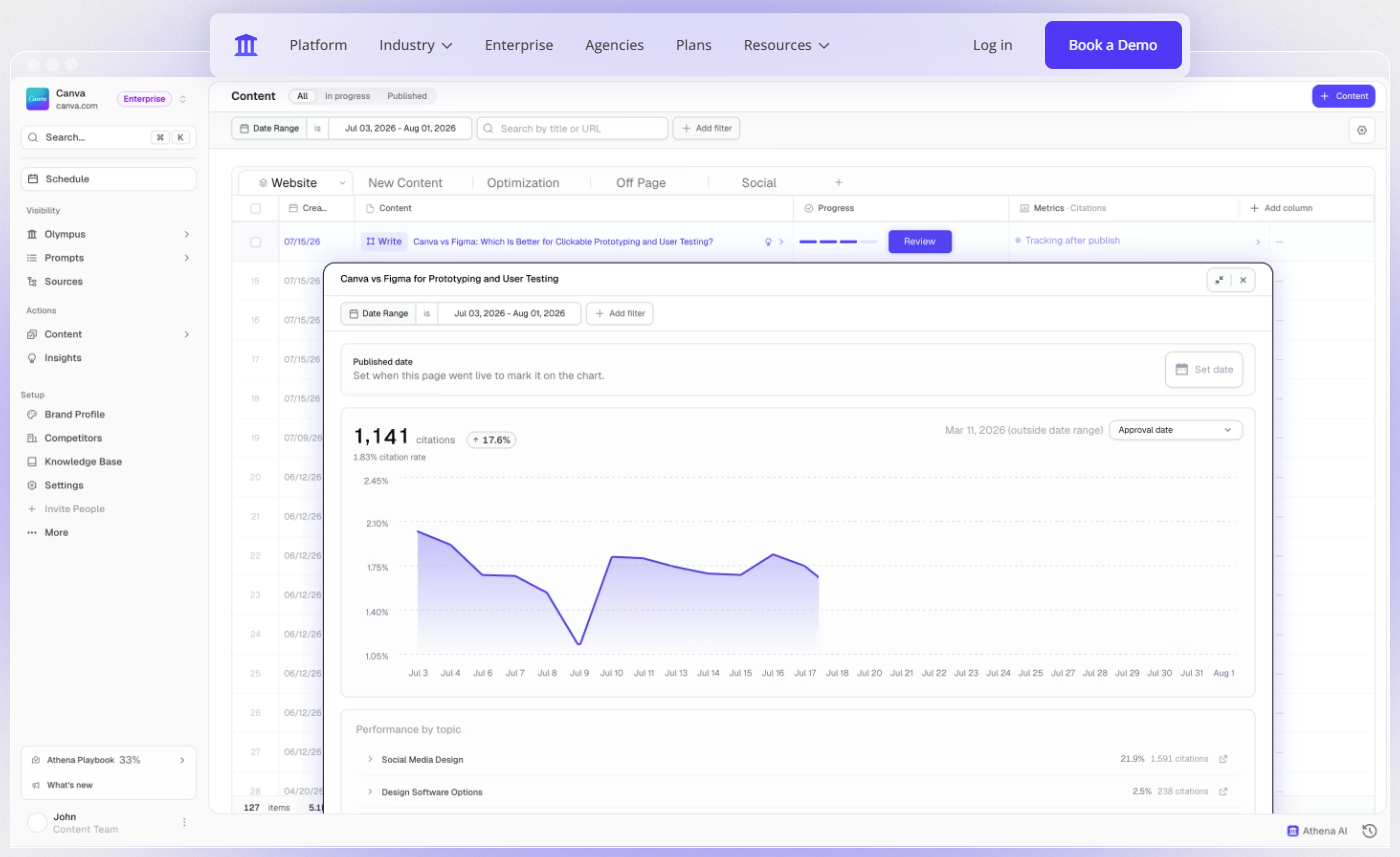
Where AthenaHQ stands out among similar platforms is its Oracle and Action Center features. Oracle is the “reputation-management center” – it identifies and flags hallucinations and misstatements, delivering real-time alerts when AIOs (or one of the other 8 tracked LLMs) misrepresents your brand, product, service, or category.
Meanwhile, the Action Center acts as narrative control plus gap-closing engine, turning findings into assignable tasks which you can use to update your source content to address both factual inaccuracies and informational voids, thereby aligning how AIO’s with your description of your brand.
Where Athena gets real frustrating, real fast, is billing. The platform runs on credits (one credit = one AI response), which isn’t a problem only if you’re tracking AIOs exclusively. Since single-engine focus is rarely the endgame, and you’ll likely use the tool to monitor AI Mode and a few others, you’ll burn through the Starter plan’s 3,600 credits in a matter of weeks.
What’s more frustrating is that many of Athena’s headline features are locked behind the Enterprise paywall. Full-strength accuracy detection, persona targeting, multi-country tracking, and more are gated above Starter, so the tool’s touted capabilities are practically inaccessible to mid-market.
| AthenaHQ is strong for: | AthenaHQ is weak for: |
| Mid-market and B2B teams who want their AIO visibility tied directly to GA4/GSC traffic, with brand-accuracy monitoring and the ability to close gaps folded into the same suite | Small teams who need to track a single engine and do so on a budget; mid-market teams who need headline features (or a close variation), but not on the Enterprise price tag |
Otterly.ai is the booster rocket of AI Overview tracking tools – it will help you reach the AI visibility orbit (and even hover there for a while), but that’s about the full extent of its capabilities. Realistically, for only $29/month (Lite), that’s more than enough, especially considering that Otterly isn’t just a bare-bones tracker.
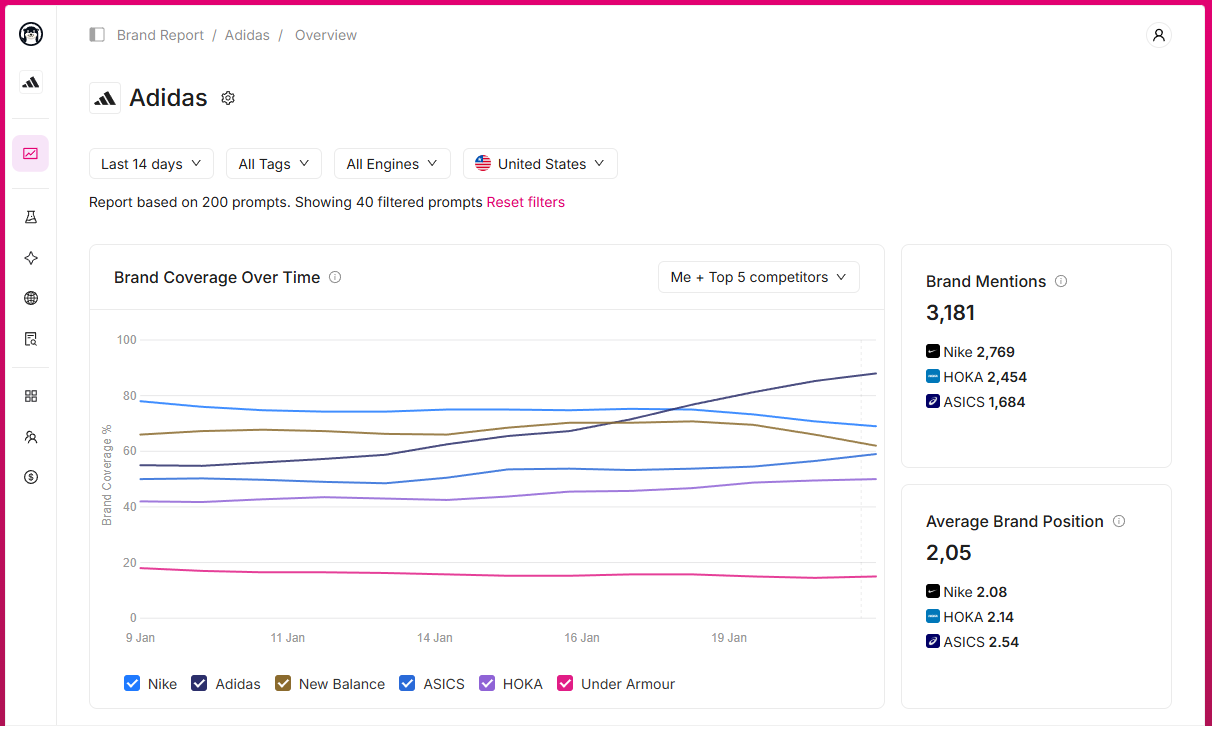
Otterly tracks AIOs (plus ChatGPT, Perplexity, and Copilot) and refreshes daily, so you’re getting a reliable read on a volatile surface, rather than a laggy, directional weekly snapshot. However, its prompt-research tool is a genuine bonus and a true star of the show.
It surfaces the questions users actually ask and hands you GEO recommendations and URL audits, enabling you to act on the findings. That’s a surprising level of depth for what is essentially an entry-level tool – and exactly what earns Otterly its place on this list.
The downside, though, is that you’ll hit the ceiling fast. The entry plan (Lite) tracks only 15 prompts, and you’re limited to a single workspace and only 3 recommendations per week – and you can’t increase the prompt volume with add-ons like you can on Starter.
This effectively makes Lite only good for testing the waters, and Starter the realistic floor for any kind of serious work. At $29/mo versus $189/mo, the price gap between the two plans is considerable, but still well below the competitors.
| Otterly.ai is strong for: | Otterly.ai is weak for: |
| Budget-conscious SMBs and smaller teams who want a capable AI Overviews SEO rank tracking tool with actionable insights, at the lowest entry price | Teams tracking a large prompt set or multiple engines (or both), or that require more than rudimentary tracking depth |
seoClarity and Surfer are non-native AI search optimization tools – they are established SEO and content platforms that fold AIO tracking capabilities into the broader suite. As such, they come with a trade-off: you’ll be sacrificing some of the specialist depth for consolidation and convenience. Still, if you want your AIO data right beside your rankings and content workflows, without having to run a separate toolkit, these two platforms are definitely worth the look.
| Table 2 — Keyword-level AIO trackers (rank-tracking / SEO suites) | |||||
| Tool | Best for | AIO refresh cadence | Standout extra | Pricing (from) | Notable limitations |
| seoClarity | Enterprises tracking AIO citations across massive keyword portfolios, unified with SEO + content | Daily or weekly (weekly default; daily for volatile sets); hourly/on-demand for priority groups | URL-level “who’s cited” (you vs. competitors); AIO-CTR impact; 500M+ keyword Research Grid; AI Content Writer | Research & Content $2,500/mo; Technical SEO $3,200/mo; Enterprise $4,500/mo (annual) | No self-serve/monthly entry; enterprise commitment; steep onboarding; overkill for small sets |
| Surfer | Content teams pairing AIO tracking with an established content-optimization editor | Weekly on Standard; daily on Pro and above | SoV + mention-gap + sentiment; close gaps in the Content Editor (WordPress/Docs) | AIO from $158/mo standalone or $182/mo Pro; Standard $99 = ChatGPT only | Modest volume (50/day Pro, 100 standalone); Standard has no AIO |
seoClarity is built for enterprise brands and agencies – and it shows across all facets: scale, infrastructure, capabilities, depth, and pricing. This is a tool designed specifically for massive organizations who demand reliable tracking of rankings and AI visibility across thousands or tens of thousands of keywords across multiple regions, with zero compromises.
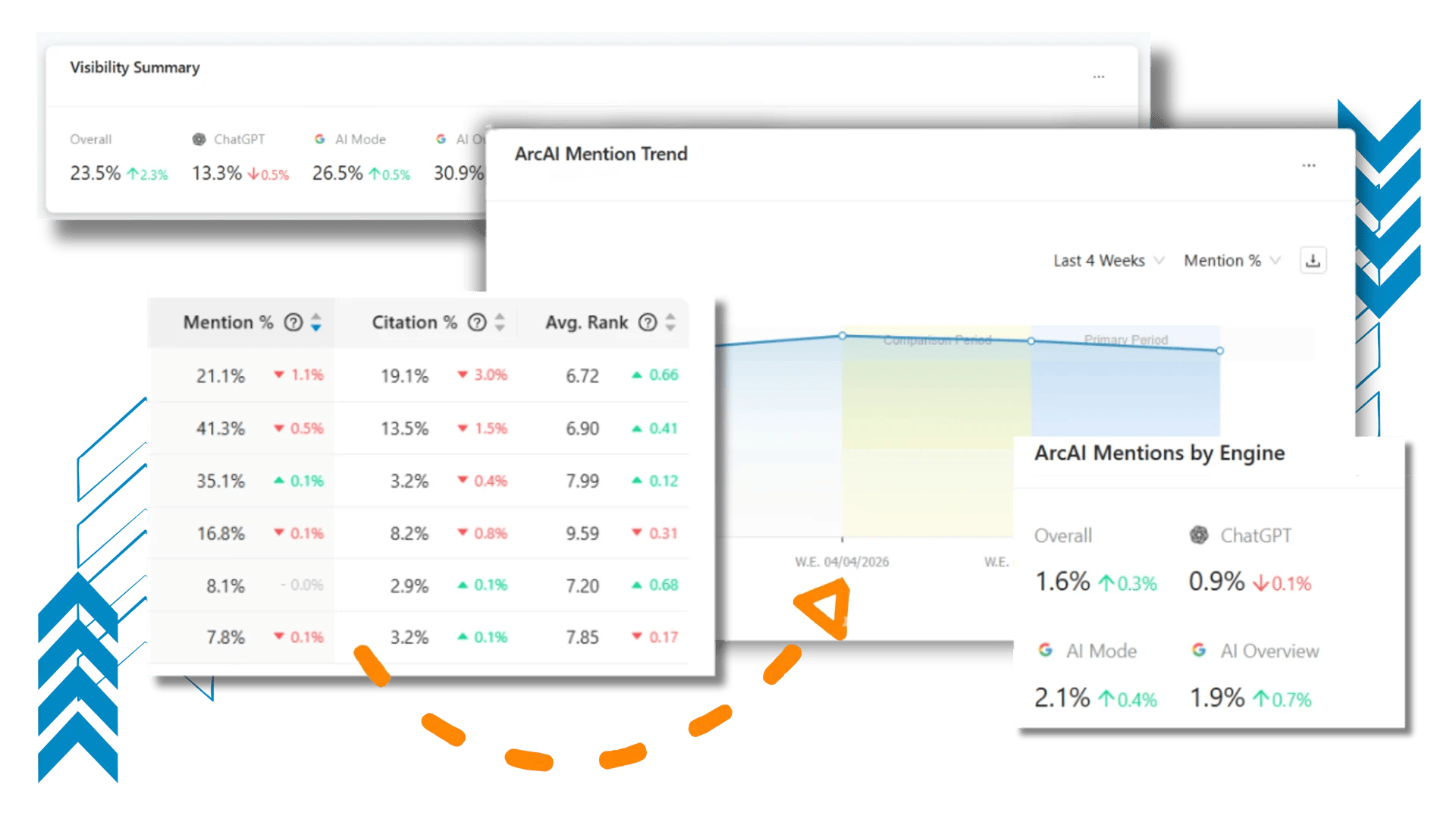
seoClarity’s AI layer (Clarity ArcAI) flags which of your tracked keywords are triggering AI Overviews, displays the citations at URL level (yours and competitors’), and ties it all back to the click-through impact on the underlying result, all grounded against its Research Grid – a dataset of 500M+ keywords, refreshed monthly across 90+ countries.
Surprisingly, for a suite this size, the refresh cadence is quite flexible: by default, keyword sets refresh daily or weekly, but volatile or revenue-critical groups can be checked hourly or on-demand, enabling you to always react to the current state of the surface.
Furthermore, seoClarity’s Content Fusion feature helps you surface high-impact content gaps in real time and close them immediately – either automatically, with the help of an integrated AI Content Writer, or manually, by giving you a full brief you can act upon.
As for limitations, let’s start with the obvious: access. seoClarity packages start at $2,500/mo (Research & Content) and $3,200/mo (Technical SEO), or $4,500/mo for a full Enterprise suite – typically on an annual commitment.
Beyond that, it features a steep learning curve, usually requiring onboarding and setup support (included in the price). Finally, for anyone tracking a relatively small keyword/prompt set, especially across AIOs only, the majority of the tool’s potential will be wasted.
| seoClarity is strong for: | seoClarity is weak for: |
| Enterprise-level organizations who track AIO citations across massive keyword portfolios, and want AI visibility unified with SEO and content | SMBs, small-to-mid-sized teams, and anyone who wants affordable, self-serve access, plug-and-play AIO tracking platform |
Surfer is one of those suites that feels like it was made for content teams. While plenty of tools today pair tracking with some form of AI Overview optimization, that typically requires juggling different platforms. Surfer takes a more pragmatic approach: it folds tracking into its SEO content editor, so your team can use the same platform to identify and close the gap.
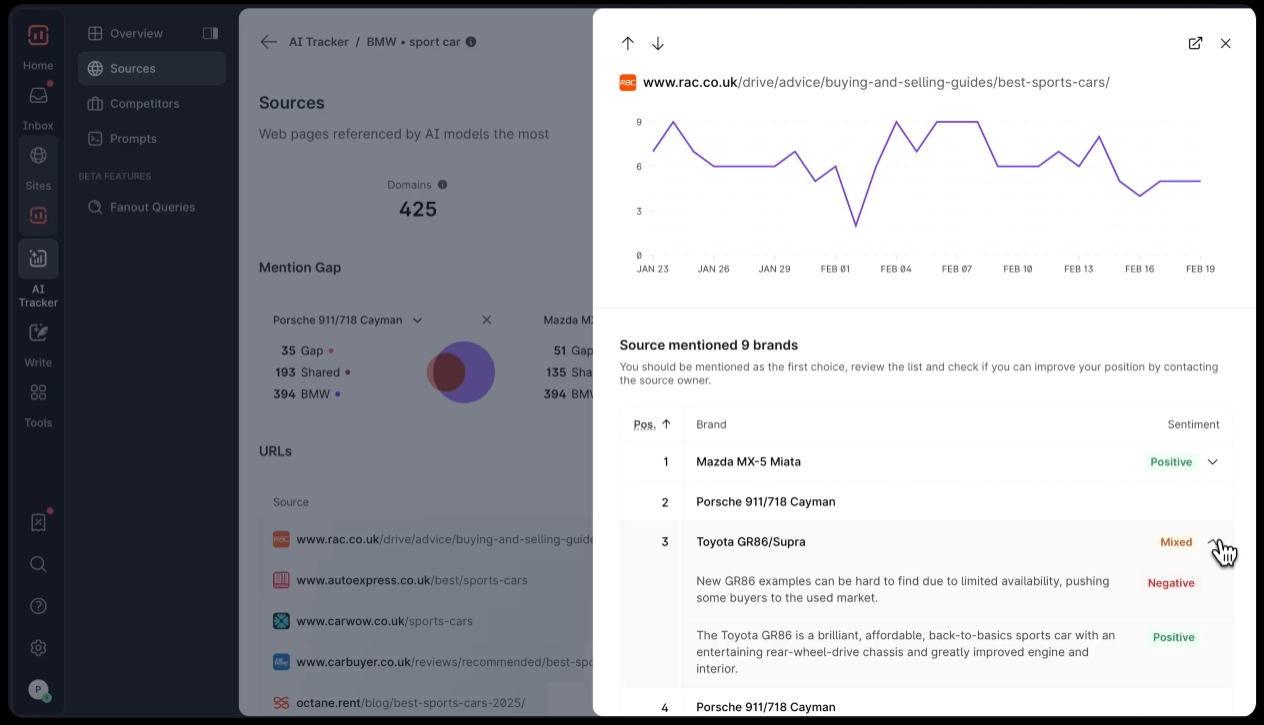
Even on the entry plan (Standard), Surfer integrates with Google Docs and WordPress, albeit not as a sidebar widget. In practice, the tracker is its own dashboard inside the app, meaning you will be switching from tracker to editor – but that’s still only one switch and definitely beats exporting the data and importing it into another tool.
The tracker itself reports standard AI visibility metrics (share of voice, sentiment), but also specific mention gaps, while the Content Editor hands you the brief and the info required to rewrite the page so it aligns with AIO selectability criteria, thereby increasing the odds of appearing in its answers.
That being said, the entry pricing is misleading: the lowest tier (Standard, $99/mo) does NOT track AIOs, only ChatGPT. If you want AI Overviews SEO rank tracking, you will have to get either the Pro plan ($182/mo) or a standalone AI Search Analytics tracker (from $158/mo).
Other than that, the prompt volume is quite modest, with only 50 prompts per day on Pro and 100 on the standalone tracker, so a larger tracking set will push you to pricier plans – either Peace of Mind at $299/mo or upgrading the standalone (from $308/mo for 200 prompts/day).
| Surfer is strong for: | Surfer is weak for: |
| Content teams who want real AIO tracking paired with a gap-closing tool, all in one suite | Teams needing AIO tracking on a budget or a higher prompt volume without jumping up tiers |

Lily Evans is the Managing Director at ZeroClick Labs, bringing over 8 years of comprehensive experience in SEO, local SEO, and AI optimization to every project. She began her career in content writing, developing a strong sense for search intent and messaging clarity in the digital realm – skills that form an unshakable core of her leadership to this day.
And there’s nothing you can do about it.
Or is there?
ZeroClick Labs’ expertise is all about taking faint signals and raw visibility data, and turning them into stable placement across frontier AI search engines – including AI Overviews, AI Mode, Gemini, Perplexity, and ChatGPT.
So, are you ready to put an end to uncertainty and dominate the AI answers?
Because your competitors already are.
“Our agency had no idea how to approach AI visibility. ZeroClick only does this one thing so they actually know what works. Worth every penny just to not waste time figuring it out ourselves.” – Jay