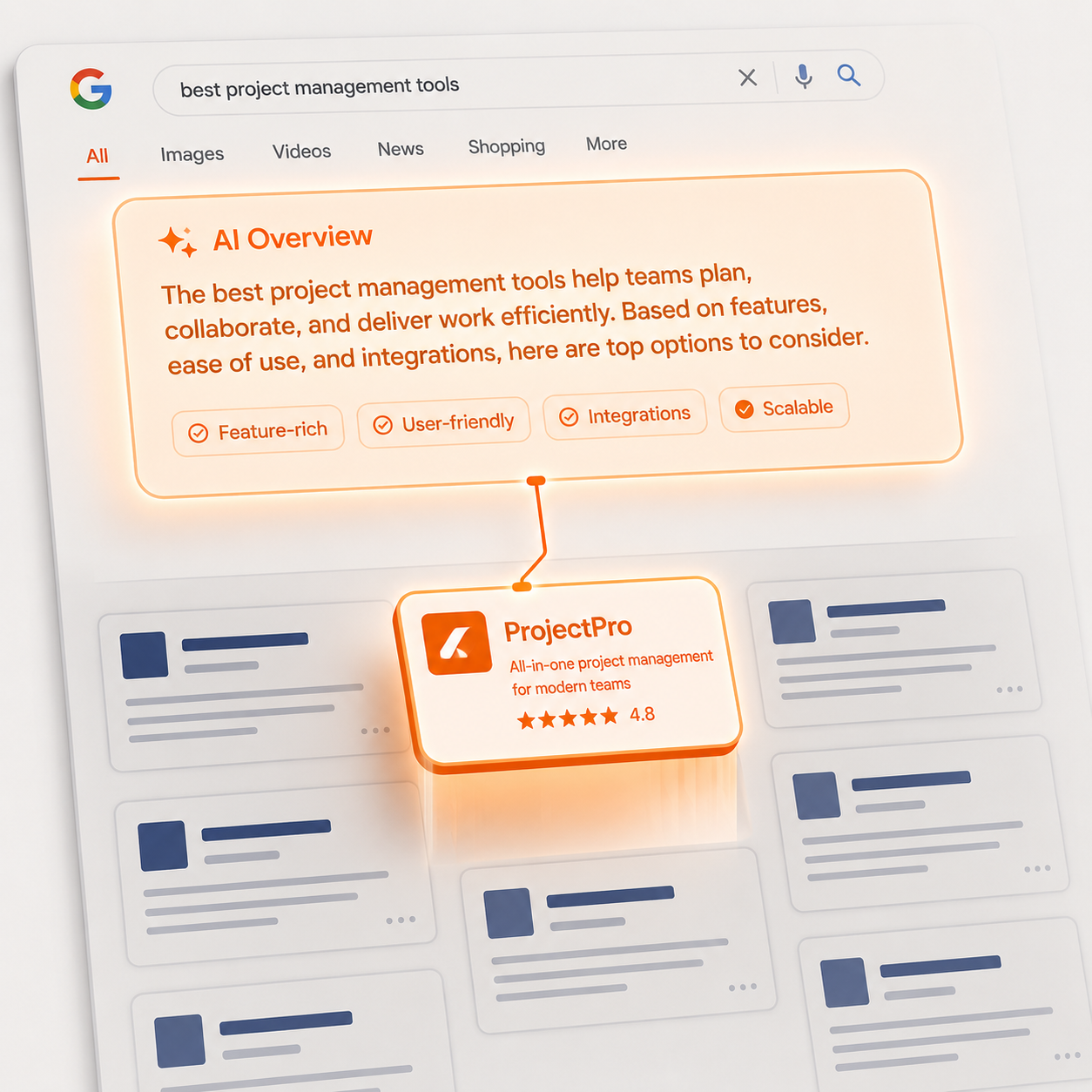
Visibility in AI Overviews is a distinct commercial objective, not a byproduct of SEO.
Page-one ranking no longer guarantees citation – query fanout and Reciprocal Rank Fusion (RRF) reward consistent presence across sub-queries.
Original, answer-first content that covers a full decision arc wins grounding.
Structure, Schema, and recency make quality content machine-legible, but never substitute for it.
The capstone is a website that AI agents can operate as an endpoint – not just access and pull data.
Executive Summary: AI Overviews have turned Google’s result page into a decision-making surface, where traditional ranking no longer equals visibility. Winning citations requires intentional optimization that addresses all four selectability criteria: answer-first architecture, machine readability, full decision-arc coverage, and third-party validation.
AI Overviews trigger for approximately 20% of all Google queries, 46% of conversational queries, and for nearly 60% of question-type queries – and users are no longer ignoring them.
They’re embracing them.
As models advance and discovery becomes more agentic, AIOs will only grow in popularity, prevalence, and importance. For brands, the implications are clear: buyers are increasingly relocating to zero-click environments; environments that no longer reward being #1 in SERPs.
With the traditional ranking deprecating and the value of a click skyrocketing, the question decision-makers and marketers increasingly agonize over is “How do I optimize my SEO for Google AI overviews?”
Disclaimer: This is deliberately not a technical manual on how to optimize a website for AI Overviews. Rather, it is built to explain how AIOs select and cite content, and why current AI SEO practices work, giving marketing leaders and business owners strategic, directional understanding of the new visibility model.
How are AI overviews changing search?
Before anything else – mechanics, tactics, finesse – it’s crucial to understand what’s actually at stake, because AIOs caused a real and measurable shift in how people use Google Search.
First, when AIOs appear, users stop scanning. They backscroll, they pause, they linger, they revisit. Although it may seem so, this behavior does not signal disengagement – it signals evaluation. The search page has quietly become a decision-making surface.
The shift
Where AI Overviews show up
All Google queries~20%
Roughly one in five searches now triggers an AI Overview.
Conversational queries (7+ words)46%
Longer, natural-language searches trigger AIOs far more often.
Question-type queries~60%
Nearly every how / what / why question is answered on the SERP.
Hover a bar for detail.
Second, AI Overviews now act as veritable answer engines. They satisfy informational intent directly on the SERP, effectively turning a substantial volume of traditional traffic into zero-click searches.
The cost of that shift is reflected in the dramatic CTR decline: a negative 32% to 34.5% for the top organic result, 39% for the second result, and between 20% and 61% for non-branded informational queries. The flip side is that branded query CTR actually jumps by 18% when AIO is present.
It cuts both ways
When an AI Overview is present
The cost of being left out — and the upside of being cited.
If you’re not cited
#1 organic result−34.5%
#2 organic result−39%
Non-branded informational−61%
If you are cited
Branded query CTR+18%
Clicks vs. uncited rivals+35%
Convert vs. organichigher
Bars scaled within each column. Hover any row to highlight.
This signals opportunity. In fact, brands cited inside an AIO can earn roughly 35% more clicks than uncited competitors. What’s more, those clicks carry much higher value than blue-link ones, because AI-referred visitors convert at meaningfully higher rates.
So, if there’s one thing to take away from this guide, it’s this: Visibility in AI Overviews is NOT just a side effect of good SEO – it’s a distinct commercial objective with real bottom-line impact. However, to be able to capture that impact, you must first understand how Google’s AI engine actually processes information.
How do AI Overviews actually work?
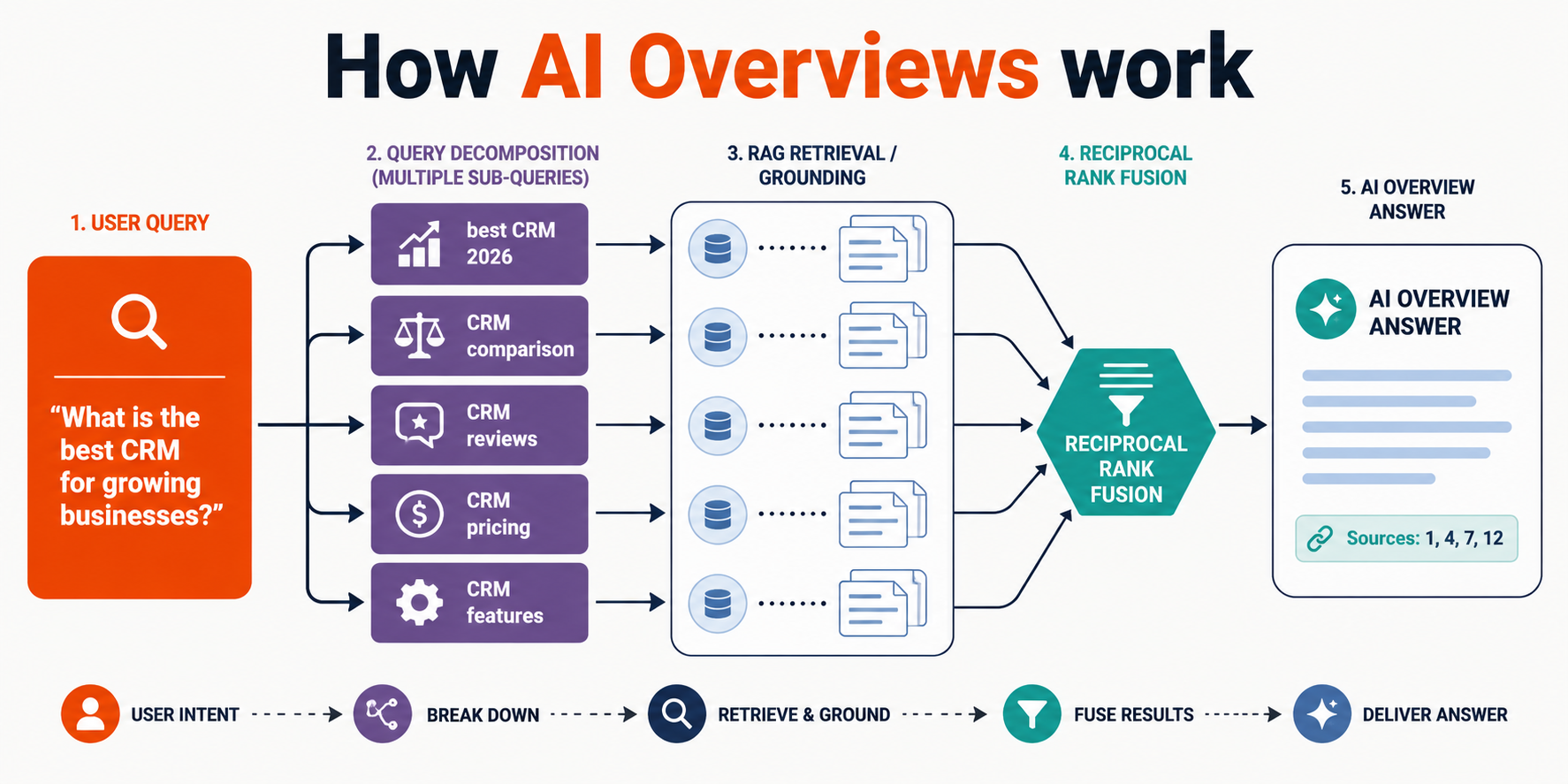
When a user types in a question, Google’s AI doesn’t just pluck the top blue link and paraphrase it. According to Google’s own Search Central guidance, AI Overviews and AI mode operate on the same core ranking and quality principles as regular Search, but also utilize two AI-specific mechanics: Retrieval-Augmented Generation (RAG) and Query fan-out.
A visual representation of how AI Overviews synthesize responses. [Image credit: ZeroClick Labs via ChatGPT]
Retrieval-Augmented Generation (RAG)
Also known as “grounding,” RAG is how the model fetches relevant passages from Google’s index and uses them to build a factual answer. Their own research showed that what RAG systems actually need is sufficient context: a content block that contains enough self-contained information to answer the question on its own.
Core focus: The “Information Gain” principle
Google’s search engine actively demotes, devalues, or skips pages that merely regurgitate existing index data. In other words, to be selected for a RAG grounding block, your content must be original: offering unique perspectives, proprietary data, or first-hand experience.
Query fan-out
Rather than searching for the exact phrase a user typed in, AIs expand it into several parallel sub-queries. Specifically, Google’s AI Mode issues an average of 8-12 of these sub-queries, depending on the context of the initial question.
Now, here’s the part that flips the old playbook upside-down. Answer engines use a mechanic called Reciprocal Rank Fusion (RRF) to combine sub-results from fanouts into a unified answer. What isn’t obvious is that each sub-result is ranked independently and counted cumulatively.
In practice, that means that a page ranking #5 across ten fanouts will beat a page that ranks #1 across two – and that’s confirmed:
Ahref’s study showed only ~38% of URLs cited in AIOs ranked in the top 10 for the same query and 31% didn’t even rank in the top 100.
Surfer’s research found that brands appearing in main AND fanout queries are 161% more likely to get cited – and 49% more likely to get cited if they rank solely for fanouts.
How to show up in AI Overviews: the 4 optimization pillars
Across every platform we studied (i.e., not AIO-exclusive), the same four principles determine whether content is citable: Answer-first architecture,machine readability, full decision-arc coverage, and third-party validation. None of these mechanics are some magical visibility hacks – they each derive directly from how RAG and fanout work.
Why content gets cited
The four pillars of AI Overview optimization
01
Lead with the answer
RAG grounds the first 50–100 words of a section.
70% read only the top third
In practice: open every section with a direct, self-contained answer — then expand.
02
Structure for machines
Clean, modular units lift without guesswork.
Schema = grounding, not magic
In practice: turn queries into headings; answer each immediately; use lists and tables.
03
Cover the full decision arc
RRF rewards presence across many fan-outs.
+161% citation odds across queries
In practice: build clusters — what it does, who it’s for, comparisons, pricing, reviews.
04
Earn third-party validation
AI reads the web as an entity graph.
Reviews searched unprompted
In practice: manage G2, Reddit, Capterra and directories as deliberately as your own site.
Hover a pillar for the practical move.
Pillar 1: Lead with the answer
An average user reads only the top third of any AI Overview – and the models exhibit similar front-loading bias. In general, AI systems favor content blocks that resolve the query within the first 50-100 words, because that’s what RAG can cleanly extract and ground against.
In practice: Adopt the “BLUF” (Bottom Line Up Front) model – open each section with a direct, self-contained answer, then expand. Front-load the definition, the recommendation, the number first, or whatever the core of the message you’re trying to convey is. THEN provide context.
Forcing humans – or machines – to dig through a wall of text (or, worse, fluff) to find the point is a surefire way to get skipped.
Pillar 2: Structure for machine parsing
AI models love clean structure and obvious hierarchy. Descriptive H2>H3>H4 headings (preferably phrased as questions), numbered steps, bulleted lists, comparison/data tables – these are all disproportionately represented in AI answers, and for a good reason.
These formats are clean, modular units that a model can lift without guesswork. Google’s generative AI search optimization guide reinforces this point, advising organizing pages with clear headings, paragraphs, and sections so they are easier for users to read and comprehend.
However, we must point out the caveat in Google’s guide: It’s framed around human readability, explicitly stating that you don’t have to “format for the machine”. A commendable sentiment – but history speaks otherwise: algorithms consistently reward content formatted for the machine.
In practice: Turn queries into headings, answer each one immediately, and deploy formats that historically earn citation, not what Google says earns citations.
Structure is the cheapest citation advantage available
Structured data: useful – but not the hack people think
Schema markup is one of the most misunderstood aspects of SEO, with too many people still thinking it’s some kind of magic bullet for AI visibility. It isn’t. Schema’s value in AIO optimization is indirect: it helps build entity and knowledge-graph relationships that ground RAG systems, reducing ambiguity about your brand.
Alt Tag/Caption: Schema is not parsed directly – it builds context. [Image credit: ZeroClick Labs via ChatGPT]
In practice: Implementing Schema.org types (Organization, Product, Article, FAQPage) is still the actual gold standard, serving as a translation layer that helps AI systems eliminate guesswork when parsing data. What Schema IS NOT is a replacement for quality content.
Recency is a top-tier trust signal
AI models sport a massive recency bias, typically favoring content that’s been updated within the last 30 – 90 days. Although AIOs somewhat deviate from this rule, it doesn’t beat the fact that AI models are trained to deliver the most current context.
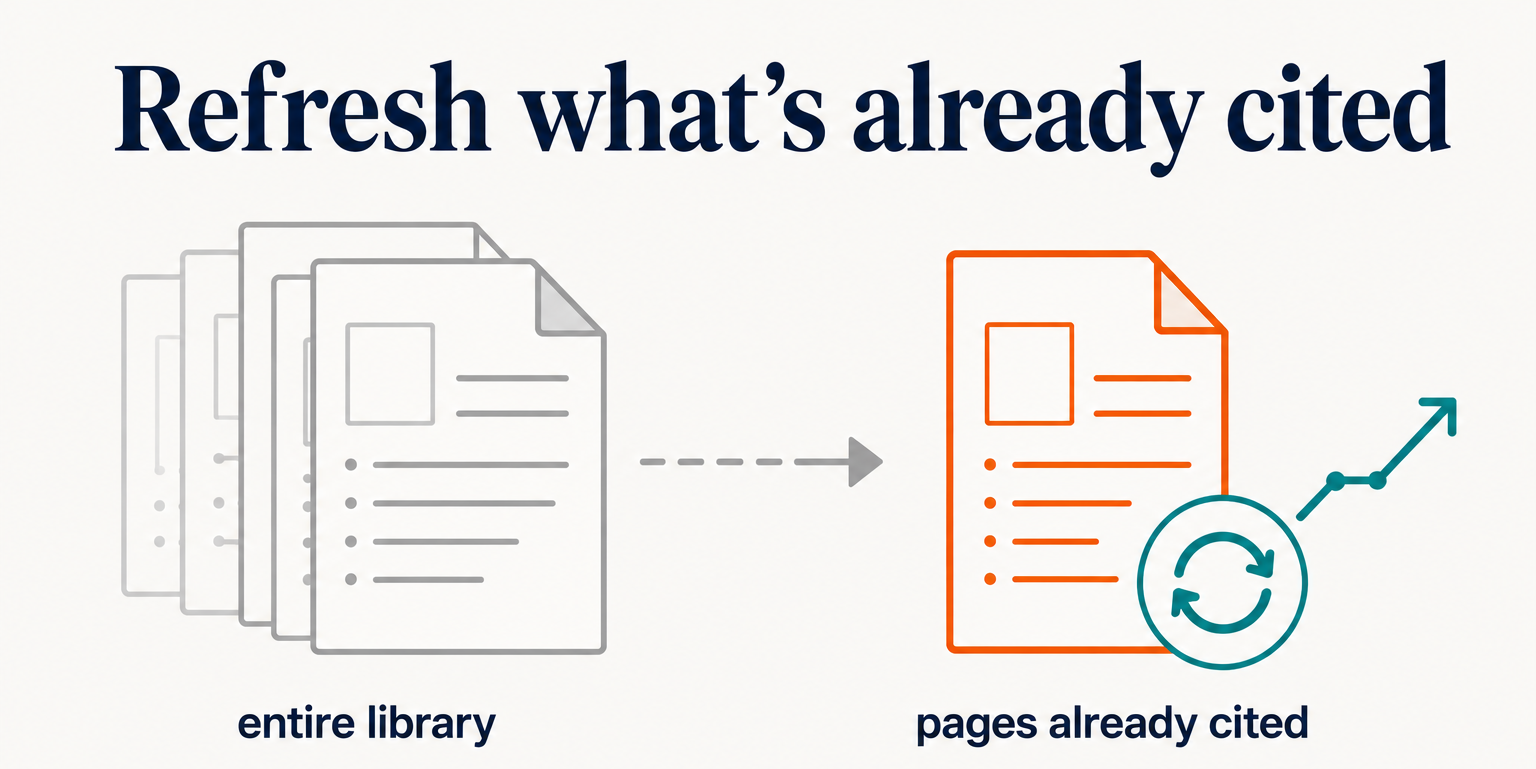
In practice: Refresh your pages periodically (quarterly will suffice) with substantive revisions – simply changing the publication date won’t fool AI. Note that you don’t have to update your entire library – focus on content that’s already being cited, as doing so tends to deliver faster, more measurable lift than brand-new pages, since they start from zero.
Focused quarterly refreshes of already-cited pages beat mass updates. [Image credit: ZeroClick Labs via ChatGPT]
Pillar 3: Cover the full decision arc
As noted in section 2.2, RRF rewards consistent presence across multiple sub-queries. This means that a content cluster covering the whole decision journey (pref. from multiple angles) will outperform a single, hyper-optimized page.
In addition, folding content into fanout-friendly patterns (e.g., “best for [use case]”, “top [solution] for [category]”, “[X] vs [Y]”) rather than statements (e.g., “what [product/service] is”) consistently earns more fanout coverage, since it matches injected intent modifiers.
In practice: Build content clusters that address what your products do, who they’re best for, how they compare (yes, even to competitors’), and what users say. Be sure to tightly interlink all pages using highly descriptive anchors, as this helps crawlers map out your topical authority. Covering the full decision arc is the ultimate double win: it feeds the machine’s query fanout AND guides a user from evaluation to deliberation to transaction.
One critical note, straight from Google’s optimization guide: Do NOT spin a thin, separate page for every fanout variation. Google explicitly flags that as scaled content abuse, which is a spam-policy violation, and even recommends excluding it from Search.
Pillar 4: Earn third-party validation
AI systems treat community platforms as a trust layer, and they search for them unprompted. They will pull from sites like Reddit, Quora, G2, and Capterra, as well as industry directories and review sites, even if the user never explicitly asks for them.
What’s more, LLMs look at the web as a graph of entities (Brands, People, Places), neither of which exists in isolation, meaning that AI models can trace a peripheral mention right back to its source (i.e. your site).
Effectively, this means that an outlier rating on an obscure site can shape how AI describes your brand at scale. Think of it as an AI-era upgrade to E-E-A-T signals, which Google still treats as central, and so do their models.
In practice: Audit which third-party sources AIO/AI Mode cites for your category, and manage your presence there as deliberately as you manage your on-site content.
If the AI doesn’t see an independent consensus about your brand across the web, you won’t exist in the answers.
Critical note: Google’s guide explicitly notes that seeking inauthentic mentions (“forum astroturfing”) won’t work since AI Overviews still rely on core ranking and quality systems.
Stay in the Loop – Stay Ahead
Sign up for The Laboratory newsletter and get the latest insights from AI world straight to you inbox!
Nearly half of all citations — AIO reaches for pre-organized “best of” coverage first.
Product pages22.9%
Clear features, pricing, and specs make these clean to extract and ground.
Homepages6.4%
Strong brand-entity signals can earn a citation on their own.
Video content6.05%
AIO cites video more than any other engine — don’t overlook YouTube.
Discussions3.27%
The thinnest slice — AIO leans on structured pages over forum threads.
AIO behaves like an at-scale SERP summarizer — it favors pre-organized formats that deliver the most options, fastest.
ZeroClick Labs citation study, March 2026 — ~3.3K URLs, ~38.5K citations. Hover any bar for detail.
The reason why these specific formats win is twofold. The first one is structural: AIO’s generative features are rooted in Google’s core index, meaning it behaves like an at-scale SERP summarizer, reaching for a pre-organized format first, as it allows for the fastest synthesis of a large volume of data.
The second one is commercial: AIOs are fundamentally tied to a commercial search engine, whereas platforms like ChatGPT or Perplexity are conversational synthesis engines, so the optimization approach changes based on whether the platform is trying to monetize or simply answer a question.
The practical implications are simple: Although it may be tempting to spread your AI SEO efforts across all platforms, resist that urge. The reality is that a “one-size-fits-all” approach can only dilute the visibility strategy, and a diluted strategy is destined to underperform.
Gauge where your buyers live, and then optimize intentionally.
How to monitor visibility in AI Overviews
If citations increasingly come from outside the top 10 results, traditional ranking measurements can’t explain why you are (or aren’t) showing up. In addition, tools for measuring AI visibility have historically been underdeveloped, forcing analysts to default to inference and extrapolation. Fortunately, that’s no longer the case.
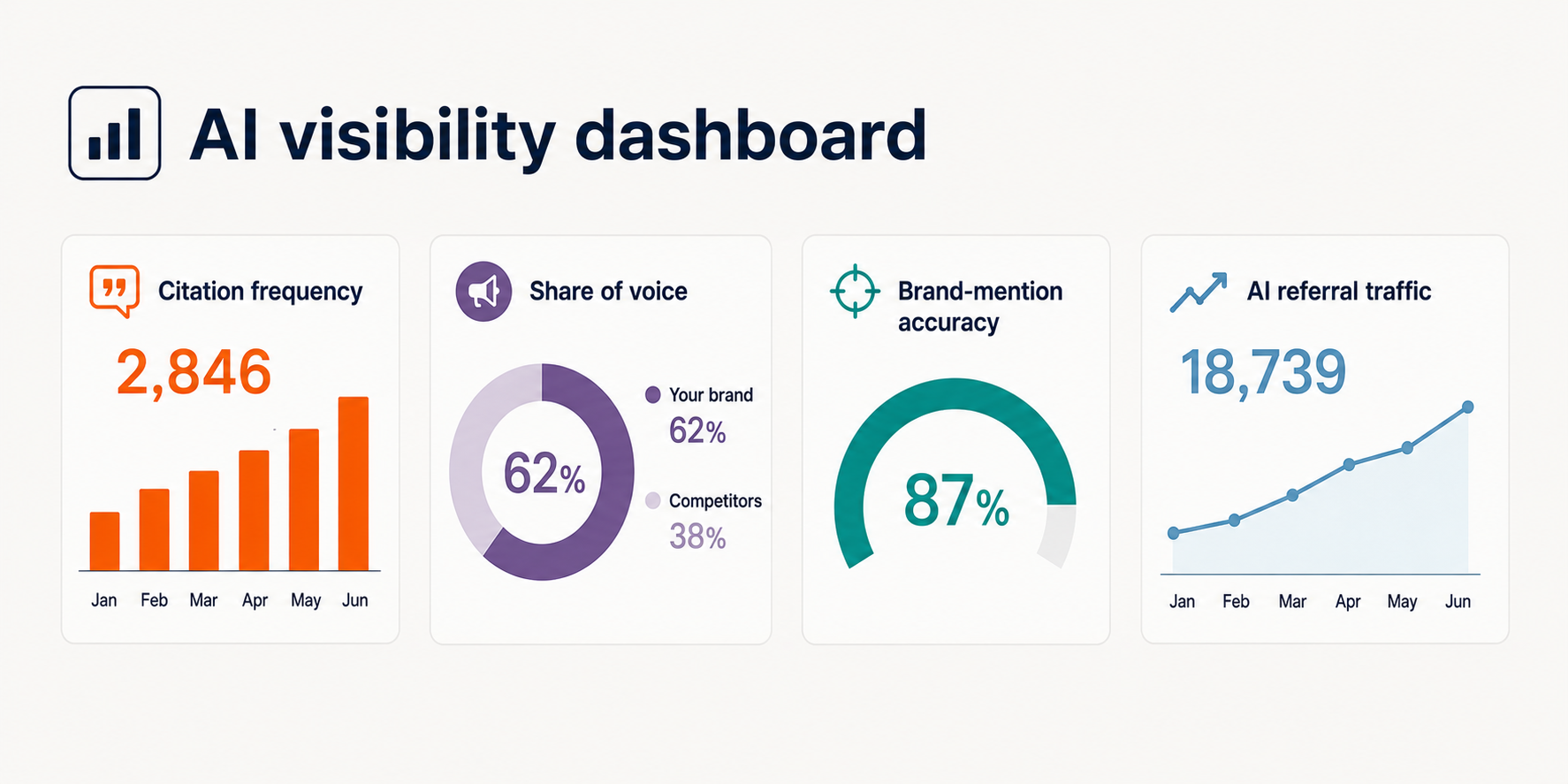
AI visibility measuring is still underdeveloped – but no longer theoretical. [Image credit: ZeroClick Labs via ChatGPT]
The toolkit is maturing quickly, with Google once again spearheading the change by launching features such as the AI Assistant channel in GA4 and the Search Generative AI performance report in Console, giving teams a means to track AI-sourced referral traffic for the first time ever, however partially.
Beyond that, the metrics that matter today are fundamentally different from rankings, with the primary four being:
Citation frequency: how often you’re cited across target prompts.
Share of Voice (SoV): your citation share vs. competitors in the same category.
Brand mentions: how often AI includes your brand in generated answers (w/ or w/out link – i.e., cited or not), and how accurately.
AI-sourced referral traffic & conversion rate: the commercial bottom line.
In practice: Run a recurring set of high-intent prompts and log whether you appear and where, how many times, and where your competitors beat you. Be especially vigilant about how you’re characterized and how accurately – AI hallucinations can cost you a deal, and are typically caused by data inconsistencies on your own site.
Build for the agentic future
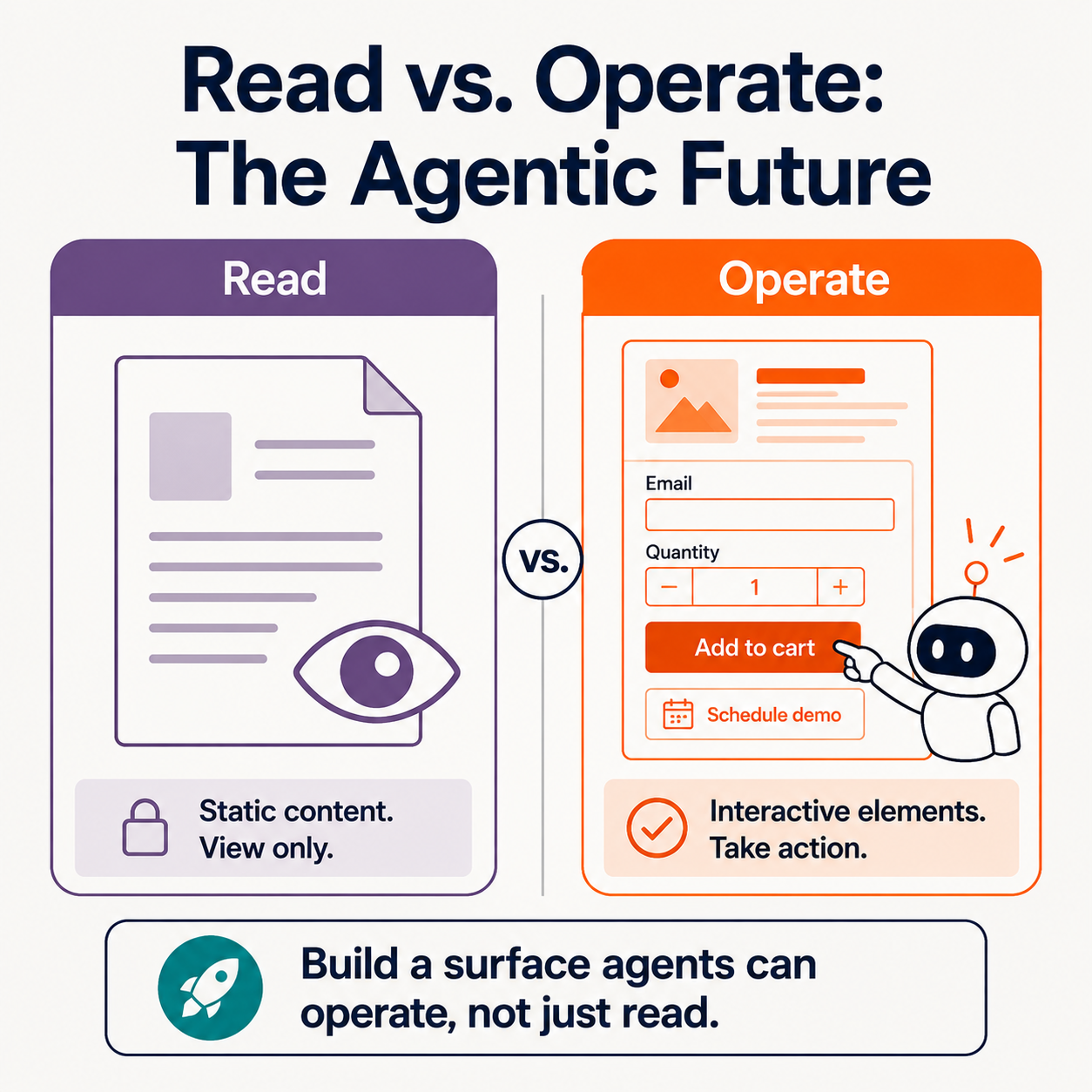
Google Search is already moving past summaries and toward action, with new functionality enabling it to spawn independent AI agents that browse, compare, and even perform transactions on users’ behalf. Therefore, the new endgame is transforming a website into a surface that AI agents can operate, not just access and read.
Search is transforming into an agent. Staying on top means staying relevant. [Image credit: ZeroClick Labs via ChatGPT]
However, agentic systems still suffer some technical limitations, like the inability to parse JavaScript and to navigate interaction-dependent flows. As such, optimizing your website for AI agents will involve a bit of flexibility, at least until the processes get standardized, which, judging from the recent interview with Google’s CEO, isn’t so far.
In practice: Google’s documentation already references agent-friendly best practices and emerging standards, such as clean interfaces, stable layouts, and making critical data and actionable elements available in clean, static HTML.
Lily Evans is the Managing Director at ZeroClick Labs, bringing over 8 years of comprehensive experience in SEO, local SEO, and AI optimization to every project. She began her career in content writing, developing a strong sense for search intent and messaging clarity in the digital realm – skills that form an unshakable core of her leadership to this day.
Buyers are getting their answers before they reach your website.
If you’re not in the summary, you’re not in the room
AI optimization is how you get back in.
ZeroClick Labs does one thing, and does it relentlessly: we get brands cited.
Whether your buyers live in AI Overviews, ChatGPT, or Perplexity, we know how to position you to reach them – at the moment their intention is highest
Your competitors are already optimizing for citations. Why aren’t you?
Connect with us today, and let’s make your brand AI-recommended!
“Our agency had no idea how to approach AI visibility. ZeroClick only does this one thing so they actually know what works. Worth every penny just to not waste time figuring it out ourselves.” – Jay

![Schema is not parsed directly - it builds context. [Image credit: ZeroClick Labs via ChatGPT]](https://zeroclicklabs.ai/wp-content/uploads/2026/06/schema-as-a-translation-layer.png)