There’s no single “best” AI visibility tool – the right pick is the one that aligns with your budget, engine-coverage needs, and the actionability of the findings.
Profound is the enterprise benchmark, but multi-engine tracking starts at $399/mo and it’s built for teams with dedicated analysts.
Peec AI is the value pick for mid-market and B2B teams, though all packages (exc. Enterprise) cap you at three engines.
AthenaHQ and Evertune go beyond monitoring to help close gaps with task workflows and AI-optimized content, respectively.
Scrunch adds an AI-crawler delivery layer aimed at Sitecore users.
Otterly.ai is the best low-commitment starting point for small teams at $29/mo.
Executive Summary: ZeroClick Labs tested five AI-native visibility platforms – Profound, Peec AI, AthenaHQ, Scrunch, and Evertune (plus Otterly.ai as a budget entry point). Each verdict weighs engine coverage, prompt volumes, pricing, and real limitations.
Whether you’re managing visibility for your own brand or tracking it across a portfolio of clients, measuring presence inside AI answers is rapidly becoming an integral part of every Generative Engine Optimization (GEO) strategy – and here’s why:
In 2026, search is increasingly not beginning or ending at a page of blue links.
Buyers are increasingly asking ChatGPT, Gemini, Perplexity, AI Overviews, and a whole host of other LLMs for a recommendation, and then they act on that answer – often without a single click.
With AI answers intercepting clicks and generative engines gatekeeping customer discovery, there’s only one correct strategic move:
Securing insights to reposition your brand or your clients as a prime choice for recommendation.
That’s exactly what the best AI search visibility analysis tools are for, and today, we’re bringing you our Top 5.
Is there a single best AI visibility tool?
No, there isn’t – and any listicle that hands you a single “ultimate” solution is usually the one selling it. That being said, the best tool will be the one that fits how your team operates and what you’re trying to measure.
This comes down to a handful of factors, including budget, prompt volume, engine coverage, whether you need to act on the finding (or just monitor it), and how much analyst time you’re willing to invest.
Note that, if all you care about is visibility on a single surface rather than a broad answer-engine ecosystem, a smart move is to check surface-specific toolsets. For instance, if you’re focused on Google, you’ll be better off with dedicated Google AI mode tracking tools or the one that lets you track your presence in Google AI Overviews.
Upstream, it is important to determine whether you need a dedicated AI-native platform, or whether you can meet your goals by extending your existing SEO suite with AEO/GEO capabilities.
The tools in this category were purpose-built for AI search, not just retrofitted with AI-tracking functionalities. As such, they are an excellent choice if AI visibility is your core KPI, rather than a side metric.
What are the best AI visibility tracking tools?
While there are many excellent platforms out there, our choice boiled down to 5 (plus an honorable mention for a starting option):
Mid-market & B2B teams wanting clean multi-engine monitoring
Choose 3 of 6 (ChatGPT, AI Mode, AI Overviews, Copilot, Perplexity, Gemini). Enterprise = up to 11 (adds Claude Sonnet 4, GPT-5 Search, DeepSeek, Qwen, Mistral)
Claude, expanded engines, AXP crawler analytics & hallucination detection are Enterprise-only; no in-tool content generation; now Sitecore-owned (standalone-tool status in question)
10 named (ChatGPT, ChatGPT Search, Gemini, Gemini Search, Google AI Mode, Google AI Overviews, Meta AI, Claude, Perplexity, DeepSeek); pricing page states “11 models”
$800/mo Pro (100,000 prompts, 11 models, daily/weekly/monthly, global, 25 AI-optimized articles/mo, affiliate advertising, AI retargeting)Enterprise custom
Entry is $800/mo (above most trackers); both tiers demo-led (public price, purchase via sales); content capped at 25 articles/mo on Pro (unlimited only on Enterprise)
Otterly.ai
Solo marketers & SMBs (cheapest credible entry)
4 core all plans (ChatGPT, AI Overviews, Perplexity, Copilot). AI Mode, Gemini, Claude = paid add-ons on all plans.No DeepSeek/Grok/Meta AI
$29/mo Lite (15 prompts)$189/mo Standard (100)$489/mo Premium (400)Enterprise custom;free trial
Only 4 core engines; Gemini/AI Mode/Claude are paid add-ons; steep prompt jump ($29→$189);no API on Lite
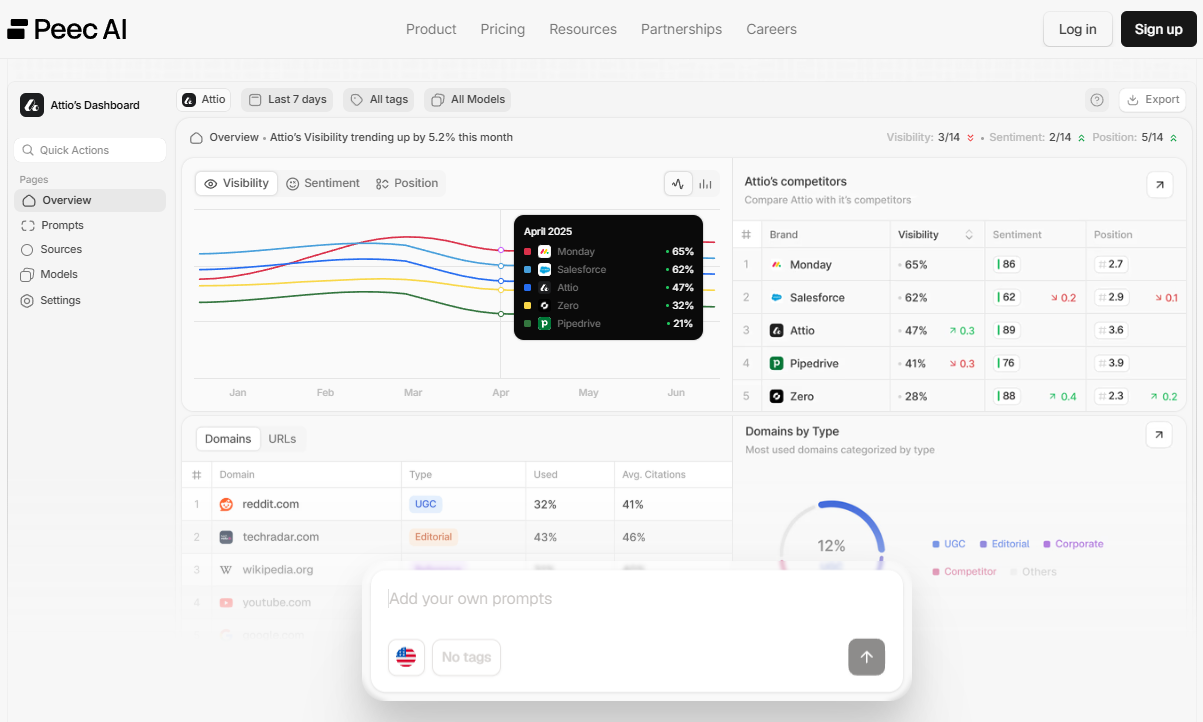
Peec AI: Mid-market & B2B favorite
Peec AI holds the status as one of the best AI visibility tools for B2B companies and mid-market teams for several good reasons, arguably the biggest one being its sheer data legibility, not just for analysts but stakeholders as well.
If your job is to show stakeholders where your brand stands across the major engines, few tools do it as legibly as Peec AI [Image credit: Peec AI]
Beyond legibility, Peec AI is genuinely easy to pick up, requiring minimal training to operate on a basic level, so you can get value out of it without being (or paying) an analyst. Beyond that, daily tracking via UI scraping captures the real on-screen AI responses your buyers see, and unlimited seats from $95/month undercut most VC-backed rivals.
If you need breadth, that’s where Peec AI has real limits. All three core plans (Starter, Pro, Advanced) only cover three engines (buyer-chosen from a pool of six), and adding more costs $35–$165/month each, which can quickly take the platform out of the affordable zone.
That said, Peec AI isn’t purely a monitoring tool: its Actions tab turns visibility data into a prioritized roadmap, surfacing owned-media opportunities (content to fix or create on your own site) and earned-media opportunities (editorial coverage, forums, reference sites to pursue), each paired with concrete next steps and an opportunity score. This means there’s a built-in bridge from insight to execution, not just a dashboard of scores.
Peec AI also goes beyond core brand tracking with a few other modules: Shopping (product-level visibility and win rate in AI shopping surfaces like ChatGPT’s product carousel), Crawl Insights (which AI bots and agents are actually crawling your site), Query Fanouts (the underlying searches an AI model runs behind the scenes to build its answer), and Ads (tracking when AI engines serve ads referencing your brand).
Peec AI is strong for:
Peec AI is weak for:
mid-market and B2B teams that want clean, presentable monitoring plus built-in guidance on what to fix next
teams that need broad multi-engine coverage or more robust action tools than the built-in guidance offers
Profound: Closest thing to an enterprise standard
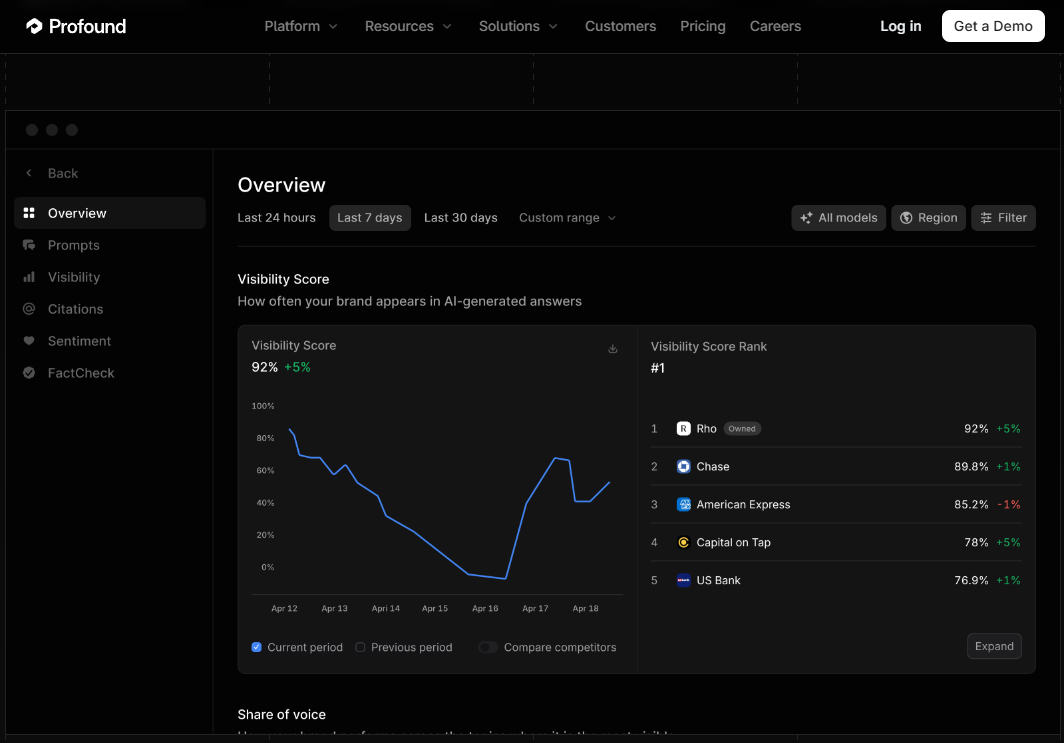
Profound tops virtually every AI visibility tool list – especially its own, which is worth remembering. Strip away the self-aggrandizement (and masterful SEO), and what do you get? As it turns out, a serious, highly functional platform.
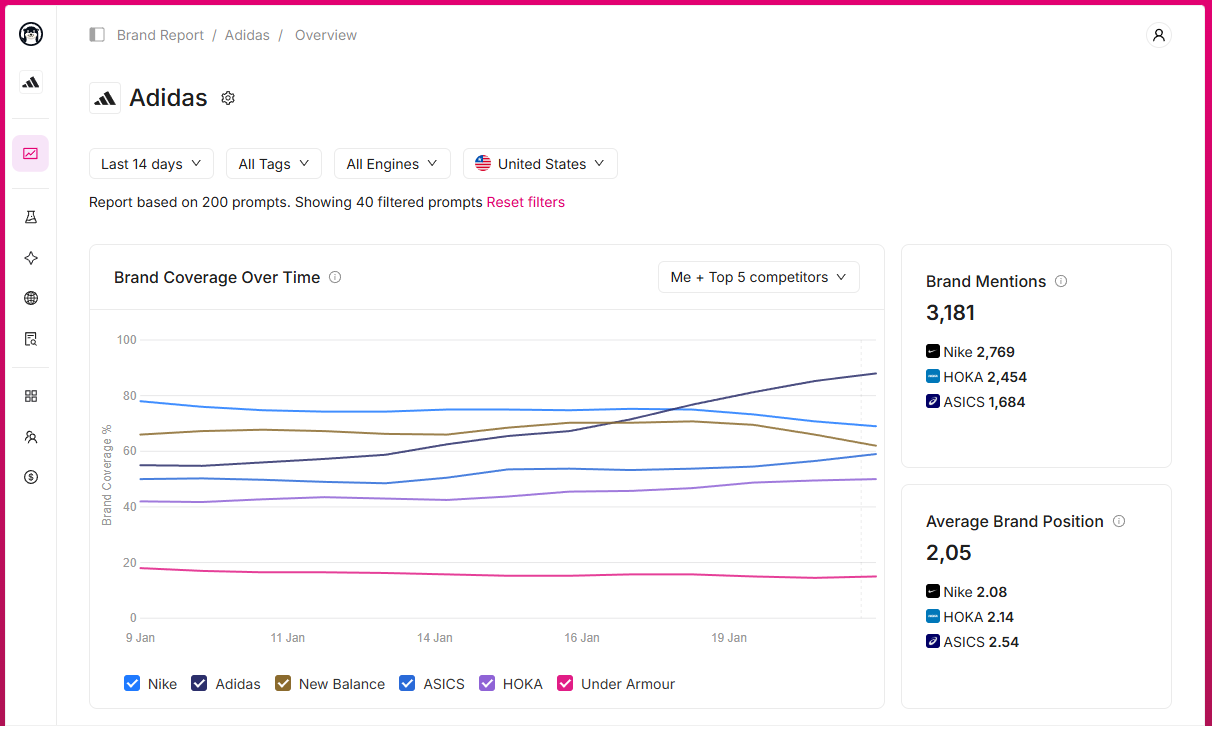
Profound breaks visibility down engine by engine and prompt by prompt – the exact granularity that analyst teams require. [Image credit: Profound]
Profound can track up to nine engines, measure visibility with structured prompts run daily, and offer crawler-to-conversion attribution that hardly any rival can match. According to the vendor, its Prompt Volumes data draws on real buyer conversations, meaning you’ll be able to build your tracked prompt set from genuine, concrete questions not modeled ones. This combination of dedicated, AI-native functionality is why Profound is the closest thing to an enterprise standard in this category.
The downsides are that the entry plan tracks ChatGPT only, multi-engine coverage doesn’t begin until $399/month, and the platform is designed for organizations running full teams of analysts. For SMBs still weighing whether AI visibility deserves its own budget line, Profound is a steep first step.
Profound is strong for:
Profound is weak for:
enterprises w/ dedicated analyst teams
Teams with humbler budgets and simpler needs
Stay ahead of what’s changing in AI search
Subscribe for practical updates on AI discovery, answer engine visibility, and the shifts that matter most for brands trying to stay visible.
AthenaHQ: Monitor + problem-solver
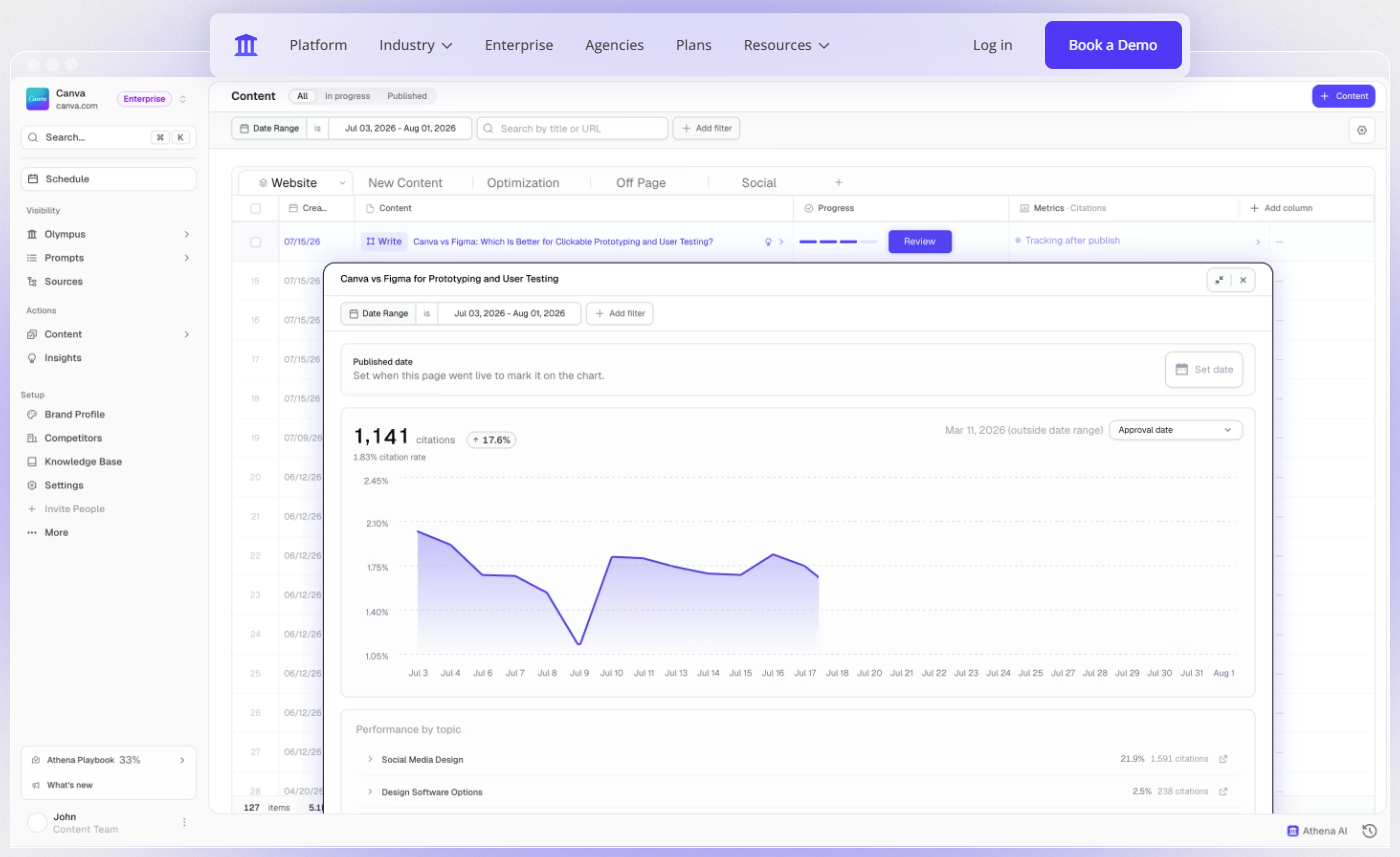
AthenaHQ doesn’t just help you track – it helps you act. Whereas most other platforms stop at pointing out there is a problem, Athena’s task-generating Action Center actually draws a map to solve it. That and the array of other functionalities, many of which are reachable from a free starting tier, is reason enough to position AthenaHQ as one of the best AI visibility optimization tools available today.
AthenaHQ enables you to turn each visibility gap into an assignable task. [Image credit: AthenaHQ]
AthenaHQ comes with 8+ engines tracked on the paid Starter plan, hallucination detection that flags when AI gets your brand factually wrong, and an Action Center that turns findings into assignable tasks. Its entry tier (Essential) is free and tracks five engines, making it excellent for businesses trying out options (and as a commercial hook).
Where AthenaHQ gets real limiting real fast is billing, which can be both unpredictable and restrictive. The $295/month Starter plan runs on credits (3,600/month, one per AI response) that a realistic monitoring cadence (e.g., ≈50 prompts × 5 engines daily) can burn through in roughly two weeks. Furthermore, the features that actually justify the price (the citation engine, persona targeting, multi-region) all sit behind Enterprise (custom quote only).
AthenaHQis strong for:
AthenaHQis weak for:
mid-to-enterprise market teams who want monitoring plus action across a wide set of engines
teams who need predictable flat-rate billing or who need multi-region and advanced features without an Enterprise contract
Scrunch: Clearing the blockers that reduce your retrievability
Scrunch is an obvious candidate for brands already in the Sitecore ecosystem, as it was acquired by the company in June 2026. What makes it an interesting option is a feature that helps AI agents read your website.
Scrunch delivers visibility monitoring and agentic readability boost in one toolset. [Image credit: Scrunch]
When Scrunch’s AXP (Agent Experience Platform) detects AI agents’ presence on your page, it strips said page of JavaScript, tracking, and layout shell, and serves it to the agentic crawler in a machine-readable form. In doing so, AXP helps LLM retrieval bots overcome several limitations that tank your retrievability, making your content a more citable target – and it does it all in real time and without changing what the human sees.
However, if you want a standalone, self-serve tool – Scrunch may not be the best option. Post-acquisition roadmap is still unsettled, AXP is locked behind Enterprise, the entry (Core) plan tracks only four engines, and prompts are configured by you rather than pulled from real user demand. At $250/month for brands or $500/month for agencies, that’s a bit too many conditionals – unless you’re already on Sitecore.
standalone/self-serve buyers and budget teams (most of the features that make Scrunch distinct are locked behind Enterprise)
Evertune: For when presence and reputation are of equal importance
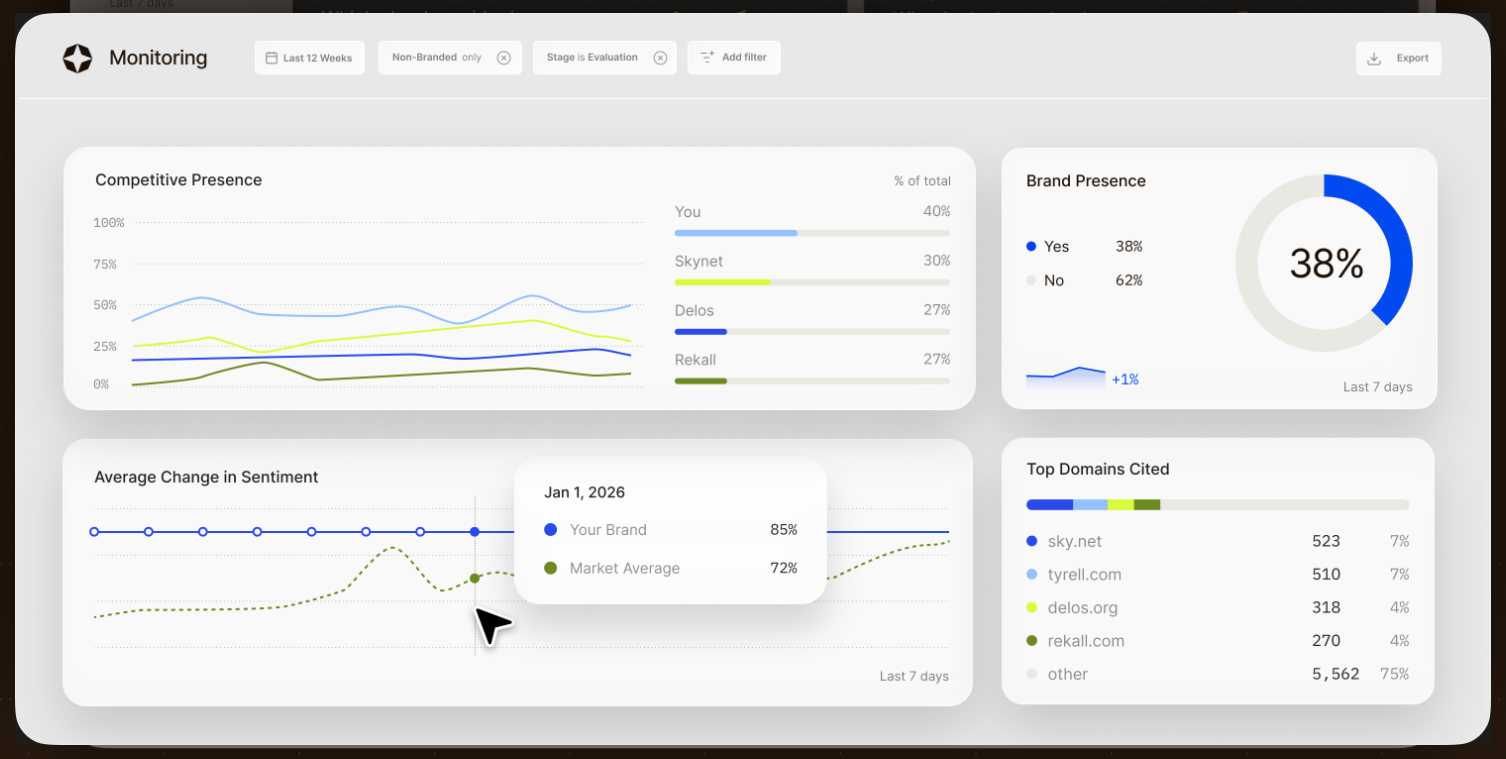
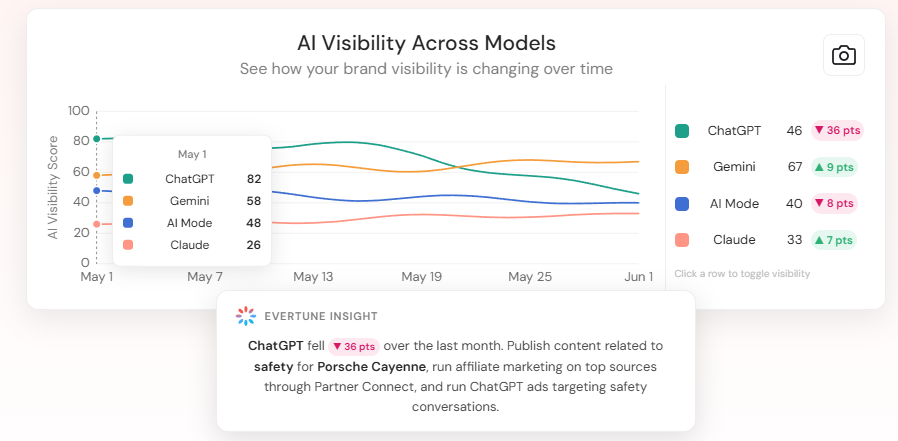
Evertune is fine-tuned to two frequencies: whether AI mentions your brand and whether it does so correctly. It’s one of the few tools that measures both what the model “knows” about your brand from its training data and what it pulls from live answers, grounding it all in EverPanel: a panel of 150M+ real conversations instead of a handful of cherry-picked or modeled prompts.
Evertune scores how accurately AIs describe your brand – not just how often.[Image credit: Evertune]
Evertune’s AI Brand Index samples each prompt at scale (roughly a hundred runs per prompt), delivering a statistically stable read on how models frame your brand. One of its strongest (marketed) features is the ability to identify and fill in content gaps with AI-optimized articles. For organizations where reputation and presence carry equal weight, Evertune ranks among the best AI brand visibility tools on the market.
What makes Evertune restrictive is its cost and access: entry is $800/month for the Pro plan – well above most trackers on this list. Furthermore, both tiers run through a sales demo rather than a self-serve checkout, meaning you can’t just pick it up and kick it off.
Lastly, the flagship feature (content activation) is capped at 25 articles a month. So if your main reason for buying is closing gaps at scale, there’s a high likelihood that you’ll hit that ceiling fast, pushing you to spend up to reach Enterprise.
Evertuneis strong for:
Evertuneis weak for:
enterprise and mid-market organizations where brand accuracy matters as much as presence, and who’ll use the platform’s content and advertising layers
small teams and anyone who wants a cheap, self-serve, monitoring-only tool
Honorable mention: Otterly.ai
Otterly.ai is one of those tools that doesn’t pretend to be more than it is: it’s a starter solution, not an enterprise one – and it’s honest about that. As such, it is one of the best AI visibility checking tools for beginners and budget-conscious teams.
Otterly.ai is a low-friction entry point for smaller teams, offering excellent functionality without breaking your bank.[Image credit: Otterly.ai]
At only $29/month for the Lite plan, Otterly.ai delivers a genuinely rare and advantageous combination: daily tracking across ChatGPT, AI Overviews, Perplexity, and Copilot, with unlimited seats even on the entry tier.
The interface lowers the entry barrier even further: you enter the prompts you want tracked, and Otterly monitors your brand’s presence, ranking, and citations daily, with sentiment and share-of-voice reporting layered on top. For marketers who want to start measuring AI visibility today, with minimal commitment and training, Otterly offers exactly that (and not much else).
As for limitations, two stand out. First, if you want to also track Gemini, AI Mode, or Claude, they are all paid add-ons. Gemini and AI Mode are $9/month each and Claude is $29/month on Lite, climbing to $149 and $439 (respectively) on Premium.
Second, the base tracking is only 15 prompts, and increasing it to 100 will run you $189, which is quite steep and an abrupt jump. What’s more, Lite can’t buy extra prompt packs at all, so if you hit that ceiling, upgrading is the only option.
Otterly.ai is strong for:
Otterly.ai is weak for:
solo marketers, SMBs, and beginner teams who want the cheapest yet functional entry
teams that need Gemini/AI Mode/Claude coverage, high prompt volume, or enterprise depth
Tina Clarke is the AI SEO Manager at ZeroClick Labs, specializing in AI search optimization and Generative Engine Optimization (GEO). With a strong foundation in content strategy, technical SEO, and operations, she leverages her expertise to help brands shift from traditional rankings to discoverability and excel in AI-driven ecosystems.
ZeroClick Labs helps brands act on what tools only measure, so they earn the citations reliably, get presented correctly, and win the AI visibility game repeatedly.
The data is all there.
The time to act is now.
Connect with us today, and let’s talk winning!
“Our agency had no idea how to approach AI visibility. ZeroClick only does this one thing so they actually know what works. Worth every penny just to not waste time figuring it out ourselves.” – Jay