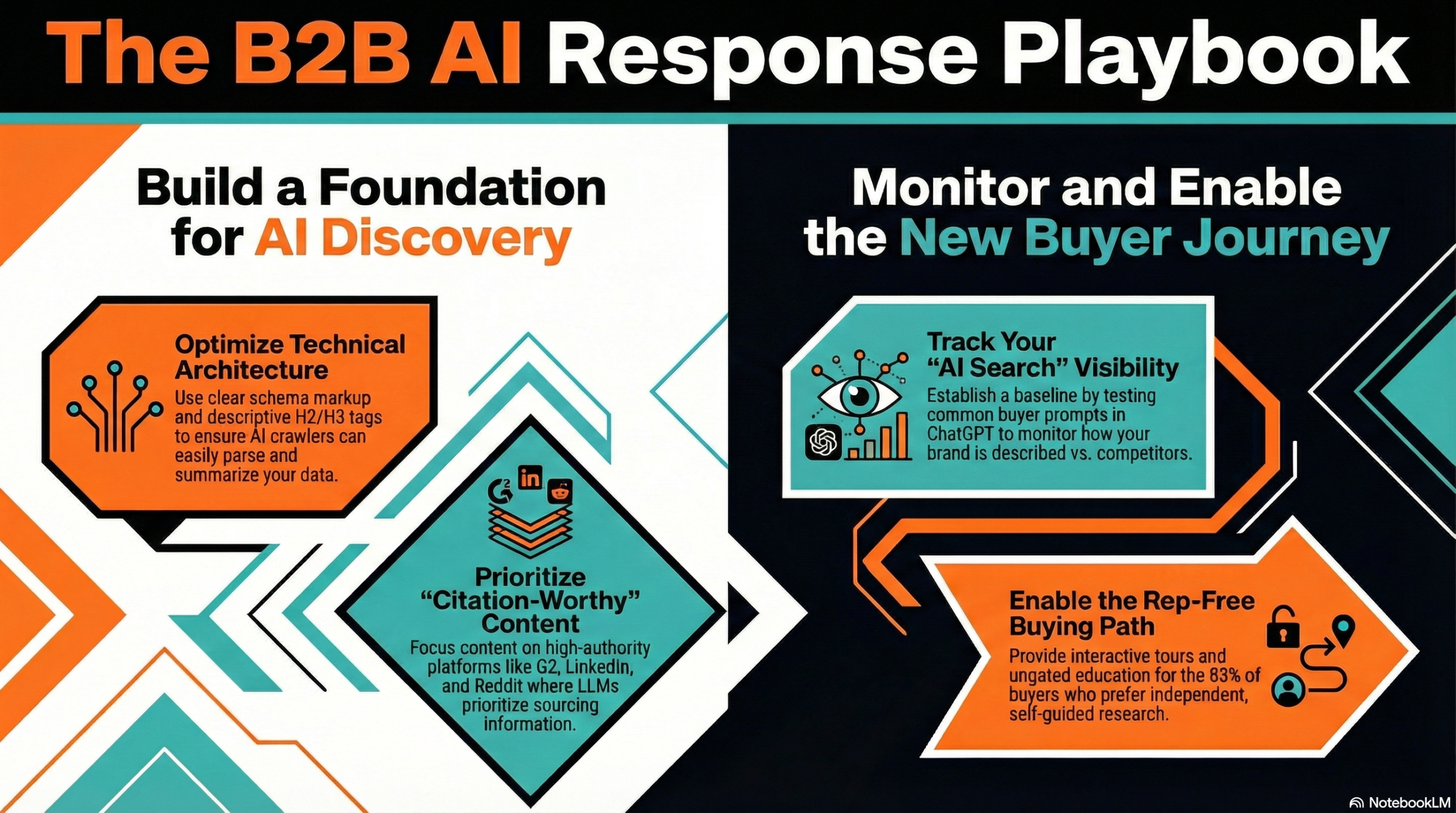
More than 50% of the B2B buyers now start their search on AI platforms.
ChatGPT is the preferred model for 74.09% of respondents.
60.8% already leveraged AI insights in sales negotiations.
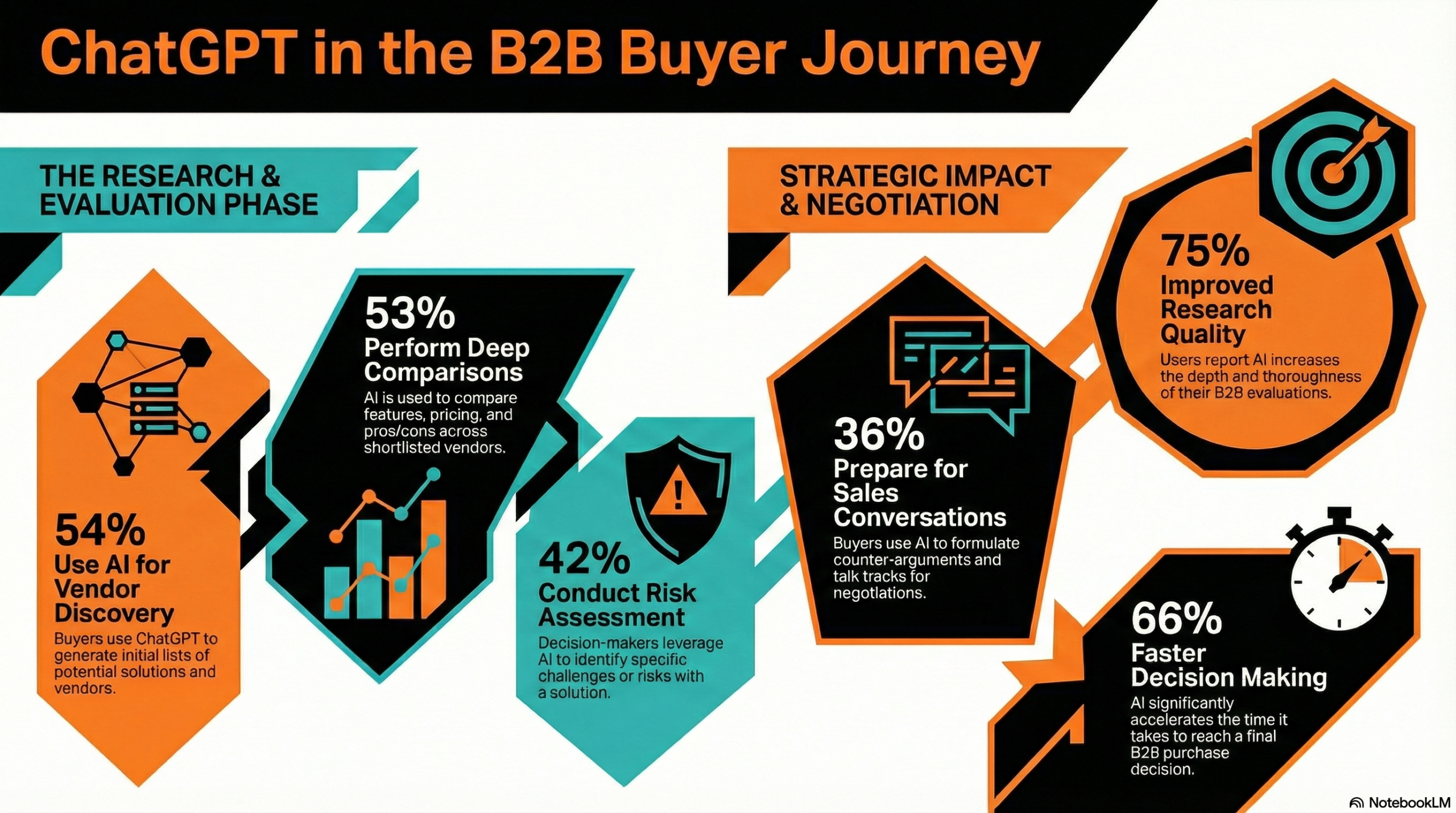
The most common use cases are generating vendor lists (53.8%) and comparing features across shortlisted options (53.5%).
To adapt to the “zero-click” shift, vendors must pivot from SEO to GEO.
TL;DR: A survey of 400 high-level B2B decision makers, fielded in December 2025, revealed that the utilization of ChatGPT in the purchasing process is widespread and accelerating. ChatGPT is by far the most dominant platform, with nearly three-quarters of respondents relying on it for research and information synthesis. The survey indicates a shift toward “zero-click” behavior, with buyers shortlisting vendors, comparing features, and performing risk assessments within the AI platform, completely bypassing traditional search or contacting sales. Consequently, traditional SEO is no longer enough, and vendors are advised to bolster their strategies with intentional Generative Engine Optimization (GEO) solutions.
In December 2025, ZeroClick Labs conducted a survey encompassing 400 high-level decision-makers across various industries, intent on determining just how widespread the adoption of AI is in the B2B ecosystem.
Among other findings, the survey revealed that OpenAI’s ChatGPT has become an integral part of the B2B purchasing process. Buyers are using it in virtually every stage of their journey, leveraging its analytical power to save time and gain the upper hand over vendors.
Today, we’ll be analyzing the most common use cases for ChatGPT across the B2B buyer journey and consequent implications for merchants, as well as providing actionable insights to help vendors ensure alignment with a “zero-click” environment.
How do B2B buyers actually use ChatGPT?
B2B buyers use ChatGPT for a broad array of tasks, including problem framing and requirement definition, vendor discovery and shortlists generation, product features comparison, complex data analysis and synthesis, internal alignment and justification, and even negotiation preparation.
ChatGPT infiltrated virtually every stage of the B2B buyer journey
Where does ChatGPT fit in the B2B buying journey?
Our survey data shows that ChatGPT is predominantly being used early in the decision-making process – specifically, during the awareness, consideration, and decision stages of the buyer journey.
However, its ability to generate actionable strategic insights, such as formulating arguments and counterpoints to be used during sales negotiations, makes it an invaluable tool during virtually every phase of the purchasing process.
1. Problem framing & requirement definition
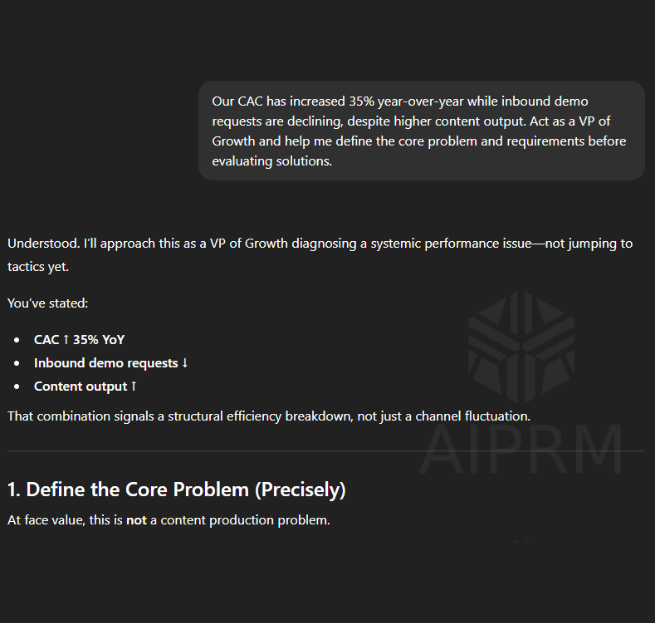
Decision-makers know that “a problem well-stated is a problem half-solved,” which is likely why nearly a quarter (23.92%) of respondents use AI tools to define initial requirements, before even starting to look for a solution. Here’s how this typically works:
“Raw input”: The buyer inputs the challenges they face and asks the model* to clarify objectives, constraints, and success criteria;
“AI Translation”: The model then structures the problem into key requirements, risks, and evaluation metrics;
Iteration(s): The buyer keeps refining the scope, adding context, or pressure-testing assumptions, and the circle repeats until the requirements are crystal clear.
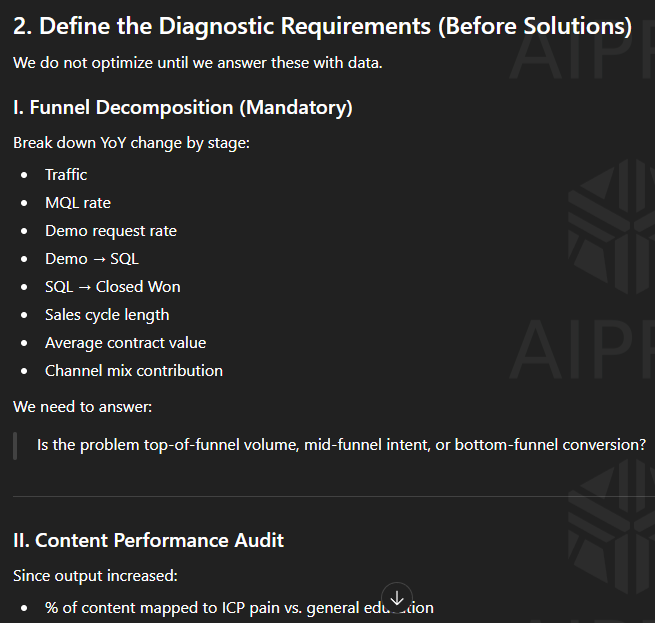
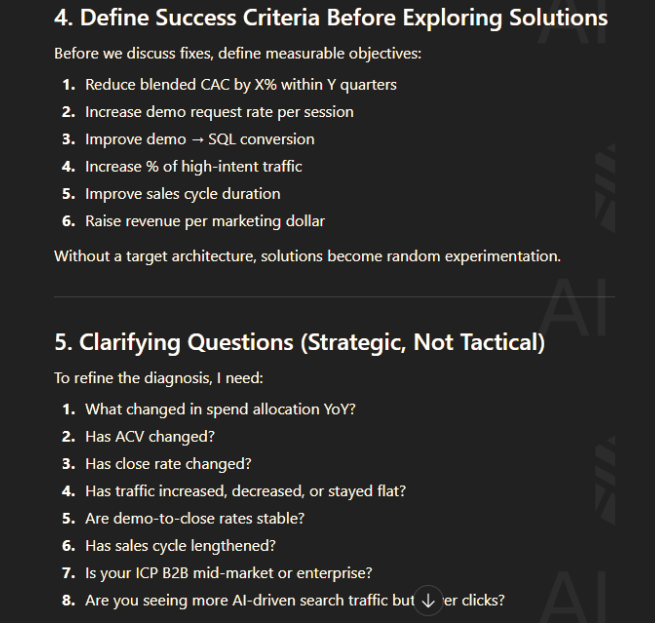
We provided a “raw” input, but we also assigned a role (“Act as a VP of Growth”) to frame the analysis through a functional lens.
ChatGPT then “translated” our messy, unrefined input into structured, actionable requirements (e.g., “Funnel Decomposition”, “Content Performance Audit”), and even provided guidance on how to proceed with problem definition (e.g., “Define Success Criteria…”, “Clarifying Questions”).
From this point onward, it’s only a matter of refinement through iteration.
The value here is obvious: Instead of jumping headfirst into vendor research and risking investing in incomplete solutions, decision-makers can now leverage generative AI to sharpen the problem statement first – so when they do reach the next step (vendor discovery and shortlisting), they have a crystal-clear search criteria.
2. Vendor discovery & shortlisting
Building off of our previous SaaS example, and assuming that one of the problems was “Content isn’t converting into qualified demos,” the buyer will now simply ask ChatGPT: “What are the top 5 tools that connect content engagement directly to the revenue pipeline for B2B SaaS companies?” – and they’ll get their Top 5 solutions immediately.
At this point, a buyer is no longer asking “What’s wrong?” – they are asking “Who can solve my problem?” Only, instead of spending hours or days browsing online directories or clicking Google links, 53.8% of buyers ask GenAI to synthesize a list of potential vendors or solutions.
According to our survey, nearly 28% of respondents begin their research in the AI space, with 74% of buyers using ChatGPT specifically, making it the most dominant AI tool in the B2B ecosystem. What’s more, supporting data from multiple independent studies backs these findings, revealing a shift: B2B buyers are bypassing traditional search entirely in favor of AI.
3. Feature comparison & synthesis
Armed with a shortlist of vendors, each of which aligns with their criteria, buyers can now proceed to use the ChatGPT Shopping Research feature to perform an in-depth comparative analysis and find their perfect match. In fact, that’s exactly what 53.5% of buyers do – use ChatGPT to compare features, pros/cons, and pricing across shortlisted vendors.
What’s more, 50.83% of B2B Buyers use AI tools to summarize and synthesize dense information (e.g., vendor whitepapers, market reports, product specifications). This not only vastly accelerates the research phase, but effectively enables non-technical buyers to produce professional-grade technical documentation to be used for internal justification – or as leverage during sales conversations.
Stay Ahead of AI Search Developments
Sign up to The Laboratory and get the latest GEO insights, AI optimization strategies, and expert tips straight to your inbox.
4. Internal alignment & justification
In B2B purchasing, the real hurdle isn’t the vendor – it is internal alignment. Before any deal moves forward, the entire buying committee must be on the same page. For 22.6% of our respondents, ChatGPT is an invaluable means of ensuring alignment, aiding them in drafting business case documents or ROI justifications for internal stakeholders.
Furthermore, 41.53% use the model to identify specific risks associated with a vendor or a product, enabling them to not only confidently defend their choice to their CFOs or board of directors – but to ensure transparency across the organization before committing the budget and to raise awareness of the solution’s potential limitations once implemented.
5. Arming the buyer
Finally, the most striking finding our survey produced regards the readiness of B2B buyers to leverage GenAI insights in sales negotiations. 35.5% actively use AI platforms as their personal “coach” – specifically, to formulate counter-arguments and negotiation points to be used in sales conversations.
However, that’s just the top of the iceberg. As many as 60.8%of respondents have already used AI-generated information to challenge a vendor or sales representative, while 31.23% said they can see themselves doing the same in the future. What this means is that vendors no longer have the upper hand in negotiating. The playing field is leveled at best, and if this “trend” continues – which it most likely will – the sellers can expect to be at a significant disadvantage.
A sound GEO strategy can help vendors excel in the new “zero-click” environment.
How should vendors respond to the use of ChatGPT in the B2B purchasing process?
The critical paradigm shift – from blue-link to zero-click discovery – requires vendors to pivot from traditional Search Engine Optimization (SEO) to Generative Engine Optimization (GEO), in order to ensure AI-alignment and increase their selectability by the answer engines.
Audit your “AI Brand” – Treat ChatGPT as a reputation engine:
Perform regular testing of high-intent prompts (e.g., “Best [category] solutions for [Industry]”) to determine where/if you appear, AND;
Identify how ChatGPT summarizes pricing, features, and risks associated with your brand/product, AND;
Compare results to your competitors and address the gaps or ”hallucinations” before they shape buyer perceptions.
Ensure “AI Agent Readiness” – Make it easy for AI to “read” your website:
Implement structured data (Page/Article/FAQ/HowTo Schema Markup) to help ChatGPT accurately parse the information on your website.
Publish “Citation-Worthy” content – Shift the focus from keyword density and marketing fluff to factual accuracy and narrative clarity:
Identify and provide clear, concise, and factual answers to specific questions your buyers may ask;
Ensure AI-friendly formatting, including logical H-hierarchies, data tables, bullet points, and step-by-step guides to make it easy for ChatGPT to lift and summarize the content for the user.
For B2B decision-makers, OpenAI’s flagship is no longer a mere “chatbot” – ChatGPT is now a veritable research assistant, trusted advisor, and strategic partner. Buyers no longer need to visit a website to obtain the information they need, except to maybe verify said information. “Maybe,” because they’re increasingly considering AI insights equal in weight (55.81%) and even more valuable than traditional analyst or review site rankings (32.23%).
For you as a vendor, the shift to “zero-click” discovery is the critical “adapt-or-perish” point. The reason: if your brand does not appear in the AI-synthesized list – it effectively doesn’t exist. With the entire discovery cycle taking place within an AI platform, the confidence in generative AI rapidly on the rise, and the “armed buyer” entering negotiations guns-AI-blazing, your brand needs solutions that surpass the capabilities of traditional SEO.
You need a high-level, intentional ChatGPT SEO optimization strategy that will align you not only with the AI-driven discovery – but with a new era of e-commerce.
You need ZeroClick Labs.
“Our agency had no idea how to approach AI visibility. ZeroClick only does this one thing so they actually know what works. Worth every penny just to not waste time figuring it out ourselves.” – Jay