With the new self-serve Ads Manager (beta), any verified U.S. business can buy ChatGPT ads directly.
CPC bidding has been added in addition to CPM, with a recommended $3 – $5 starting max bid.
Impressions alone cost nothing – advertisers are charged only when the user clicks an ad.
Conversions API and OpenAI-issued pixel let advertisers measure post-click outcomes.
The $50,000 minimum spend has been removed, opening the platform to startups and SMBs.
Organic and paid AI visibility are now complementary channels, not substitutes.
Executive Summary: On May 5, 2026, OpenAI launched a self-serve Ads Manager for ChatGPT. The new platform adds cost-per-click (CPC) bidding alongside CPM, as well as Conversions API with pixel-based management. By leveraging the model’s dual-channel nature, brands can reap the benefits of both organic and paid visibility.
On May 5, 2026, OpenAI announced the launch of a beta self-serve ChatGPT Ads Manager – a major expansion to its pilot program, this time including CPC bidding, a Conversions API with pixel-based measurement, and the ability to manage the full campaign lifecycle. Today, we’ll be exploring what the new system does, how it works, and what it means for brands and advertisers looking to stay on top of the ever-changing AI-powered ecosystem.
What is the ChatGPT Ads Manager & what can it do?
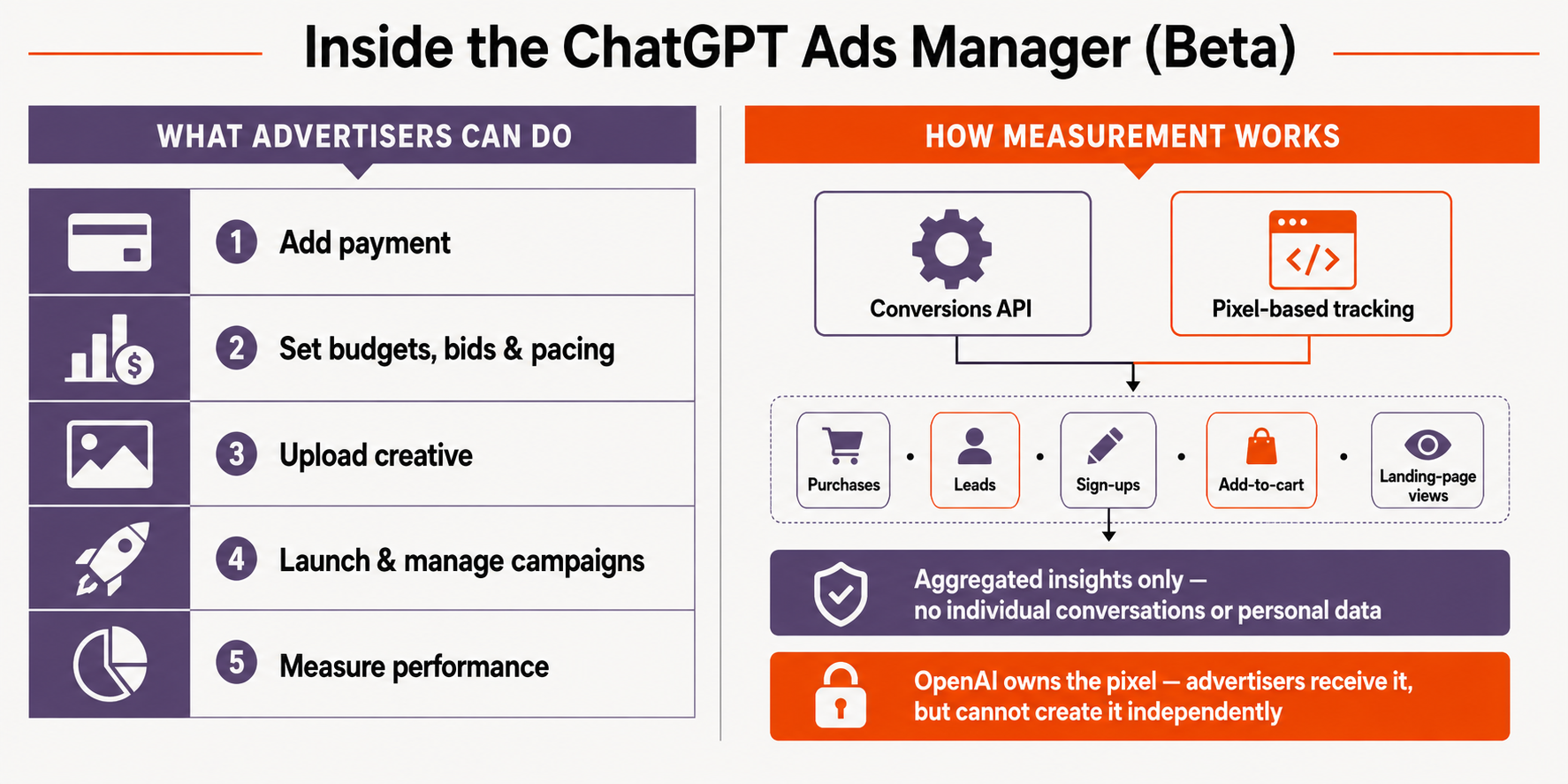
OpenAI’s newest tool, ChatGPT Ads Manager, is a self-serve portal that allows registered advertisers to run a full advertisement campaign lifecycle autonomously. In its current Beta state, the platform enables its users to:
Add payment information;
Set budgets, bids, and pacing;
Upload creative;
Launch and manage campaigns;
Measure performance directly.
From a technical perspective, this is nothing revolutionary – it’s the same baseline workflow advertisers have been encountering on Google Ads and Meta Ads Manager for years now. However, considering we didn’t even have that when the pilot was released, this is a meaningful improvement.
A newly-released ChatGPT Ads Manager boasts the same baseline functionality as its Google and Meta counterparts. [Image Credit: ZeroClick Labs via ChatGPT]
Can advertisers now measure ChatGPT Ads results?
Yes, they finally can! The platform offers two measurement options: a Conversion API and a pixel-based system. In combination, these tools allow advertisers to track what happens after the click, including purchases, leads, sign-ups, add-to-cart events, and landing-page views.
However, reporting comes back as aggregated performance insight – i.e., advertisers cannot see individual conversations or personal user data. In addition, Jellyfish’s CSO for media activation, Jai Amin, noted that OpenAI retains ownership of the pixel – they can issue it based on what the advertiser wants to track, but the advertiser cannot create them independently.
Still, let’s not split hairs. Realistically, for a channel where visibility tracking and analytics – and consequently, transparent and honest reporting – have historically been the toughest parts of the job, even a rudimentary measurement system is a massive step up.
How can businesses purchase ChatGPT Ads?
Advertisers in the U.S. (and, soon, UK, Mexico, Japan, Brazil, and South Korea), can buy ChatGPT Ads via two channels: a managed setup via OpenAI’s agency and technology partners, or directly through the new beta self-serve Ads Manager.
Managed setup: The current partner roster includes Dentsu, Omnicom, Publicis, and WPP, alongside technology partners Adobe, Criteo, Kargo, Pacvue, and StackAdapt.
Self-serve: Registration requires business verification, but the $50,000 foot-through-the-door minimum ($200K – $250K on launch) has been removed, effectively opening the channel to SMBs and startups, and not just the biggest players.
How much do ChatGPT ads cost?
Since ChatGPT Ads campaigns are currently organized around Reach (for CPM buying) or Click (for CPC buying) objectives, the pricing remains fluid. However, while the advertisers can set their own bids, OpenAI published its recommended starting max bids via the help center:
For CPC campaigns: $3 – $5 per click
For CPM campaigns: $60 per thousand impressions
It should be noted that auctions run on a relevance-weighted, second-price model, meaning that the price an advertiser pays is determined by competition and ad relevance – as opposed to maximum bid. In OpenAI’s words, this approach enables them “to find the best ad for eligible conversations,” thereby allowing the system to “maximize both advertiser and user value.”
How does CPC bidding work in ChatGPT Ads?
As noted above, CPC bidding charges advertisers only when a user clicks an ad – the impressions alone cost nothing. The inclusion of this system marks a meaningful shift from the CPM-only model used in the early ChatGPT Ads pricing phase, paving the way for advertisers to “align their spend more directly with the actions people take after seeing an ad.”
Gartner VP analyst, Nicole Greene, seems to agree. In a recent interview, she stated that “this is going to help advertisers directly compare their results on OpenAI to other major advertising platforms and manage their spend,” and added that “this consistent measurement will help advertisers justify reallocation of spend to OpenAI.”
Needless to say, for performance marketers, this is a huge and more than welcome change – for the first time since the release, the ChatGPT inventory can actually be benchmarked against Google’s or Meta’s on a 1:1 basis, rather than against an impression-only sponsored results model that defined Phase 1.
Stay in the Loop – Stay Ahead
Sign up for The Laboratory newsletter and get the latest insights from AI world straight to you inbox!
What does the release of ChatGPT Ads Manager mean for brands and marketers?
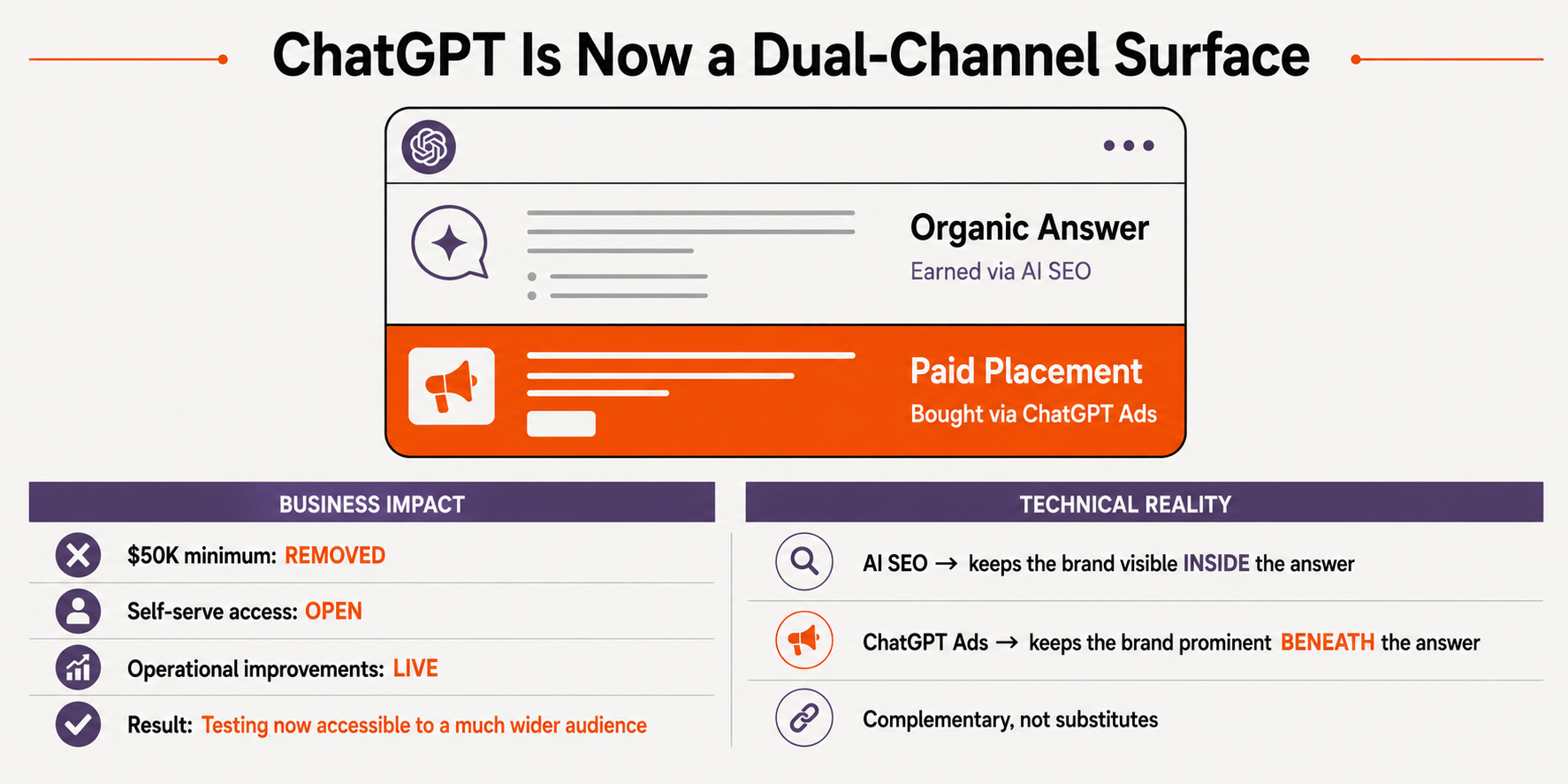
The launch of the new tool, combined with OpenAI’s explicit intention to keep ChatGPT answers independent of advertising, effectively positions the model as a dual-channel surface – meaning that brands can now benefit from both organic citations AND paid placement. The practical implications are twofold.
From a business perspective, the lower barrier to entry (made possible by removing a $50k minimum, self-serve access, and the operational improvements) makes testing the new system more accessible to a much wider audience.
From a technical standpoint, AI Search Engine Optimization and ChatGPT Ads are now complementary, not substitutes – the former keeps the brand visible inside the answer, while the latter keeps it prominent when it matters the most.
A new, dual-channel nature of ChatGPT opens combined visibility avenues for brands. [Image Credit: ZeroClick Labs via ChatGPT]
Lily Evans is the Managing Director at ZeroClick Labs, bringing over 8 years of comprehensive experience in SEO, local SEO, and AI optimization to every project. She began her career in content writing, developing a strong sense for search intent and messaging clarity in the digital realm – skills that form an unshakable core of her leadership to this day.
OpenAI’s Ads Manager is new and untested. Your competitors aren’t.
The brands that win in ChatGPT will be the ones running both channels at once.
ZeroClick Labs is here to help you set up a dual strategy that ensures your organic and paid fronts are unified in a single purpose – winning your brand visibility in the new ecosystem.
Connect with us today, and let’s talk victory!
“Our agency had no idea how to approach AI visibility. ZeroClick only does this one thing so they actually know what works. Worth every penny just to not waste time figuring it out ourselves.” – Jay