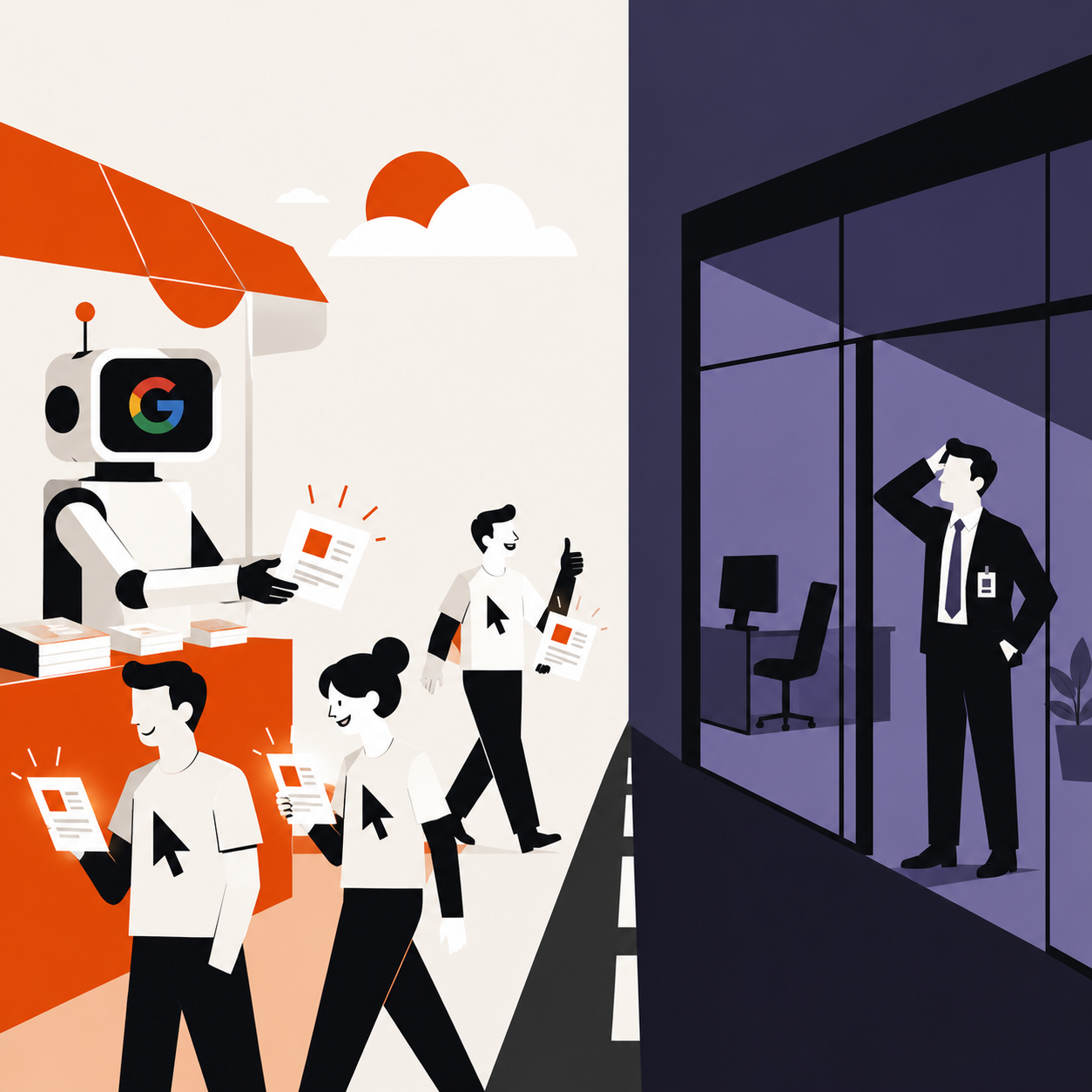
When AIOs appear, users no longer bounce – they back-scroll, re-read, and compare listings directly in SERP.
The #1 organic ranking loses between 32% and 61% of its clicks when an AI Overview is present.
Being cited inside AIOs reverses the loss, with brands standing to earn 35% more and higher-quality clicks.
Executive Summary: AI Overviews (AIOs) have transformed Google’s result page from a gateway into an evaluation surface. Users now research, analyze, and compare information directly in SERPs. Consequently, top-position CTRs have dropped by up to 61% – yet cited brands gain up to a 35% traffic lift at higher conversion rates. The volume of clicks is shrinking, but their value is skyrocketing.
Google processes more than 8.5 billion searches every single day. Up until recently, the commanding majority of those queries resulted in a click-through to a source website, presenting brands with 8.5 billion traffic opportunities.
That is no longer the case.
With the AI Overviews “hijacking” a substantial portion of queries (even up to 99.9% for informational searches), the click-through rates are plummeting across virtually every commercial environment – and it’s not because the search is used less.
It’s because AIOs rewire user behavior, making them less likely to visit your website.
Today, we’ll be exploring how the presence of AIOs shifts searchers’ behavior and the consequential impact on brands and their websites, as well as how you can mitigate the negative effects by employing intentional AI Overviews SEO.
How are AI Overviews changing searchers’ behavior?
In a word: dramatically. When AI Overviews appear, users no longer “scan and go;” they read, revisit, and compare information – and they’re doing so deliberately and repeatedly. It’s not just about clicking less – the decision-making process of whether to click at all has fundamentally changed.
The evidence
Recently, ClickStream Solutions published a study of 846,000 U.S. Google search sessions via SEJ, analyzing metrics that ranking data cannot capture (i.e., cursor movement, scroll depth, session duration) and how they change when AIOs are present. The results, albeit granular, provide clear evidence of the behavioral shift, the most defining pattern being:
Back-scrolling: Nearly half (47.5%) of all activity on AIO pages consists of users scrolling back up the page (vs. 27% without AIOs).
Time-in-SERPs: The evaluation interval (the time between SERPs appearing and click-through) shot up from 3 to 21 seconds.
Searchers are now revisiting content they have already scanned, working through the results and weighing their options, often doing so multiple times before clicking through to the source page. Make no mistake, these aren’t the markings of an “indecisive” user – but of the one whose mindset is shifting from mere discovery to scrutiny.
The change
The next evolution of SERP is not just functional – it’s structural on a fundamental level. Once a brief gateway, Google’s search results have now become a veritable decision-making surface, enabling users to conduct a majority of research and evaluation without ever needing to visit a source website. The behavioral and structural shift is not isolated, but evident across the broader data:
Share of Google searches ending without any click to an external website — by search environment
Traditional SearchNo AI feature present
Zero-click: 60%
60%
Traditional Search
Zero-click rate~60%
Click-through rate~40%
The pre-AIO baseline. Even before AI Overviews, 3 in 5 searches ended without any website visit.
Source: Bain / Semrush, 2025
AI Overview QueriesAIO present in SERP
Zero-click: 83%
83%
AI Overview Queries
Zero-click rate~83%
Click-through rate~17%
Brands cited within an AI Overview earn 35% more clicks than non-cited competitors.
Source: Semrush / Seer Interactive, 2025
AI Mode QueriesFull AI Mode enabled
Zero-click: 93%
93%
AI Mode Queries
Zero-click rate~93%
Click-through rate~7%
Only 7 in 100 AI Mode queries result in any external website visit — the highest zero-click rate in Google Search.
Source: Semrush, September 2025
Zero-click share (no external visit)Remaining click-through share
Sources: Bain, Semrush, Seer Interactive, 2025–2026 · Hover any row for details
The combined effect can be best understood through a banal example: a listing that might have been skimmed in seconds just a few years ago is now being thoroughly read, scrutinized against an AI summary, and weighed against competitors.
The new SERP rewards brands capable of earning ATTENTION – not just clicks.
What does the change in search behavior mean for brands?
The behavioral change directly translates into measurable commercial consequences, as evidenced by the CTR decline directly correlated with AI Overviews’ expansion, but also a notable upside when it comes to branded queries:
At scale, the structural implications are severe, with CTR losses already reaching 89% for certain publisher categories, which is a “trend” Google’s shift to agentic search is only set to accelerate further. Fortunately, there is a silver lining, once again evident in broader industry data:
Brands cited within an AIO can see a 35% CTR increase over non-cited competitors.
Even though CTRs are collapsing for organic positions, the new SERPs present a clear opportunity for brands willing to adapt.
Stay in the Loop – Stay Ahead
Sign up for The Laboratory newsletter and get the latest insights from AI world straight to you inbox!
How to win the new search, despite the behavioral shift?
Winning in the new Google Search (and zero-click era in general) requires building upon the foundations of traditional SEO with solutions engineered specifically for winning placements in AI-generated answers. Here’s how to optimize for AI Overviews, specifically:
Lead with the answer: AI systems favor front-loaded content that addresses the question within the first 50-100 words of a section – and so do users.
Structure for machine parsing: FAQ schema markup, descriptive and hierarchical H2/H3 headings, numbered steps, bulleted lists, and comparison tables are disproportionately represented in AIOs.
Shift measurement from ranking to citations: Since traditional SEO metrics don’t capture AI visibility, tracking AI citation frequency, share of voice, brand mentions, and AI-sourced referral traffic in GA4 is key to gauging real performance.
Shift focus toward high-intent content: Informational queries trigger AIOs at a much higher rate than all others, so investing in decision-stage content (e.g., case studies, data-backed guides, product/feature comparisons) positions the brand for citability.
Lily Evans is the Managing Director at ZeroClick Labs, bringing over 8 years of comprehensive experience in SEO, local SEO, and AI optimization to every project. She began her career in content writing, developing a strong sense for search intent and messaging clarity in the digital realm – skills that form an unshakable core of her leadership to this day.
Brands that earn AI citations will be the ones to win them.
ZeroClick Labs is here to help position your brand as the source of record for Google’s AI Overviews and AI mode, but also for other prominent AI search engines, including ChatGPT, Perplexity, and Copilot.
Reach out to us today, and let’s start building trust and purchase intent that actually convert!
“Our agency had no idea how to approach AI visibility. ZeroClick only does this one thing so they actually know what works. Worth every penny just to not waste time figuring it out ourselves.” – Jay