Google named five AI SEO tactics as myths. Two of them are. The rest? Depends on which Google you’re listening to – the one that writes the guidelines, or the one that runs the algorithm.
Google’s AI optimization guide identifies five tactics as unnecessary for AIO citations.
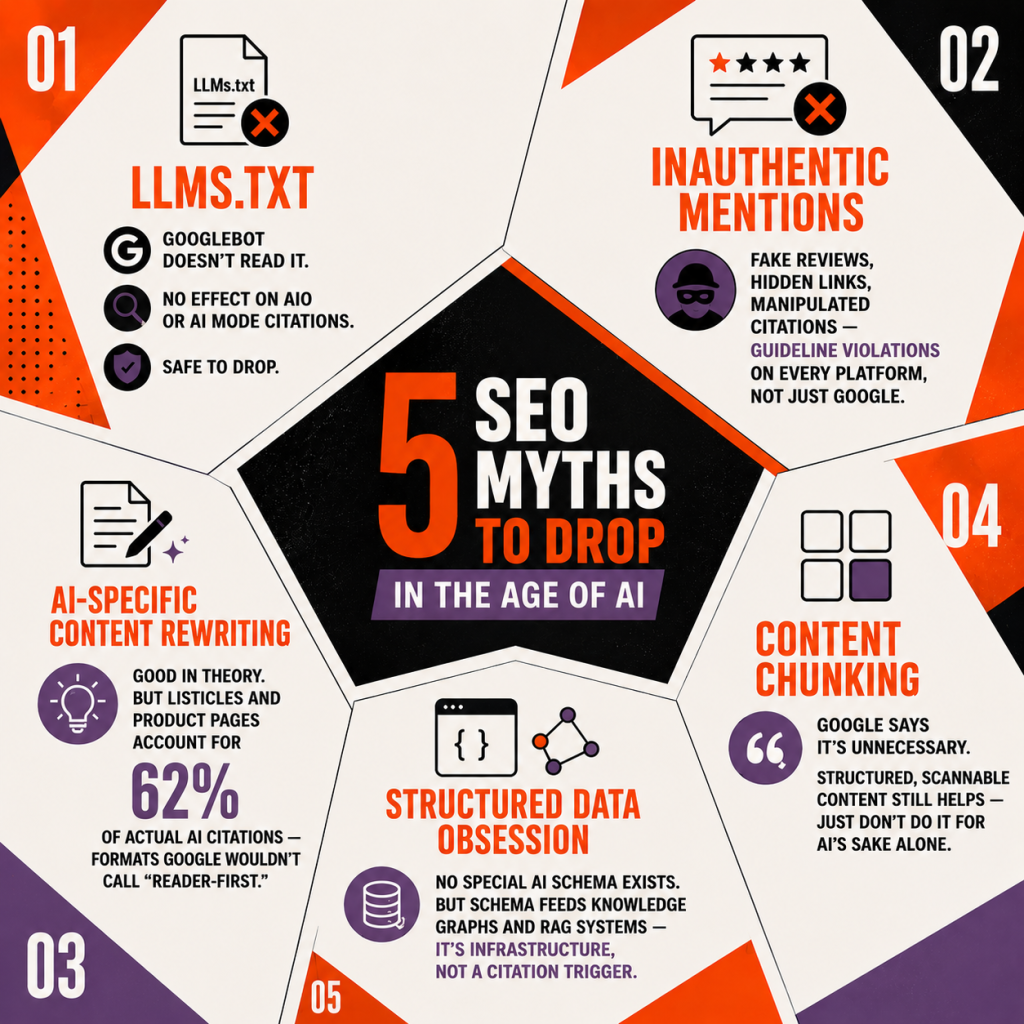
Two are genuinely settled: LLMs.txt does not move citation counts and inauthentic mentions are a guideline violation, regardless of platform.
The guide says write for readers, not AI – but external data and our own citation research tell a different story.
Schema markup isn’t a direct citation lever, but that doesn’t make it irrelevant.
Executive Summary: Google’s new AI optimization guide correctly identifies several overused SEO tactics, but presents the ideal as though it were the reality. Two of five “debunked” claims are settled: LLMs.txt and inauthentic mentions. The remaining three – AI-Specific Content Rewriting, Content Chunking, and Structured Data Overuse – require more nuance than the guide provides.
Google recently published a new AI optimization guide for “website owners looking for official best practices from Google Search on how to succeed in generative AI features in Google Search” – specifically, how to optimize for AI Mode and AI Overviews.
A welcome resource, most definitely – that should be taken with a grain of salt.
The reason is simple: when Google tells you how to optimize for its own systems, it’s worth remembering what those systems have historically rewarded – not just what Google says they reward.
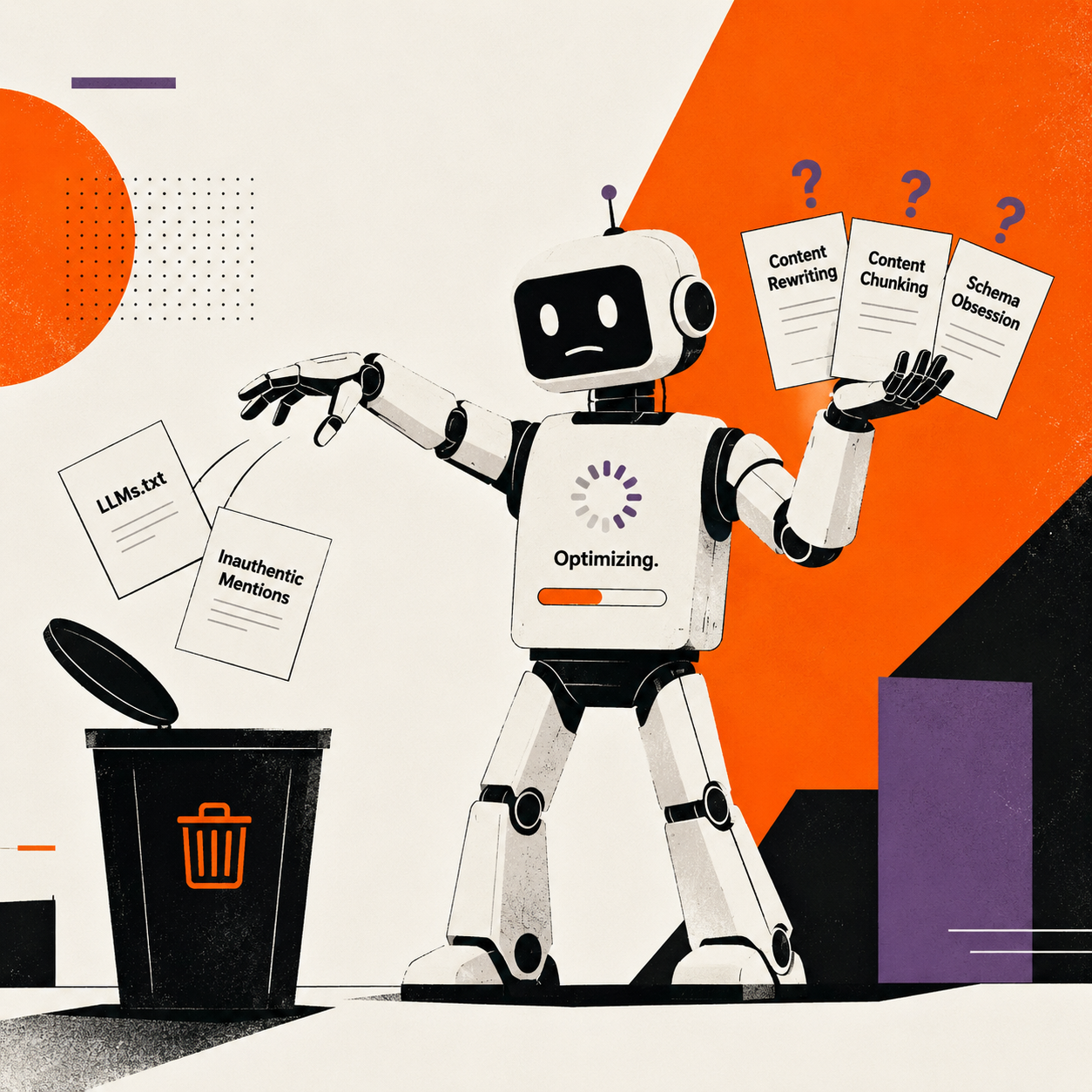
Google debunked 5 AI SEO myths. Even so, their advice shouldn’t be taken at face value [Image credit: ZeroClick Labs via ChatGPT]
Which of the five optimization tactics should you stop employing?
Unambiguously, only two of them: inauthentic mentions and LLMs.txt. The case against them is practically settled, and no serious counterargument exists to justify their continuous presence in AI SEO optimization strategies.
Inauthentic mentions: Full stop, no go
While they framed it really tactfully in their guide, saying that “seeking inauthentic “mentions” across the web isn’t as helpful as it might seem,” Google also strongly implied that this practice is counterproductive and subject to penalization, stating “Our core ranking systems focus on high-quality content while other systems block spam; our generative AI features depend on both.”
One thing worth noting: “inauthentic mentions” and “paid placements” are NOT synonyms. The latter remain a legitimate advertising practice, provided the disclosure. What Google is flagging is manipulation – tactics such as fake reviews, hidden link buying, and mentions designed to deceive retrieval systems. These practices have been guideline violations across every platform (not just Google) for the better part of two decades – and will persist as such.
LLMs.txt: Put it on the back burner
Googlebot does NOT read or utilize LLMs.txt (and similar files) for crawling, indexing, and ranking, and these categories of “special” markup have no documented effect on AIO or AI Mode citation rates.The caveat is that the concept of machine-readable index may prove useful for autonomous AI agents, once the agentic search mode becomes more prevalent. As for whether it moves citation counts today – the answer is no.
Stay in the Loop – Stay Ahead
Sign up for The Laboratory newsletter and get the latest insights from AI world straight to you inbox!
Where Google’s track record should make you skeptical about the guidelines?
On the topics of AI-Specific Content Rewriting & Content Chunking, we part ways with the guide. “Write for readers, not for AI” is genuinely good advice – probably the best in the whole document. It’s also the same narrative Google has been pushing, in one form or another, for the better part of the decade. Yet, during that same decade, its algorithm consistently rewarded content optimized for search engines over content that genuinely served readers.
The numbers don’t support Google’s framing either. Our own research, covering ~38.5K citations across Perplexity, ChatGPT, and AI Overviews, found that listicles (33.8%) and product pages (28.0%) account for nearly 62% of all AI citations – and the majority of those cited URLs are self-promotional, first-party sources. Independent research aligns:
Ahref’s analysis found that “best” blog lists were the most cited content type at 48.9%
Amsive’s dataset confirmed that affiliate and review aggregators rank among the most frequently cited domains in LLM responses.
Platform-level behavior further reinforces the above point, showing AIO as listicle-dominant, with 46.3% of all citations coming from this content-type category.
Neither of the above is a content format that you would describe as “written primarily for the reader” – and neither does Google. They are formats built for retrieval – and they are winning citations and rankings at scale.
Naturally, in more competitive industries, well-researched and reader-first content tends to outperform, but this is not the case across industries. The same goes for AI Search – roundup content and paid brand mentions absolutely move the needle, and brands are likely to keep doing it. Still, just like with traditional SEO, there definitely are ways to structure content for improved visibility, and it’s not something that should be ignored just because Google said so.
Should you stop using Schema?
This is where Google’s new guide gets internally conflicted and slightly misleading. The guide states that “Structured data isn’t required for generative AI search, and there’s no special schema.org markup you need to add. However, it’s a good idea to continue using it as part of your overall SEO strategy, as it helps with being eligible for rich results on Google Search.”
The first part is accurate: there is no “special AI schema” that can act as a direct citation lever, and treating it as such is a misuse of dev resources. The “rich results” part is conflicted, since Google officially deprecated FAQ and HowTo rich results, effective June 2026. However, this does not imply that the Schema has become irrelevant – it isn’t.
The mechanism has simply changed. Although the markup is stripped during preprocessing before content is tokenized, schema still feeds knowledge graphs and RAG systems that ground AI outputs. Therefore, the purpose of structured data is not to trigger citations – but to reduce entity ambiguity and strengthen content attribution.
In other words, Schema is infrastructure – not a shortcut to citations. The mistake isn’t using it, but expecting it to do the job it simply isn’t designed to do.
Jordan Parkes, the CEO and founder of ZeroClick Labs, has been building and scaling digital marketing strategies since 2012, leveraging performance-driven SEO and data-based digital marketing solutions to guide the growth of hundreds of companies across the U.S. and Europe.
Knowing which five tactics to stop wasting budget on is not enough. You need to know what to replace them with.
The gap between Google’s stated best practices and what actually earns citations is documented and widening. Winning requires tracking both sides of it. That’s where we come in.
ZeroClick Labs tracks what the guidelines say and what the citation data shows, helping you optimize for AI Mode and AI Overviews based on what’s actually working – not what Google wishes were working.
Connect with us today, and let’s engineer an AI visibility strategy that holds up outside the guidelines too!
“Our agency had no idea how to approach AI visibility. ZeroClick only does this one thing so they actually know what works. Worth every penny just to not waste time figuring it out ourselves.” – Jay