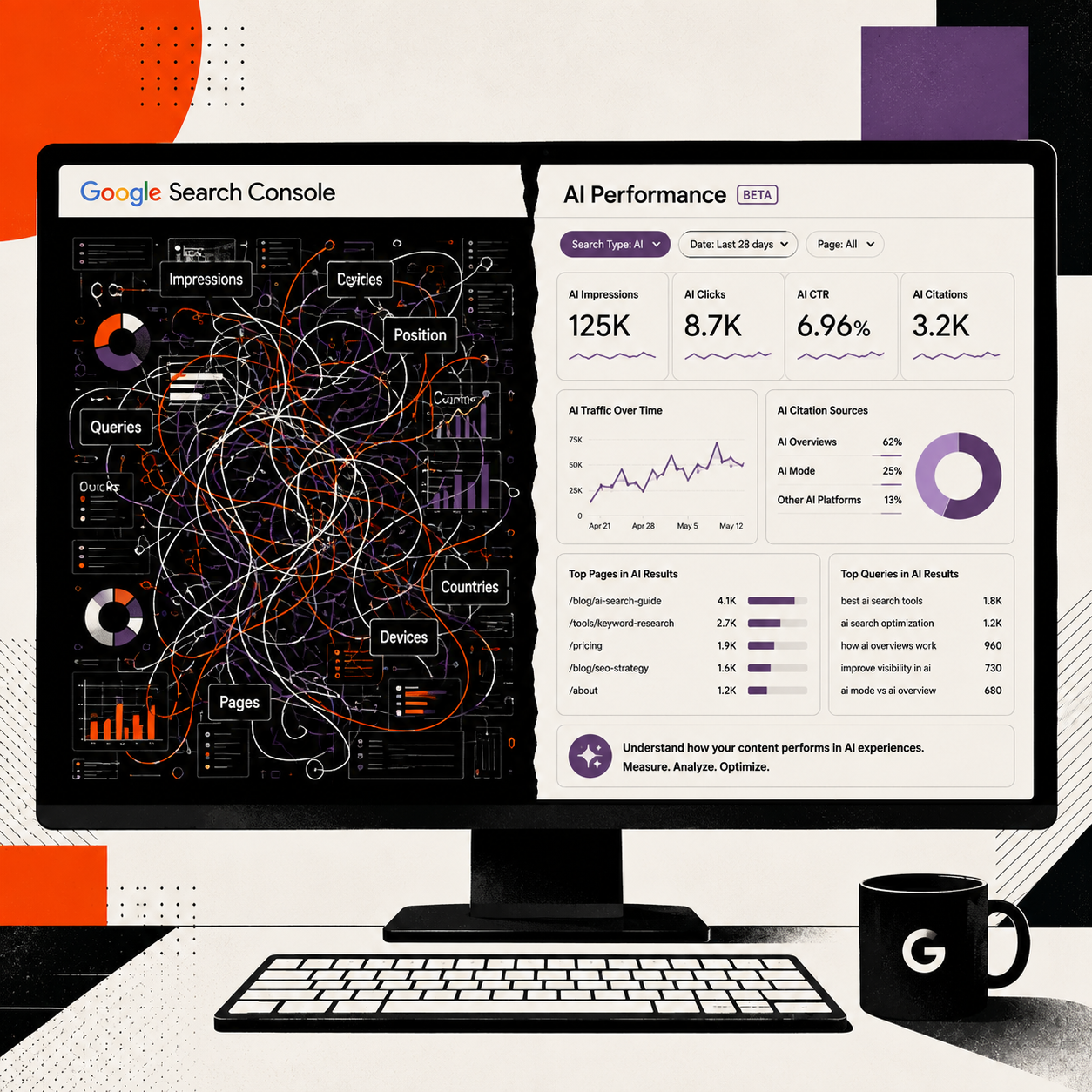
Google launched dedicated Search Generative AI performance reports in Search Console, separating AI impressions from traditional organic data for the first time.
The reports omit click data entirely – they show where content appears, not how it fares.
A new opt-out toggle, launched simultaneously, enables site owners to block their content from AIOs, AI Mode, and Discover – without affecting organic rankings.
For most brands, using the opt-out option without supporting data is the wrong strategic move.
Executive Summary: On June 3, 2026, Google launched two new Search Console features: a dedicated AI performance report and a toggle to opt out of generative AI search features. The report delivers impression-level visibility into AI Overviews, AI Mode, and Discover, but lacks any click data. The opt-out toggle is functional but, for most brands, using it without evidence is a strategic mistake.
Ever since AI Search became a viable mode of discovery, brands and their AI optimization teams had a hard time gauging whether AI visibility strategies actually worked. Sure, traffic was arriving from LLM platforms – but there was no way to isolate or measure it, or even understand which content was generating it.
To make matters worse, Google Search Console bundled AI-driven impressions with organic data, making analysis a perfect storm of probabilistic measurements, estimates, and extrapolations.
For years, everybody was flying blind – but no more.
What did Google actually launch in Search Console?
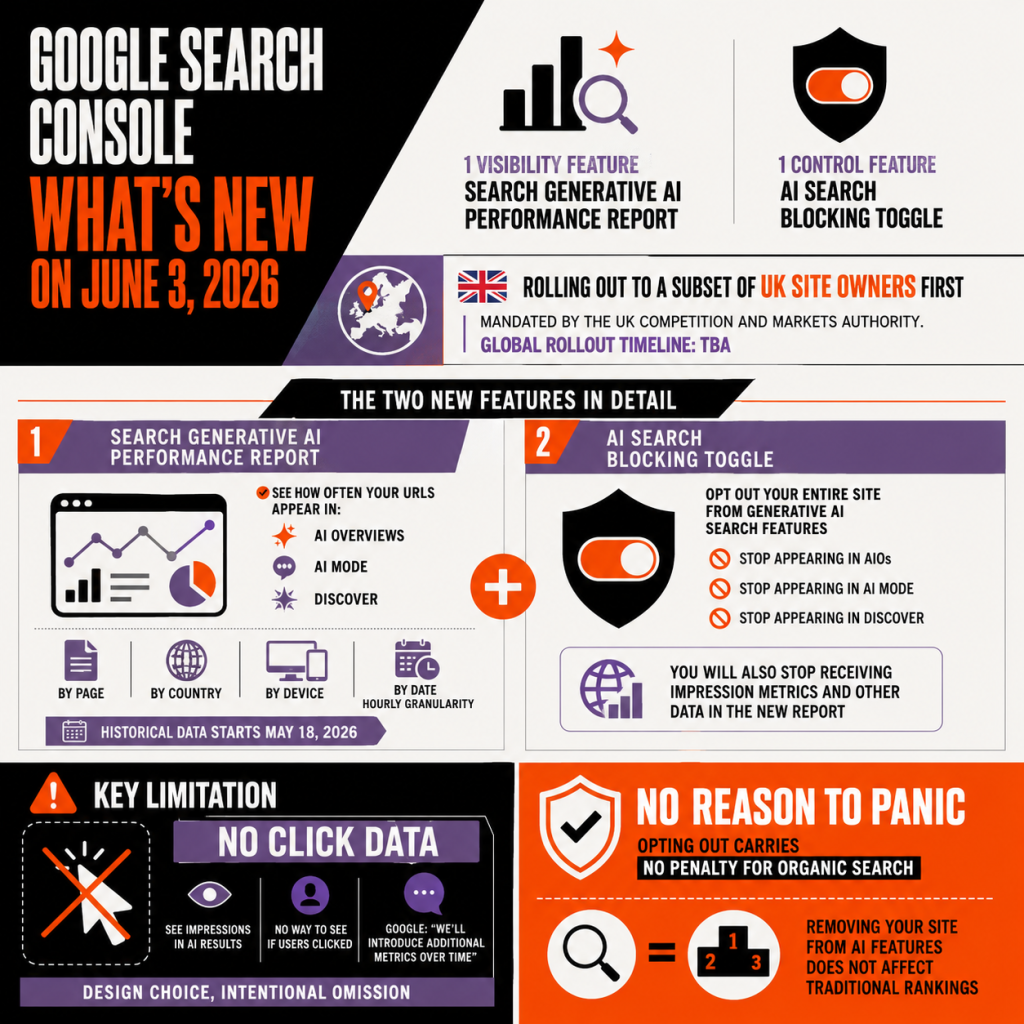
Both features are rolling out to a subset of UK site owners first, brought about by direct pressure from the UK’s Competition and Markets Authority, which mandated publisher opt-out controls. The global rollout is still happening on Google’s timeline, which is not yet established.
Google Search Console boasts two new functionalities – but they come with some limitations [Image credit: ZeroClick Labs via ChatGPT]
What is the Search Generative AI performance report?
This feature gives site owners a dedicated view of how often their URLs appear in AI Overviews, AI Mode, and Discover. Previously, this data was buried inside the main performance report with no way to isolate it, making it impossible to discern which impressions are AI-driven and which are organic. The new report surfaces the data in a standalone view, with breakdowns by page, country, device, and date down to hourly granularity – with the historical data only starting May 18, 2026.
What does the blocking toggle do?
The blocking toggle lets owners opt their entire website out of all generative AI Search features. Sites that opt out will stop appearing in AIOs, AI Mode, and Discover platforms, and will also stop receiving impressions metrics and other information included in the aforementioned report.
Although it may seem so at a glance, this development is no reason to panic. Google has confirmed that opting out carries no penalty for organic search – i.e., removing a website from AI features does NOT affect traditional rankings.
What are the limitations of new Search Console features?
Neither includes click data. You can see that your URL appeared in AI search results – but there’s no way to see if a single user actually clicked through from it. This “design choice” is all but confirmed intentional – pressed to comment on the omission, Google just gave a vague “we’ll introduce additional metrics over time” non-answer. As such, it may be best not to hold your breath.
Stay ahead of what’s changing in AI search
Subscribe for practical updates on AI discovery, answer engine visibility, and the shifts that matter most for brands trying to stay visible.
What do new Search Console features mean for your AI SEO strategy?
Although new features do not provide click data, they do provide direction by giving you a baseline to work with (or set up), narrowing the measurement gap (albeit slightly), and most importantly, providing you with opportunities to jump on.
1. Establish or fine-tune your AI SEO baseline
Document which URLs generate AI impressions, in which countries, and on which devices. The pages appearing consistently in AI features are your best-structured, most authoritative content. These pages are your AI SEO template – analyze them to see why they perform, then replicate them across the rest of your website.
2. Don’t touch the opt-out toggle without evidence
Would you block Google from using your content for AI Overviews and AI Mode – Google may be giving us more controls – take my poll below. https://t.co/60M3Vt0YlN
While the instinct is understandable, making that call without the actual click data to justify it isn’t risk management – it’s just guesswork. The actual rationale for opting out is extremely narrow:
Paywalled publishers;
Premium subscription platforms;
Proprietary directories where AI summarization directly cannibalizes revenue.
For everyone else, opting out means forfeiting AI real estate whose value you’ve never been able to measure and therefore don’t know what it’s worth.
3. Turn competitor opt-outs into your opportunity
Every brand that pulls out from AI search leaves behind a gap – and that gap will be filled by the next available source. Whether due to panic or justified reasons, if your competitor pulls out, their AI real estate is up for grabs – and if circumstances allow it, you should move to occupy.
4. Supplement impressions with GA4 and third-party monitoring
Since click data isn’t arriving any time soon, pair Search Console impressions with the new GA4’s AI Assistant channel and third-party visibility tools to build a complete picture of your AI Search performance:
3rd-party tools help compare your footprint to competitors.
Granted, even with the above method, the measurement gap persists – but a partial view is still better than no view at all.
Seth Matthews, an AI SEO content writer within ZeroClick Labs, began his career in civil engineering, but his passion for writing drove his deliberate transition into professional content strategy and SEO. The clash of two worlds produced a writer who can effortlessly combine technical precision and narrative clarity with the emotional and psychological impact of creative storytelling.
Knowing your URLs appear in AI features is useful. Knowing WHY they appear and how to replicate that across your entire content portfolio – that’s what actually moves the needle.
ZeroClick Labs turns AI visibility signals into repeatable, scalable AI SEO strategy, transforming your baseline into a veritable growth lever.
The visibility window is open. It won’t be for long.
Connect with us today, and let’s make sure your brand is what people see through it!
“Our agency had no idea how to approach AI visibility. ZeroClick only does this one thing so they actually know what works. Worth every penny just to not waste time figuring it out ourselves.” – Jay