Best AI Visibility Tools in 2026
Whether you’re managing visibility for your own brand or tracking it across a portfolio of clients, measuring presence inside AI...
Continue Reading
Spam risk is now visibility risk on two layers: classic rankings AND AI-citation eligibility.


On May 15, 2026, Google expanded its spam definition to include attempts to manipulate generative AI responses in Search.
The June 2026 spam update aims to enforce that broader spam framework.
The new policy targets manipulation of AI-generated answers, not AI-written content itself.
Google is focused on intent and behavior: whether a tactic is designed to deceive, distort, or artificially influence what Search and its AI features surface.
Enforcement still relies on familiar spam mechanisms: algorithmic demotion, manual actions, and possible removal from Search for repeat or egregious violations.
Executive Summary: In May 2026, Google updated its spam policy to include a new violation: attempting to manipulate generative AI answers in Search. In June 2026, Google also rolled out a spam update that appears to enforce it. The two are routinely conflated into one “AI-spam apocalypse.” The truth is sharper:The policy language is new. The enforcement system is not. Google is not saying that AI-written content is spam, and it has not announced a new standalone crackdown on AI SEO. What has changed is the risk around tactics designed to force, fake, or manipulate brand visibility inside AI-generated answers..
On June 26, 2026, Google completed the rollout of its latest spam update. Depending on which analysis you read, the update either changed very little or marked the beginning of a major crackdown on AI-search manipulation.
Both are true, both are partial. Neither is reason to panic.
Well, not the brands that have been adhering to traditional and generative AI SEO values. Those who were resorting to “shortcuts,” though…
Actually, there are two events here: the spam policy change (May 15, 2026) and the enforcement update (June 24-26, 2026). Most of the panic comes from conflating those two into a single story.
Effectively, Google only revised the opening line of its spam policies. The old version only covered manipulating Search systems “into ranking content highly.” With the new clause, spam now also includes “attempting to manipulate generative AI responses in Google Search.” Two interesting developments here, worth noting:
First, Google’s written rules explicitly named AI-answer manipulation as spam, folding AI Overviews and AI Mode into the existing spam framework. Second, on the same day, Google published its first official guide to optimizing for those AI features legitimately, and also named several SEO “hacks” as unnecessary for earning citations, despite the historical evidence to the contrary. So, basically: here’s the rulebook, here’s what’s against it (*hint, hint).
Here’s the deflating part: The June 2026 update does NOT add new spam categories, does NOT target link spam or site reputation abuse, and does NOT name a public target list or disclose any impact percentage.
In practical terms, this looks less like a brand-new AI-spam crackdown and more like a refinement of Google’s existing spam enforcement systems. Anyone framing it as a major new offensive against AI spam is filling in details Google has not provided.
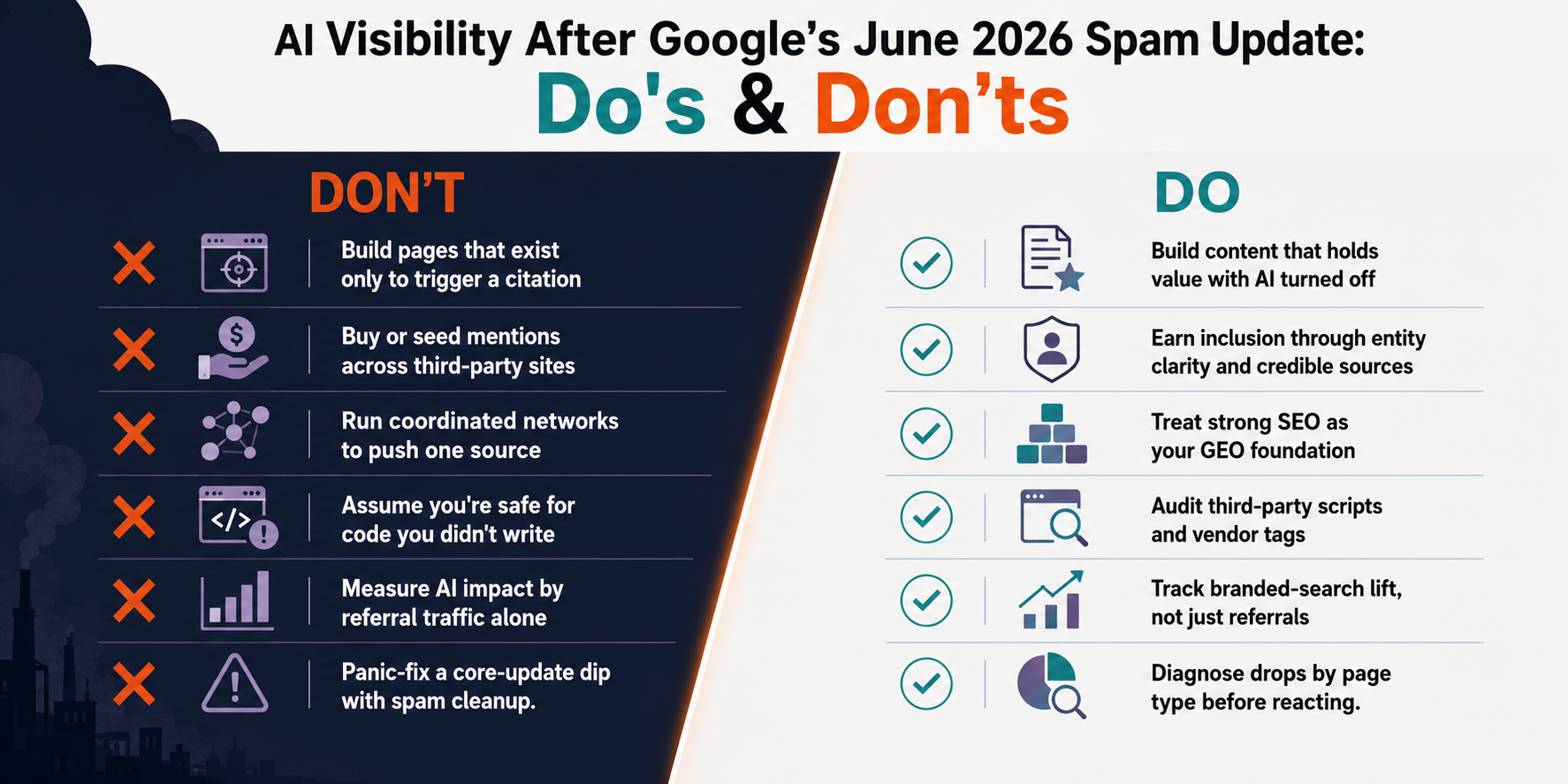
The new policy targets methods that trick the AI layer rather than earning it, including recommendation poisoning, inauthentic mentions, scaled content abuse, and other over(ab)used manipulation tactics.
Effectively, what Google keeps hinting at is whether the content would retain value without the AI intermediary – what the GenAI guide calls “non-commodity content” (i.e., content that isn’t interchangeable with what a model could trivially generate itself).
The key takeaway is that the new policy does NOT penalize the AI layer itself or the content for being AI-written. Tools were never a problem here, but using them to manufacture content and links at scale, without any substance behind them, is.
In other words, standard AI SEO best practices and AIO/AI Mode-specific optimization strategies remain the legitimate way to earn inclusion in AI-generated answers.
Mechanically, nothing changed: enforcement uses the same tools as the rest of the spam framework – algorithmic demotions via SpamBrain and targeted manual actions, with repeat or egregious violations able to trigger deindexing.
What should be especially concerning is that recovery is excruciatingly slow or, in specific cases, impossible. Google said that reassessment can take months, and some penalties (particularly link-based gains) are non-reversible.
A recent Cornell Tech study on poisoning AI research agents found that a single community page can appear in nearly half of sub-queries for a topic, and that roughly 13 words of planted text on a recurring page can insert a brand into the generated report 38%-51% of the time.
What’s more, the defenses tested (source blocking, input filtering, and output filtering) weren’t able to stop the poisoning without degrading the agents’ output.
Google has now defined AI-answer manipulation as a spam violation. But many of the channels that can be used for manipulation are also the channels AI systems depend on to retrieve, compare, and synthesize information.
That means Google can name the violation more easily than affected brands can detect it. A brand may lose visibility, gain suspicious visibility, or be pulled into manipulated AI outputs without having a clear view of which source, mention, page, or passage caused the issue.
The policy-writing was the easy part. Giving brands any way to see what actually happened – that’s what needs resolving.
Treat clean ranking as your strongest AI-visibility asset, and stop chasing shortcuts that now carry formal penalty exposure. Topical authority, real expertise, clean structure, factual accuracy, impervious entity anchoring, third-party validation – these are the signals that protect your blue-link position AND the ones that will help you earn AI citations going forward.

Seth Matthews, an AI SEO content writer within ZeroClick Labs, began his career in civil engineering, but his passion for writing drove his deliberate transition into professional content strategy and SEO. The clash of two worlds produced a writer who can effortlessly combine technical precision and narrative clarity with the emotional and psychological impact of creative storytelling.
EARNED AI visibility just became the only real advantage
Gaming the system now carries formal penalty exposure – often through channels you can’t even see to fix.
So why risk it?
The proven solution is readily available.
“Our agency had no idea how to approach AI visibility. ZeroClick only does this one thing so they actually know what works. Worth every penny just to not waste time figuring it out ourselves.” – Jay