Google officially introduced native AI agents into Search, marking the biggest search transformation in the past two and a half decades.
Information agents synthesize from external sources 24/7, making citation authority more valuable than ever.
Agentic Search is highly likely to accelerate traffic reduction to source pages.
Brands that optimize for AI selectability stand to gain visibility – not lose it.
Task Completion Eligibility is emerging as a dominant visibility criterion in the agentic era.
Executive Summary: Google’s new update marks a structural transformation in how Search works – from reactive to proactive, from query-based to agent-driven. AI Overviews already reduce source page traffic, and this shift is likely to accelerate the pressure. For brands already optimizing for AI citability, this is an amplification opportunity. For those that aren’t, it’s a call to action.
Say what you will about Google, but their determination to push boundaries (and conveniently “appropriate” another massive chunk of web search in the process) is nothing to scoff at. On May 19, 2026, only days after giving us a tool to measure AI performance in GA4, the tech overlord actually went ahead and made sure we’ll be using it:
They made Search an agent.
Did Google Search just become an agent?
In short, yes. At Google I/O 2026, the company unveiled what it described as “the biggest upgrade to [our] Search box in over 25 years” – and the core of it is native integration of Gemini 3.5 Flash into AI Mode. The upgrade introduces three distinct changes, worth noting separately:
Search box redesign:
The search box now dynamically expands to accommodate longer, conversational queries.
The search box becomes multimodal – accepting images, files, videos, and Chrome tabs as inputs in addition to plain text.
The feature is rolling out globally this week.
Information Agents:
Users can now create custom AI agents directly inside Search.
Rollout is scheduled for summer 2026, also for Google AI Pro and Ultra subscribers first.
While the new changes are massive, they aren’t unexpected. Back in April, Google’s CEO Sundar Pichai more than hinted at the future of Search, and the direction was crystal clear: the shift to agentic search wasn’t a question of “IF” – but “WHEN.” Well, the “when” just arrived – sooner than most anticipated. So let’s call it what it actually is:
Google just made agentic search mainstream – and in doing so, force-ushered the agentic era globally.
Changes to Search that Google announced at I/O 2006. [Image Credit: ZeroClick Labs via Gemini]
Is Google Search going agentic actually bad news for brands?
Sign up for The Laboratory newsletter and get the latest insights from AI world straight to you inbox!
Is there any good news to Search becoming an agent?
Yes, there is – but it got buried under a layer of fright. What the initial panic missed is the simple fact that AI agents don’t generate answers out of thin air. They synthesize existing information – blogs, news articles, social posts, discussions, studies, and other forms of authoritative content. Only now, they do so autonomously, proactively, and continuously – which means only one thing:
Citation authority just became MORE valuable – not less.
In other words, brands already structured for AI selectability (e.g., clear entity signals, content structured for extraction, consistent third-party presence) have nothing to fear. Information agents do not threaten their visibility – they amplify it.
Arguably, the most important thing to understand is that said visibility amplification is not a “consolation prize.” As we already identified in the Pichai analysis, Task Completion Eligibility (the degree to which web content enables AI agents to autonomously complete tasks on a user’s behalf) is fast becoming one of the dominant visibility criteria. The Search going agentic just narrowed the window for building that foundation.
How to make a brand visible to Google’s new AI agents?
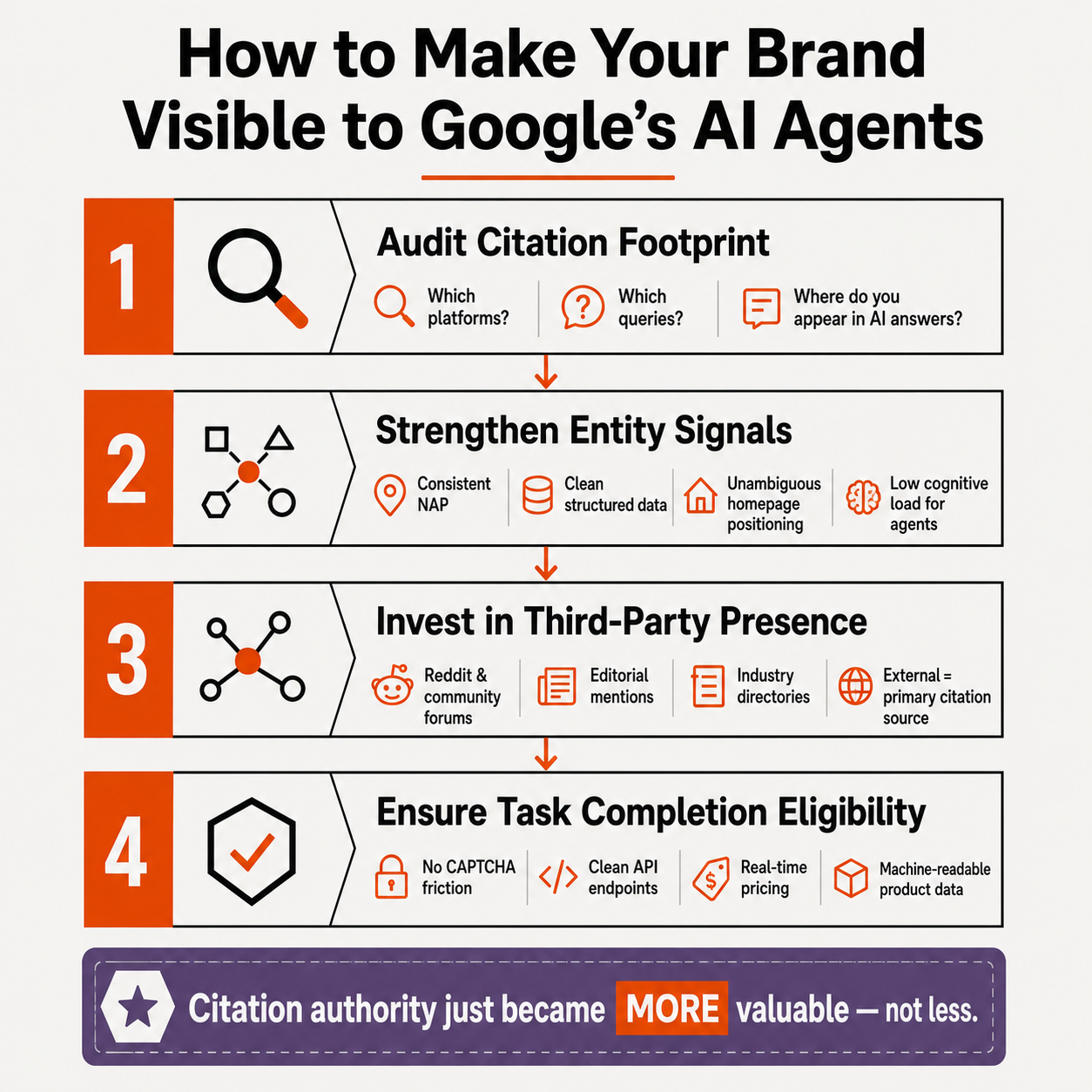
Brands wishing to win and stay in Google AI agents’ FOV should take these immediate actions:
Audit the citation footprint: Clearly identify where the brand appears in the AI-generated answers, across which platforms, and for which queries. Agents draw from the same citation pool AIOs currently use, so being present in it dramatically increases the likelihood of being surfaced.
Strengthen entity signals: Consistent NAP, clean structured data, unambiguous homepage positioning. Information agents prioritize sources that are minimally taxing on their cognitive load – removing any ambiguity means removing friction.
Invest in third-party presence: AI agents explicitly synthesize from external sources – not just a primary website. Reddit threads, community discussion, editorial mentions, industry directories – these are all primary citation sources.
Ensure Task Completion Eligibility alignment: A brand that’s appealing to AI agents is the one that is operable as an endpoint. This entails being easily navigable (e.g., no CAPTCHA friction, clean API endpoints) and loaded with machine-readable data (e.g., real-time pricing, easily-extractable product specifications, etc.).
A visual representation of the steps required to make a brand visible to Google’s AI agents [Image Credit: ZeroClick Labs via ChatGPT]
Seth Matthews, an AI SEO content writer within ZeroClick Labs, began his career in civil engineering, but his passion for writing drove his deliberate transition into professional content strategy and SEO. The clash of two worlds produced a writer who can effortlessly combine technical precision and narrative clarity with the emotional and psychological impact of creative storytelling.
Search just became Agentic. Is your brand in its FOV?
Google didn’t just upgrade Search – it redefined the concept of discovery.
The only question now is whether your brand deserves to be discovered.
AI Overviews optimization and Gemini SEO are no longer forward-looking investments. They just became table stakes.
And the window for becoming agent-aligned is getting narrower by the day.
Connect with ZeroClick Labs today, and let’s make sure your brand is impossible for AI agents to ignore!
“Our agency had no idea how to approach AI visibility. ZeroClick only does this one thing so they actually know what works. Worth every penny just to not waste time figuring it out ourselves.” – Jay

![Changes to Search that Google announced at I/O 2006. [Image Credit: ZeroClick Labs via Gemini]](https://zeroclicklabs.ai/wp-content/uploads/2026/05/Changes-to-Search-that-Google-announced.png)