AI Marketing SaaS Statistics
ZeroClick Labs compiled a list of SaaS marketing statistics to help brands and marketers understand how their buyers research, what...
Continue Reading
Optimizing for traditional and new-age visibility simultaneously is becoming imperative. These 9 AI SEO tools make it manageable.


Extending your existing SEO stack is the most affordable AI visibility tracking entry point.
An AI layer atop SEO infrastructure offers convenience, consolidation, and incumbency – but that’s also the hard ceiling.
Semrush, Ahrefs, Conductor, and SE Ranking can only monitor a brand’s position in AI answers.
Clearscope and Surfer help address content gaps, in addition to AI visibility tracking.
Frase, MarketMuse, and Jasper use AI as the engine, making them the closest thing to end-to-end optimization automation.
Pricing rarely matches the marketing – upgrading some of these suites can cost the same or more than a dedicated, AI-native toolset.
Executive Summary: ZeroClick Labs tested nine AI-powered SEO tools across three groups: four SEO suites with an AI visibility layer (Semrush AI Visibility Toolkit, Ahrefs Brand Radar, Conductor, SE Ranking), two content-optimization toolsets with an AI visibility layer (Clearscope, Surfer), and three full-AI platforms where AI powers the optimization itself (Frase, MarketMuse, Jasper). Shortlisted entries are selected based on engine coverage, prompt volumes, pricing, and limitations.
In 2026, optimizing for traditional rankings alone is no longer enough, and likely never again will be, if the current trajectory of AI search is any indication. SEO and content optimization teams are feeling the brunt of this shift.
They’re increasingly required to boost AI visibility alongside traditional rankings, which means layering AI optimization atop standardized SEO workflows, which means expanding their toolsets. But here’s the catch:
Expansive doesn’t have to mean expensive.
For most teams, the cheapest entry point to AI visibility is often a weapon already in your arsenal: an SEO or content-optimization suite you already use and pay for, upgraded with AI search-tracking capabilities.
For teams ready to take it further, however, a new generation of fully AI-powered optimization platforms can help close more of the content loop than any bolt-on layer can. Today, we’re bringing you our selection of top AI SEO tools in 2026.
The best option for you depends entirely on what you’re trying to achieve: track where a brand stands in AI search, optimize content to get cited, or both. Effectively, the answer comes down to a handful of factors:
With these criteria in mind, we split our shortlist of AI-based SEO tools into three groups:
While every solution on this AI SEO tools list uses AI to some degree, the depth varies significantly. Groups 1 and 2 are SEO or content-optimization platforms with an AI capabilities layer bolted on. Consolidation, incumbency, and convenience are their genuine strengths, but also the ceiling.
Group 3 flips the narrative: the AI is the core, and the platforms are built around it rather than on top of it. This enables much deeper content optimization/production automation, but at the cost of near-mandatory pairing with a dedicated tracker.
Finally, it must be pointed out that none of these tools will match a dedicated, AI-native visibility-tracking platform in depth and only come close in breadth. What they will do is provide a relatively low-barrier entry into AI visibility, in the space you already know.
The four tools in this group (Semrush AI Visibility Toolkit, Ahrefs Brand Radar, Conductor, SE Ranking) add AI answer tracking to platforms your team is already using. The trade-off is straightforward: you get convenience and functionality of a unified platform, but with only a fraction of the depth of a dedicated tracker.
| Table 1: SEO Suites With an AI-Visibility Layer | ||||
| Tool | Best for | Engines tracked | Pricing (from) | Notable limitations |
| Semrush AI Visibility Toolkit | Teams already standardized on Semrush who want AI-search tracking in the same dashboard | 4 named: ChatGPT, Google AI, Gemini, Perplexity | Starter $199/mo (≈$165/mo billed annually; entry plan, only one tracked domain) Pro+ $299/mo (100 prompts/day); Advanced $549/mo (200 prompts/day); Standalone AI Visibility plan: $99/mo per domain;Enterprise custom | AI search excluded from the base SEO plan ($139.95/mo); Starter’s AI brand performance only covers a single domain Multi-domain portfolios scale steeply due to per-domain billing; No Claude or Copilot; Monitoring only; |
| Ahrefs Brand Radar | Teams already deep in Ahrefs who want AI-mention tracking beside their SEO data | 6 – AI Overviews, AI Mode, ChatGPT, Perplexity, Copilot, Gemini (Grok is in the prompt database but not the tracked set) | Standalone: From $199/mo per engine (no paid Ahrefs plan required) OR $699/mo for all six + 2,500 custom-prompt checks. Also bundled into the SEO plans (Lite $129 / Standard $249 / Advanced $449) with just 5 / 10 / 20 tracked prompts. | Meaningful coverage gets expensive; Custom-prompt checks are capped (2,500/mo on all-platforms plan; more sold in $50 – $250 packages) Bundled SEO plan versions track only 5-20 prompts. No Claude or Meta AI. |
| Conductor | Enterprise teams wanting AI-visibility tracking unified with SEO, content generation, and site monitoring | 6 – ChatGPT, Gemini, Copilot, Claude, Perplexity, Google AI Overviews (Conductor states “and more”) | Custom quote; Usage-based, not per seat. Free 3-week trial available (self-serve Essentials); Growth and Enterprise via demo. | No public pricing on paid tiers; Enterprise-oriented feature set and onboarding. |
| SE Ranking | Budget-conscious SMBs and agencies wanting SEO + AI tracking in one affordable suite | 5 – ChatGPT, Perplexity, Gemini, AI Overviews, AI Mode (base GEO tracking) | Core $103.20/mo annual ($129/mo monthly); Growth $223.20/mo annual; Enterprise custom. Basic GEO tracking included; Deeper AI layer (AI Results Tracker + SE Visible) is a paid AI Search add-on, +$89/mo. | Base GEO capped at 100 prompts/day on Core and limited to 5 engines; Brand-mention, citation, and sentiment tracking via SE Visible – costs +$89/mo on top; No Claude or Copilot; |
Semrush is one of those platforms that doesn’t need much introduction, as a huge number of SEO teams already run it as their primary suite. Its AI Visibility Toolkit bolts share of voice (SoV), sentiment, and prompt tracking onto an already familiar frame – and in a highly convenient way. It’s a solid AI layer on top of a great SEO suite, but not a replacement for a dedicated platform.
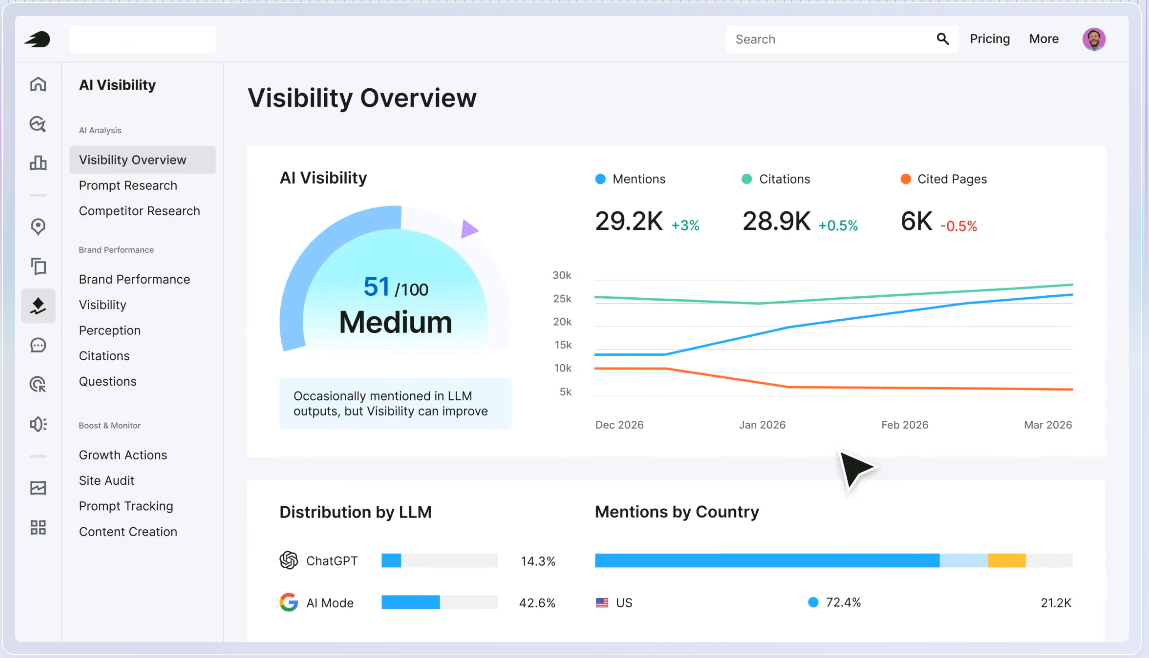
Besides convenience, where Semrush AI Visibility Toolkit stands out is the integration and setup – because there’s practically none. It tracks four major engines (ChatGPT, Google AI, Gemini, Perplexity), can seed tracked prompts straight from the Semrush keyword data, and AI visibility metrics display right next to the traditional SEO ones, updated as often as daily.
Where Semrush’s Toolkit bites, and rabidly, is price. Its lowest-cost tier that includes AI search (Starter) is $199/mo, and it comes with 50 prompts/day and only one trackable domain. Furthermore, its standalone AI Visibility plan runs $99/mo per domain (25 tracked prompts apiece). As scaling goes, that’s the furthest thing from “gentle” – especially if you have to track a full portfolio of brands. Finally, Claude and Copilot aren’t covered, and you can only monitor performance, not close gaps or fix anything.
| Semrush is strong for: | Semrush is weak for: |
| teams already using Semrush who want AI-search tracking in the same dashboard, and either manage a low number of domains, scale slowly, or can comfortably withstand steep scaling price | large multi-domain portfolios, smaller teams, or those needing Claude/Copilot coverage. |
Ahrefs Brand Radar is the natural “path of least resistance into AEO” for teams already using the surface. It enables users to track AI search visibility metrics from inside the tool they already trust, backed by what Ahrefs touts as the largest AI-visibility database in the category: hundreds of millions of search-backed prompts – not synthetic ones.
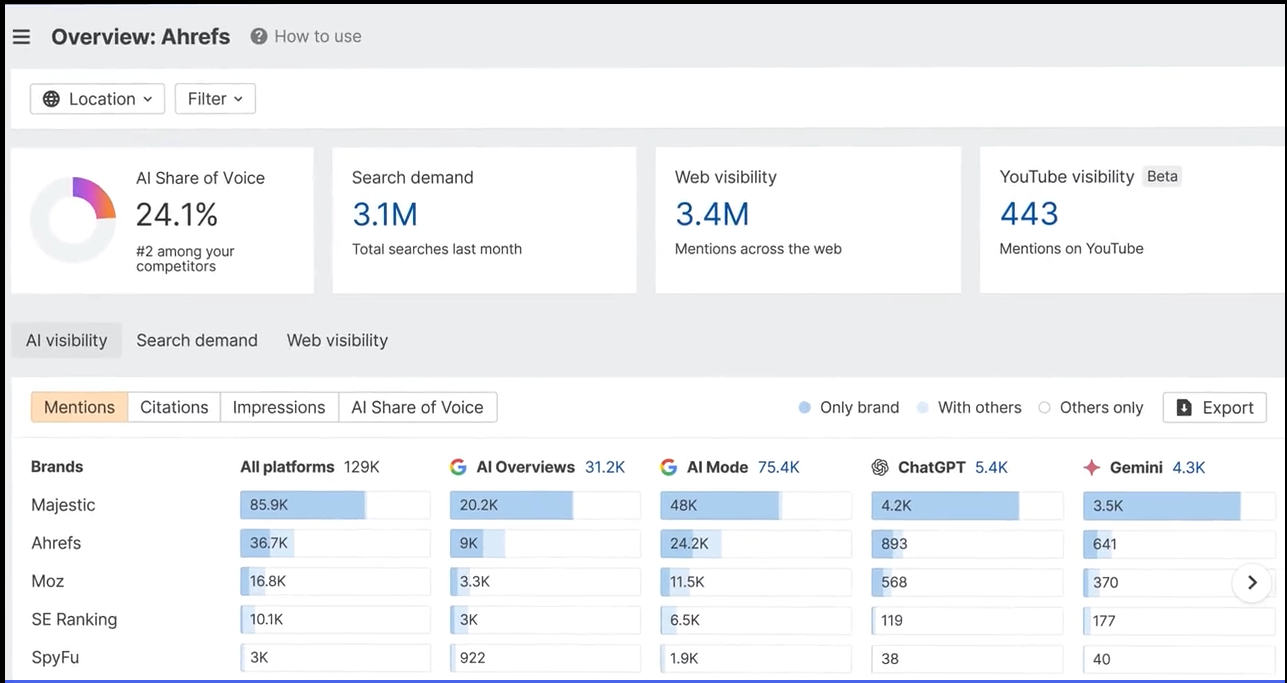
The breadth is where Brand Radar excels. Six tracked engines (ChatGPT, AI Overviews, AI Mode, Perplexity, Copilot, Gemini), backed by citation data showing exactly which URL an AI answer pulled from – plus YouTube, TikTok, and Reddit source tracking (free while in beta). Entry is also reasonable, with standalone Brand Radar starting at $199/mo, and even included in Ahrefs’ main SEO plans, making it a great “sampler platter” for existing and new users.
On the negative side, Brand Radar suffers from a similar problem as Semrush: the cost climbs with coverage. Mentioned bundled versions only track 5-20 prompts, meaning real use practically mandates standalone tiers which run $199/mo per engine (feasible for up to 3 engines) or $699/mo for all six. Custom-prompt checks are also capped at 2,500/mo, with extra checks sold in $50-$250/mo packages on top. Finally, neither Claude nor Meta AI is in the tracked set, and Grok can’t be selected in any bundle (although it’s listed as supported on the Brand Radar page).
| Ahrefs is strong for: | Ahrefs is weak for: |
| teams already using Ahrefs who want AI-search tracking and deep prompt research in addition to SEO data | teams that need full multi-engine or Claude/Meta coverage on a budget |
Conductor is an enterprise-centered platform that layers content generation, technical monitoring, organic-search intelligence, and now AI visibility tracking atop powerful SEO functionality. For an enterprise looking for a consolidated SEO+AEO platform rather than a stack of point tools, Conductor delivers exactly that.
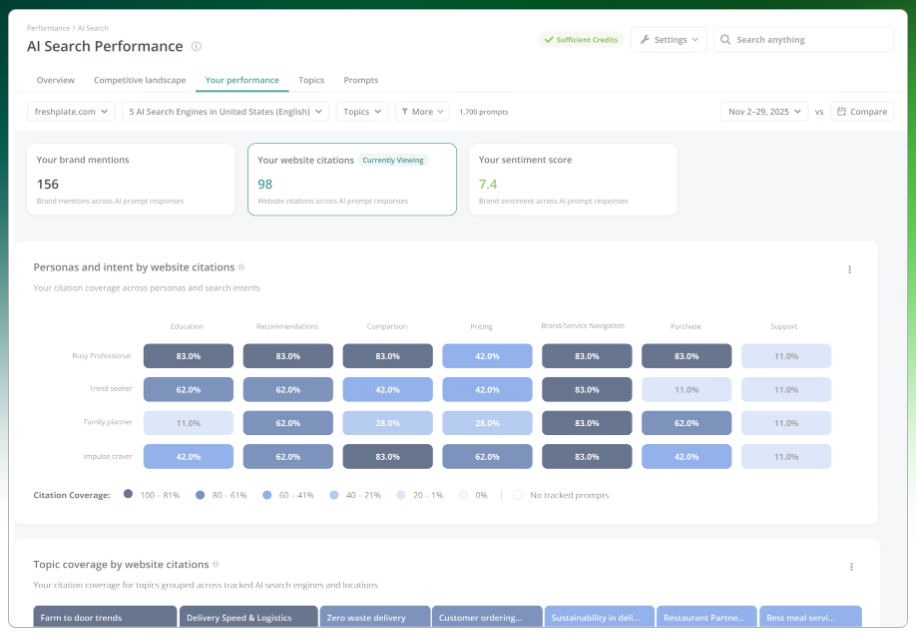
One thing to understand about Conductor: it’s built for scale across the board. Its Intelligence layer tracks mentions, citations, and sentiment across the six engines most-used by enterprises (Copilot, ChatGPT, Claude, Gemini, AIOs, Perplexity) – and ties those visibility metrics to traffic, conversions, and revenue.
The platform also ships an official MCP server and API, so AI assistants/LLMs as well as your other systems can pull its data directly, logs which AI bots crawl your website and what they’re accessing, and even delivers pre-built automated agents that can perform optimization tasks autonomously.
Conductor is built to be a part of enterprise infrastructure, and its pricing model reflects it. Although there is a self-serve tier (Essentials), higher ones (Growth and Enterprise) are quote-only and usage-based (instead of per-seat), and third-party estimates place annual contract values within $30k – $150k+. Everything considered – pricing, feature depth, integration – it is obvious that Conductor was not designed for small organizations.
| Conductor is strong for: | Conductor is weak for: |
| enterprise teams who want AI-visibility tracking unified with SEO | SMBs and any organization wanting self-serve pricing across tiers |
SE Ranking has a reputation for being a budget-friendly full-stack SEO suite. Now, it also gives agencies and SMBs the means to track AI visibility, albeit at a rudimentary level, even with core plans, with a deeper AI layer available as an add-on. Despite the depth being paywalled, SE Ranking is still a capable and affordable way to start monitoring AI visibility.
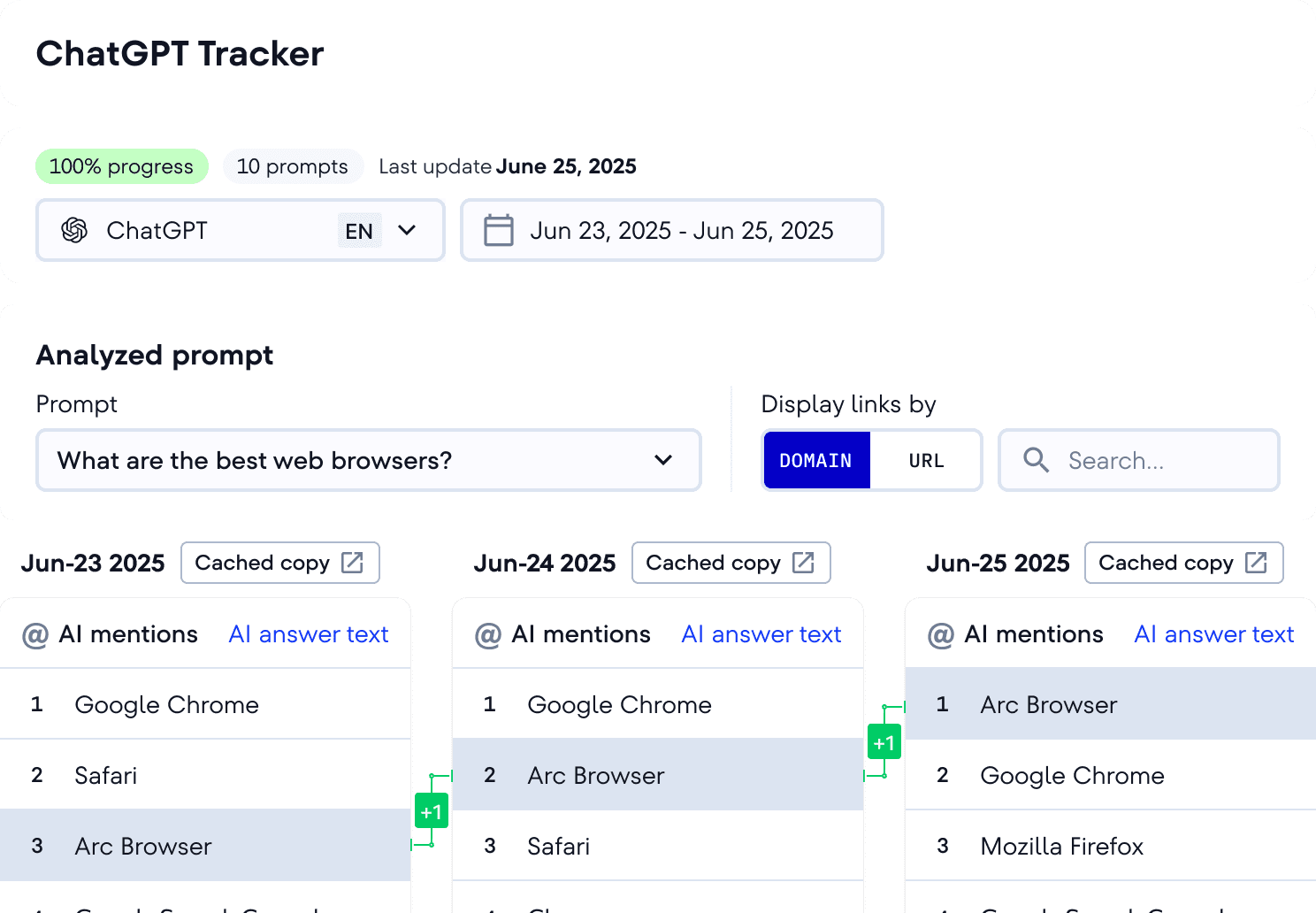
With SE Ranking, the value is the biggest part of the draw. Basic AI tracking is integrated into the Core and Growth plans, enabling you to track five engines: ChatGPT, Perplexity, Gemini, AI Overviews, and AI Mode. On Core, you get 100 tracked prompts a day and unlimited AI-source tracking, alongside a genuinely capable rank tracker, audit, and keyword suite, from as little as $129/mo ($103.20 on annual billing).
However, if you want anything more than a surface read, that will cost extra. The AI Results Tracker plus SE Visible (which track brand mentions, citations, and sentiment analysis) is a paid AI Search add-on at +$89/mo for 200 tracked prompts – not part of base plans. With daily prompt volume capped at 100 (Core) and 250 (Growth), and no coverage for Claude or Copilot, SE Ranking remains the pragmatic pick.
| SE Ranking is strong for: | SE Ranking is weak for: |
| budget-conscious SMBs and agencies wanting basic AI tracking on top of an SEO suite, on one affordable bill | teams that need Claude or Copilot coverage, or deeper sentiment/citation tracking without extra fees |
The trackers above are just that – trackers. They can show you where you stand in AI answers, not how to close gaps. That’s where two of the best AI SEO tools for content optimization come in: Clearscope and Surfer. Both are well-established SEO content-optimization tools, now extending their writing+grading capabilities into AI search – so you can directly address the content gaps engines show you, without extra analysis.
| Tool | Best for | Engines tracked | Pricing (from) | Notable limitations |
| Clearscope | Editorial and content teams wanting AI-citation tracking tied to best-in-class content optimization | Prompt Tracking: ChatGPT, Gemini, Claude AI Overviews & AI Mode via Content Reports/SERP analysis | Essentials $129/mo Business $399/mo Enterprise custom (14-day free trial; unlimited users/projects) | Optimization-first: prompt tracking excludes Perplexity and Copilot; Essentials capped at 50 tracked prompts / 50 pages; Extra pages and drafts are paid add-ons; Premium pricing |
| Surfer | Content teams already optimizing in Surfer who want AI-visibility tracking beside their content scores | 5 – ChatGPT, Perplexity, Gemini, Google AI Overviews, AI Mode (all five on Pro and up; Standard tracks ChatGPT only) | All-5-model tracking from $158/mo (standalone AI Search Analytics, billed yearly, 100 prompts/day) or the Pro content plan at $182/mo. Standard ($99/mo) tracks ChatGPT only; Peace of Mind $299/mo; Enterprise $999/mo. | Cheapest tier tracks a single engine (ChatGPT); Full 5-model coverage needs Pro or the standalone tracker; Refresh is weekly below Pro, daily above. |
Clearscope doesn’t need much introduction. For roughly 10 years, it was the go-to for editorial teams needing to grade drafts against what already ranks. In 2026, Clearscope extended that functionality into AI search, giving its users a way to produce content that AIs actually want to cite, thereby increasing their chances of winning the new-age ranking game.
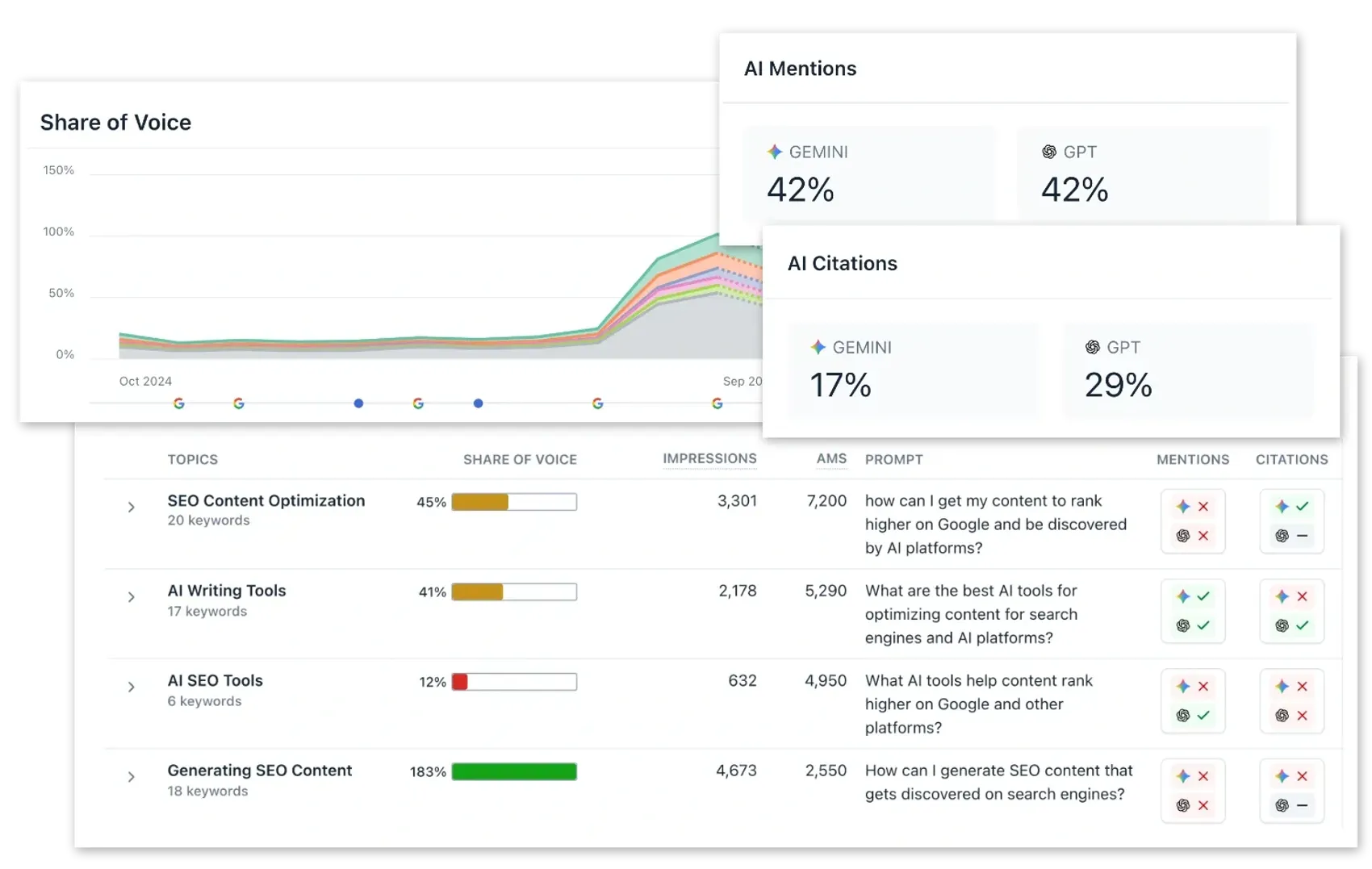
Clearscope’s Expand module tracks citations and SoV across ChatGPT, Gemini, and Claude via dedicated Prompt Tracking, while presence in AIOs and AI Mode surfaces through the Content Reports and SERP analysis, which have always been the backbone of the platform. All plans come with unlimited users and projects, a free 14-day trial period, and transparent pricing on base plans at $129/mo (Essentials) and $399/mo (Business).
Although the AI layer is a great addition, Clearscope remains an optimization-first tool – and its tracking capabilities clearly show it. As noted above, the Prompt Tracking feature only covers three engines, which is narrower than all other tools on this list, and Perplexity and Copilot are not in the mix. Also, the Essentials tier caps you at 50 tracked prompts and 50 pages, with extras being paid add-ons, which you’ll most likely need, considering 50/50 is barely enough to cover an active content program.
| Clearscope is strong for: | Clearscope is weak for: |
| editorial/content teams that want to translate their content optimization into AI surfaces | teams who need broad, multi-engine visibility monitoring |
Surfer has been the staple content-optimization suite for almost as long as Clearscope. Now, its Content Editor received a functional AI-visibility layer, enabling you to fix mention gaps on the spot, without having to switch platforms.
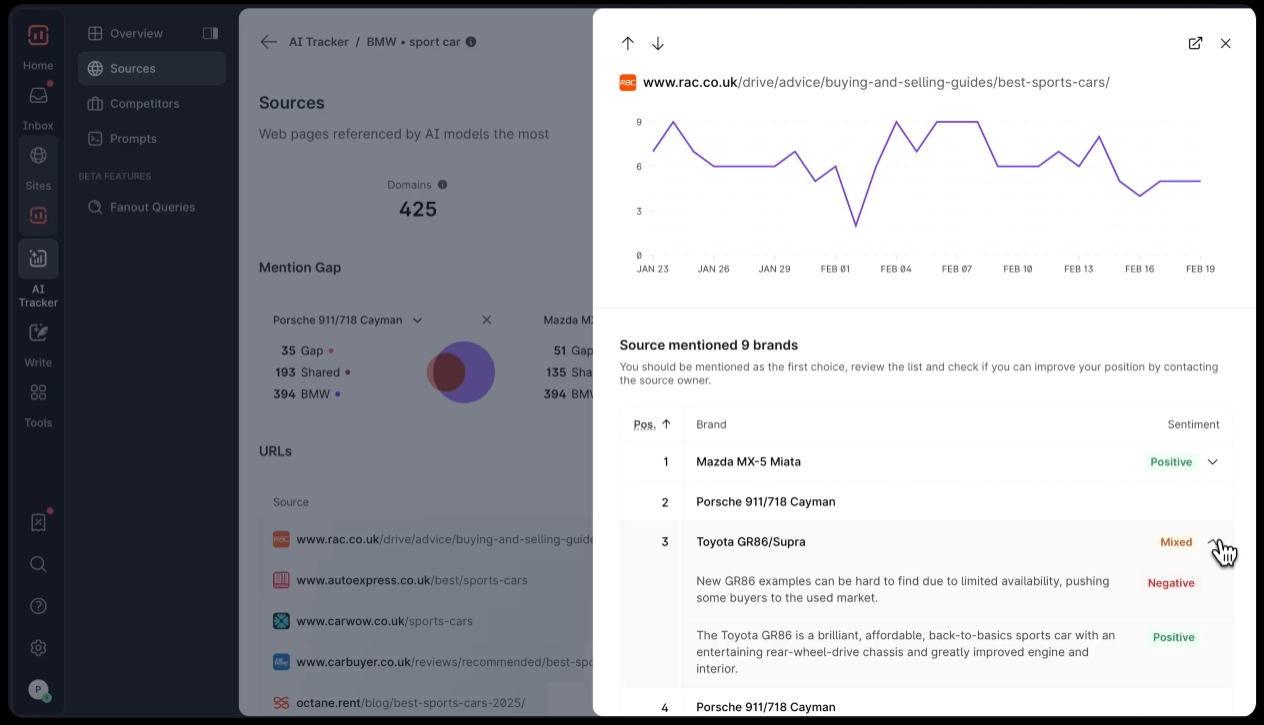
Surfer’s AI Tracker plugs directly into the Content Editor, WordPress, and Google Docs and monitors your brand across ChatGPT, Gemini, Perplexity, AIOs, and AI Mode simultaneously. Its biggest strength is the ability to scrape real AI answers users see rather than pulling sanitized API data, and give you SoV, mention-gap, and brand sentiment analysis, which is genuinely impressive and something most rivals don’t do.
However, that coverage is the catch: The affordable Standard plan ($99/mo) only tracks ChatGPT, refreshing weekly. If you want the full five-model coverage with daily refreshes, you’ll have to commit to either the Pro plan ($182/mo) or the standalone tracker ($158/mo).
| Surfer is strong for: | Surfer is weak for: |
| content teams who want to track AI visibility and fill gaps using real, scraped multi-model data, all within the same platform | teams wanting full multi-engine tracking at the lowest price point |
Every previously described tool uses AI to some extent, either bolting on visibility tracking atop content optimization, or vice versa. For Frase, MarketMuse, and Jasper, however, AI isn’t a layer, but the core. These three platforms can perform content research, planning, drafting, and in the case of one of them, even autonomous publishing.
The trade-off, in this case, is scope: all three of these AI SEO optimization tools focus on producing content that earns citations. With the exception of Frase, none of them has a built-in visibility tracker, meaning you’ll have to pair them with one of the tools from Group 1 or 2 to close the loop.
One thing we must point out – and it goes for all tools in this category: AI-generated content can rank well, but published as-is, that ranking tends to be short-lived. Therefore, it’s highly advisable to treat drafts as starting points rather than finished products, and have a real writer edit them before publishing.
| Table 3: Fully AI-powered SEO tools | ||||
| Tool | Best for | Engines tracked | Pricing (from) | Notable limitations |
| Frase | Solo marketers, agencies, and content teams wanting the full research-to-publish loop AI-driven at a budget-friendly price | AI Visibility included: Starter tracks ChatGPT + Google AI; Professional adds Perplexity; Scale adds Claude + Gemini | Starter $39/mo annual ($49/mo monthly); Professional $103/mo annual ($129/mo monthly); Scale $239/mo annual ($299/mo monthly); Enterprise custom. 7-day free trial, no CC | Starter capped at 10 articles/mo, 1 seat, 1 site; AI Visibility engine breadth is tier-gated; AI drafts still need human editing before publish |
| MarketMuse | Teams managing large content libraries needing AI-driven strategic planning, domain-aware difficulty scoring, and topical-authority gap analysis | n/a – MarketMuse is a content strategy and optimization platform, not an AI-visibility tracker | Quote-only via demo; Third-party sourced (unconfirmed on current site): legacy tiers reported as: Optimize $99/mo Research $249/mo Strategy $499/mo free tier capped at 10 queries/month | Pricing behind a demo call (no self-serve rates); strategy-first workflow means slower time-to-content than turnkey drafters; steeper learning curve |
| Jasper | Enterprise content teams and multi-brand agencies needing AI writing at scale with brand-voice governance | n/a – Jasper is an AI writing platform, not a search or AI-visibility tracker | Pro $69/mo monthly or $59/mo annual per seat (1 seat included); Business custom. 7-day free trial Third-party sourced (unconfirmed on current site): deployment from ~$900 to 6,000+ | Pro’s 1-seat-included model scales steeply per additional writer; no team plan between Pro and Business; no built-in SEO scoring or ranking research (routinely paired with Surfer or Clearscope) |
Frase is being marketed as “the content operating system for AI search” – but unlike most similar AI SEO tools, this one actually earns the title. With Frase, every content plan runs a full loop: research, brief, AI draft, SEO/GEO/AEO-visibility audit, publish, and monitor for decay. The most surprising thing is that the core loop is available on all plans – from Starter to Enterprise.
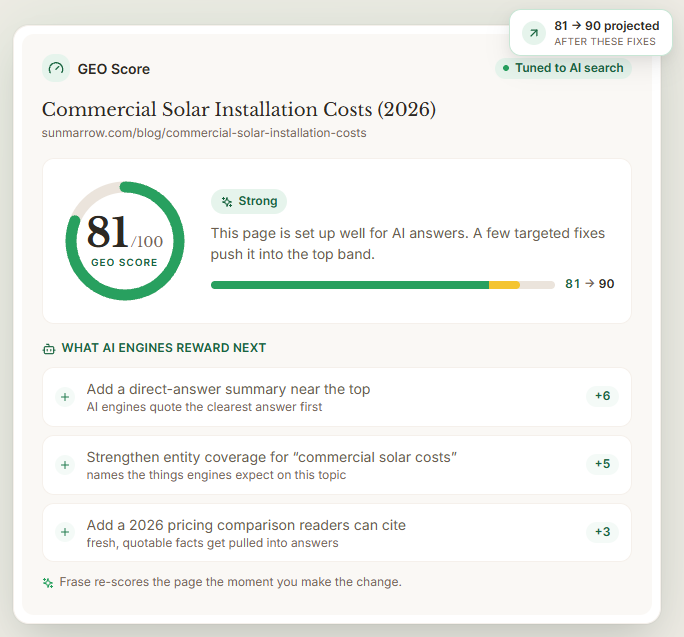
Frase features an AI agent that can publish autonomously across WordPress, Webflow, Sanity, Wix, or FraseCMS (their own hosting), with you setting the autonomy level anywhere from “draft only” to “ship low-risk fixes.”
Meanwhile, Content Guard monitors your published content for Google ranking decay and pushes updates (on approval), maintaining your presence and visibility with only a few clicks – an incredible resource saver, especially if you’re managing a massive content portfolio.
Of course, all that functionality isn’t without constraints, and the must-mention ones are volume and engine breadth on entry, as well as scaling. Starter plan caps at 10 articles per month, one seat, and one site, which is limiting for anything beyond smallest-scale ops.
The entry tier AI Visibility only covers ChatGPT and Google AI (incl. AIO and AI Mode) – which is not bad at all. However, Perplexity is locked behind Professional ($103/mo annual), and Gemini and Claude behind Scale ($239/mo annual).
Finally, higher tiers are also restrictive: Professional includes 3 seats and 5 sites at 40 articles/mo, and Scale is 5 seats, 10 domains at 100 articles/mo, with extra seats at $29/mo (on both plans). So, for teams past 5 operators or 10 clients, Enterprise is the realistic entry point.
| Frase is strong for: | Frase is weak for: |
| Solo marketers, agencies, and content teams who want to automate the majority of the research-to-publish loop, and do so at an affordable price. | Teams past 5 operators, multi-site/domain portfolios, or anyone needing full multi-engine tracking on a budget |
MarketMuse is the platform for enterprise teams who plan content strategies on the per-domain scale. That site-wide framing, paired with authority-based gap analysis and personalized difficulty grading, is why MarketMuse can be better sorted into “authority-optimization” rather than just AI content optimization tools.
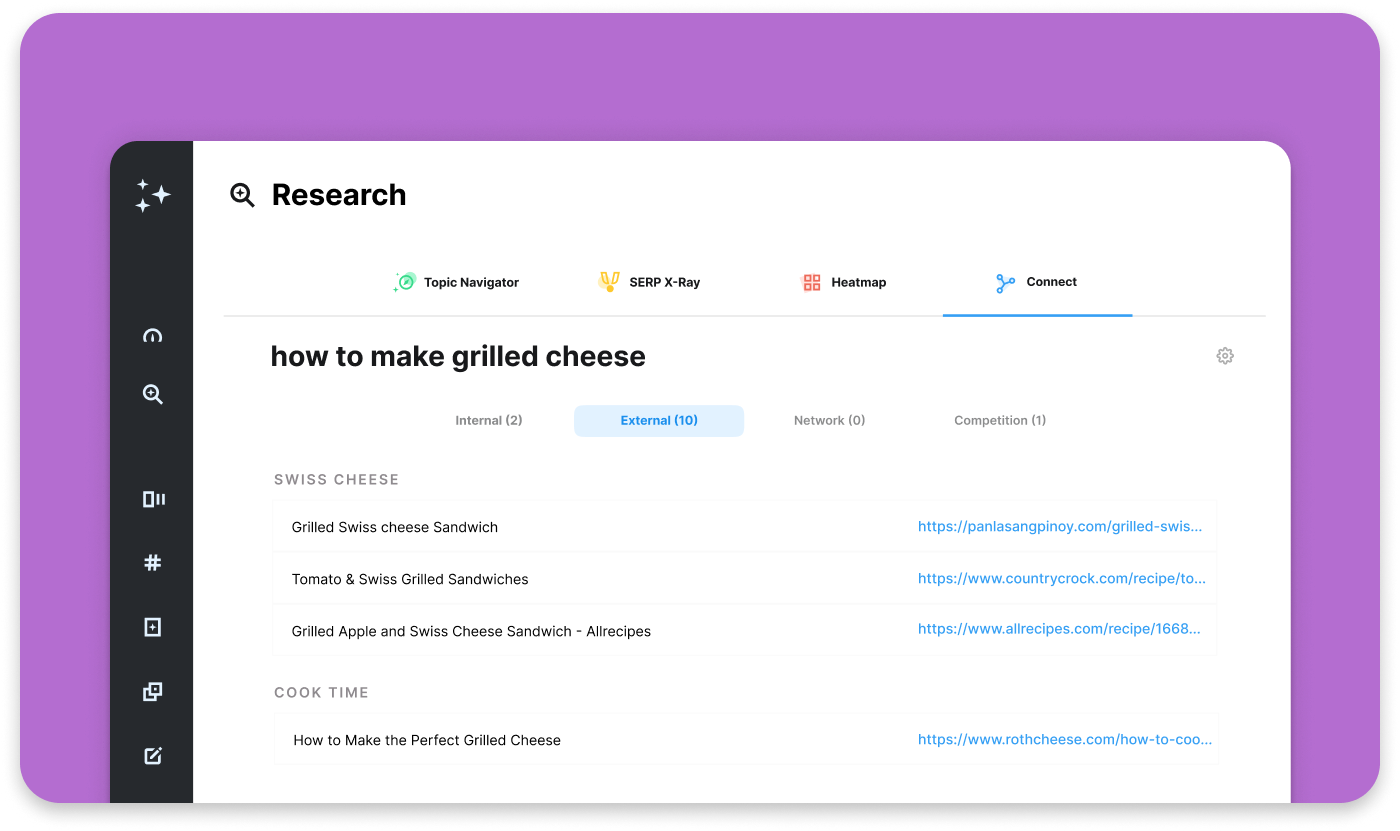
The Muse’s AI analyzes topic clusters across your domain, identifies coverage gaps against competitors, and generates content briefs or full content plans – with executive summaries, cluster details, competitive overviews, and recommended actions per page.
The Personalized Difficulty score is what differentiates MarketMuse from competitors: whereas other SEO tools give you a generic rating, the Muse estimates how hard it will be for your specific domain to rank on page 1, based on your existing authority.
The most important thing to understand about MarketMuse is that it’s a strategy builder first and content generator a distant second. It can create content via the AI First Draft feature, but it’s built for humans doing the writing with heavy AI assistance, not the other way around.
That’s also the first of its constraints: because the workflow is strategy-first, involving a lot of planning over drafting, time-to-content is relatively long. As such, if you’re looking for a tool that delivers publish-ready pieces fast – MarketMuse is not it.
The second drawback is pricing, which is gated behind “Book a Demo.” Third-party sources report legacy tiers as Optimize $99/mo, Research $249/mo, and Strategy $499/mo – but these are not confirmed on the official site.
| MarketMuse is strong for: | MarketMuse is weak for: |
| Teams managing large content libraries, with focus on content strategy first and content production second | Teams that want finished, publish-ready content fast and at an affordable rate |
Jasper is one of the earliest commercial AI writing platforms, and it has been scaling lockstep with the market since 2021. Today, it is a full-fledged content operation layer built around brand governance and workflow control – which is exactly why it’s a preferred AI SEO software pick for large, enterprise marketing teams.
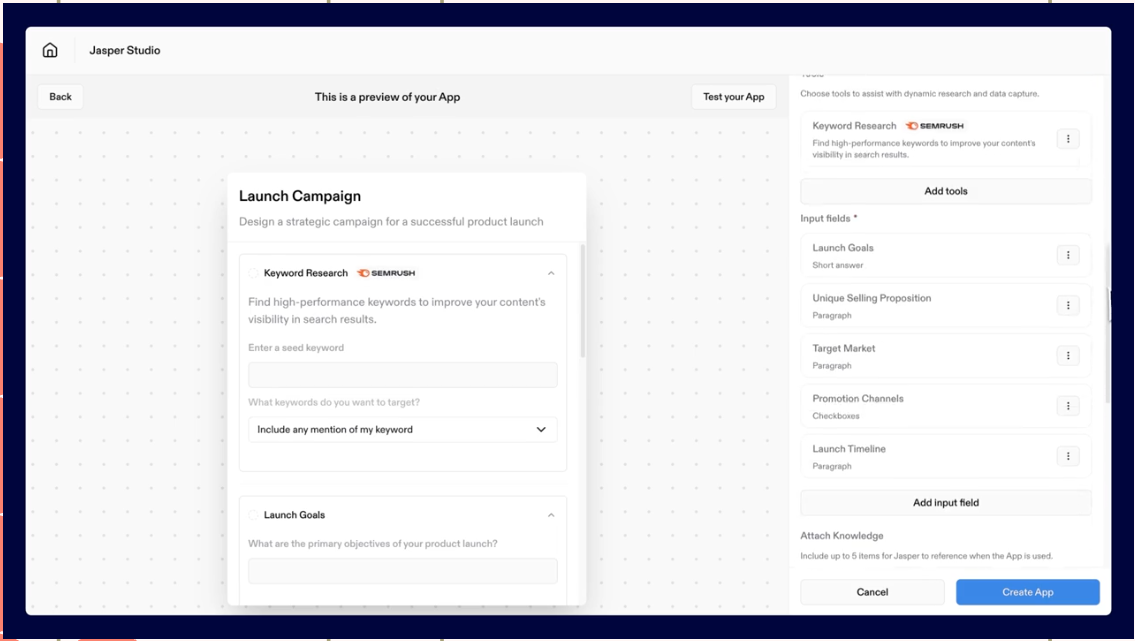
Although Jasper doesn’t have its own LLM, instead routing prompts through OpenAI (ChatGPT) and Anthropic (Claude) models, it can still be considered fully AI-powered because the layer utilizing those models is where the majority of work happens – and it’s entirely AI-driven.
Where Jasper shines is governance at scale. Its Brand Voice feature ingests the existing site content to train AI models on your specific tone, terminology, and style, ensuring consistent drafts across distributed teams – without the editor having to “police” every single content piece.
On the Business plan, unlimited Brand Voices, Knowledge assets, and Audiences let agencies manage dozens of client tones simultaneously, while Jasper Grid lets you build content at scale from a single setup (e.g., thousands of ad variants, dozens of localized pages).
Beyond content production, Jasper also ships 100+ pre-configured marketing agents that can execute specific tasks, such as drafting emails, generating ad variations, or writing product descriptions – and on the Business plan, you can even build custom agents.
Everything described is just a fraction of the platform’s capabilities. Jasper is incredibly powerful, and the price reflects it: the Pro plan is $59/mo (annual) per seat; Business is custom-priced, with third-party data suggesting deployment is anywhere between $900 and $6,000+ per month.
Also, there’s no built-in SEO scoring or ranking research, which is why enterprise teams routinely pair it with Surfer or Clearscope for the optimization part. Without that, Jasper can produce on-brand content, but that content won’t necessarily be optimized for search or citation.
| Jasper is strong for: | Jasper is weak for: |
| Enterprise content teams and multi-brand agencies who require no-compromise on-brand AI writing at scale | Small teams, tight budgets, and anyone wanting AI writing, optimization, and tracking in a single suite |
HubSpot’s AI Search Grader is not a tracker or a full tool suite – it’s a one-time AI visibility check you can run in under two minutes, completely for free. Simply enter your brand details, and you get a snapshot of how ChatGPT, Perplexity, and Gemini describe you.
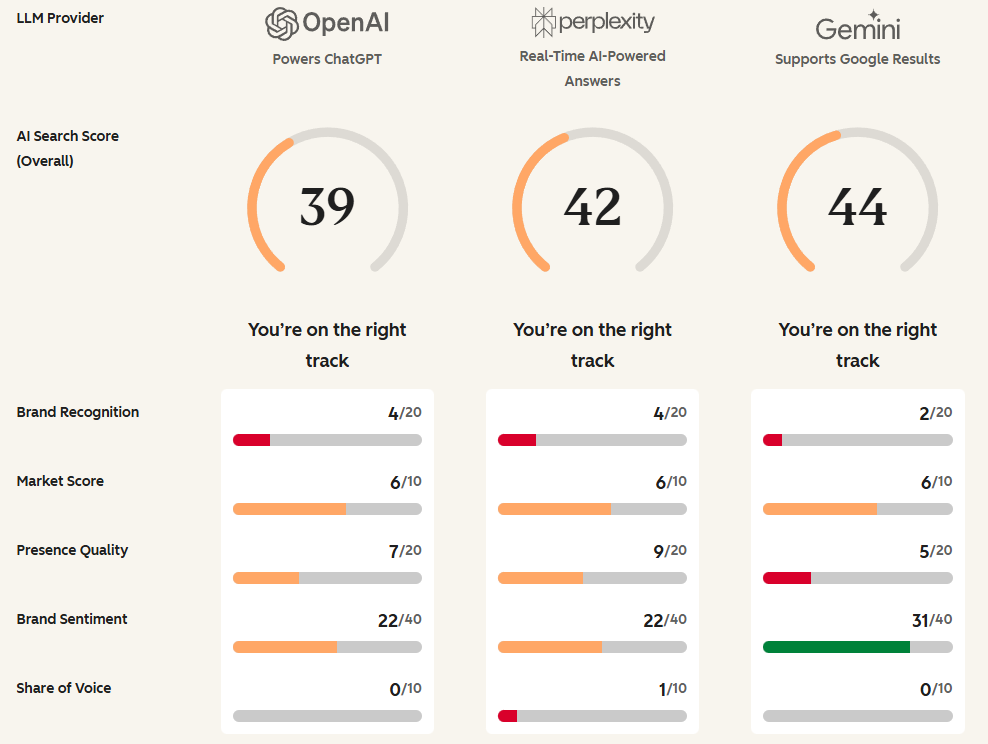
While it doesn’t provide anything more than a one-time, single-point snapshot, which can barely be interpreted as directional, the zero-cost baseline and effortless use make HubSpot’s AI Search Grader a smart first stop on the way to a paid tool.
| HubSpot AI Search Grader is strong for: | HubSpot AI Search Grader is weak for: |
| teams that want a fast, no-cost snapshot of how their brand fares in AI search, before committing to a paid tool | anyone who needs ongoing tracking, custom prompts, or engine breadth |
Tina Clarke is the AI SEO Manager at ZeroClick Labs, specializing in AI search optimization and Generative Engine Optimization (GEO). With a strong foundation in content strategy, technical SEO, and operations, she leverages her expertise to help brands shift from traditional rankings to discoverability and excel in AI-driven ecosystems.
Realizing its potential to the fullest?
That’s what you need ZeroClick Labs for.
With 15+ years of optimization expertise, our team excels at taking raw output of whichever tool you choose and turning it into consistent AI citations, accurate brand framing, and measurable visibility gains across ChatGPT, Gemini, Perplexity, AIOs, and AI Mode.
You keep your stack.
We do the hard work that makes it pay off.
“Our agency had no idea how to approach AI visibility. ZeroClick only does this one thing so they actually know what works. Worth every penny just to not waste time figuring it out ourselves.” – Jay