AI Marketing SaaS Statistics
ZeroClick Labs compiled a list of SaaS marketing statistics to help brands and marketers understand how their buyers research, what...
Continue Reading
Google’s new AI Search update promises more links – but not more clicks.

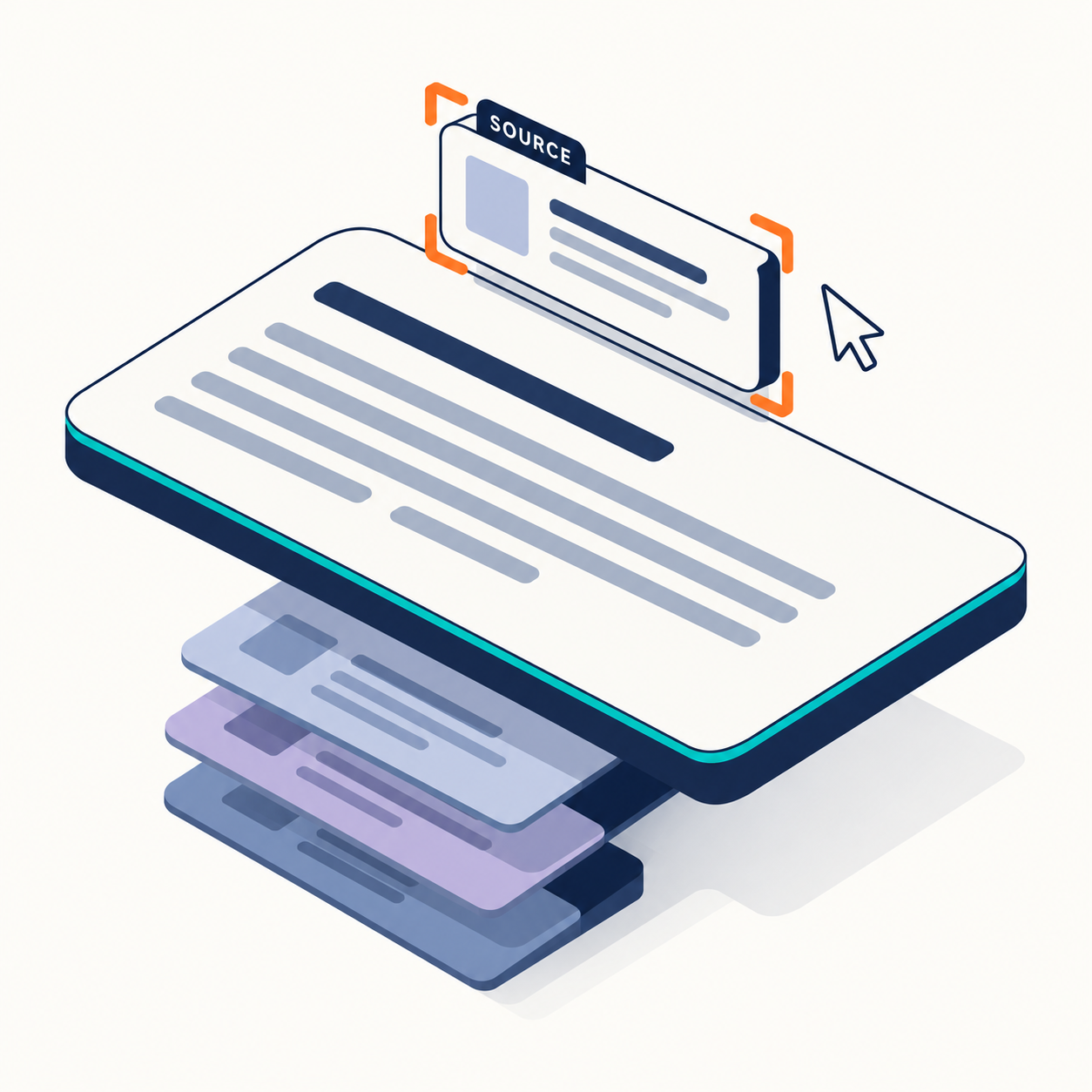
Google’s October 15 update changes how AI citations are presented, not how they are selected.
When an AI answer appears, users click far less; better link placement alone won’t change that.
Citation prominence is a distinct dimension of AI visibility, separate from citation frequency and citation CTR.
Navigational and transactional queries stand to gain the most, while informational queries stand to gain the least.
Citation positioning has to be tracked manually, since Google Search Console (GSC) can’t measure it.
Executive Summary: On October 15, 2026, Google announced five changes that make links in AIOs and AI Mode more visible, from higher inline placement to dedicated official-source sections. The update only changes where citations appear, not which sources are cited, and the changes come with no click data to show how the system works. For brands, citation prominence is becoming a GEO metric in its own right, and GSC can’t measure it.
Google is introducing five changes to AI Overviews (AIOs) and AI Mode, all revolving around the same idea:
Making it easier for users to leave AI summaries and head straight to the source.
Most coverage read into this as Google trying to mend fences with publishers. For those who’ve been watching AI summaries cannibalize their clicks, it read like a relief. And it would be, if it weren’t for one fact:
A more visible link does NOT equal a clicked link.
What it does, however, is add a dimension to AI Overviews SEO that most visibility reporting ignores: where you are cited.
Google changed how sources are presented in AIOs and AI Mode, but not how they are selected. In their October 15, 2026 announcement, they outlined five changes:
It’s important not to assume any of these changes are live everywhere – two are in test phase, one is a phased rollout, and the remaining two have no rollout scope disclosed.
October 15, 2026 update
Five link changes, three different statuses
Google changed how AI citations are presented, not how they’re selected.
| Change | What it does | Status |
|---|---|---|
| More inline links | Appear higher up in AI responses, more often | Undisclosed |
| Official-source links | 1–2 official pages in a dedicated section at the top | Test |
| News carousels | More locations, languages and queries; highlight Preferred Sources | Phased rollout |
| Related articles | Thumbnails and a more clickable design | Undisclosed |
| Creator names | AI Mode video results link to Google-hosted Search profiles | Test |
Bottom line: don’t assume any of these changes are live everywhere.
Source: Google, “More ways to connect with the web from Search” (October 15, 2026).
The stated reason is user demand: Google says people want more choice over the sources they engage with, and points toward a 7x increase in Preferred Sources adoption as evidence. What it conveniently fails to address is more than a year of independent data showing AI summaries rarely send users anywhere and that Google’s own AI surfaces are the primary driver of click loss. The two headline figures are:
Although the two figures measure different things (behavior on summary pages and a single ranking position, respectively), they both point toward the same conclusion: when an AI answer appears, users click far less, both on cited sources AND organic results.
Some probably will, but the thing about the above conclusion is that prominence only fixes access, and not the users’ actual motivation to click. AI visibility reporting generally tends to collapse three distinct dimensions of citation performance into one:
Google’s update affects only the third dimension, which could affect the second (indirectly and marginally), but not the first. The reason is simple: if the AI summary already satisfied the user’s query, clicking the link remains optional, regardless of how prominently that link is placed.
Beyond “were we cited?”
Three dimensions of citation performance
Google’s update moves only one of them directly.
Citation frequency
How often the page is cited
Citation CTR
How often users follow the cited link
Citation prominence
How visible and reachable the cited link is
Prominence can’t earn the citation or create the motivation to click – it shapes whether the citation gets noticed.
Source: ZeroClick Labs analysis of Google’s October 15, 2026 AI Overviews and AI Mode update.
The most obvious beneficiaries of Google’s changes are:
Once again, the overarching theme is intent or, as noted earlier, motivation: someone looking for an official application has to click; someone looking for a definition doesn’t. Therefore, sites that satisfy navigational and transactional queries stand to gain more from prominent citation positioning than sites satisfying informational ones.
Not directly. GSC’s Generative AI performance report only shows impressions from AIOs and AI Mode, but no clicks and no citation CTR. That being said, AI-driven clicks do exist in GSC – blended with every other organic click and with no way to isolate them.
Google’s announcement does nothing to remedy that black box: it contains no mentions of click or traffic data, continuing the “trend” of making changes without giving site owners virtually any means to measure their impact. So, as of now, the only workable approach to gauging the impact is to:
The most important thing to understand is that eligibility for citation doesn’t change, so the fundamentals of AI Search optimization remain intact. What sharpens now is the distinction most optimization programs blur: earning a citation vs. earning a click.
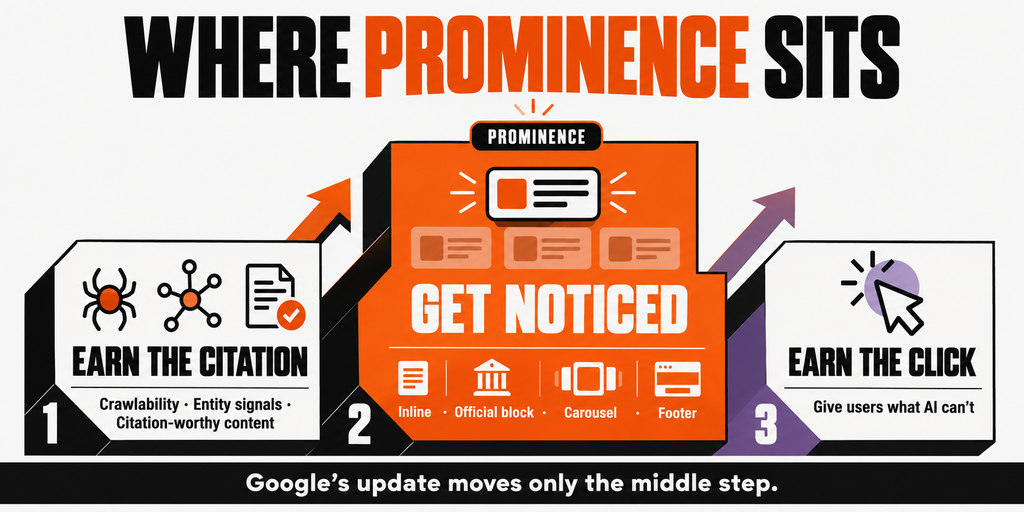
The former requires the fundamentals (crawlability, unambiguous entity signals, citation-worthy content) and gets your brand into the AI answer. The latter requires something far more difficult: giving users something AI answers can’t.
Prominence, however, sits at the exact midpoint between the two: it can’t earn you the citation, and it can’t create motivation to click. But it can shape whether the citation gets noticed in the first place.

Lily Evans is the Managing Director at ZeroClick Labs, bringing over 8 years of comprehensive experience in SEO, local SEO, and AI optimization to every project. She began her career in content writing, developing a strong sense for search intent and messaging clarity in the digital realm – skills that form an unshakable core of her leadership to this day.
It won’t stay that way for long
Getting noticed in AI Mode and AI Overviews just became a matter of optimization.
ZeroClick Labs tracks all three dimensions of AI citation performance: how often you’re cited, how prominently, and what those citations actually earn – and we do it across AI Overviews, AI Mode, and all the engines your buyers use.
“Our agency had no idea how to approach AI visibility. ZeroClick only does this one thing so they actually know what works. Worth every penny just to not waste time figuring it out ourselves.” – Jay