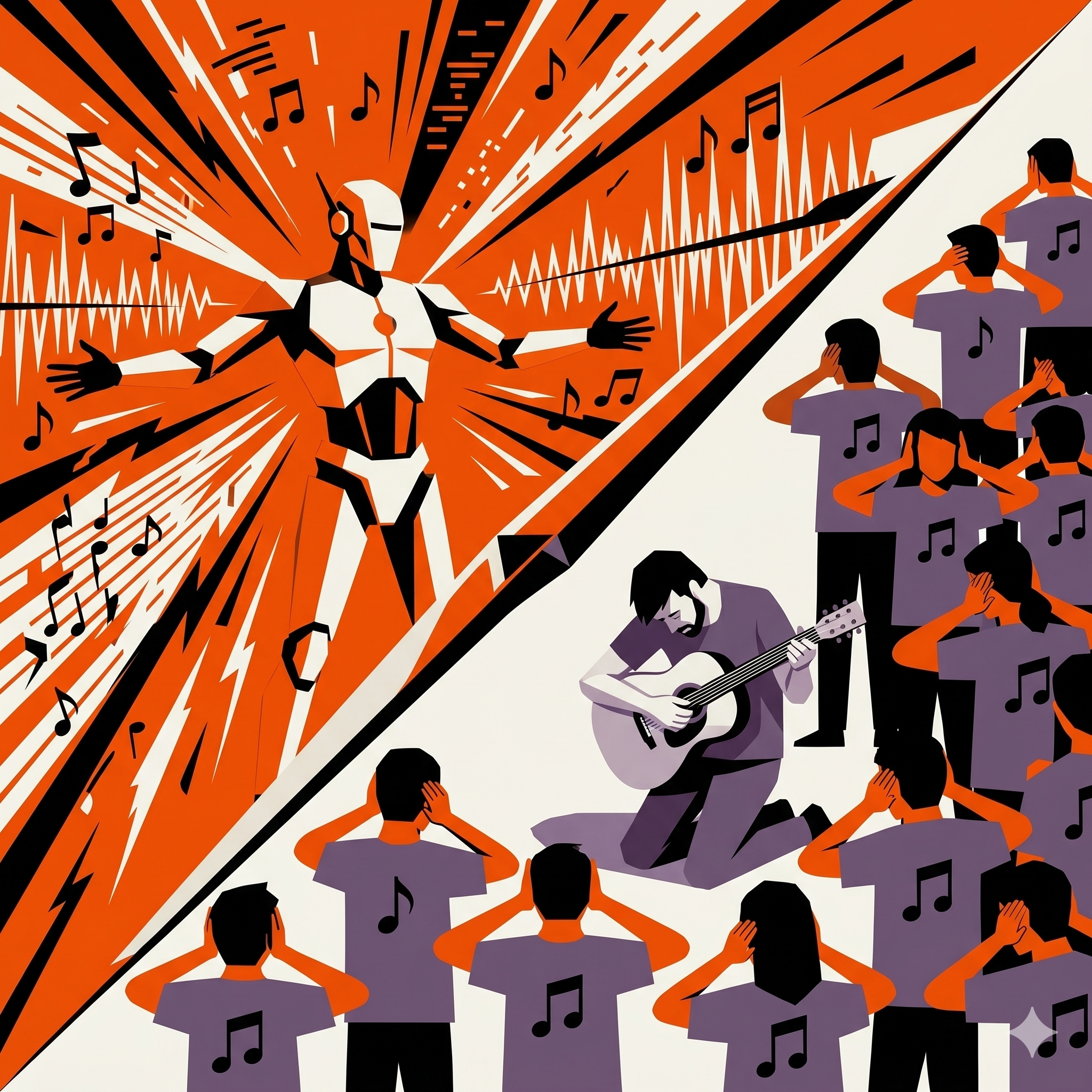
Nearly 3 in 4 respondents demand mandatory labeling of AI-generated tracks on streaming platforms.
Nearly half (46.57%) of respondents believe streaming platforms should bear the burden of disclosure.
Threats to musicians’ livelihoods (30.57%) and listener deception (25.71%) are the dominant concerns.
65% expect AI music to become mainstream within five years, but also expect significant pushback and controversy.
Executive Summary: AI-generated music divides listeners on almost every front – but unites them on one demand: transparency. Across 350 respondents, nearly three-quarters (74%) support mandatory labeling of AI tracks, and nearly half believe streaming platforms should be the ones to enforce it. Key concerns center on musician livelihoods and listener deception, rather than music quality, signaling that the fight is not about the aesthetics or preference – but survival and authenticity.
Ask 350 people how they feel about AI music. 211 people will say they actively avoid it, and 139 will tell you they actively pursue it – a nice, relatively even, polarized 60:40 split. Ask the same 350 people whether they want to know if a track they’re about to listen to is AI-generated, and 259 will immediately say yes.
“But, wait,” you might say, “ those numbers are suspiciously specific…” A keen observation – and a correct one – because that’s exactly what we did! The team at ZeroClick Labs surveyed 350 listeners, from casual enjoyers to professional musicians, aiming to determine the sentiment toward the AI music flood. What we found wasn’t a verdict. It was a warning.
The great divide
People have always felt strongly about music, and it has been a point of division for literally forever. In the Age of AI – nothing has changed. The divide is still there, but before getting into why, something else stands out – specifically, the way how we asked the question: How often do you KNOWINGLY listen to AI-generated music?
Awake and alive
The “knowingly” part of the question effectively collapses the distribution into just two segments: those who actively avoid AI music (60.29%) and those who actively pursue it (39.71%). A relatively even split suggests strong sentiment on both fronts (especially on extreme ends), and is reinforced by findings from Q3. If we zoom out even slightly, some interesting things immediately pop out:
The percentage of avoidants (60.29%) practically overlaps with the percentage of dedicated fans (61.71%).
The negative sentiment in open-ended responses (32.0%) almost perfectly coincides with the segment that finds music less authentic once they find out it’s AI-generated (32.57%).
While the overlaps are correlational, not causal – they are consistent enough to suggest that the people who are most resistant to AI music are those who engage with music the most. Still, it doesn’t tell us anything we didn’t already know.
How often do you knowingly listen to AI-generated music?
Q2 · Public opinion survey
Rarely, and usually by accident34.86%
Sometimes, out of curiosity29.71%
Never — I avoid it25.43%
Often — it’s part of my regular listening10.00%
Hover any bar to isolate it. Survey data — % of respondents per answer option.
The AI music debate has been ongoing for years now – and nobody’s winning. Not the purists who call it “soulless” or “not real music”, and not the pragmatists who say “good music is good music, regardless of who (or what) made it.”
The problem is that, when music enters the conversation, objectivity leaves – despite what anyone might claim. However, when faced with concrete, real-life stakes – concerns about the increasing presence and impact of AI music in mainstream channels – now, that’s where things take a darker turn.
Rage against the machine
When we come to the concerns, the two primary ones cut deeper than we could’ve presumed: AI-generated music threatens the livelihoods of working musicians (30.57%) and deceives listeners (25.71%).
What is your single biggest concern about AI music?
Q4 · Public opinion survey
Hover any bar to see the value. Survey data — % of respondents per answer option.
At this point, this is no longer a debate about quality. It’s a debate about existence and truth.
The third concern - that the artists aren't compensated when their music trains AI models (18.6%) - feeds directly back into the first, forming a closed loop of exploitation. This is NOT a theory - it’s happening right now, in real time.
There’s substantial evidence of artists, major record labels, and industry advocacy groups taking aggressive legal and public action against AI companies, including cases such as:
2024 ARA open letter, signed by 200+ artists, alleging “predatory use of AI to steal professional artists’ voice and likeness.”
2024 RIA lawsuit against Suno and Udio (AI music generators), alleging these platforms trained their models on copyrighted recordings on an “almost unimaginable scale” - without permission.
2026 “AI Slop Crisis”, where independent artists complained about Spotify and Apple Music flooding their official channels with AI-generated music, locking them out of their own brands and diverting royalties to scammers.
This is not a war of dominance anymore. It's a fight for survival.
Can’t fight this feeling
Here’s the biggest twist of this survey: no matter how they feel about AI music, people want to know they are listening to it. In fact, 74% of respondents want mandatory labeling of AI-generated tracks. That’s not a slim majority - that’s three-quarters of the sample, spanning every age group, every opinion camp, every demographic - even people who enjoy AI music.
But, what’s most surprising - and shows there’s yet hope - is who the people want enforcing the mandatory labeling rule. It’s not the governments, regulatory bodies, AI tool companies, or even the artists.
Public opinion on AI-generated music labeling
Survey responses across two questions on streaming platform policy
Hover any bar to isolate it. 74% of respondents support mandatory AI labeling on streaming platforms.
Hover any bar to isolate it. Streaming platforms are seen as the primary responsible party by nearly half of respondents.
Nearly half (46.57%) of respondents believe the burden of disclosure should fall to streaming platforms, followed by artists or individuals who upload the tracks (23.14%) - in other words, entities that profit the most from the “quantity-over-quality” nature of AI music.
The numbers scream louder than a death metal vocalist, and the message couldn’t be clearer: “If you want to produce, distribute, and profit from AI slop - fine - as long as you don’t insult our intelligence by presenting it as actual music.”
The thrill is gone
Even through all the concerns, controversies, and corporate noise, one simple concept keeps emerging - both through the data and common sentiment: what makes music music is the same thing that makes us human.
I remember watching a B.B. King and Eric Clapton concert way back in 2000, as a part of their “Riding With the King” album tour. About halfway through the concert, an improv battle ensued. Clapton went first, shredding on his Strat as his livelihood depended on it (pun so intended).
Then, it was the King's turn. He didn’t start right away. He let the calm wash over the audience. He let the moment breathe. And only when the silence was absolute, did Lucille speak - a single, dirty, harrowing note - and half the audience started weeping (present party included).
One note - but it was the only right note for that exact moment. Now, nobody disputes Clapton’s knowledge, quality, or virtuosity - the man is a legend for a reason. But whereas he was plucking strings, the King was caressing heartstrings. And that’s why he is THE King.
That’s also why people feel so strongly about music, whether it be AI-generated or actual - because music is not “about” emotion - it is emotion. And that’s something AI will never be able to emulate - at least, not without heavy human involvement.
Which brings us to what’s probably the most honest answer in our survey: for 9.14% of respondents, the sentiment toward AI music “depends on whether a human was meaningfully involved [in its creation].”
In other words, if AI is used as an “instrument,” a medium of self-expression - then it can be fine, but even then only marginally. However, when used as a replacement for human artistry - well, then you can expect sentiments such as: “Most of it is pretty soulless.” “Music is about real people and emotion.” “It will never be what I appreciate about music.” And our favorite: “AI-generated music is the spawn of Satan.”
Countdown to extinction
The final close-ended question of our survey (Q8) provides the most interesting insight into the future position of AI music. 43% think AI music will be mainstream but controversial, and 21% believe there will be significant pushback. That's a total of ~65% who know that AI music will be omnipresent - but not universally or unconditionally accepted.
Five years from now, do you think AI-generated music will be mainstream and widely accepted?
Q8 · Public opinion survey
Hover any bar to see the value. Survey data — % of respondents per answer option.
The outlook gets even more interesting when you consider which demographics made these predictions: 18-24 and 25-34-year-olds - the very people who actually engage with AI the most, and many of whom undoubtedly dabbled in making AI music at some point.
The 18-24 is also the smallest segment that thinks there will actually be a significant pushback against AI music becoming mainstream. The 25-34 segment goes even further, predicting complete, unconditional normalization.
On the flip side, the ones predicting the most controversy or resistance are people over 35 - individuals with a significant music-listening headstart. The pattern is obvious: those who know music the best are the ones most certain that the fight is not over.
The battle rages on…
In the Loudest Silent War, there’s only one clear-cut, agreed-upon rule of engagement - LABEL IT! Everything else remains contested, and it will stay that way until the streaming platforms, the AI companies, the industry leaders - and the consumers - finally decide if AI music is a product or something else entirely.
And we’re certain most of us already know the answer to that question.
Seth Matthews, an AI SEO content writer within ZeroClick Labs, began his career in civil engineering, but his passion for writing drove his deliberate transition into professional content strategy and SEO. The clash of two worlds produced a writer who can effortlessly combine technical precision and narrative clarity with the emotional and psychological impact of creative storytelling.
The AI flood is real – and it’s drowning your brand’s voice.
It’s time to stop grasping at straws and take real, intentional action.
ZeroClick Labs offers you a full set of AI search optimization services, designed to make AI models sing your brand’s name – loud and clear and exactly where your audience is listening.
“Our agency had no idea how to approach AI visibility. ZeroClick only does this one thing so they actually know what works. Worth every penny just to not waste time figuring it out ourselves.” - Jay