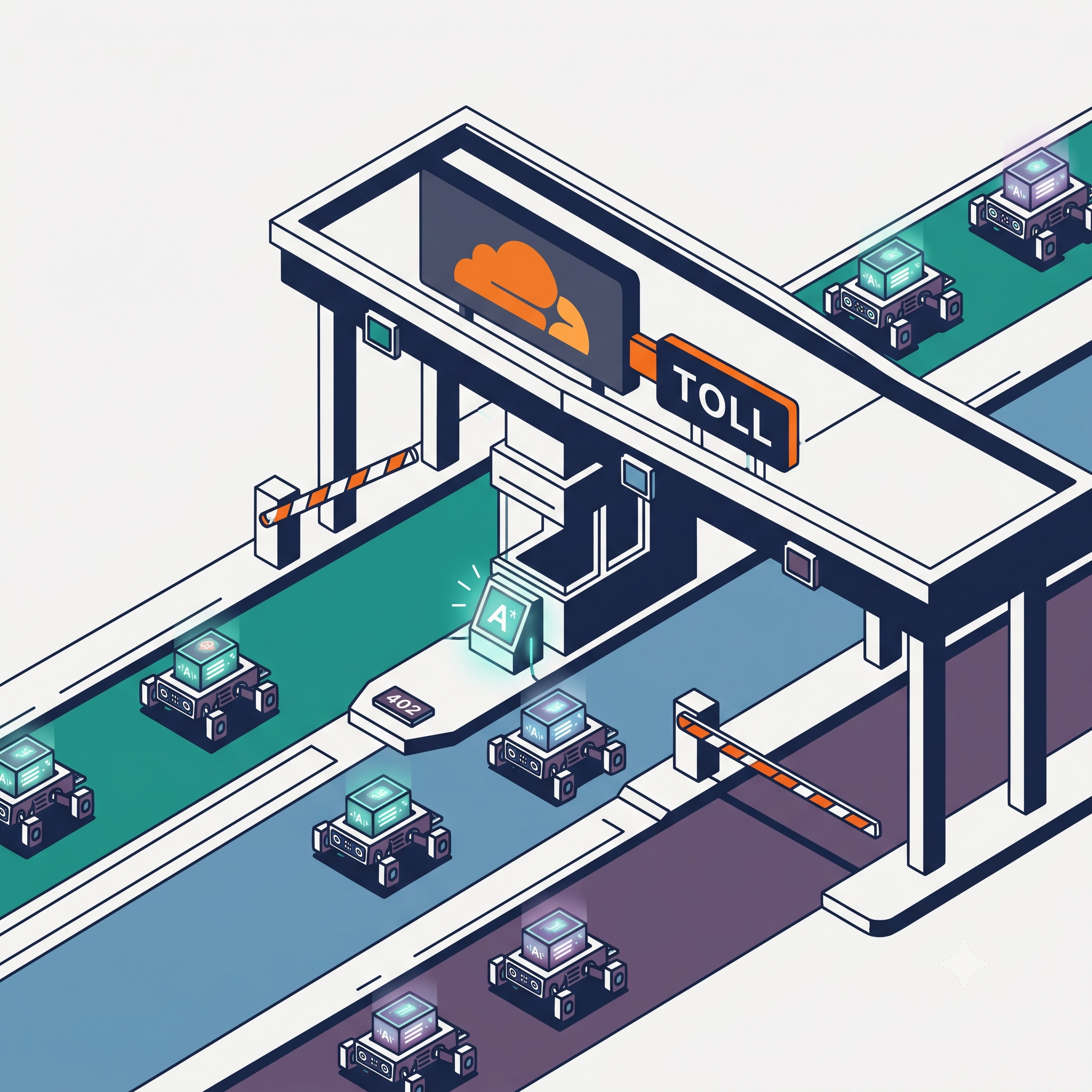
Cloudflare is pivoting from charging per crawl to paying per use.
Compensation now tracks whether content is actually used in an answer.
The AI web’s billable unit is moving from click to citation – the exact thing AI SEO already works to earn.
Tolling is a publisher play; if your content is a marketing asset, staying open protects your visibility.
The middle path: toll proprietary datasets or tools, while keeping marketing content open and crawlable.
Executive Summary: Cloudflare evolved its Pay Per Crawl model into a Pay Per Use toll, allowing site owners to charge AI crawlers when their content is used in an AI answer. However, the real signal isn’t the toll, but the unit being priced. Citation is becoming the billable currency of the AI web – and brands are already competing for it..
On July 1, 2026, Cloudflare tightened its crawler controls and simultaneously started laying out the toll road for AI bots, throwing a shiny hook to site owners:
If bots are going to use your content, make them pay for it.
An interesting idea and a potentially lucrative prospect which, without a doubt, many will jump onto. But the story here isn’t the toll itself.
It’s what’s being tolled.
Why is Cloudflare telling site owners to charge AI crawlers?
For two decades, the deal that funded the open web remained incredibly simple: search engines crawl your content and send human visitors back to see your ad, subscribe to your newsletter, or buy your product. AI crawlers took the first half and promptly dropped the second.
Cloudflare’s own data paints the best picture of the imbalance:
AI crawlers request content anywhere from a hundred to tens of thousands of times for every visitor they send back.
So, here’s a billion-dollar question: With the majority of your traffic no longer human and the ad-and-subscription model it funded no longer working – how do you fill the gap? Cloudflare suggests the answer: build the “toll booth.”
What is the Cloudflare “toll booth”?
It all started in 2025, when Cloudflare launched Pay Per Crawl, enabling site owners to set a per-crawler access rule: Allow the bot in for free, Charge it a flat price, or Block it outright. A charged crawler is served on payment, or handed an HTTP 402 “Payment Required” if it declines, with Cloudflare running the booth as merchant of record.
The twist: Just a year later, Cloudflare declared that model insufficient – so, they reimagined it. The newly-dubbed “Pay Per Use” model pays the publisher when their content is actually used in an AI answer, not merely crawled, thereby effectively moving the toll from the fetch to the outcome.
How the toll changed
2025 · Pay Per Crawl
The billable unit
The fetch
Charge a flat price per crawl. Unpaid bots get an HTTP 402 “Payment Required.”
2026 · Pay Per Use
The billable unit
The outcome
Get paid when your content is actually used in an AI answer — not merely crawled.
The toll moved from the fetch to the citation.
The reasoning: Crawling is a poor proxy for value. There’s actually a case to be made here, since a pagemight be fetched once and cited thousands of times – or it can be fetched thousands of times and cited never.
Cloudflare pushed this idea even further, extending the same model to any resource (e.g., pages, datasets, APIs, tools) by opening a Monetization Gateway, where AI agents pay per request over neutral rails, with no account required.
Why does Cloudflare’s Pay Per Use model matter for your AI SEO?
Think about it: Pay Per Use charges for the exact thing AI optimization strategies exist to earn – the citation. When the market starts paying for content because it appeared in an AI answer, it puts a literal dollar value on the precise KPIs AI SEO already optimizes toward: citation frequency and share of voice. The trajectory is unmistakable:
Citation is becoming the new billable unit of the AI web – and you’re already competing for it.
There’s also a practical upside: Cloudflare’s new Attribution Business Insights dashboard promises to show which bots consume your content, where it gets cited, and how much human traffic each AI platform sends back.
Subscribe for practical updates on AI discovery, answer engine visibility, and the shifts that matter most for brands trying to stay visible.
Should your brand toll or stay open?
At its core, tolling is a publisher play – it makes sense if your content is the product. However, if you are a SaaS company, an agency, or a local service provider (among others), your content is a marketing asset whose job is to get you discovered and recommended. As such, charging crawlers to access it would firewall the very visibility you’re after.
That being said, if you hold genuinely proprietary assets (e.g., original research, data, tool), the Monetization Gateway lets you charge agents for those specific resources, while keeping your marketing content open and citable. In short: toll the dataset, give away the blog.
Should your brand toll AI crawlers — or stay open?
Recommended for most brands
Stay open
ForSaaS, agencies, local & service businesses.
DoKeep content free and citable — your visibility depends on it.
Best of both
The middle path
ForBrands holding proprietary research, data, or tools.
DoToll the dataset; give away the blog.
Publisher play
Toll everything
ForNews, media, and research — where content is the product.
DoCharge crawlers for access; the content is the revenue.
What are the caveats surrounding Cloudflare’s Pay Per Use?
This is the first caveat: Cloudflare’s idea looks good on paper, but the model only works if AI companies adopt verified identities and paid access instead of simply routing around them. The problem is – none of them are obligated to.
The second caveat concerns the attribution. AI models may synthesize an answer from dozens of different sources, paraphrase without crediting, or simply cite no concrete source at all. This makes the whole “pay when your content delivers value” far easier to announce than to audit.
The reality, and the key takeaway, is that this is still an experiment, and not a settled market. Yes, it has real momentum – but whether it lands or not depends on too many fluid factors. Therefore, the best approach is to treat it as a direction, not a done deal.
Jordan Parkes, the CEO and founder of ZeroClick Labs, has been building and scaling digital marketing strategies since 2012, leveraging performance-driven SEO and data-based digital marketing solutions to guide the growth of hundreds of companies across the U.S. and Europe.
The web’s unit of value is shifting from click to citation
The brands that win the next phase won’t be the ones tolling their content.
They’ll be the ones cited so consistently that answer engines cannot route around them.
ZeroClick Labs’ AI SEO services exist for exactly that purpose: earning your place in AI Overviews, ChatGPT, and Perplexity – so when the buyer asks, your brand is the answer.
The toll economy is forming now.
Connect with us today, and claim your position in answers before it settles!
“Our agency had no idea how to approach AI visibility. ZeroClick only does this one thing so they actually know what works. Worth every penny just to not waste time figuring it out ourselves.” – Jay