Google’s UGC Spam Guide Targets AI Share Links
Much of what’s on the Internet is user-generated. A lot of it is junk. Some of it is just careless...
Continue Reading
Three Google surfaces, two interviews – one agent to unify them all.
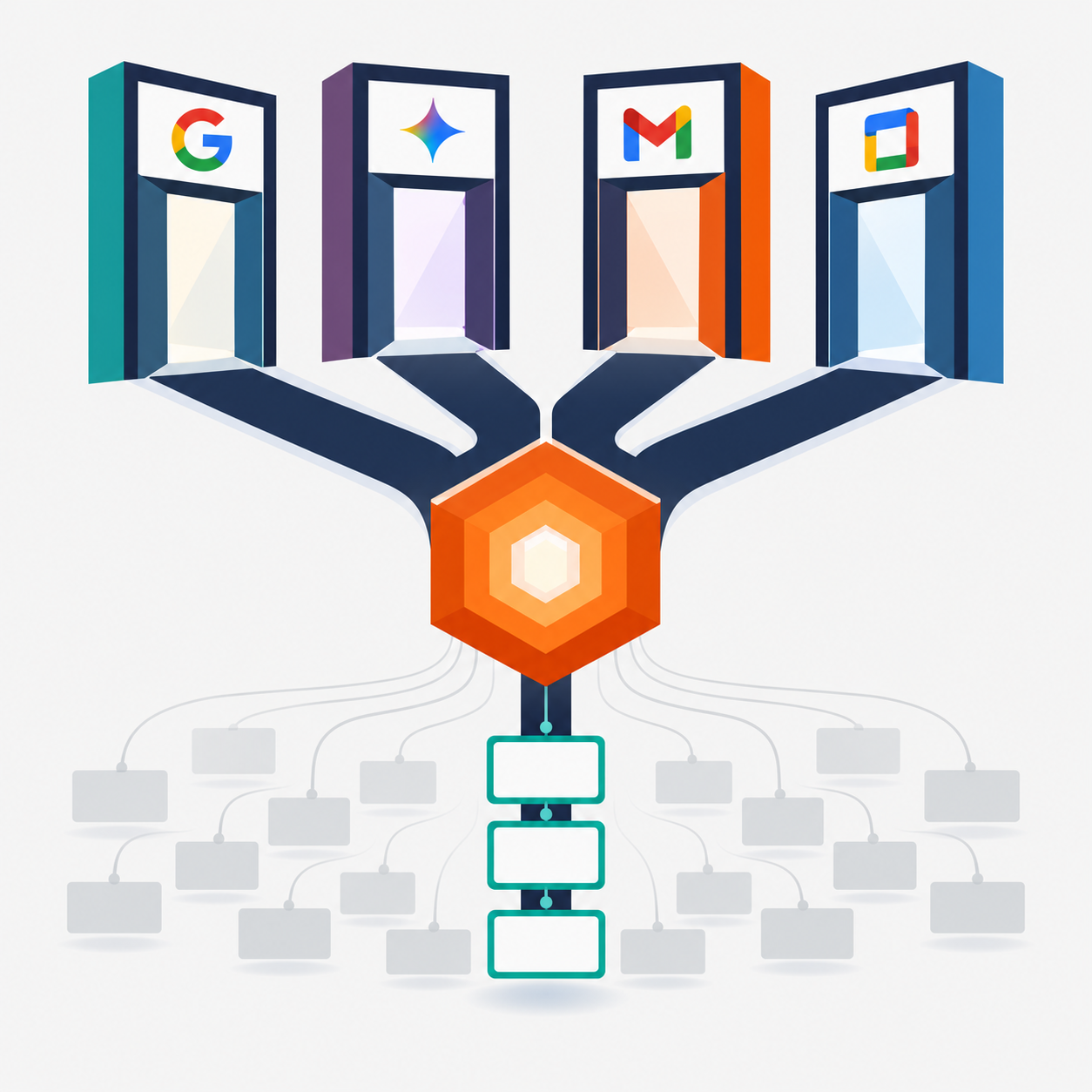
Pichai expects Google’s AI agent to unify Search, AI Overviews, and Gemini.
The agent will be reachable from Google Search, Workspace, the Gemini app, and Gmail.
Ranking on any single surface no longer guarantees a place in the results – an agent carrying the user’s context decides which brands make the cut.
Agents will reach websites in two ways: standard browsing and through protocols such as MCP and UCP.
Blocking an agent may protect the customer relationship, but also hand its shortlist to a competitor.
Executive Summary: Within 48 hours, Google CEO Sundar Pichai gave two interviews with the same message: Google isn’t merging Search, AI Overviews, and Gemini into one product – it is attempting to unify them with a single AI agent that follows users across all surfaces. For brands, this relocates the contest for visibility from the results page into said agent. Crucially, it also makes readiness for both browsing agents and agent protocols an immediate priority, since Pichai expects agentic features to reach more users within months.
In April 2026, Google CEO Sundar Pichai stated that Search would evolve into an “agent manager.” At the time, this signaled a strategic direction.
In October 2026, Pichai reinforced that position in two interviews within 48 hours: one with Alex Kantrowitz of Big Technology on October 20, and another with Alex Heath of Sources on October 21. Taken together, these statements suggest the direction has become a concrete plan.
For brands, this has significant implications for visibility. The competition for attention is shifting away from the search results page and toward the AI agent itself.
Rather than merging Search, AI Overviews, and Gemini into one product, Google is betting on an AI agent to unify them all.
In the Sources interview, when asked whether Search, AIOs, and Gemini will ever fully merge, Pichai stated that the agent layer “offers us a chance to bring a unified product experience better than ever before.”
In an interview with Big Technology, Pichai was more explicit, naming four Google surfaces the consumer agent will be reachable from: Gemini app, Search, Workspace, and Gmail.
Across both interviews, Pichai provided more details that give us a more complete picture:
Let’s look at the chronology: In April, Pichai described Google Search shifting toward an agentic model. In May, Google shipped agents inside Search. And now, Pichai has described the layer that ties every surface together and makes the agent the place where answers and brand choices get made.
Notably, at no point did Google’s CEO imply Search is disappearing, only that it will be one of several ways to reach the same agent (alongside Workspace, Gemini app, and Gmail). As we see it, that has two consequences for brands:
2026 timeline
From direction to plan: Google’s agentic Search in three steps
April 2026
Search becomes an “agent manager”
Pichai describes Google Search shifting toward an agentic model.
The direction Read our April analysis →May 2026
Agents ship inside Search
At I/O, Google puts AI agents directly into Search.
The first products Read our I/O breakdown →October 2026
One agent across every surface
Twice in 48 hours, Pichai describes an agent layer reachable from the Gemini app, Search, Workspace, and Gmail.
The planBoth by browsing and through protocols. Pichai expects agents to keep navigating sites the way people do, while the industry builds protocols such as Model Context Protocol (MCP) and Google’s Universal Commerce Protocol (UCP). He called protocols “a far more scalable approach,” but expects them to take longer. He also predicted a “chaotic evolution” before the industry (hopefully) converges on shared standards.
To make the transition smoother, brands should start aligning with both browsing and protocol requirements, treating them as parallel tracks:
Quick reference
Two tracks for the agentic shift
Agents will reach your website both by browsing and through protocols. Treat them as parallel tracks – and start on both now.
Optimize your website for agentic operability.
Adopt the existing protocols that fit your business.
Sources: Sundar Pichai on Sources with Alex Heath (Oct 21, 2026); Google crawling documentation; Google UCP documentation; GeekWire (Sep 2026).

Seth Matthews, an AI SEO content writer within ZeroClick Labs, began his career in civil engineering, but his passion for writing drove his deliberate transition into professional content strategy and SEO. The clash of two worlds produced a writer who can effortlessly combine technical precision and narrative clarity with the emotional and psychological impact of creative storytelling.
And it doesn’t hand out second chances
If the AI agent can’t navigate your site, can’t verify who you are, or can’t complete the transaction, it won’t stop to ask – it will move on.
ZeroClick Labs builds for both tracks so that doesn’t happen: Our AI search optimization gets the agent to know and trust your brand, while our technical SEO and web development for AI lets it get the job done on your site.
Google’s CEO himself confirmed it: the rollout is coming within months.
“Our agency had no idea how to approach AI visibility. ZeroClick only does this one thing so they actually know what works. Worth every penny just to not waste time figuring it out ourselves.” – Jay