Key Takeaways:
-
Self-promotional content helps new brands; it barely moves the needle for established ones.
-
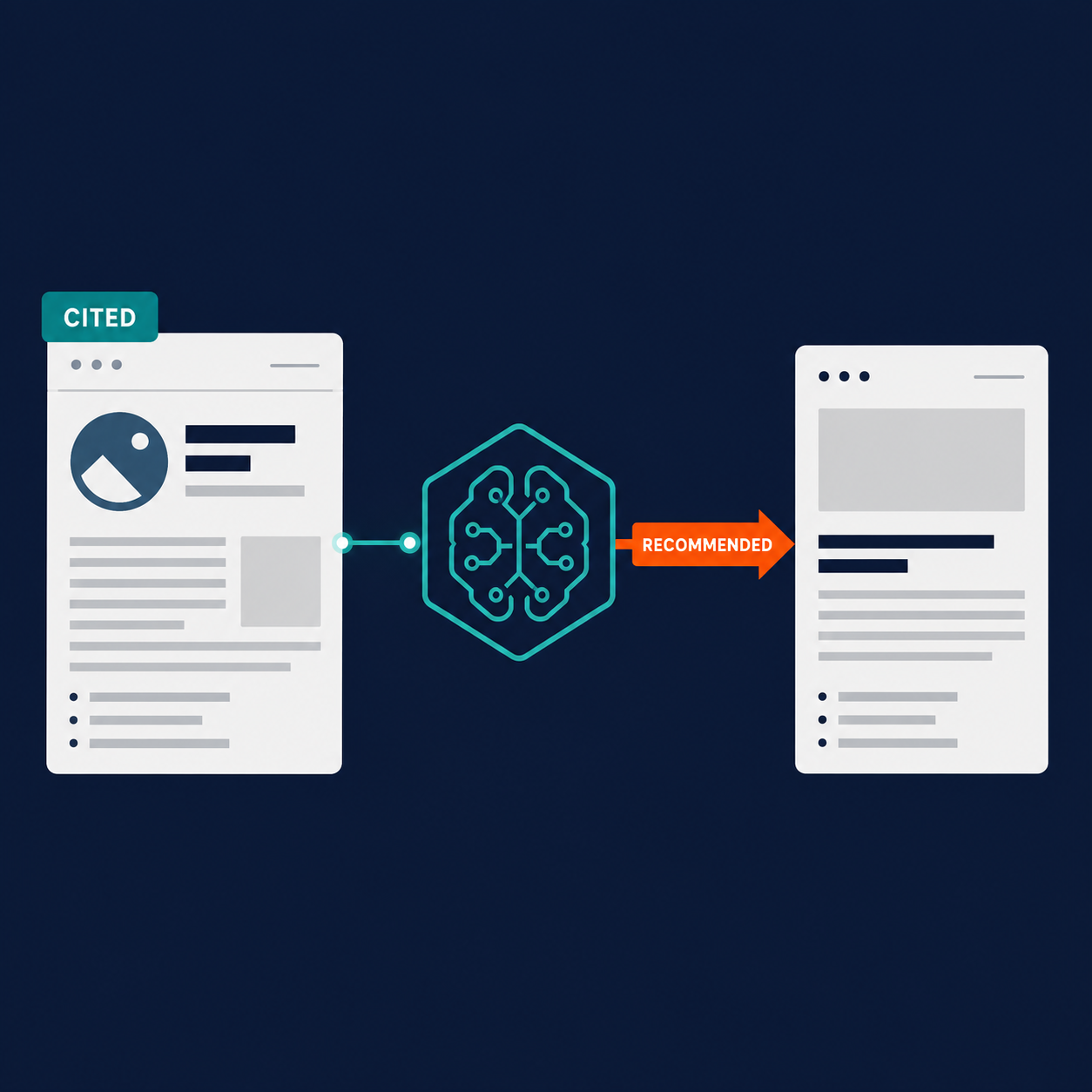
Citation is not the same as recommendation – they are two different, fleeting assets.
-
“Backfire” is the wrong word – found-but-not-cited pages failed to improve AI visibility; they did not induce damage.
-
Self-promotional content can work if an awareness gap, query fit, and established trust overlap.
Executive Summary: Ahrefs’ Feb-May 2026 experiment showed that self-promotional content earns AI recommendations – sometimes, briefly, and under specific circumstances. However, found-but-not-cited pages actively damaging a brand’s AI visibility is overreaching.
A couple of months ago, Peec AI ran a study showing that self-promotional content performed admirably in AI search. Surprise? Hardly – these content types (listicles, “best of” roundups, X vs Y pages, reviews) are built to be every AI’s wet dream: easily discoverable, effortlessly extractable, and densely packed with machine-readable information. In simple terms:
They are built to secure a placement first, and to provide actual useful information a distant second.
For these reasons, self-promo content remains the subject of ongoing controversy. SEOs hate them, but use them reluctantly because they deliver results. Google says it penalizes them, then surfaces them excessively because they align with how their search algorithm works.
Here’s the bigger question: Is self-promo content an asset or a liability?
A new Ahrefs experiment provides one of the most rigorous insights (yet) into whether “best of” type of content earns AI recommendations. Their core finding holds up. The claim that “pages AI finds but doesn’t cite backfire” – not so much.
What did the Ahrefs experiment find?
Between February and May 2026, Ahrefs published 34 self-promotional pages across 5 domains and analyzed 9,886 answers from 4 dominant AI engines: ChatGPT, Gemini, Perplexity, and Copilot.
The evidence base
Inside the Ahrefs experiment
- 34 self-promotional pages
- 5 domains
- 9,886 AI answers
- 4 assistants
- Feb–May 2026
FINDING 01
New brands benefit more than established ones
+
The new Evolve conference entered 72 previously empty answer slots — 82% citing Ahrefs’ own pages. For the established tool, only 6% of new mentions traced back to those pages.
FINDING 02
Being cited is not being recommended
+
Even when a page was cited, the answer left the brand out 43% of the time — naming a competitor from the same list instead.
FINDING 03
Citations are rented, not owned
+
Roughly a quarter of pages were cited once and never again. Even recurring citations showed up on only about one eligible day in three.
The three core results are genuinely well-supported:
- New brands benefit more than established ones: Ahrefs’ new Evolve conference broke into 72 previously empty answer slots, 82% of them citing Ahrefs’ own pages. In contrast, only 6% of new mentions of the existing tool (Ahrefs Brand Radar) traced back to Ahrefs’ own pages. The remaining 94% came from third-party content.
- Being cited isn’t the same as being recommended: In cases when their Evolve page was cited, AI models still omitted it from their actual answers 43% of the time – instead, naming a competitor from the same list.
- Citations only earn a temporary placement, not permanent: The experiment found that pages do not hold citations over time. Roughly a quarter of pages were only cited once and never again, and even recurring citations were absent two-thirds of the time.
This finding shows that publishing a single self-promotional article can improve AI visibility in the short term, but this doesn’t replace real third party trust signals. Without continued authority building efforts, the effects are likely to fizzle out.
Stay ahead of what’s changing in AI search
Subscribe for practical updates on AI discovery, answer engine visibility, and the shifts that matter most for brands trying to stay visible.
Does uncited retrieval really “backfire”?
This is where Ahrefs’ article overreaches: it reports that “Among answers where a conference-promoting page was found but not cited, 74% skipped mentioning Ahrefs Evolve (compared to 43% when a conference-promoting page was cited)”, and frames that gap as evidence the tactic that can “backfire the most.”
The framing outruns the evidence
“Backfiring” implies the found-but-not-cited page left a brand worse off than publishing nothing. However, three points in Ahrefs’ report undermine this claim:
- No competitor counterfactual: The baseline records where Evolve was absent from the answers, not which competitor occupied those slots. Therefore, we can’t see if the found-but-not-cited page shifted recommendation to a rival.
- The wording: One finding states that “found-but-not-cited conference pages were especially likely to strengthen the existing consensus” – this points to a null effect, not net-negative.
- Engine-level bias: The study concedes that “whether a present page counts as cited or merely found appears to be influenced by the engine, not the page.” Uncited rate ranges from 43% to 76% across observed models, so the 74% figure likely conflates engines that behave completely differently.
All of the above implies that the 74% miss rate measures failure to perform, not induced harm. Put plainly: uncited retrieval didn’t actively damage the brand’s AI visibility, it just didn’t help it.
Reading the numbers
Does uncited retrieval really “backfire”?
43%
of answers that cited a page still skipped the brand
74%
of answers that found but didn’t cite a page skipped the brand
Ahrefs frames the wider gap as the tactic “backfiring the most.” But whether a present page is counted as found or cited is an engine-level call — uncited rates run from 43% to 76% across engines — so a single pooled figure blends models that behave very differently.
A higher skip rate measures failure to convert, not induced harm. Uncited retrieval didn’t damage the brand’s AI visibility — it just didn’t help it.
When does self-promotional content actually earn recommendations?
When three factors overlap: an awareness gap, tight query fit, and existing trust. The clearest signal in Ahrefs data is category fit: for the “best SEO conferences 2026” query, Evolve showed in 66.4% of the answers; for the much broader “best marketing conferences 2026” query, it only surfaced in 15.8% of the answers.
So, self-promo content can nudge AI search engines to pay attention to a new page – if they don’t yet know the brand belongs in a category, if the brand provides a highly plausible answer to a highly specific query, and if the brand already boasts an established reputation.
If all those stars align and if the brand earns its place in AI engine’s retrieval pipeline, the recommendation may still be temporary and may still go to a rival on the brand’s own list. And that’s exactly 5 IFs and 2 MAYs away from a reliable visibility strategy.
Lily Evans is the Managing Director at ZeroClick Labs, bringing over 8 years of comprehensive experience in SEO, local SEO, and AI optimization to every project. She began her career in content writing, developing a strong sense for search intent and messaging clarity in the digital realm – skills that form an unshakable core of her leadership to this day.