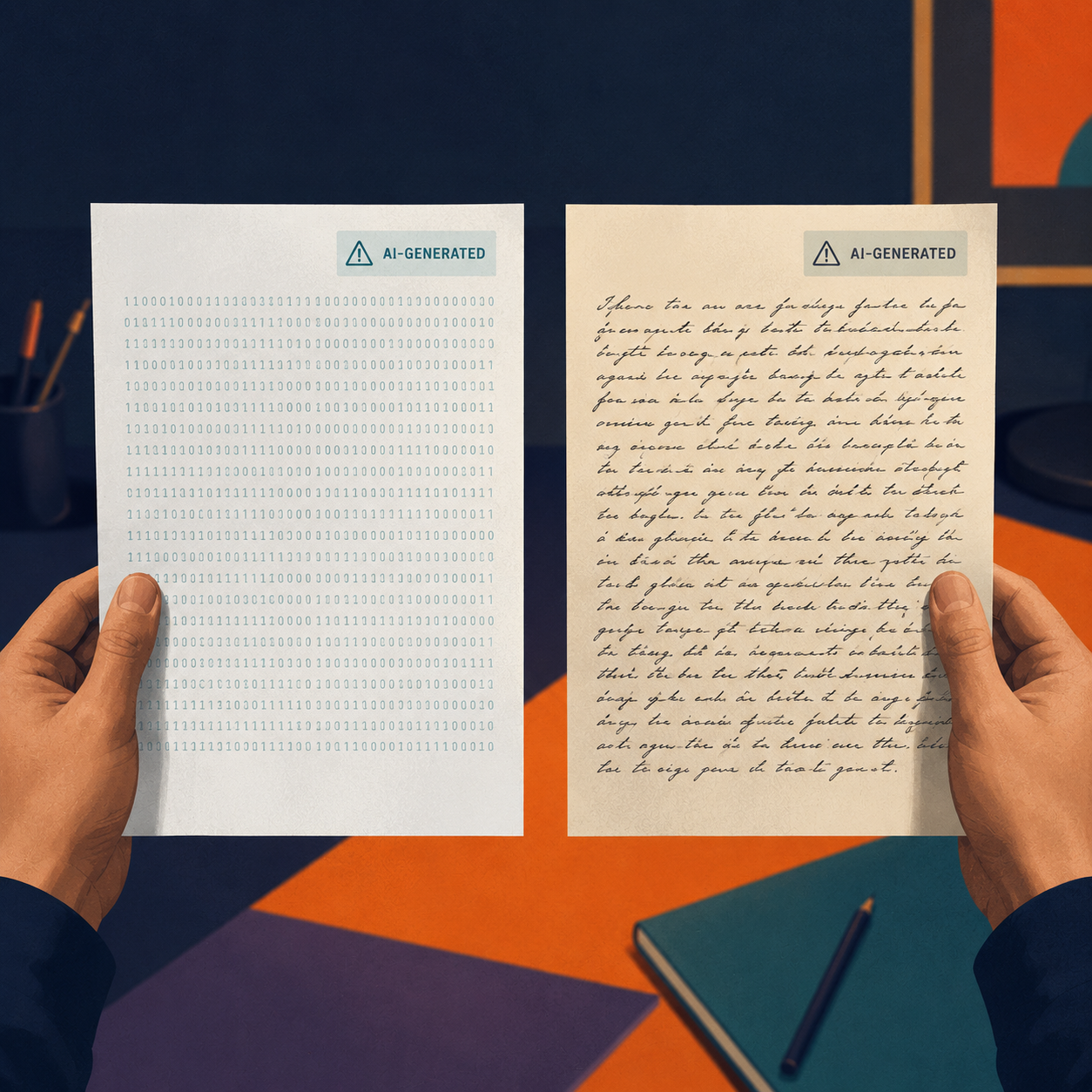
A Claude mark proves contact, not authorship – it cannot discern fully AI-generated content from human work merely edited by AI.
Provenance is not a quality signal – a mark cannot help or hurt visibility on its own.
No major AI search engine detects or penalizes these marks currently, but that can easily change.
Genuine human editorial control protects brands on both the compliance and visibility fronts.
Executive Summary: In August 2026, Anthropic began embedding machine-readable marks in Claude-generated content to comply with EU transparency law. A mark only signals that content was processed by AI – not that AI wrote it, nor that it is low quality. No AI search engine penalizes these marks today, but that doesn’t mean the provenance layer won’t become a citation input in the future.
Once again, Anthropic is openly doing what OpenAI has chosen not to:
Giving us a signal that text has passed through an AI.
Granted, they’re doing it just to comply with EU transparency laws, but still – on the internet overwhelmed by AI slop, any such flag is a welcome one. Here’s the other side of that medal, though:
What about people who are genuinely writing their copy and using AI tools to sharpen it (which, let’s be real, are the majority)? What about brands publishing that work to legitimately win business (which, let’s be real, are the majority)?
What happens when content gets flagged as AI-generated just because it passed through an AI at one point or another?
Anthropic’s move is not new, but it raises several bigger questions related to AI visibility and broader generative engine optimization (GEO), not the least of which is what happens if engines ever start acting on these marks.
Disclaimer: This article describes the EU AI Act’s transparency rules in general terms. It is not legal advice. Consult qualified legal counsel before making any compliance decisions.
The documentation confirms that Claude will be embedding machine-readable marks in the content it generates, applying to both text and files, with distinct mechanisms:
Text: An invisible watermark will be woven into generated text.
The marks will apply at the model level, across Claude’s surfaces worldwide, not just the EU. Claude models launched in the EU on or after August 2, 2026 carry this mark from the start, while older models fall under a transition window that closes December 2, 2026. Content generated before August 2, 2026 does not need to be labeled retroactively.
Stay ahead of what’s changing in AI search
Subscribe for practical updates on AI discovery, answer engine visibility, and the shifts that matter most for brands trying to stay visible.
What does a Claude mark signal?
First, a (detected) Claude mark only proves that the content was processed by the model – not authored by it. Run your own copy through Claude for whatever reason (e.g., proofreading, tightening, translating, summarizing, etc.), and the output gets “treated” to the same mark as text generated from a one-liner prompt.
Second, the absence of a mark does NOT prove the content isn’t AI-generated. Although the mark is durable, it is not indestructible: post-generation actions (e.g., heavy editing, paraphrasing, translation, format conversion, screenshots, re-saving) can still strip it, thereby preventing the signal.
Here’s the critical nuance: reading into this as “mark = content is AI-generated, no mark = content is human” is plain wrong. Effectively, the mark’s presence only indicates that content came into contact with Claude; its absence confirms – nothing.
What a Claude mark does — and doesn’t — prove
A detected mark is a one-directional signal: it records contact, not authorship or quality.
✓ What a detected mark confirms
The content came into contact with Claude — it was processed by the model.
✕ What it does not confirm
That Claude authored it — proofreading, editing, translating, or summarizing your own work carries the same mark.
That the content is AI-generated rather than human-written and merely AI-edited.
That the content is low quality — provenance is not a quality signal.
That unmarked content is human-made — heavy editing, paraphrasing, translation, format conversion, or a screenshot can strip the mark.
Presence means contact. Absence confirms nothing.
Does the Claude watermark hurt your content’s visibility?
Currently, no major AI engine (incl. AI Overviews, AI Mode, ChatGPT, Perplexity) has announced, documented, or is publicly known to detect, down-weight, or penalize AI provenance marks in either citation or ranking – even the tooling required to act on Claude’s text marks at scale isn’t publicly available. The real question here is what happens IF that changes?
The nuance above is the answer: because a mark records contact, not authorship, it cannot separate AI slop from human content that AI merely touched. In both cases, the mark is identical, and that makes it structurally useless as a quality signal. Consequently, introducing an extreme “penalize everything marked” policy is self-defeating, as it would:
Punish the most human-directed, AI-edited work that regulators themselves treat as legitimate.
Collide with the engines’ own output, since it would carry the provenance marks under the same rules.
Penalize transparency itself essentially, by rewarding anyone who strips the mark.
So, if engines ever start reading these marks, the plausible use won’t be a penalty but a sorting input that would give more weight to the same qualities that already determine whether content is citation-worthy: originality, experience, and expertise, all backed by human oversight.
How should brands and marketers respond to Claude marks?
Article 50 clearly distinguishes between the Provider (the entity that develops an AI system and places it on the market under its own name) and the Deployer (a legal entity using AI under its authority for professional activity). The provider (Anthropic) is charged with content-marking duty (Article 50(2)), and brands can’t control it like they can Google’s opt-out switches for generative search features.
Provider vs. deployer: who must do what under Article 50
The AI Act splits the marking duty from the labelling duty across two different parties.
Source: EU AI Act, Article 50 (Arts. 3(3), 50(2), 50(4)) and European Commission guidance on transparency of AI-generated content. General information, not legal advice.
Provider Anthropic
Deployer Your brand / agency
Who it is
The entity that develops an AI system and places it on the market under its own name or trademark (Art. 3(3)).
A person or business using an AI system under its own authority for professional activity.
Core duty
Mark generative outputs in a machine-readable, detectable format (Art. 50(2)).
Clearly label AI-generated or manipulated text published to inform the public on matters of public interest (Art. 50(4)).
Your control
None — the mark is applied at the model level and can’t be switched off.
The labelling duty falls away when the text carries genuine human review or editorial control.
Key exemptions
Source code, short character sequences, machine-to-machine output, closed-loop industrial use, and standard-editing assistance.
Substantive human review — authority to approve, alter, or reject the content, incl. fact-checking and source vetting. Spell- and grammar-checks do not count.
The deployer’s (i.e., yours) own duty per Article 50(4) is to clearly label AI-generated or manipulated text that is:
Published
Informative to the public
On matters of public interest
Two notes here, one important and one critical. First, purely commercial marketing copy that doesn’t fall under (B) or (C) is largely out of scope of Article 50(4), though the boundary is fact-specific. This doesn’t mean marketing copy is automatically exempt, only that exemption is determined on a per-case basis, depending on the copy subject, claims, and context.
Second, and this is crucial: Published text that has undergone genuine human review or editorial control does NOT require the deployer’s label. So, a genuine editorial process protects you on both fronts – compliance and visibility.
Furthermore, the EC is explicit that superficial or purely formal checks do NOT constitute “human review.” Real editorial control means authority to approve, alter, or reject the substance of the content (including fact-checking and vetting the sources), not just to correct grammar or spelling.
If your piece carries verifiable human judgement on top, marks become far less consequential – despite them being out of your control.
Seth Matthews, an AI SEO content writer within ZeroClick Labs, began his career in civil engineering, but his passion for writing drove his deliberate transition into professional content strategy and SEO. The clash of two worlds produced a writer who can effortlessly combine technical precision and narrative clarity with the emotional and psychological impact of creative storytelling.
The brands that win are the ones whose content is worth citing…
… regardless of whether AI touched it.
ZeroClick Labs can help your brand build the originality, experience, and expertise signals that AI engines reward – and that no watermark will be able to jeopardize.
Connect with us today, and let’s make your brand the one AIs recommend – mark or no mark!
“Our agency had no idea how to approach AI visibility. ZeroClick only does this one thing so they actually know what works. Worth every penny just to not waste time figuring it out ourselves.” – Jay