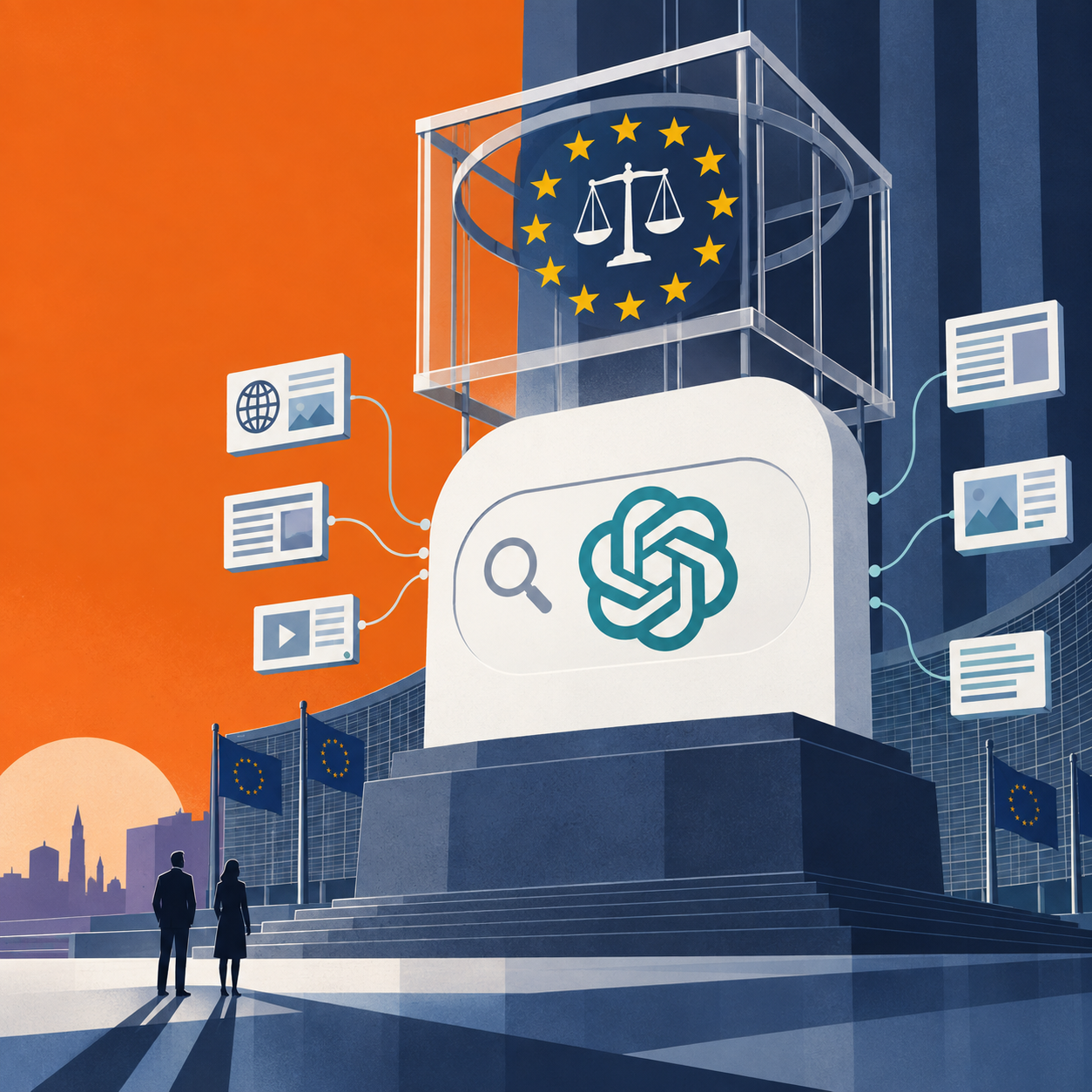
The EU officially labeled ChatGPT as VLOSE, folding it under the Digital Services Act (DSA) strictest regulatory tier.
Compliance will require enhanced source transparency, misinformation safeguards, advertising disclosure, child protection, and researcher access.
OpenAI has until the end of December 2026 to fully comply, or risk fines of up to 6% of global annual revenue.
The designation inadvertently recognized ChatGPT as one of the most influential European search and visibility channels, in the ranks of Google and Bing.
Executive Summary: On August 31, 2026, the European Commission designated ChatGPT as a VLOSE (Very Large Online Search Engine), placing it under the EU’s strictest regulatory requirements. By the end of 2026, OpenAI is required to strengthen transparency, safety, advertising disclosure, and data access – or face devastating fines. Inadvertently, the VLOSE designation reinforced ChatGPT’s status as the prime search, discovery, and marketing channel.
ChatGPT’s rise to prominence is nothing short of incredible. When it launched, it caught the world by storm. Some adored it; others abhorred it;
In the EU alone, ChatGPT has nearly 160 million monthly users, meaning it can influence roughly 35%-40% of the total population, whether through AI ads or generated responses.
And the risks scale with influence.
Recognizing the model’s potential to shape opinions and decisions of EU citizens, and the dangers that come with it, the EU Commission made a decision:
ChatGPT requires the most rigorous oversight.
How did the EU Commission label ChatGPT under the DSA?
This is the first time in history that an LLM (Large Language Model) earned VLOSE status, making it a landmark regulatory move by the EU. As such, it’s not unreasonable to assume other models will get the same treatment as soon as they clear the 45M+ EU users threshold.
Why is ChatGPT labeled a VLOSE and not a VLOP?
Per the EU Commission’s argument, ChatGPT acts as a hybrid service since it can search the live web in response to user queries and redirect users to external sites, which folds it under the VLOSE definition.
To trigger the VLOP (Very Large Online Platform) definition like Reddit and Roblox did, a digital service must have the capacity to disseminate third-party or user-generated content (UGC) to the public at a large regional scale, at the request of a recipient of the service.
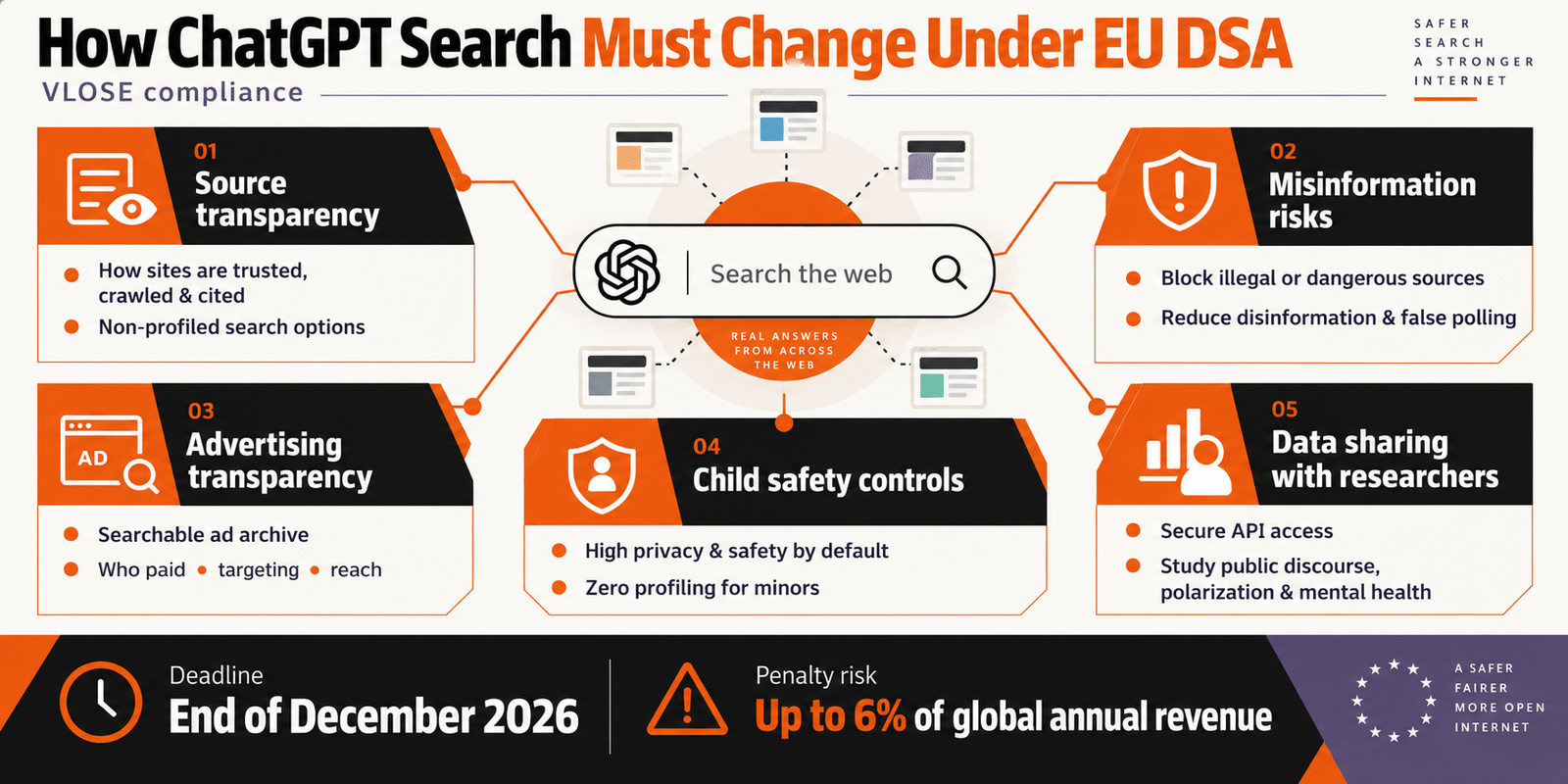
EU DSA compliance requirements for OpenAI (ChatGPT) [Image credit: ZeroClick Labs via ChatGPT]
How will OpenAI change ChatGPT search to comply with the EU DSA VLOSE requirements?
From the technical/functional standpoint, compliance with the EU DSA effectively requires OpenAI to overhaul the crawl, index, and live web retrieval parts of ChatGPT to ensure transparency and enhance users’ safety. This entails addressing five major areas:
Offering search options that generate answers without profiling the user’s personal history, location, and behavioral data.
Mitigation of misinformation risks:
Implementing rigorous guardrails so ChatGPT’s web search does not point users toward illegal or dangerous websites and content.
Preventing the retrieval and synthesis of coordinated disinformation campaigns or inaccurate polling data during European elections.
Advertising transparency:
Building a publicly searchable ad archive (repository) that must explicitly state who paid for the sponsored placement in a ChatGPT response, as well as what parameters were used to target the user and the total reach of the ad.
Strict child safety controls:
Mandatory inclusion of high privacy, safety, and security settings for minors by defaul.
ZERO profiling for minors, including using their search history or data for targeted behavioral advertising.
(Forced) Data sharing with researchers:
Granting secure API access to ChatGPT data to vetted academic and independent EU researchers, for the purpose of studying how its outputs impact public discourse, societal polarization, and mental health in the EU.
OpenAI has until the end of December 2026 to fully comply with enhanced obligations, or risk fines of up to 6% of the company’s global annual revenue.
Stay ahead of what’s changing in AI search
Subscribe for practical updates on AI discovery, answer engine visibility, and the shifts that matter most for brands trying to stay visible.
How will ChatGPT search change following VLOSE designation?
Although it’s too early to tell, adherence to new rules may lead to an “EU version” of ChatGPT that cites sources more restrictively than its US counterpart or behaves differently when redirecting users to external websites.
What’s much more interesting is the marketing implications. First, by labeling ChatGPT as VLOSE, the EU Commission effectively elevated its status from “chatbot” to a full-fledged search engine. Now, it’s on par with the only two platforms that ever held that rank: Google Search and Bing.
Second, the designation came less than two weeks after OpenAI rolled out ChatGPT ads to 31 European countries. The timing, paired with the imposed non-profiling and minors-related restrictions, not only highlighted – but actually amplified the platform’s position as a prime advertising channel.
Although the connections are likely coincidental rather than causal, the conclusion is the same: Officially, ChatGPT became subject to the most rigorous legal scrutiny. Unofficially, ChatGPT got acknowledged as one of the prime visibility channels in all of the EU – however indirectly.
Seth Matthews, an AI SEO content writer within ZeroClick Labs, began his career in civil engineering, but his passion for writing drove his deliberate transition into professional content strategy and SEO. The clash of two worlds produced a writer who can effortlessly combine technical precision and narrative clarity with the emotional and psychological impact of creative storytelling.
OpenAI’s platform is one of the top places where visibility – and business – is won or lost.
ZeroClick Labs is built to help brands win in ChatGPT, as well as Perplexity, Gemini, AIOs, and AI Mode. Using the best AI SEO practices, we infuse brands with structure, authority, and signals necessary to compete inside the hostile zero-click environments.
Connect with us today, and let’s make you more visible as AI platforms become more influential – and consequential!
“Our agency had no idea how to approach AI visibility. ZeroClick only does this one thing so they actually know what works. Worth every penny just to not waste time figuring it out ourselves.” – Jay