ChatGPT Ads Adds Target CPA & Target CPC
Saying that OpenAI moved fast to build out ChatGPT ads is an understatement. CPM-only test in early February, self-serve CPC...
Continue Reading
ChatGPT is eating Search. Websites barely even get breadcrumbs.
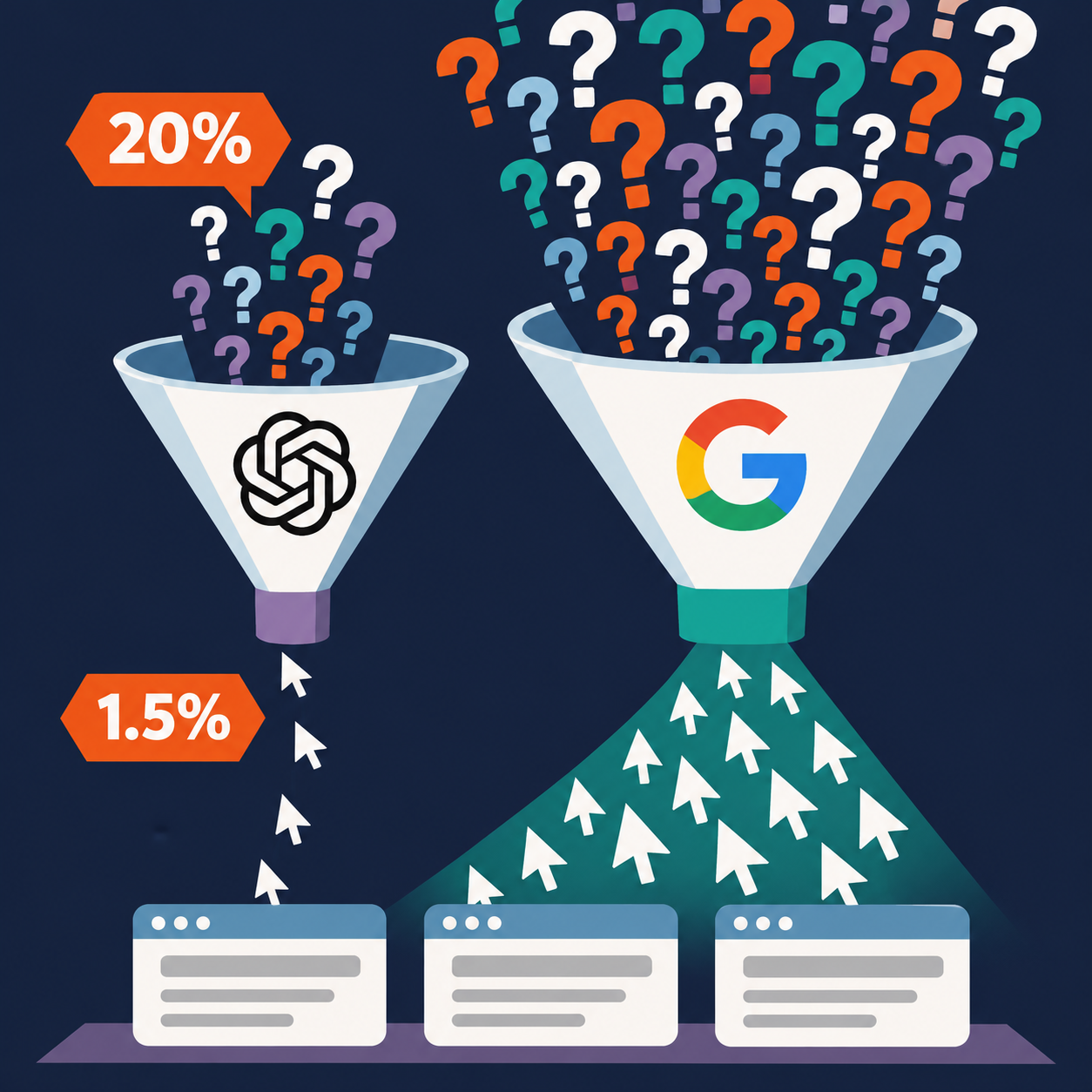
OpenAI’s 20% doesn’t count clicks, it counts questions that triggered a ChatGPT web search, measured against an undisclosed Google baseline.
ChatGPT sends ~1.5% of Google’s referral traffic, roughly 93% fewer clicks per query, at 20% query volume.
ChatGPT is still the only AI engine sending meaningful traffic – its referrals rose 69% since June 2025.
Query share and referral share are two separate metrics – they should never be merged into one “AI search share.”
Measure by presence, not traffic – being cited is currently the only value ChatGPT provides.
Executive Summary: OpenAI’s Adam Fry stated that ChatGPT now handles roughly a fifth of Google’s query volume, but referral data shows it sends websites only about 1.5% of Google’s traffic. The bigger the query figure, the wider the per-query click gap, which makes OpenAI’s own number strong evidence that ChatGPT delivers answers rather than referrals. Brands should measure ChatGPT visibility by citations and mentions and treat Google as a shrinking traffic baseline.
At an OpenAI dinner that took place on November 2, 2026, ChatGPT’s consumer product lead Adam Fry shared a statistic that every brand investing in AI search SEO should read and re-read twice:
ChatGPT now handles roughly 20% of Google’s query volume.
Taken at face value, that’s a massive market-share win. Pitted against referral data, however, it says something different:
ChatGPT is taking a growing share of web queries and sending back a near-negligible fraction of the clicks.
And the bigger the query number gets, the wider that gap looks.
OpenAI’s reported figure is a count of every question that triggered ChatGPT’s web search, relative to Google’s query volume. The problem with this figure is that it comes with more caveats than the average ChatGPT answer.
The first one concerns Fry’s definition of what counts as search and question, as it helps us understand what OpenAI actually counted and the scope of the “20%”. In his own words:
The second and more important one is what Fry left out: which Google figure OpenAI compared against and what time period it covered. The reason why this matters is that the ratio moves with the baseline:
Google’s last public total (5 trillion searches a year) is based on January 2025 data, and its query growth has since accelerated (Alphabet reported its steepest year-over-year rise in Search queries in five years).
Finally, when asked whether this makes ChatGPT “multiple times larger than Bing,” Fry neatly pivoted to user growth, stating that “ChatGPT has gone from one billion [weekly active users] to 1.2 in just the last two months.”
First, it’s closer to Ahrefs’ estimate for all ChatGPT usage: Ahrefs’ February estimate (based on July 2025 usage data) puts all ChatGPT prompts at 18% of Google’s daily searches, and its search-only estimate at around 12% – yet OpenAI’s “search-like” figure tops both.
User growth since then may explain part of the gap, but the rest likely comes from the difference in methodology: Ahrefs classifies prompts by intent, while OpenAI counts every question that triggers a web search.
Second, query fanout isn’t addressed: Asking ChatGPT anything often triggers multiple parallel web searches (2.3 to 2.8 on average, per PeecAI’s research). Counted per question, the figure is directly comparable to Google’s (one query = one search).
Counted per web search, however, one question can register as two or more, which would inflate the comparison. Fry was asked about conversations vs. questions – not about a single question triggering several searches. His wording suggests one search per question, but we have no confirmation from OpenAI on which method it uses.
In a nutshell, a bigger query share with the same referral traffic means fewer clicks per question. In October 2026, Google sent 24.74% of traffic across the 118,671 sites in Ahrefs’ tracker. ChatGPT sent 0.36%.
Despite handling ~20% of Google’s query volume, ChatGPT returns only ~1.5% of Google’s referral traffic (0.36 ÷ 24.74 = 1.455). Now, let’s divide that by query share, keeping October’s traffic data fixed:
So, the traffic is the same; only the denominator got bigger, and the click-through rate declines with it. And that’s the real kicker – the evidence now comes from OpenAI itself:
ChatGPT is an answer engine first and a traffic-generating engine a distant second.
ChatGPT is gaining referral ground – Google is losing it. Across the Ahrefs-tracked sites, from June 2025 to October 2026, ChatGPT visits rose 69% while Google’s fell 37%, taking Google’s share of all tracked traffic from 35% down to 25%.
| Who sends websites traffic: June 2025 vs October 2026 | ||||
|---|---|---|---|---|
| Source | Jun 2025 share | Oct 2026 share | Change in visits | Avg. monthly change |
| 35.11% | 24.74% | −37% | −2.8% | |
| Bing | 1.32% | 1.19% | −20% | −1.4% |
| ChatGPT | 0.19% | 0.36% | +69% | +3.3% |
| Meta AI | 0.05% | 0.06% | +5% | +0.3% |
| Gemini | 0.01% | 0.02% | +131% | +5.4% |
| Claude | <0.01% | 0.01% | +478% | +11.6% |
| Perplexity | 0.02% | 0.01% | −78% | −9.1% |
| Source: Ahrefs AI vs Search benchmark (118,671 sites). AI figures are a floor: some AI visits are logged as direct traffic. Claude’s +478% is growth from a very small base. Monthly change compounded by ZeroClick Labs. Share bars scaled to Google’s October share. | ||||
In the table above, two more things immediately stand out. First, even at 0.36%, ChatGPT remains the only AI engine that actually sends meaningful traffic to websites, accounting for roughly 79% of all AI-assistant visits.
Second, and this is the comparison Fry sidestepped, Bing still sends more than three times the traffic ChatGPT does. So, whether or not ChatGPT handles more queries than Bing, the conclusion remains the same: more queries, fewer clicks.
You should report query share and referral share as two separate metrics. Never merge them into a single “AI search share” figure, because they measure two different things:
In practical terms, this means you should:
Ultimately, the question brands and marketers should focus on isn’t whether or how big ChatGPT is, nor how fast it is growing. It’s whether your brand appears in the answer – because with roughly 93% fewer clicks per query than Google, being cited is practically the full extent of what the platform has to offer.
Seth Matthews, an AI SEO content writer within ZeroClick Labs, began his career in civil engineering, but his passion for writing drove his deliberate transition into professional content strategy and SEO. The clash of two worlds produced a writer who can effortlessly combine technical precision and narrative clarity with the emotional and psychological impact of creative storytelling.
Each one it resolves is a buyer who never sees your site
Unless you’re in the answer.
ZeroClick Labs specializes in making brands visible on surfaces their buyers frequent – and make decisions on: in ChatGPT’s answers, in Google’s AI Overviews, and most importantly, in the sources both engines trust.
One thing is for sure: AI will name someone.
“Our agency had no idea how to approach AI visibility. ZeroClick only does this one thing so they actually know what works. Worth every penny just to not waste time figuring it out ourselves.” – Jay