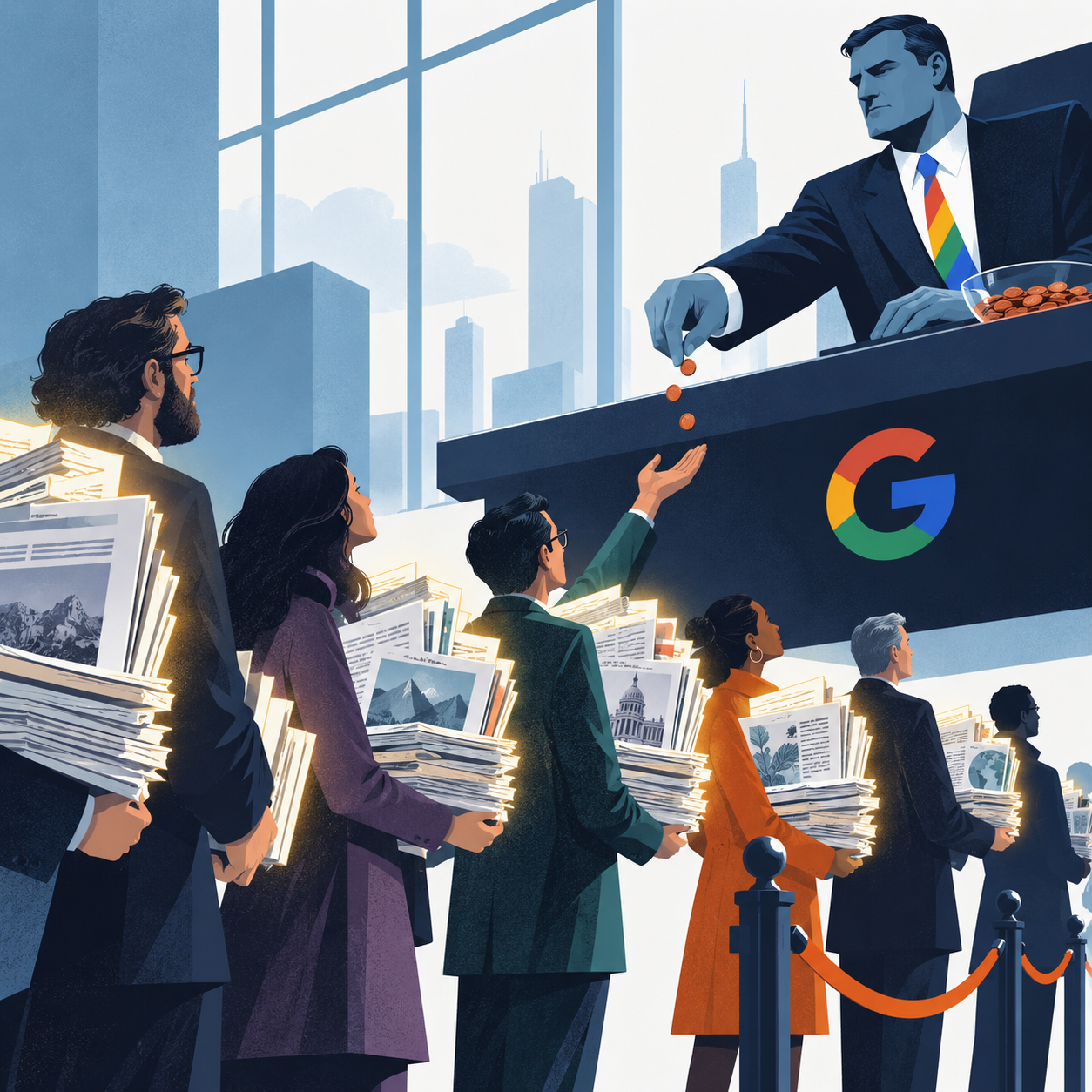
Google’s AI Contribution Pilot pays publishers when their content meaningfully shapes an AI answer.
Compensation triggers when content is used during answer synthesis – not when it is cited.
Publishers can see payout data in Search Console, but it is rudimentary, without any valuation formulas or usage metrics.
Opting in secures immediate monetization, but may reduce future leverage in licensing negotiations or legal disputes.
Opting out preserves licensing leverage at the cost of direct revenue and visibility in AI answers.
Executive Summary: Google is testing AI Contribution Pilot, a pay-per-value model that compensates publishers when their content is used to shape or ground an AI answer in Gemini, AI Overviews, and AI Mode. Payments depend on how much the content influenced the AI answer during synthesis rather than whether it was cited. Opting in trades immediate micro-monetization for potentially weaker licensing leverage. Opting out forfeits monetization, leaving publishers to rely on AI ads and other means of generating revenue, but preserves negotiating power. Either way, organic Google Search performance remains unaffected.
For a while now, the Internet has been suffering from a severe case of AI slop: mass-produced, regurgitated, generic content with bare-minimum quality and even less originality.
And AI models still use it to train and ground their answers.
The problem is that, if the input is low-quality, the output will be as well, and vice versa. And that means that original, high-quality content will only become more valuable. So, the real question is:
What is the value of high-quality, original content?
As it turns out, that’s what Google’s trying to gauge with its new AI Contribution Pilot program.
What is the Google AI Contribution Pilot?
The AI Contribution Pilot is Google’s experimental pay-per-value program, designed to directly compensate publishers when their material shapes generated answers in AI Overviews, AI Mode, or Gemini.
“…we are piloting a new way to partner with websites whose contentmeaningfully contributesto thefreshness and factualityof generative AI responses through the process ofgrounding.”
Essentially, AI Contribution Pilot is a value-exchange mechanism: Google gets accurate, original content for its AI models/features to ground their answers in, while the publisher gets compensation and, more importantly – incentive to keep producing high-quality content.
How does Google AI Contribution Pilot monetization work?
Compensation triggers when content significantly influences an AI answer as it is being synthesized.
Compensation doesn’t triggerafter an answer has been synthesized, even if content is used to confirm facts or linked to.
Effectively, the AI Contribution system rewards retrieved content, not cited content – provided, of course, that said content has been used to a meaningful degree in answer RAG grounding during synthesis, not post-generation.
Stay ahead of what’s changing in AI search
Subscribe for practical updates on AI discovery, answer engine visibility, and the shifts that matter most for brands trying to stay visible.
What feedback do site owners get from AI Contribution Pilot?
Participating site owners get an “AI Contribution” widget in their GSC, displaying monthly payout figures, basic payment history, and settings, and that’s it. The panel does NOT disclose the valuation formula, per-article pricing, or any specific usage metrics (e.g., AI impressions) to at least gauge the potential payout totals.
Granted, the system is still in the testing phase, so it’s fair to assume we’ll get more details soon. Still, given Google’s inclination to ship features that hide more than they reveal (case in point: GA4’s AI Assistant channel and GSC’s Search Generative AI performance reports), it’s also fair to assume that the panel will continue to operate (mostly) as a “black box.”
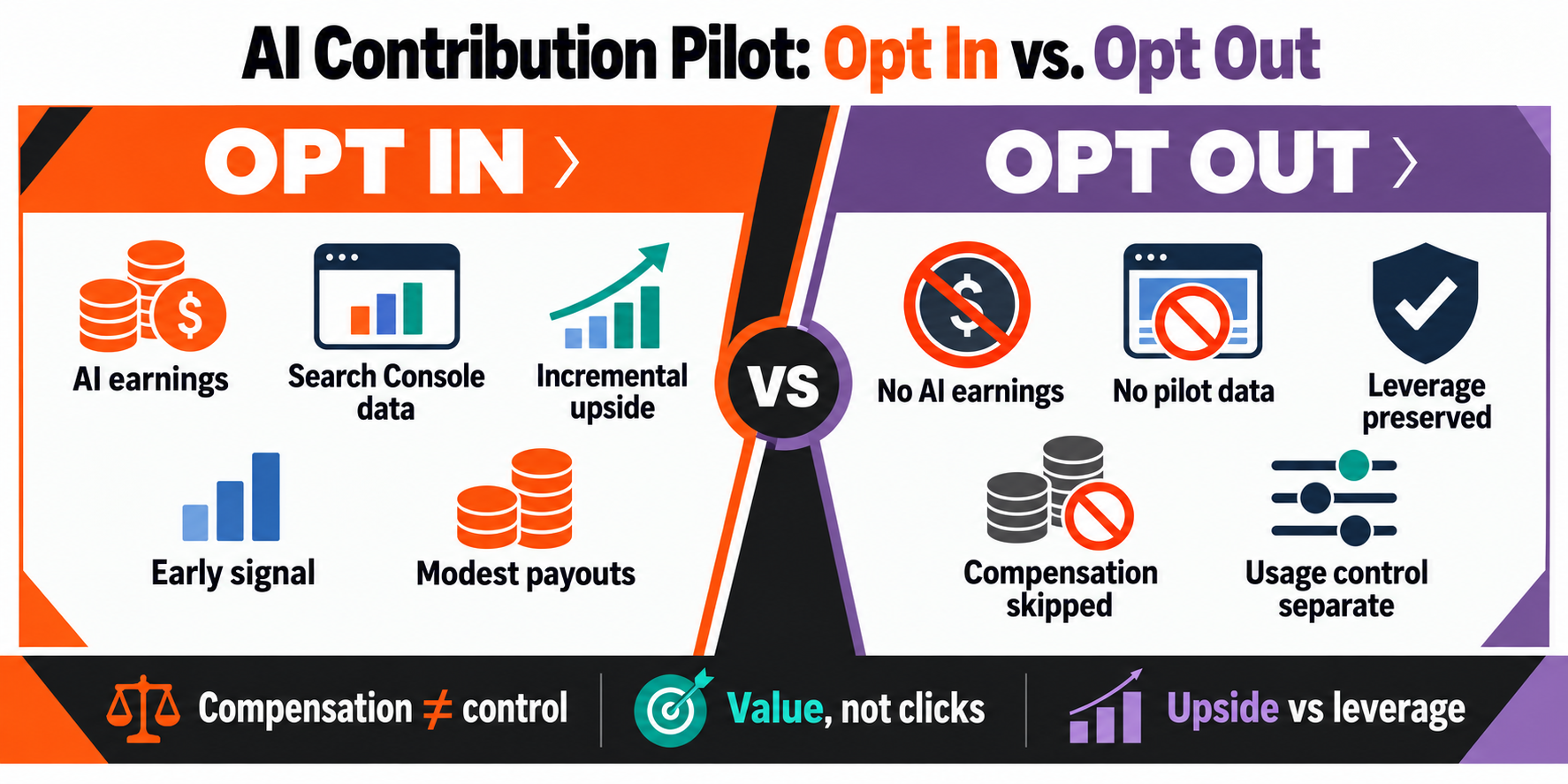
What are the implications of opting in vs. opting out of AI Contribution Pilot?
Google AI Contribution program is a perfect study of “you can’t have your cake and eat it too” – you can either have content monetization OR you can have maximum content licensing leverage.
Opting in or out of Google AI Contribution Pilot comes with real stakes [Image credit: ZeroClick Labs via ChatGPT]
Opt in, and you secureimmediate micro-monetization as your content continues to feed Google’s AI models and features, along with (however limited) first-party data on how often your content is being used to ground AI answers. However, you’re riskingweakening your leverage in future enterprise licensing negotiations and potential publisher class actions, as participation validates Google’s pay-per-value paradigm.
Opt out, and you maintainmaximum bargaining power for content licensing agreements or regulatory frameworks. In exchange, you’re forfeiting direct Pay-per-Value revenue, instead relying entirely on traditional monetization models (e.g., ads, affiliate links, paywalls). Plus, you’re riskingcompetitor displacement, because opting out only removes your site from the grounding pool, allowing other publishers to fill that gap – and gain your chunk of AI visibility.
What remains unchanged: Whether you opt in or opt out, standard organic search rankings remain unaffected. They are completely decoupled from AI Contribution Pilot, so if you decline participation or use GSC to restrict AI grounding on your content, standard Google Search indexing, SERP positioning, and web referral traffic won’t be penalized.
Lily Evans is the Managing Director at ZeroClick Labs, bringing over 8 years of comprehensive experience in SEO, local SEO, and AI optimization to every project. She began her career in content writing, developing a strong sense for search intent and messaging clarity in the digital realm – skills that form an unshakable core of her leadership to this day.
Our team specializes in aligning your content – or your entire brand – with trust, authority, and selectability signals that make you the prime target for AI summaries.
Connect with us today, and let’s make your content useful, credible – and irreplaceable!
“Our agency had no idea how to approach AI visibility. ZeroClick only does this one thing so they actually know what works. Worth every penny just to not waste time figuring it out ourselves.” – Jay