ARR replaces separate retrieval and reranking models with a single, unified LLM-based ranking system.
ARR model can produce tokenized document IDs sequentially and in ranked order.
SToICaL improves ranking reliability by weighing relevant documents more heavily, while suppressing invalid/weak candidates.
Benchmark results show stronger overall ordering, but no improvement in the Top-1 ranking.
If ARR becomes the standard, clear entities, structured content, and topical authority could become even more relevant – and valuable.
Executive Summary: Autoregressive Ranking (ARR) is proposed to replace traditional retrieval-and-reranking pipelines with a unified LLM that directly generates ranked document IDs. Early tests suggest improved performance and ranking quality with fewer relevance errors. However, Top-1 performance remains inconsistent, and the model is untested under real-world, live-web conditions. If ARR becomes the default ranking model, content structure, unambiguity, and authority could gain even more weight.
These changes all happened in the span of a few short years and they were all massive – yet, the underlying ranking mechanisms remained virtually unchanged.
Now, a team of researchers from Google DeepMind, the University of Massachusetts Amherst, and the University of Texas at Austin offer an alternative – Autoregressive Ranking (ARR).
Disclaimer: The ARR paper is theoretical, focusing on information retrieval architecture. It does not explicitly mention SEO or GEO. As such, all conclusions regarding traditional andAI optimizationpractices and their impact are theoretical extrapolations.
What is the Autoregressive Ranking (ARR) research about?
In their paper “Autoregressive Ranking: Bridging the Gap Between Dual and Cross Encoders,” researchers from Google DeepMind, UMass Amherst, and UT Austin introduced a new search ranking architecture – one that doesn’t rely on multi-model pipelines to find and sort search results. Instead, ARR replaces them with a single fine-tuned Large Language Model (LLM) that does both.
Architecture & system comparison — retrieval and ranking approaches
Feature / dimension
Dual encoder (DE)Stage 1 retrieval
Cross encoder (CE)Stage 2 reranking
Autoregressive ranking (ARR)With SToICaL
Pipeline role
Stage 1 retrieval: scans the full document index to select a candidate shortlist.
Stage 2 reranking: takes the Stage 1 shortlist and puts candidate pages in precise order.
Unified replacement: replaces the entire two-stage DE/CE pipeline with a single LLM.
Model mechanism
Encodes query and document into separate dense vectors independently.
Jointly processes query and document tokens together via cross-attention.
Generates document identifiers (docIDs) token by token, conditioned on the query.
Ranking output
Fast approximate nearest neighbor (ANN) vector similarity search.
Calculates explicit numerical relevance scores for each query-document pair.
Outputs sorted docID strings directly via beam search with prefix-tree (trie) decoding.
Theoretical capacity
Linear growth required: embedding dimension n must grow linearly with corpus size k to express arbitrary document rankings.
High expressivity, but constrained by pairwise evaluation costs.
Constant hidden dimension: proven theoretically sufficient to rank an arbitrary number of documents.
Computational cost
Very low cost during search; highly scalable across massive indices.
Extremely expensive; requires a separate forward pass per candidate document.
Generates rankings in a single model pass, without external vector indices or pair-by-pair scoring.
Key strengths
Ultra-fast candidate retrieval at web scale.
High precision and deep query-document interaction modeling.
Matches CE-level accuracy while suppressing invalid docIDs and maintaining constant hidden-dimension capacity.
Key limitations
Lacks fine precision because query and document vectors never interact during encoding.
Infeasible for full-index retrieval due to linear scaling cost.
One variant showed a drop in top-1 placement (Recall@1) on product queries; unproven on live web traffic.
How does the old ranking system work?
Traditional search engines rely on a two-stage ranking system, split into retrieval (via Dual Encoder – DE) and reranking (via Cross Encoder – CE):
Stage 1 – retrieval (Dual Encoder): The DE independently converts queries and documents into separate numerical vectors, enabling it to rapidly scan a massive volume of pages and pull a broad candidate shortlist. Because vectors are generated ahead of time, this method is fast and computationally inexpensive, but lacks precision.
Stage 2 – reranking (Cross Encoder): The CE system takes the candidate shortlist from Stage 1, analyzes each query-document pair, and calculates relevance scores. While highly accurate, this method is far too computationally expensive to run across an entire web index, restricting it to a relatively small candidate shortlist.
How is Autoregressive Ranking different from the old ranking system?
ARR unifies the dual-model ranking pipeline under one LLM, effectively aiming to take the best of both worlds: the speed and computational cost-effectiveness of DE, combined with the precision of CE.
This is achieved through Generative Ranked Decoding: in response to a query, the ARR LLM generates ranked document identifiers (docIDs) token by token, which can then serve two downstream purposes depending on the type of the search system:
Traditional search engines: docIDs can be used to fetch titles, snippets, and URLs to display ranked links on a Search Engine Results Page (SERP).
Generative AI search features: docIDs pull the full text of top-ranked pages, passing it to the AI model as a grounding (RAG)context for a unified response generation.
In theory, the ARR system can be efficient and effective, but we mustn’t forget that the underlying mechanism is still based on an LLM, meaning it inherits several limitations.
How does ARR address LLM limitations?
The two limitations in question are rank-agnostic training and hallucination risk. To solve both problems, the researchers developed a new training method: SToICaL (Simple Token-Item Calibrated Loss).
SToICaL assigns heavier weight to top-ranked documents and guides the probability mass toward more relevant docIDs. In doing so, it reduces the risk that the ARR LLM ranks an irrelevant document highly, simply because its identifier forms a high-probability token sequence, as well as inventing a docID that doesn’t correspond to an actual document.
Stay ahead of what’s changing in AI search
Subscribe for practical updates on AI discovery, answer engine visibility, and the shifts that matter most for brands trying to stay visible.
What did the ARR research results show?
The ARR research showed that the new method matches high-precision rankers while displaying fewer irrelevance errors:
On the WordNet dataset, ARR performed similarly to Cross Encoders and significantly outperformed Dual Encoders.
SToICaL training drastically reduced constraint violations, with irrelevant documents consistently being ranked below relevant ones.
On the flip side, the ARR system didn’t show any improvement on the Top-1 ranking – quite the opposite: on the ESCI shopping query dataset, one variant actually became worse at placing the single most relevant result first, despite the overall list order improving.
In addition, there was no live web validation, since all experiments were conducted on two benchmark datasets. This also means the study didn’t test practical constraints search engines face on the regular, such as real-time index updates, content freshness, or spam/manipulation resistance.
What are the SEO/GEO implications of ARR becoming the default ranking mechanism?
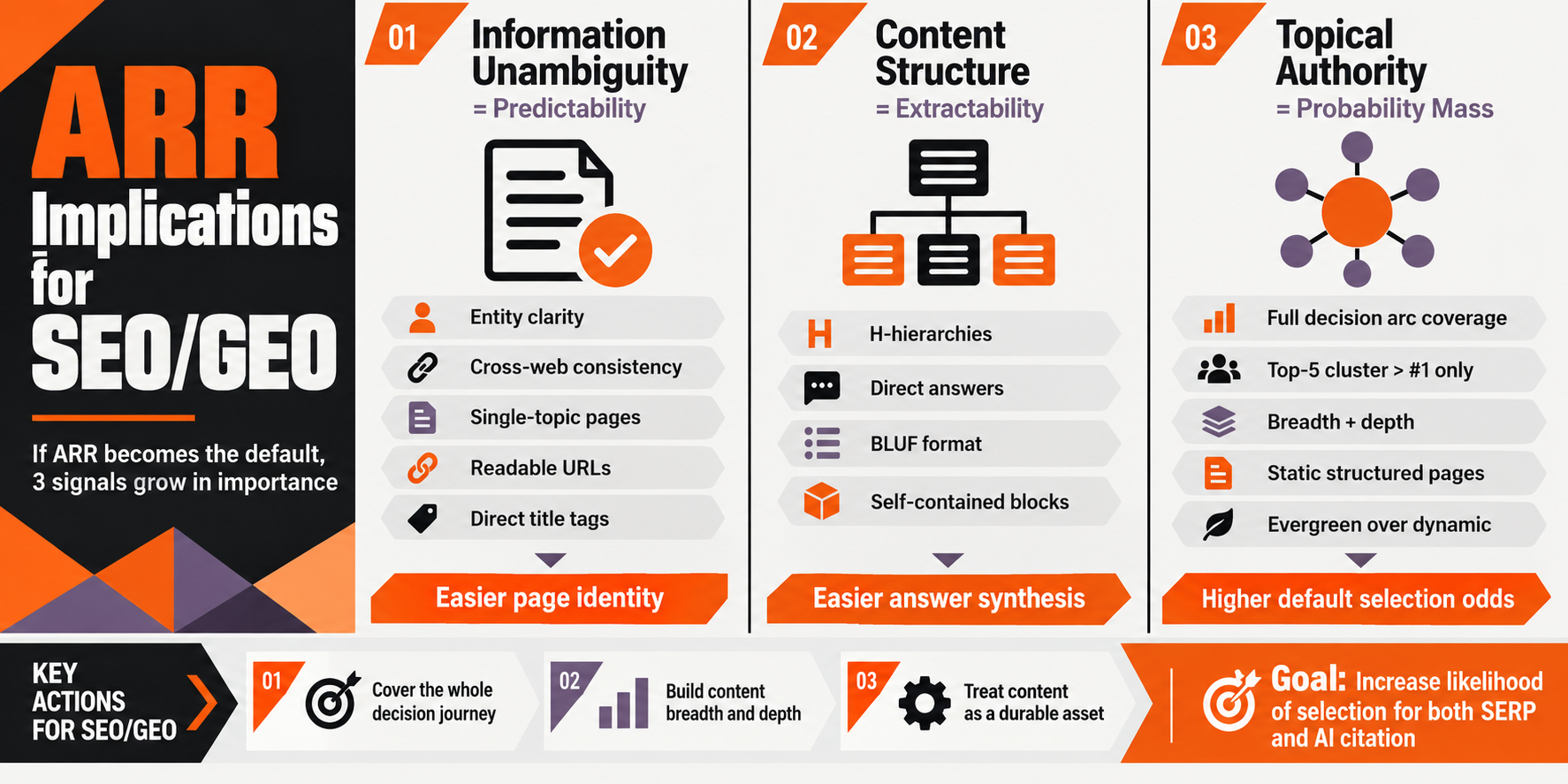
If ARR ever becomes the standard, three ranking signals will immediately skyrocket in relevance: information unambiguity, content structure, and topical authority. These are already the pillars of high-performing SEO/GEO strategies – ARR will only amplify them.
The SEO/GEO implications of ARR becoming the default ranking model [Image Credit: ZeroClick Labs via ChatGPT]
Information Unambiguity = Predictability
Maintaining entity clarity and consistency (cross-web), single-topic focus per page, and human-readable URLs with direct title tags (e.g., yoursite.com/category/topic-name) make it easy for ARR LLM to discern the page’s identity – and to generate docIDs without token confusion.
Content Structure = Extractability
Strict H-hierarchies, direct answers (BLUF model), and self-contained content blocks ensure that, once an AI search feature selects the document/page for answer synthesis, it doesn’t have to waste resources piecing together the context.
Topical Authority = Probability Mass
Because ARR is based on an LLM, it acts like an LLM:
It relies on learned neural weights and struggles to update dynamic index paths on the fly.
These mechanisms look similar, but are completely different from how query fanout, RRF and training data work, yet the end result for SEO is the same. Therefore, from an optimization standpoint, leveraging these mechanics entails:
Full decision arc coverage: Securing a spot or, better, as many spots in the Top-5 cluster, instead of pouring resources into securing a #1 spot in SERPs.
Content breadth and depth: Ensuring comprehensive coverage of your domain’s primary and supporting topics.
Content as an asset: Prioritizing creating static, highly structured pages with evergreen content, rather than dynamic or fast-changing pieces.
Building content portfolios aligned with the above criteria embeds your entity into the LLM’s underlying training data and checks more ranking boxes – giving you a higher default likelihood of being selected for both SERP and AI citation.
Tina Clarke is the AI SEO Manager at ZeroClick Labs, specializing in AI search optimization and Generative Engine Optimization (GEO). With a strong foundation in content strategy, technical SEO, and operations, she leverages her expertise to help brands shift from traditional rankings to discoverability and excel in AI-driven ecosystems.
Ranking is bound to follow – sooner rather than later
Will your AI visibility endure when the change hits?
ZeroClick Labs is here to make it so by aligning your brand with trust and authority signals that persevere – regardless of which mechanism governs at that point.
Connect with us today, and let’s build your AI-endurance!
“Our agency had no idea how to approach AI visibility. ZeroClick only does this one thing so they actually know what works. Worth every penny just to not waste time figuring it out ourselves.” – Jay