AI discovery increasingly rewards brands that earn credible recommendations and not just clicks.
AI citations and traditional search rankings are becoming complementary optimization objectives.
Front-loaded, extractable content format strengthens AI visibility.
The race toward agentic AI imposes machine operability as a core technical requirement.
Traditional SEO remains foundational – a prerequisite unlikely to change despite AI marketing trends revolutionizing search in 2026 and beyond.
Executive Summary: AI is transforming marketing and SEO from click-driven acquisition into trust-based discovery. In 2026, GEO, AEO, extractable content, entity consistency, and brand authority are the defining optimization objectives. In 2027, these requirements will likely be expanded with agentic commerce, multimodal search, and machine operability. Traditional SEO will remain the underlying technical foundation..
Over the past couple of years, advancements in the field of AI have driven so many changes so rapidly that it’s difficult to say whether said changes were more voluminous or more volatile.
That’s the most persistent AI trend to date.
With new technologies, platforms, tools, and AI optimization frameworks emerging virtually overnight, keeping up is a colossal task in itself.
Colossal – and essential.
That’s why, today, we’re answering several critical questions regarding AI marketing and SEO trends of 2026.
How is AI changing 2026 marketing trends?
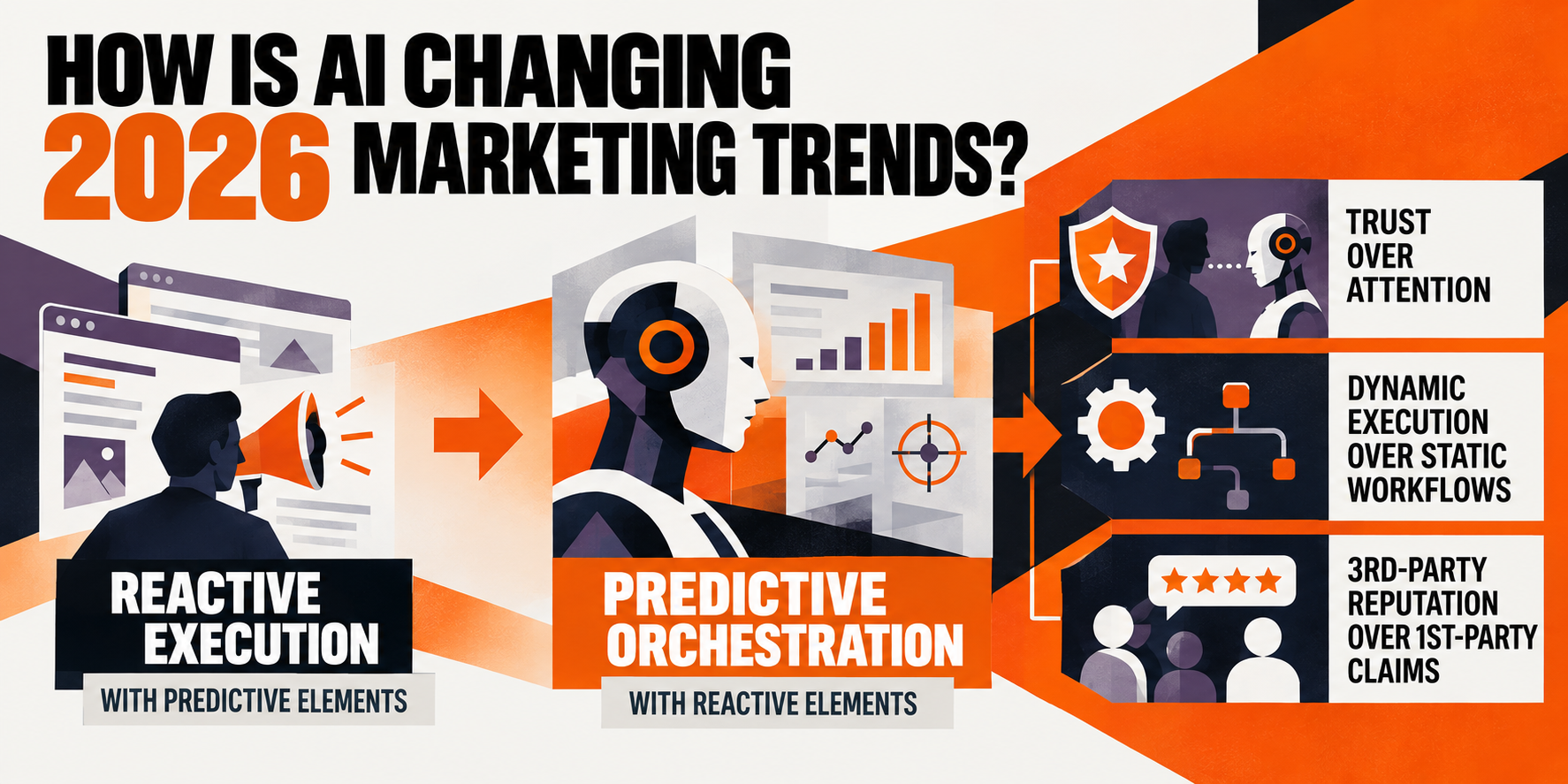
In a word: fundamentally. In a few short years, the entire discipline went from reactive execution with predictive elements to predictive orchestration with reactive elements.
Instead of manually adjusting PPC bids, scheduling blog/socials posts, and keyword-stuffing copy (to mention just a few common methods), companies are reorienting toward anticipating and satisfying consumer intent in real time – and it’s all made possible by the advancements and standardization of AI. Some of the most impactful shifts include:
“Attention Economy” becomes “Trust Economy”
Previously, brands and their preferred AI SEO agencies marketed directly to human audiences in order to drive them to owned websites. One of the defining AI search trends in 2026 is that brands must now win AI’s trust before a real user ever visits their site. Effectively, the system went from capture attention, capture the click → earn trust, earn recommendation.
Dynamic execution overtakes static workflows
Previously, marketers had to essentially anticipate every edge case and user action, and “script” workflows following a rigid “if [trigger] then [execution] else [adjust]”. Every [] element had to be set manually – otherwise the workflow stops.
Advanced AI SEO tools, especially those that allow Autonomous Agentic Execution, flip the script (pun intended): the outcome becomes the input, and the AI system independently plans, executes, and adjusts – on the fly and with minimal human intervention.
3rd-party reputation beats 1st-party claims
With traditional SEO, optimizing owned website copy was the primary visibility lever. In AI SEO, however, nearly 85% of a brand’s AI visibility comes from third-party sources (Reddit, YouTube, review platforms, etc.), driving the need to manage broader digital reputation.
What are the latest trends in AI marketing?
Trends that shaped marketing strategies in 2026 and will likely continue to do so throughout 2027 include: layering GEO/AEO on top of traditional SEO, heavier use of agentic AI in campaign orchestration, hyper-personalization, and greater focus on multi-modality, as well as AI-free brand positioning as a niche-specific “anti-strategy”.
Stay ahead of what’s changing in AI search
Subscribe for practical updates on AI discovery, answer engine visibility, and the shifts that matter most for brands trying to stay visible.
GEO & AEO are no longer negotiable
Whether it’s an AI Overview in Google or a generative answer in a dedicated AI platform such as ChatGPT or Claude, the fact is that a significant volume of informational queries are now satisfied without needing to click on blue links.
Effectively, this means that winning traditional ranking and AI citations are no longer separate goals, but rather two halves of the same strategy. That’s exactly why one of the latest SEO trends is diverting focus and resources toward GEO and AEO, while keeping traditional SEO as a foundation.
The use of (agentic) AI in marketing campaign orchestration
AI systems are no longer passive, prompt-based answer generators; they’ve evolved into full-fledged autonomous agents capable of planning, executing, and optimizing entire multi-step marketing campaigns – from start to finish.
These systems are tasked with reallocating ad budgets, testing creative variations (headlines, copy, visuals), adjusting bids in real time, and even handling sales lead routing – and they do it all automatically, without constant hand-holding.
Hyper-personalization & predictive journeys
Today’s AI models can evaluate users’ intent signals in real time, including factors such as location context and browsing behavior, and then dynamically tailor recommendations for each customer individually. With transactional queries specifically, the point is not just to satisfy user intent – but to do so at the moment said intent is at its peak.
Multi-modal marketing
Users consume information in different ways. Some prefer video, others voice, some love infographics and diagrams, others want their brand touchpoints interactive – and, of course, there are always those who still appreciate good old copy.
This diversity of preference is what drives marketers to coordinate campaigns across modalities, and AI is essential to that goal because it enables broad asset generation from a single campaign brief, rather than requiring a separate production pipeline for each format.
The exploration of “AI-free positioning”
AI-free brand positioning is an emerging movement that can be considered a direct counter to modern AI marketing trends. The premise is simple: deliberately market the absence of AI in products and services as a core value proposition. Interestingly, way back in 2023, Gartner predicted that 20% of brands in advanced economies will actively promote their lack of AI as a core differentiating factor by 2027.
While their prediction largely fell short, mainly due to the reality of mainstream commerce and consumer pragmatism, it did prove accurate in specific niches, mostly in creative and editorial sectors such as copywriting, design, artisanship, as well as high-touch industries such as wealth management, specialized hospitality, and luxury retail.
What are the dominant AI SEO (GEO/AEO) trends in 2026?
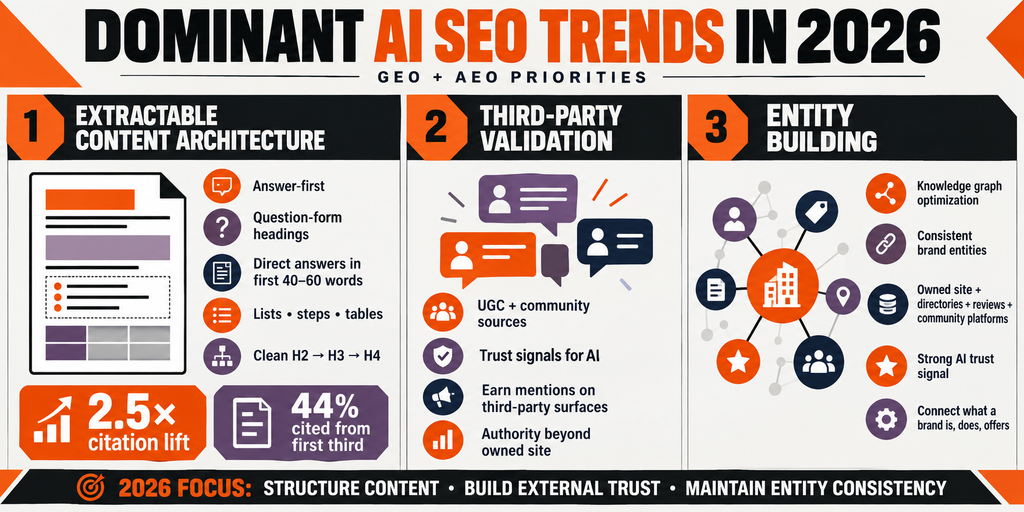
As AI search and marketing in general evolve, the optimization frameworks follow lockstep to answer the new discovery paradigm. Since the beginning of 2026, several methodologies have skyrocketed in significance, specifically content formatting for extractability, external authority building, and maintaining entity consistency.
Question-form headings with clean H-hierarchies (H2→H3→H4), followed by;
Immediate and direct answers (within the first 40-60 words), followed by;
Context (elaboration or explanation), enriched by;
Bulleted lists, numbered steps, or data tables.
Third-party validation and community consensus
Virtually every AI engine relies on User-Generated Content (UGC) & community sourcing for model training and answer generation. For AIs, platforms like Reddit, Quora, and YouTube are not just information sources, but trust signals.
For this reason, building authority and earning mentions on third-party, user-driven surfaces has become more than a mere AI SEO trend – it has become an integral part of every effective visibility strategy in 2026.
Entity building & knowledge graph optimization
AI systems do not view brands or queries as isolated keywords (like old systems do). Rather, they treat them as a structured network (“graph”) of interconnected “entities” – identifiers that unambiguously show what a company is, does, offers, and where it is positioned and how it relates to other named entities within an industry.
Maintaining entity consistency across a brand’s own domains, as well as external directories, review sites, and community platforms is one of the strongest trust signals for AI systems, making it one of the core objectives of AI SEO.
What will be the leading AI marketing & AI SEO trends in 2027?
The simplest (and most obvious) answer is: all of the above. If the current trajectory is any indication, discovery is transitioning from answer to action across platforms and modalities, inevitably pulling AI SEO and marketing strategies in the same action-oriented direction.
Answers become actions
Virtually all frontier AI developers practically race to evolve search from providing information to executing tasks on users’ behalf. Google is experimenting with “spawning” agents directly in Chrome, ChatGPT has “Agent” functionality, and many others are following suit via internal or external solutions.
So, it’s not far-fetched to assume that very soon, a “default” visitor on a commercial website might not even be human – but a machine that can compare options, evaluate technical specifications, verify product availability, and complete transactions completely autonomously.
Adoption of AI-native web standards
Tying directly into the previous point, current website infrastructure in general is barely suited to accommodate AI agents. To become machine-operable and transactional surfaces, websites will likely have to adopt some of the suggested browser-level standards, such as WebMCP or Google’s UCP, allowing them to expose forms, booking systems, and APIs to AI agents directly.
Conversational, contextual, multimodal search becomes the norm
Consumer search behavior is already shifting from purely text-based to multimodal, including photos, voice, and video. One of the likely AI marketing trends for 2027 is the convergence of said modalities into context-aware conversations, similar to what Google is trying to do with Gemini’s native cross-tab reasoning in Chrome.
Local (and regional) AI SEO expansion
One of AI’s big “pain points” right now is the lack of sufficient local source material, at least when it comes to regional and non-English-speaking markets. Since this is a massive and mostly untapped market, we could see an increase in development of location/region-specific AI SEO strategies – not just translated knock-offs of established ones.
Will new trends render traditional optimization strategies obsolete?
Regardless of how different they appear, newAI search and marketing trendswill not render traditional optimization strategies obsolete, for one simple reason: SEO is the foundation of all of them.
LLM retrieval mechanisms, grounding (RAG) pipelines, and AI crawlers all rely entirely on traditional crawling, indexing, and structured data foundations, meaning new strategies will only continue to layer or build upon the old ones – as they already do.
Fading vs. Evolving Optimization Strategies
Fading vs. evolving optimization strategies by optimization area
Optimization Area
Fading(Instead of)
Evolving(Focus on)
Technical SEO
Sole reliance on client-side JavaScript (CSR) rendering
Disregard for AI crawlers’ and agents’ crawl permissions and access control
Treating technical website health as purely a traditional indexing prerequisite
Enabling AI crawlers/agents to parse/operate a website with minimal resource usage via:
Clean server-side HTML
Fast load times
API integrations
robots.txt directives
Structured data (schema markups)
Content Strategy
“Content milling” (volume over quality)
Generic articles
Keyword stuffing
Exact-match keyword targeting
Topical authority clusters & E-E-A-T – content must be designed (or re-designed) to be:
Answer-first
Fact-dense
Cover most of the decision arc
Original (enriched with proprietary data/research or lived experience, or provide unique PoV)
Structured for extraction (self-contained semantic content blocks)
Off-Page & PR
Mass link-building
Low-quality guest posting
Spammy backlink directory submissions
Building entity-level brand authority by earning mentions on independent third-party sites, including reviews, directories, forums (Reddit), YouTube, etc.
Source: ZeroClick Labs analysis.
If we were to observe the above table through the search optimization prism, we can see that it perfectly maps back onto AI search ranking and operational factors, with each framework playing a distinct role:
The Optimization Stack: Traditional SEO as the Foundation
Agentic Preparation(a.k.a. Agentic AI Optimization – AAIO)
Ensuring AI agents can operate the website as an endpoint (e.g., perform transactions, book appointments, query real-time inventory, execute dynamic workflows via structured APIs)
GEO(Generative Engine Optimization)
Expanding off-page entity trust and brand authority across the broader AI ecosystem
AEO(Answer Engine Optimization)
Formatting web page content for extractability in direct answers (e.g., featured snippets, Google AI Overviews, conversational summaries)
FoundationTraditional SEO
Providing the baseline: crawlability, indexing, site speed, semantic hierarchy
Source: ZeroClick Labs analysis.
Tina Clarke is the AI SEO Manager at ZeroClick Labs, specializing in AI search optimization and Generative Engine Optimization (GEO). With a strong foundation in content strategy, technical SEO, and operations, she leverages her expertise to help brands shift from traditional rankings to discoverability and excel in AI-driven ecosystems.
The new era of Search isn’t just about being found
It’s about being trusted, cited, and actionable
Traditional SEO alone won’t get you there.
ZeroClick Labs will – by making your website technically accessible, your content extractable, and your authority indisputable.
Connect with us today, and let’s make your brand ready for the new age!
“Our agency had no idea how to approach AI visibility. ZeroClick only does this one thing so they actually know what works. Worth every penny just to not waste time figuring it out ourselves.” – Jay