Key Takeaways:
-
Google Gemini has started adding UTM parameters to outbound links.
-
The tags can preserve source information when browser referrer data is missing.
-
GA4 already has an AI Assistant channel, but Gemini UTMs provide an additional attribution signal.
-
Independent testing suggests the rollout may be broader than the first public reports implied.
-
The update improves measurement, not rankings or citation eligibility.
Executive Summary: Google Gemini has begun adding UTM parameters to outbound links, giving marketers another way to identify traffic generated by the AI assistant. The change could improve attribution in GA4 and make it easier to measure the impact of Gemini visibility beyond citations alone.
Gemini clicks are becoming more traceable
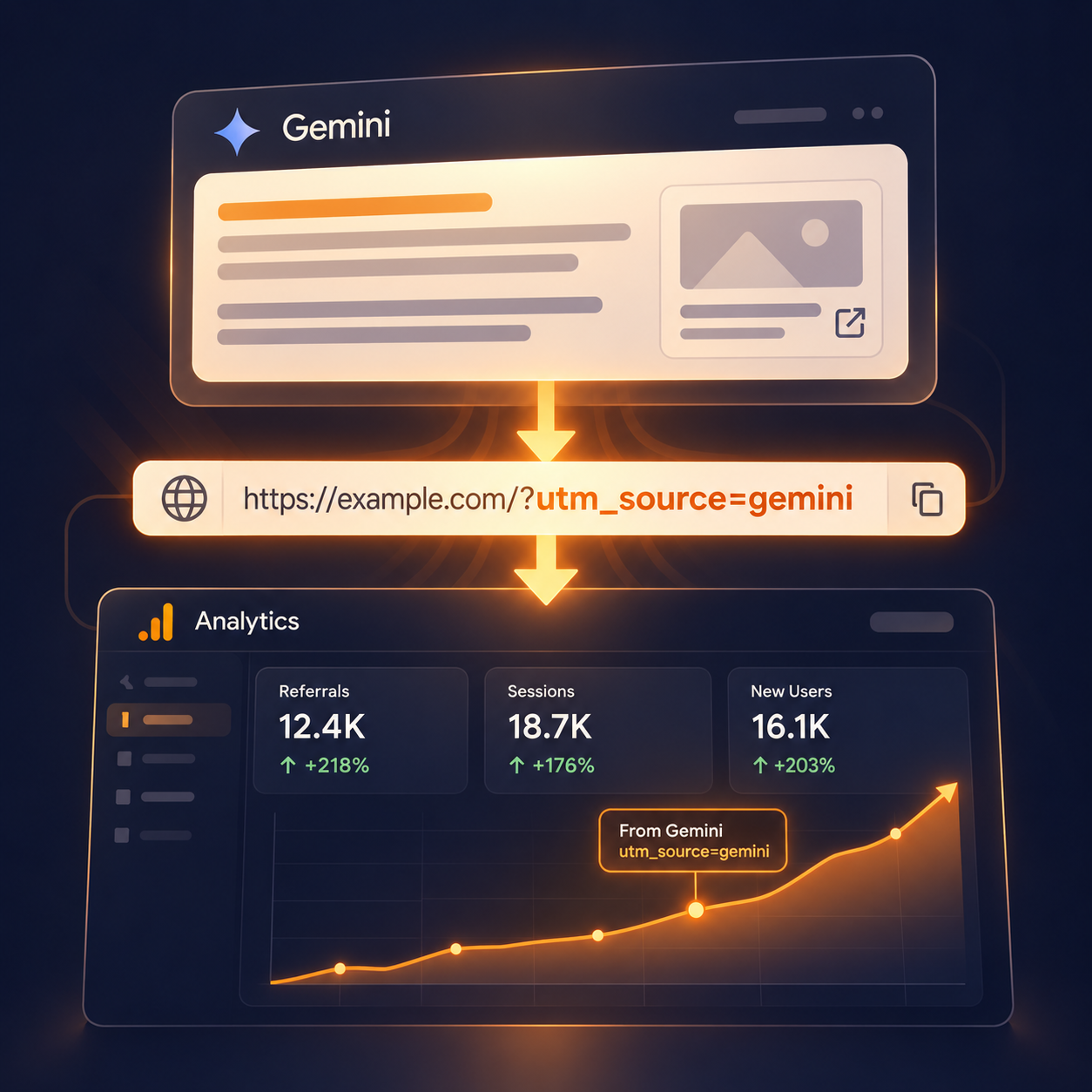
Google Gemini has begun attaching source-tracking information to links it cites in answers. Recent reporting from Search Engine Journal highlighted sightings of utm_source=gemini, with Google’s John Mueller also acknowledging the tagging in a Reddit discussion. Google has not yet released a dedicated specification explaining which Gemini surfaces receive the parameter or when it is applied.
For brands investing in Gemini SEO and visibility, the important change is not simply that another string has been added to a URL. It is that a Gemini click can carry its source identity with it even when normal browser referral information is unavailable.
This is important because attribution from AI assistants can become unreliable as users move between mobile apps, embedded browsers, and external websites. A UTM tag gives analytics platforms an explicit source value instead of relying entirely on the browser to pass a referrer.
The rollout may be further along than it first appeared
The public discussion around Gemini UTMs accelerated at the end of September, but independent data suggests tagging was already occurring at scale.
A September 23 analysis by Suff Digital examined more than 155,000 cited links across several AI platforms. In that dataset, 97.3% of Gemini citation links carried utm_source=gemini. By comparison, Google AI Overviews and Perplexity showed no equivalent tracking tags in the sample, while Google AI Mode was almost entirely untagged.
This finding is useful for two reasons. First, it suggests this is more than an isolated test affecting a handful of answers. Second, it reinforces the need to distinguish Gemini from Google’s other AI-driven search products when analyzing traffic.
The study was based on a specific U.S. dataset collected on one date, so the percentages should not be assumed to represent every device, market, or Gemini experience.
How this fits with GA4’s AI Assistant channel
Google Analytics had already taken a major step toward AI attribution before Gemini’s UTM tagging became widely noticed.
On May 13, 2026, Google introduced a dedicated AI Assistant channel in GA4. According to Google’s Analytics release notes, recognized AI referrals can receive an ai-assistant medium and appear under the AI Assistant default channel.
Google’s current default channel documentation lists sources such as ChatGPT, Gemini, DeepSeek, Copilot, and Grok within that category. Importantly, Google AI Overviews and AI Mode are explicitly excluded.
The distinction between referrers and UTMs is worth understanding. GA4 can classify an AI visit based on its referring source, while UTM parameters provide explicit campaign information contained within the destination URL. Google’s own UTM documentation explains that parameters such as utm_source, utm_medium, and utm_campaign feed acquisition reporting.
Having both signals can make AI traffic easier to identify when one of them is missing.
Stay ahead of what’s changing in AI search
Subscribe for practical updates on AI discovery, answer engine visibility, and the shifts that matter most for brands trying to stay visible.
What marketers can learn from better Gemini attribution
This update does not provide new information about why Gemini selects one source over another. Those questions still belong to the broader study of AI search ranking factors.
What it does provide is a cleaner path from visibility to performance measurement.
Teams can begin asking more useful questions: Which pages receive Gemini clicks? Do AI-referred visitors engage differently from organic-search visitors? Which citation-heavy pages contribute to leads or other conversion events? Are AI referrals growing even when conventional search clicks decline?
This is a more valuable framework than simply counting citations.
It also fits into Google’s wider experimentation around how publishers participate in AI ecosystems. Programs such as the Google AI contribution pilot show that attribution, publisher value, content use, and AI distribution are increasingly interconnected.
What to monitor next
Marketers should avoid treating utm_source=gemini as a complete measurement solution. Google has not documented whether every Gemini interface uses it, and rollout behavior could change.
A stronger approach is to monitor Gemini through multiple signals: GA4’s AI Assistant channel, session source data, UTM-tagged visits, landing-page performance, and downstream conversions. Google’s documentation also recommends consistent UTM conventions because incomplete or inconsistent parameter values can fragment reporting.
The bigger shift is clear: AI visibility is becoming easier to connect with business outcomes. As that measurement improves, marketers can move beyond asking whether they appear in Gemini and start evaluating what that visibility actually produces.
Lily Evans is the Managing Director at ZeroClick Labs, bringing over 8 years of comprehensive experience in SEO, local SEO, and AI optimization to every project. She began her career in content writing, developing a strong sense for search intent and messaging clarity in the digital realm – skills that form an unshakable core of her leadership to this day.